Belgium CRE deals have one complexity that catches non-Belgian buyers immediately: three regional legal regimes. A deal in Brussels, Antwerp, and Liège follows different environmental, planning, and soil-certificate rules - even though they're all in the same country. The 12-12.5% registration duty on commercial property is the same across regions, but almost everything else varies.
Belgian commercial property transfers require a civil law notary (notaris in Flemish; notaire in French). Title only passes on the notarial deed date, not the private sale agreement.
The Belgian land registry (Kadaster) and the mortgage registry (Hypotheekkantoor/Bureau des hypothèques) are separate. Both must be searched before contract.
In Flanders, a Bodemattest (soil certificate from OVAM) is mandatory for most commercial property transfers. The sale can be blocked if the certificate isn't clean or if a remediation plan isn't in place.
Set up an Ellty data room before diligence starts. Load all land registry extracts, notary deeds, planning certificates, and lease files so each advisor gets a scoped link from day one.
Where Belgian deals actually go wrong
Not every check carries the same weight. The table below sorts risks by deal impact - dealbreakers first, then what moves the price, then basic hygiene - so your notary, lawyer, and technical advisor know what to clear first.
| Area | Documents to pull | Belgium red flag | Matters most for | Tier | |
|---|---|---|---|---|---|
| Title and land registry | Title and land registry | Kadaster extract, hypotheekkantoor search, notarial deed chain, cadastral plan | Belgian land registry (Kadaster) and mortgage registry are separate; both must be searched before contract | All buyers | Dealbreaker |
| Bodemattest - soil certificate | Bodemattest - soil certificate | OVAM Bodemattest (Flanders), certificat de situation du sol (Brussels), Wallonia environmental cert | In Flanders: OVAM Bodemattest is mandatory for most commercial transfers; a non-clean certificate blocks the sale | All assets - Flanders required by law | Dealbreaker |
| Planning - stedenbouwkundige inlichtingen | Planning - stedenbouwkundige inlichtingen | Stedenbouwkundige inlichtingen (Flanders), Permis d'urbanisme (Brussels/Wallonia), RUP extract | In Flanders: stedenbouwkundige inlichtingen is a mandatory pre-sale planning extract; confirms all permits are current | All assets | Dealbreaker |
| Environmental contamination | Environmental contamination | Phase I ESA, OVAM contaminated site search, industrial zone register, UST records | Antwerp port, Ghent industrial canal zone, and Liège Meuse valley carry high contamination from industrial history | Industrial, logistics, port | Dealbreaker |
| Leases and tenancies | Leases and tenancies | All leases, rent roll, Belgian Commercial Lease Act compliance, sublease consents, bank guarantees | Belgian commercial leases have a default 9-year term with 3-year break options; non-standard terms must be notarial | Income-producing assets | Price-adjuster |
| Building and permits | Building and permits | PCA, building permit history, conformity certificate, fire safety certificate | Belgian commercial buildings often have unauthorized works that weren't permitted under the original stedenbouwkundige vergunning | All asset types | Price-adjuster |
| Property tax and charges | Property tax and charges | Onroerende voorheffing (property tax) notices, 3y operating statements, service charge reconciliations | Belgian onroerende voorheffing (property tax) varies by region and municipality; confirm rate and arrears before closing | Income-producing assets | Price-adjuster |
| Registration duty and VAT structure | Registration duty and VAT structure | Registration duty calculation, VAT-option eligibility for new buildings, notary closing statement | For new Belgian commercial buildings (<2 years first use): 21% VAT instead of 12-12.5% registration duty; VAT is recoverable | All deals | Price-adjuster |
| Asbestos and energy | Asbestos and energy | Asbestos inventory (required in Flanders for buildings >250m2 pre-2001), EPC certificate | In Flanders: asbestos inventory mandatory for commercial buildings >250m2 built before 2001 for all property transactions | Pre-2001 commercial buildings | Price-adjuster |
| Insurance and valuation | Insurance and valuation | Current policies, loss run, flood zone check (Waterinfo.be), independent appraisal | Belgian Ardennes and Meuse valley flood zones (see 2021 flooding) require specific insurance coverage confirmation | All | Standard check |
| Seller KYC and AML | Seller KYC and AML | KBO (Belgian company register) extract, UBO register, Wwft equivalent AML check, notary compliance | Belgian notaries are subject to AML law and perform independent KYC on both buyer and seller before deed signing | All deals | Standard check |
Due diligence on a Belgium property?
Set up your Ellty data room before diligence starts.
Start free 14-day trialBelgium CRE checklist
The table ranked risks by severity. This is the full list to work through, grouped by area.
Title and land registry
- Pull the Kadaster extract (kadastraal uittreksel/extrait cadastral) for the property parcel
- Separately search the Hypotheekkantoor (mortgage registry) for all registered mortgages and privileges
- Confirm the registered owner matches the seller in all contracts and deed documents exactly
- Pull the cadastral plan to confirm parcel boundaries and built area match the physical property
- Check for erfdienstbaarheden (easements), opstalrechten (building rights), and erfpacht (ground lease) on the registry
- For apartment buildings: pull the basisakte (deed of division) and co-ownership regulations
Bodemattest - soil certificate
- For Flanders: request the OVAM Bodemattest immediately; most commercial property transfers legally require it
- The Bodemattest confirms whether OVAM has registered the parcel as a risk site or if remediation is required
- A non-clean Bodemattest doesn't automatically block the sale, but it requires a notarial clause and may require a remediation plan before closing
- For Brussels: request the Certificat de situation du sol from Bruxelles Environnement
- For Wallonia: confirm which environmental certificate applies; requirements are less standardized than Flanders
- Budget 4-6 weeks for the OVAM Bodemattest; it often takes longer than sellers expect
Planning - stedenbouwkundige inlichtingen
- For Flanders: request the stedenbouwkundige inlichtingen from the local municipality immediately after contract
- The stedenbouwkundige inlichtingen confirms all building permits are current and no enforcement orders apply
- For Brussels: pull the Permis d'urbanisme history and confirm the certificat d'urbanisme
- For Wallonia: pull the Permis d'urbanisme and Permis d'environnement for the property
- Check for any pending planning changes that could affect permitted uses in the RUP (Flanders) or PRAS (Brussels)
- Confirm that any extensions, renovations, or changes of use have their own valid permit
Environmental contamination
- Commission a Phase I ESA for all commercial sites; Flanders follows OVAM standards; Brussels follows IBGE guidelines
- For Antwerp port-adjacent, Ghent canal zone, Liège Meuse valley, and Charleroi industrial sites: order Phase II immediately
- Check the OVAM contaminated site register for the parcel and neighboring properties
- Budget Phase II investigation (EUR 8,000-30,000) if Phase I identifies recognized environmental conditions
- For Flanders: contaminated land remediation triggers a formal OVAM procedure that can take months to complete
Leases and tenancies
- Collect all commercial leases and confirm they comply with the Belgian Commercial Lease Act (9-year default term)
- Commercial leases in Belgium have a mandatory 9-year minimum term with 3-year break options for the tenant; confirm all break rights
- Check for any leases that deviate from the standard terms; non-standard terms require a notarial act to be valid
- Cross-reference the rent roll against 12 months of actual receipts and service charge reconciliations
- Confirm bank guarantees and security deposits are current and transferable to the new owner
Give each advisor a scoped link in Ellty. The notary sees title and mortgage registry docs. The environmental consultant sees OVAM files. The planning lawyer sees the stedenbouwkundige inlichtingen. No overlap, no access creep.
Building and permits
- Commission a Property Condition Assessment; check structural condition, roof, mechanical systems
- Confirm all building permits (stedenbouwkundige vergunning/permis d'urbanisme) are current and on file
- Pull the full building permit history from the local municipality; unauthorized works are common
- Check fire safety compliance certificate; Belgian commercial buildings require regular fire safety inspections
- For pre-2001 Flemish buildings >250m2: confirm asbestos inventory (asbestinventarisatie) is current and on file
Property tax and charges
- Pull 3 years of operating statements and reconcile against onroerende voorheffing (property tax) notices
- Confirm no outstanding property tax arrears; these transfer with the property under Belgian law
- Audit service charge reconciliations against lease terms for multi-tenant commercial assets
- Check for outstanding local municipality charges or improvement levies against the property
Registration duty and VAT structure
- Confirm the registration duty rate: 12.5% in Brussels and Wallonia; 12% in Flanders for commercial property
- For new commercial buildings (<2 years from first occupancy): assess VAT-option eligibility
- If VAT applies (21%): a VAT-registered buyer can recover the input VAT; registration duty drops to a nominal fixed amount
- The VAT-option election must be made in the private sale agreement before the notarial deed; it can't be done retroactively
- Model total acquisition cost: registration duty + notary fee (0.3-0.5%) + legal fees; for Brussels it's approximately 14% all-in
Asbestos and energy
- For Flanders buildings >250m2 built before 2001: confirm the asbestinventarisatie is current
- Pull the EPC (Energieprestatiecertificaat in Flanders / Certificat PEB in Brussels-Wallonia) for the building
- Check the energy label requirement for the asset type; Belgian offices have target requirements moving toward higher performance
- For repositioning or renovation: budget asbestos remediation before any structural work begins
Insurance and valuation
- Pull current insurance policies and 3-year loss run from the seller
- Check the Waterinfo.be national flood risk map for the property parcel
- For Ardennes, Meuse valley, and Sambre basin properties: confirm flood coverage explicitly after 2021 flooding events
- Order an independent appraisal from a certified Belgian real estate appraiser for lender requirements
Seller KYC and AML
- Pull a KBO (Kruispuntbank van Ondernemingen) extract confirming the selling entity is in good standing
- Confirm all UBOs are registered in the Belgian UBO register; registration is mandatory under the 2019 AML law
- Belgian notaries perform independent AML compliance (KYC, UBO verification) before the deed is signed
- Run a sanctions and PEP check against the seller and all UBOs before committing to the deal
How due diligence in Belgium works
Step 1 - Title and Bodemattest
Pull the Kadaster extract, the Hypotheekkantoor search, and request the OVAM Bodemattest simultaneously on day one. The Bodemattest takes 4-6 weeks in Flanders and is legally required before the notarial deed can be signed.
For Brussels and Wallonia: confirm which soil certificate is required for the property address. Requirements differ significantly from Flanders, and the obtaining authority is different in each region.
Step 2 - Planning certificate and permit history
Request the stedenbouwkundige inlichtingen in Flanders or the urbanistic certificate in Brussels/Wallonia immediately after contract. These planning extracts reveal all permit history, enforcement orders, and current planning designation.
Check for any upcoming RUP (Flanders) or PRAS (Brussels) amendments. Both regions actively update their spatial planning documents; a pending change can affect building rights and permitted uses.
Step 3 - Leases and 9-year rule
Audit all commercial leases for Belgian Lease Act compliance. The 9-year default commercial term is mandatory and any deviation from it must be notarially documented to be enforceable. Shorter-term commercial leases that weren't notarially registered may be non-compliant.
Compare the Netherlands commercial lease and VAT structure if you hold both Dutch and Belgian assets. Both countries use BTW/TVA VAT elections to avoid transfer tax on new commercial buildings; the thresholds differ but the mechanism is similar.
Step 4 - Environmental review
Commission the Phase I ESA in parallel with the OVAM process. Antwerp port area, Ghent canal zone, and the Charleroi-Liège industrial belt have significant contamination from steel, chemical, and manufacturing heritage.
Load all environmental documents - Phase I, OVAM Bodemattest status, and contaminated site searches - into Ellty. Each advisor gets a watermarked, tracked link. You see who reviewed each document before the notarial deed date.
Step 5 - Notarial deed and registration
Belgian commercial closings close via a notaris (Flanders) or notaire (Brussels/Wallonia). The notary prepares the transfer deed (verkoopakte/acte de vente) and registers it at the mortgage office and land registry after signing.
Registration duty must be paid on the deed date. The notary manages the payment to the Belgian tax authority (FPS Finance); the buyer's attorney confirms the correct duty rate was applied.
How to set up your Belgium data room in Ellty.
Belgian CRE deals require document control across Kadaster, OVAM, municipality, and the notary office. Load files into Ellty before diligence opens. Each party gets a scoped, tracked link from day one.
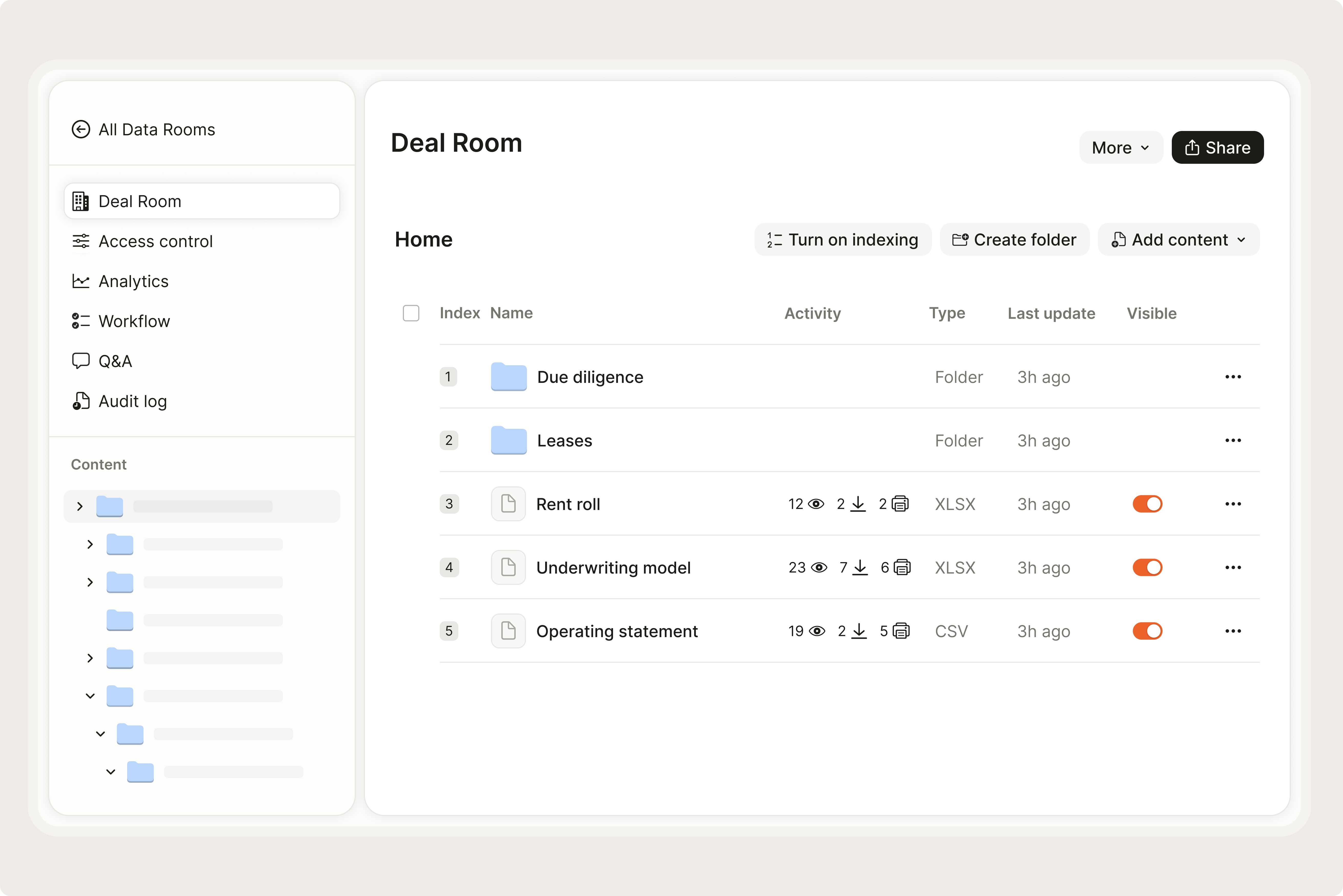
- 1.Upload Belgian property files to a secure roomDrop Kadaster extracts, OVAM Bodemattest, planning certificates, leases, and Phase I ESA into Ellty.
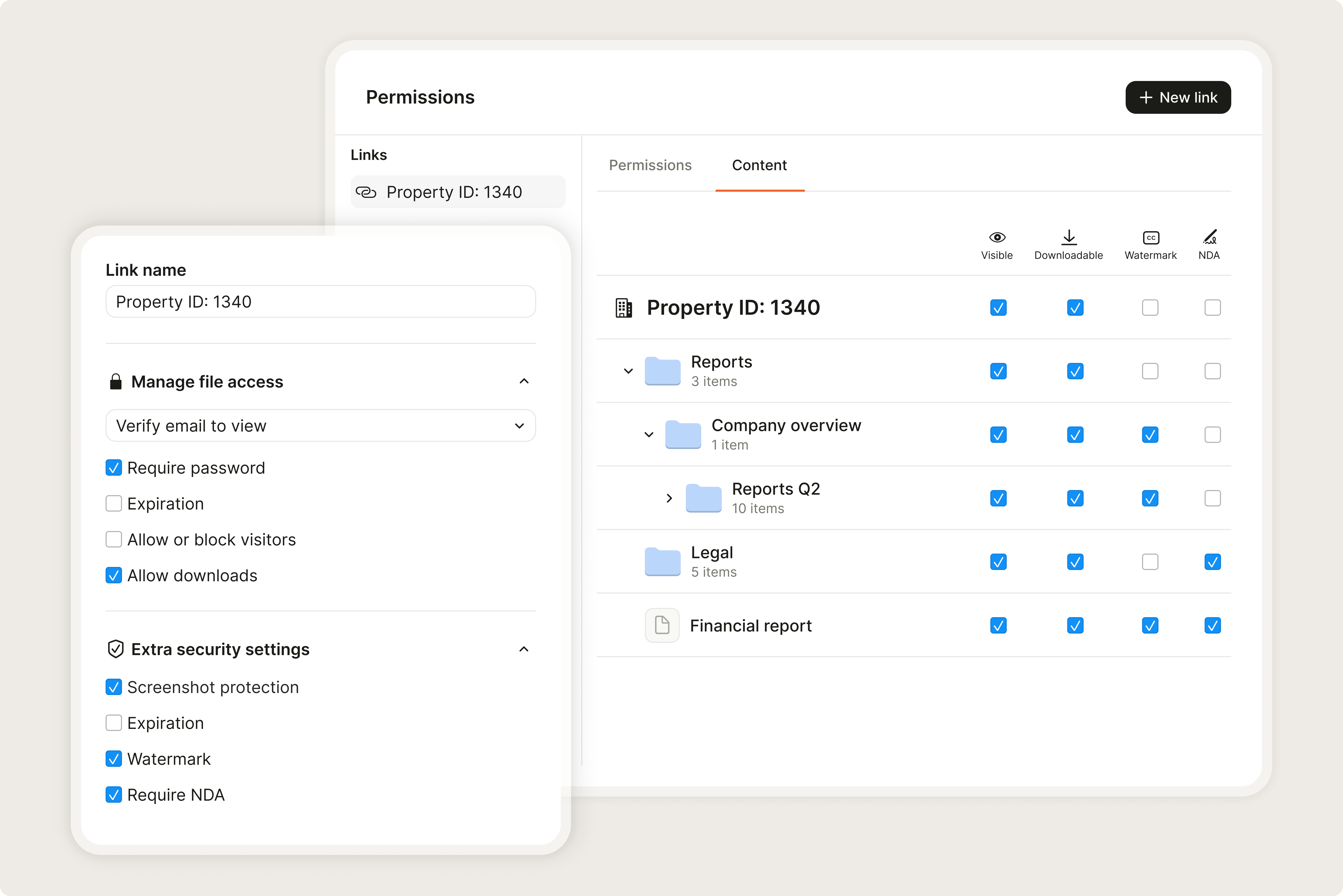
- 2.Give each advisor a scoped, tracked linkYour notary sees title and mortgage docs. Your environmental consultant sees OVAM files. Ellty enforces the scope.
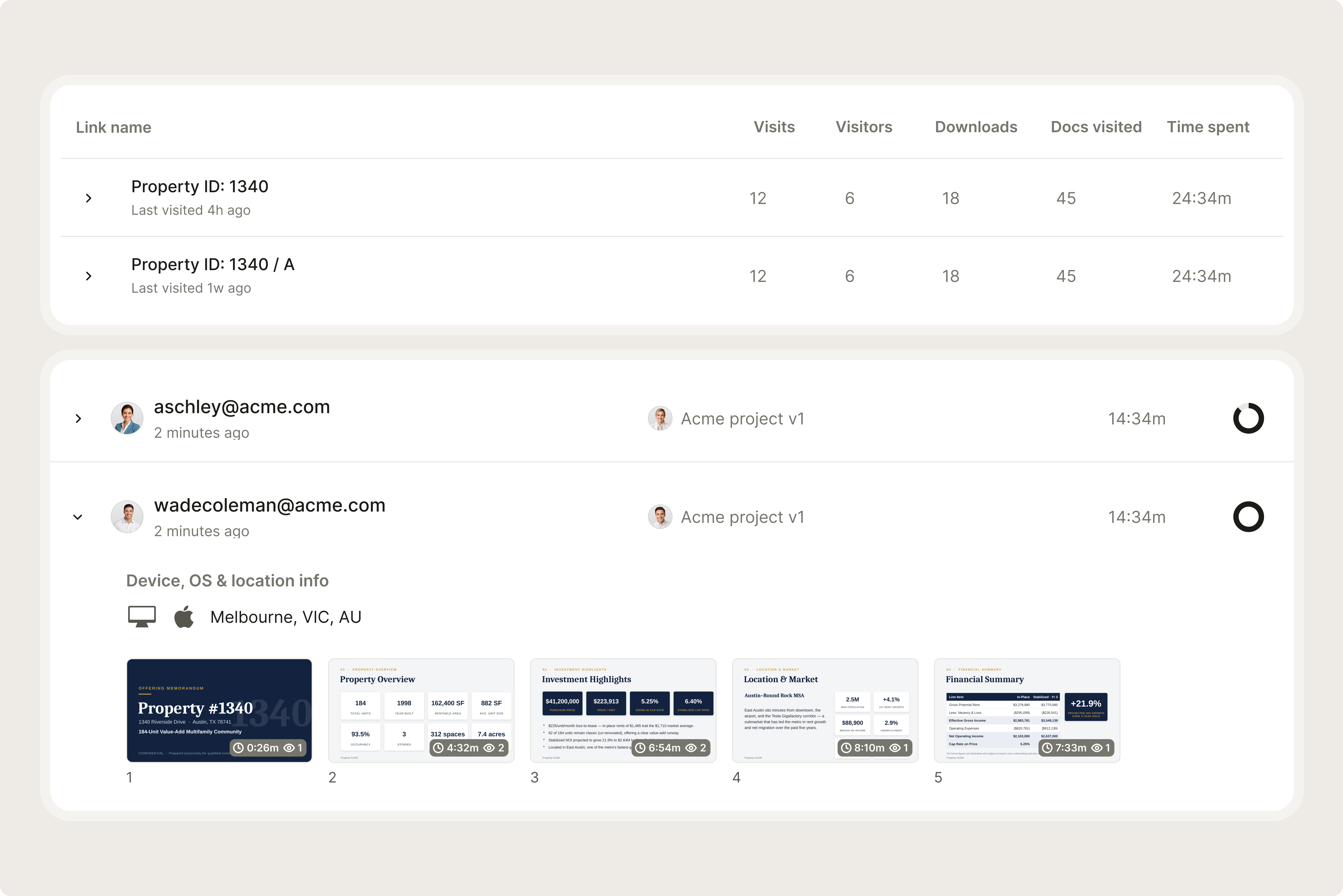
- 3.Monitor who reviews which documentsSee exactly which files each advisor opened and when. Catch delays before they affect the OVAM certificate or notarial deed date.
What makes Belgium different
Three regions, three legal regimes. A Flemish deal and a Brussels deal are not the same process. The soil certificate comes from OVAM in Flanders, Bruxelles Environnement in Brussels, and a different authority in Wallonia. The planning extract has different names, different obtaining authorities, and different timelines in each region. Know which region you're in before planning your diligence timeline.
The Bodemattest takes longer than sellers expect. OVAM legally has 30 days to issue it, but in practice it often runs to 6-8 weeks for complex sites. Start the application process on day one of diligence - waiting until the week before notarial deed is too late.
Belgian commercial lease law is protective of tenants. The 9-year term with 3-year tenant break options is the default. Commercial landlords can't escape this framework without a notarially registered lease agreement. Any income model that assumes shorter-term flexibility needs a legal opinion on whether that's enforceable.
The VAT-option on new commercial buildings can save the full 12-12.5% registration duty. For a EUR 10M new commercial building in Brussels, that's EUR 1.25M. But it requires both parties to be VAT registrants and the election to be in the private sale agreement before the notarial deed. Get the tax analysis done before you sign the private agreement.
The Belgian notary (notaris/notaire) is a public officer appointed by the state. The notary's function in real estate transactions is to authenticate the transfer deed, ensure legal compliance, collect and remit the applicable registration duties to FPS Finance, and register the deed in the land registry. No property transfer in Belgium produces full legal effect between the parties and against third parties without notarial intervention.
Timeline and cost in Belgium
Weeks 1-2 cover kickoff: Kadaster and Hypotheekkantoor search, OVAM Bodemattest application (Flanders), stedenbouwkundige inlichtingen request (Flanders) or urbanistic certificate (Brussels/Wallonia), and VAT-election eligibility analysis. Budget EUR 3,000-10,000 for this phase.
Load all files into Ellty before advisors arrive. Scoped, tracked links for each party remove at least one week of email document exchange from a standard Belgian diligence process.
Weeks 2-4 cover deep review: Phase I ESA delivery, OVAM Bodemattest receipt, lease abstraction, building permit history review, asbestinventarisatie for pre-2001 Flemish buildings, and property tax reconciliation. Cost runs EUR 5,000-20,000 depending on complexity.
Bodemattest is the most common delay in Flemish deals. If OVAM designates the parcel as a risk site, a formal remediation study and decision process begins - add 4-12 weeks for that process alone.
Weeks 4-6 handle resolution: registration duty or VAT structuring finalized, notarial deed preparation by the notary, and signing and registration. Deed registration at the mortgage office and land registry completes within days of signing.
Belgium total acquisition cost: 12-12.5% registration duty (or 21% VAT if new building, with recovery) + notary 0.3-0.5% + legal fees EUR 10,000-30,000. For Brussels commercial deals, total acquisition cost runs approximately 13-14% all-in.
Running a Belgium property deal from one room
Hold Kadaster extracts, OVAM docs, and lease files in one secure, tracked Ellty data room.
Start free 14-day trialCommon questions about due diligence on Belgium property
- Most Belgium CRE deals complete in 4-8 weeks. The OVAM Bodemattest (Flanders soil certificate) is the most common delay and often takes 6-8 weeks to obtain.
- The Bodemattest is a soil certificate issued by OVAM (Flanders soil agency) confirming the contamination status of a parcel. In Flanders, it is legally mandatory for most commercial property transfers. The notarial deed cannot be signed without it. Brussels and Wallonia have equivalent but separately administered certificates.
- Registration duty (verkooprecht/droits d'enregistrement) on commercial property is 12.5% in Brussels and Wallonia, and 12% in Flanders. For new commercial buildings, a VAT option can replace registration duty with 21% VAT, which is recoverable by VAT-registered buyers.
- Belgian commercial leases have a mandatory default term of 9 years with 3-year break options for the tenant. Shorter terms require a notarially registered lease agreement to be enforceable. This applies to retail, office, and most other commercial leases.
- Belgium has three regional governments with separate legal powers over environmental law, planning law, and property regulations. Flanders, Brussels, and Wallonia each have their own soil certificate authority, planning extract procedures, and building permit rules. The notary and registration duty regime is federal and the same across all regions.
- In Flanders: yes, an asbestos inventory (asbestinventarisatie) is mandatory for commercial buildings larger than 250m2 built before 2001 in any property transaction. It must be carried out by a certified OVAM inspector. Brussels and Wallonia have their own asbestos rules, which differ from Flanders.