
Need a secure data room without the enterprise price tag?
You're looking at data rooms because you need to share sensitive documents. Fundraising materials, M&A files, legal documents, or due diligence packages. The problem is that most enterprise virtual data rooms cost thousands per month and take days to set up.
iDeals positions itself as a comprehensive VDR solution, but their pricing starts around $500/month and scales quickly with users and storage. For many startups and small teams, that's more infrastructure than you need.
This guide breaks down what iDeals data room actually offers, what it costs (including hidden fees), how long setup takes, and whether simpler alternatives might work better for your specific use case.
What is iDeals data room?


Data rooms explained
A virtual data room (VDR) is a secure online repository for storing and sharing confidential documents. Companies use them during fundraising, mergers and acquisitions, audits, and legal proceedings. Unlike basic file sharing, data rooms offer granular permission controls, detailed analytics on who viewed what, and enterprise-grade security features like watermarking and access restrictions.
The core value is control. You decide who sees which documents, track every interaction, and revoke access instantly if a deal falls through.
iDeals data room feature
iDeals Virtual Data Room launched in 2008 as an enterprise-focused VDR provider. They built their platform specifically for high-stakes transactions where security, compliance, and detailed audit trails matter most.
The platform offers document management with folder structures, user permissions down to the page level, Q&A modules for managing investor questions, and extensive activity tracking. iDeals emphasizes their ISO 27001 certification, SOC 2 compliance, and physical data center security.
Who uses it:
- Private equity firms managing deal flow and due diligence
- Investment banks running M&A processes with multiple bidders
- Startups raising Series A and beyond with institutional investors
- Legal teams managing litigation discovery and case materials
- Pharmaceutical companies sharing clinical trial data with regulators
iDeals targets mid-market to enterprise clients who need dedicated project managers, custom branding, and advanced security features. It's built for complex, multi-party transactions where audit requirements are strict.
iDeals data room vs regular file sharing

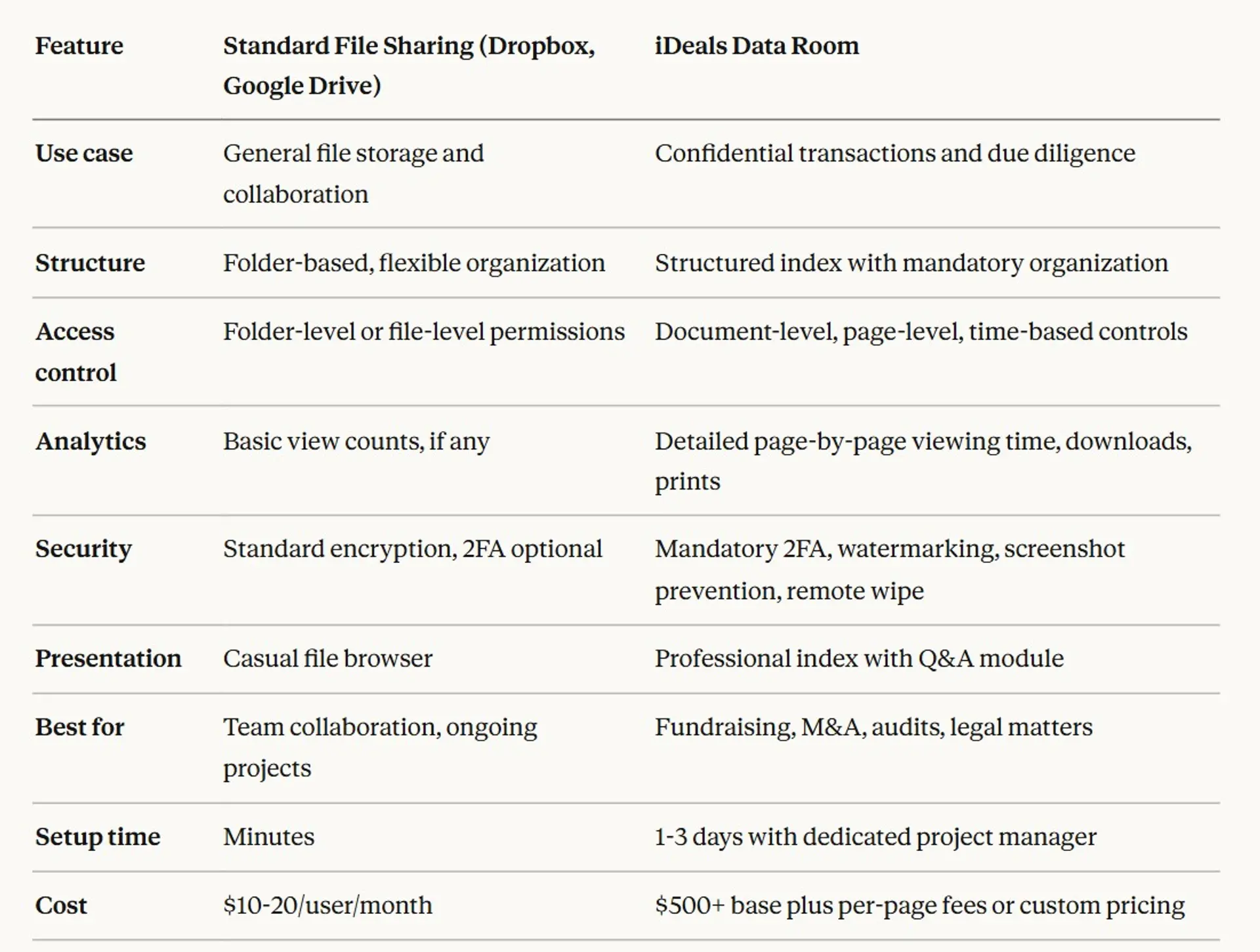
iDeals doesn't offer a "regular" version like Dropbox or Google Drive. They're exclusively a virtual data room provider. The comparison here is between using iDeals VDR and using standard cloud storage solutions for document sharing.
Here's how they differ:

When to use standard file sharing:
You're collaborating with your team on ongoing work. You need quick access from anywhere. You're sharing non-sensitive documents with contractors or partners. Budget is tight and you don't need audit trails.
When to use iDeals data room:
You're in active fundraising with multiple investors requesting access. You're managing M&A due diligence with NDAs and strict access controls. You need detailed records of who viewed which documents when. Compliance requirements demand ISO 27001 or SOC 2 certified infrastructure. You're sharing documents worth millions and can't risk leaks.
The key difference:
Standard file sharing is for collaboration. iDeals is for controlled disclosure. If you need to prove who saw what in court or satisfy regulatory requirements, file sharing won't cut it. If you're just organizing documents for your team, iDeals is massive overkill.
Setting up an iDeals data room
iDeals setup is handled by their team, not self-service like most SaaS tools. Here's the actual process based on their standard implementation.
Step 1: Initial consultation and scoping (1-2 hours)
Sales call to understand your transaction type, document volume, number of users, and security requirements. They'll recommend a package and assign a project manager.
Step 2: Contract and onboarding (1-2 days)
Sign agreement, provide company details for compliance, set up billing. Your project manager schedules kickoff call.
Step 3: Data room structure planning (2-4 hours)
Work with project manager to design folder structure. They'll suggest industry-standard indexes for your transaction type (fundraising, M&A, audit). You approve the structure before they build it.
Step 4: Document upload and organization (4-8 hours)
Either you upload documents via secure FTP or their team does it for you (additional fee). Documents get organized into the approved folder structure. Large data rooms with thousands of files take longer.
Step 5: Permission configuration (1-2 hours)
Define user groups (investors, advisors, legal team). Set document-level permissions. Configure watermarking, download restrictions, print controls. Enable Q&A module if needed.
Step 6: Testing and training (1-2 hours)
Project manager walks you through admin controls. Test user access with dummy accounts. Learn reporting dashboards and activity tracking. Get training on managing Q&A and granting access.
Step 7: User invitation and go-live (30 minutes)
Send access invitations to your first round of users. Monitor initial access and address questions.
Total setup time: 1-3 business days from contract signing to launch, assuming you have documents ready. Complex data rooms with custom requirements can take a week.
Ongoing maintenance:
Adding users takes 5-10 minutes per person. Uploading new documents and setting permissions takes 10-30 minutes depending on volume. Responding to Q&A questions happens in real-time through their interface. Monthly you'll review access reports to see engagement patterns.
The project manager support means you're not figuring everything out alone, but it also means you can't just sign up and start uploading at midnight when inspiration strikes.
iDeals data room pricing


iDeals doesn't publish pricing on their website. Everything is custom quotes based on your specific needs. Here's what we've learned from market research, user reviews, and direct inquiries.
Plan availability:
iDeals offers three general tiers, but actual pricing varies significantly based on transaction size, user count, storage needs, and contract length.
Which plans include data rooms:

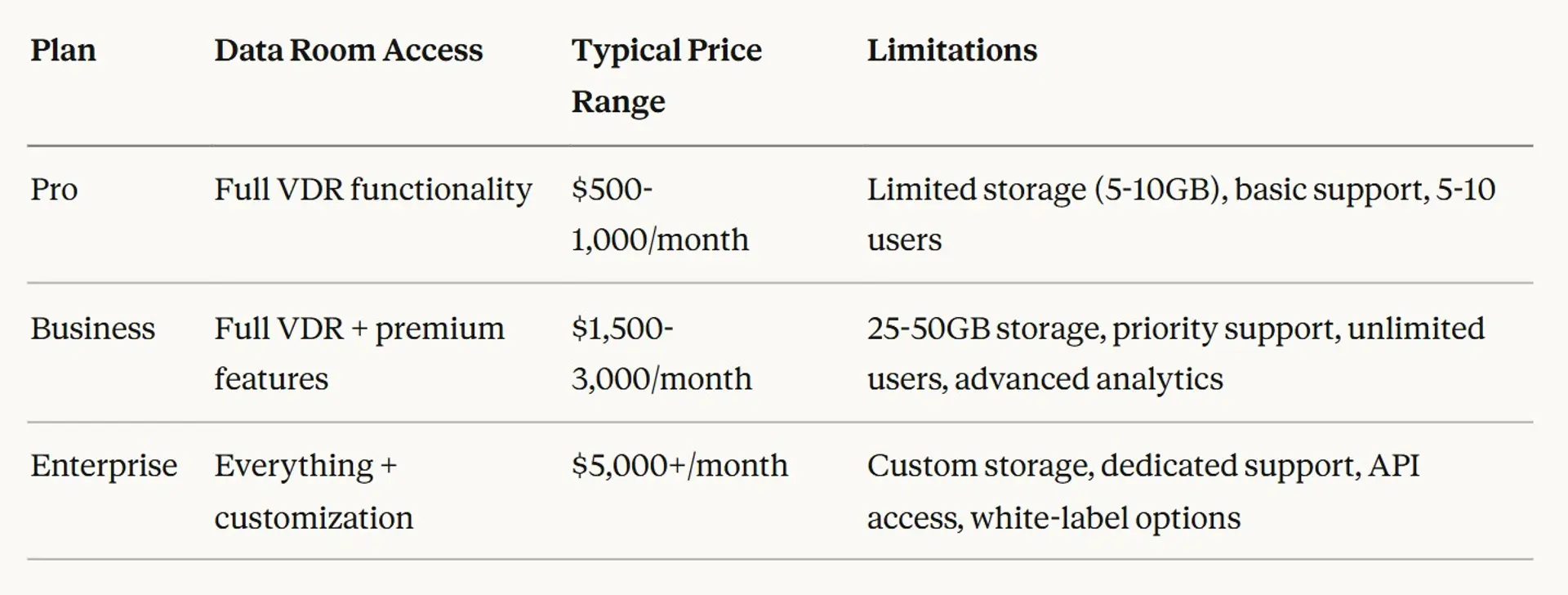
All plans include the core data room. The differences are in storage limits, support levels, and advanced features like AI-powered redaction or custom integrations.
Detailed pricing breakdown:
Pro - Starting around $500/month
What's included:
- Virtual data room with standard security features
- Up to 10GB storage (roughly 5,000-10,000 pages)
- Email and phone support during business hours
- Basic activity reports
- User authentication and permissions
- Q&A module for managing investor questions
Who it's for: Seed or Series A startups with straightforward fundraising needs. Simple M&A transactions with limited document volume.
Limitations: Storage caps out quickly with financial models and PDFs. No dedicated project manager after initial setup. Support response times can be 24-48 hours.
Business - Around $1,500-3,000/month
What's included:
- Everything in Pro
- 25-50GB storage
- Priority support with faster response times
- Advanced analytics showing heat maps of document engagement
- Unlimited users (no per-seat fees)
- Custom branding options
- Bulk upload tools
- Integration with DocuSign
Who it's for: Series B+ companies managing multiple investor relationships. Mid-market M&A with several bidders reviewing documents. Companies needing detailed audit trails for compliance.
Limitations: Still no dedicated ongoing project management. Large file repositories may hit storage caps. Advanced features like AI redaction cost extra.
Enterprise - Custom pricing
What's included:
- Everything in Business
- Unlimited storage or custom limits
- Dedicated account manager and priority support
- API access for custom integrations
- White-label interface with your branding
- Custom security requirements (specific data residency, etc.)
- AI-powered document processing
- Advanced workflow automation
Who it's for: Large enterprises running continuous deal flow. Private equity firms managing multiple simultaneous transactions. Companies with strict regulatory requirements.
Cost: Starts around $5,000/month but can reach $10,000-20,000+ for high-volume users or complex requirements.
Hidden costs to consider:
Beyond base subscription:
Setup and training: Initial setup is typically included, but extensive custom configuration or hands-on document organization from iDeals team can add $1,000-5,000 one-time fees.
User scaling: Most plans include unlimited users, but some older contracts or custom arrangements charge per-user fees. If you're quoted per-user pricing, expect $50-150/user/month.
Feature add-ons:
- AI redaction: $500-1,500/month extra
- Advanced integrations: $200-1,000/month per integration
- Additional storage blocks: $100-500 per 10GB/month
- Custom report templates: $500-2,000 one-time
Storage overages: If you exceed your plan's storage limit, overage fees run $100-300 per GB/month. A large data room can balloon costs quickly.
Contract length: Month-to-month contracts cost 20-40% more than annual commitments. Most deals close in 3-6 months, so you might pay for unused months with annual plans.
Real cost examples:
Startup raising Series A (3 investors, 2GB documents)
- Plan: Pro
- Base cost: $500/month
- Storage: Included (under 10GB)
- Setup: Included
- Duration: 4 months average fundraise
- Total cost: $2,000
Company in M&A process (5 bidders, 20GB documents)
- Plan: Business
- Base cost: $2,000/month
- Storage: Included (under 50GB)
- Advanced analytics: Included
- Duration: 6 months typical M&A timeline
- Total cost: $12,000
Private equity firm (ongoing deal flow, 100GB+ documents)
- Plan: Enterprise
- Base cost: $8,000/month
- Custom storage: Included
- Dedicated support: Included
- Annual contract: $96,000/year
- Total cost: $96,000+ annually
Cost comparison with competitors:

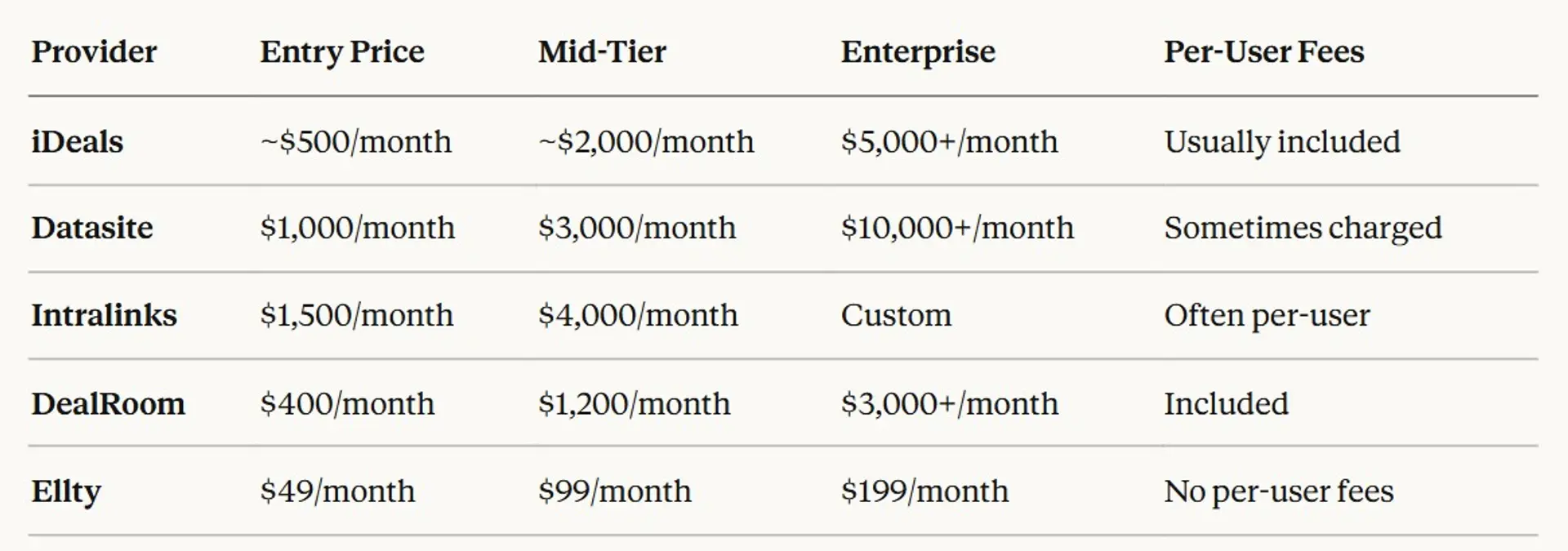
iDeals sits in the mid-range for enterprise VDR providers. They're cheaper than Intralinks or Datasite but significantly more expensive than newer platforms like Ellty or DealRoom that target startups and smaller deals.
The value proposition is proven infrastructure and extensive compliance certifications. You're paying for 15+ years of security audits and a track record with major institutions.
Use cases for data rooms
Data rooms make sense when document security, access control, and audit trails justify the cost and complexity. Here are specific scenarios where they add clear value.
1. Fundraising (Series A through growth rounds)
The scenario: You're raising $5M+ from institutional investors who will spend weeks scrutinizing your financials, contracts, and operations. You need to share sensitive information with 5-15 potential investors, each at different stages of diligence. Some want full financial access, others start with high-level metrics and request deeper materials as interest grows.
Why a data room helps:
- Centralize all investor materials in one organized location
- Grant tiered access as investors move through your funnel
- Track which investors spend time on which documents to prioritize follow-ups
- Update financials once and all investors see current versions
- Professional presentation signals you're serious and organized
- Revoke access immediately if investor drops out or deal terms change
What you'd include:
- Pitch deck and executive summary
- Three years of financial statements plus current year projections
- Cap table with all option grants and vesting schedules
- Customer contracts and revenue breakdown by customer
- Product roadmap and technology architecture
- Team backgrounds and organizational chart
- All incorporation documents, IP assignments, and material contracts
- Board minutes and previous investor updates
- Market research and competitive analysis
Example workflow: Create structured data room with clear folder organization. Send initial access to lead investors with full permissions to financials and legal docs. As warm introductions come in from other VCs, grant view-only access to pitch deck and summary materials. Expand access to detailed financial models when investors request deeper diligence. Use activity reports to see which investors are actively reviewing vs just browsing. Follow up quickly with investors who spent significant time on specific sections.
iDeals features that matter:
- User groups to manage different investor permission levels
- Page-by-page analytics to see exactly which financials get scrutinized
- Q&A module to track and answer investor questions in one place
- Automatic watermarking to discourage sharing outside their firm
- Time-based access expiration for investors who don't progress
2. Mergers and acquisitions (sell-side and buy-side)
The scenario: Your company is being acquired or you're acquiring another company. Due diligence involves lawyers, accountants, consultants, and executives from both sides reviewing thousands of documents. Multiple bidders might be evaluating simultaneously. The process takes 3-6 months and confidentiality is critical until announcement.
Why a data room helps:
- Organize massive document volumes (often 10,000+ pages) systematically
- Control which bidders see which information and when
- Prevent bidders from knowing about each other through access patterns
- Create detailed audit trail proving compliance with disclosure requirements
- Manage multiple workstreams (legal, financial, operational, technical) simultaneously
- Redact sensitive information like employee names or customer details
What you'd include:
- Complete financial records for 3-5 years
- All contracts (customers, vendors, employees, leases)
- Intellectual property documentation and patent filings
- Litigation history and outstanding legal matters
- HR records (anonymized) and benefit plan documents
- Environmental reports and regulatory compliance records
- IT systems documentation and security audits
- Insurance policies and claims history
- Tax returns and correspondence with authorities
Example workflow: Seller's legal team builds comprehensive index of all company documents. Upload and organize into standard M&A categories. Create separate access groups for each bidder so they can't see each other's activity. Grant initial access to high-level materials. As bidders submit LOIs, expand access to detailed operational documents. Track which bidders are actively reviewing vs passive. Use Q&A to manage hundreds of diligence questions efficiently. Generate audit reports proving all material information was disclosed.
iDeals features that matter:
- Fence view to prevent bidders from seeing competitor activity
- Detailed audit logs proving disclosure timeline for legal defense
- Bulk upload and auto-indexing for thousands of documents
- Redaction tools to hide sensitive information like SSNs
- Q&A workflow with assignment and tracking
- Advanced search across all documents for specific terms
3. Board reporting and investor relations (ongoing)
The scenario: You have a board of directors and investor group who need regular access to company performance data, strategic plans, and governance documents. You send monthly or quarterly updates. Board members request historical context frequently. You need to maintain organized archive of all board materials.
Why a data room helps:
- Maintain permanent archive of all board materials accessible anytime
- Grant different access levels to board members vs investor observers
- Update monthly financials in one location rather than email chains
- Ensure board members see identical materials simultaneously
- Track which board members actually review materials before meetings
- Quickly compile materials when new board members join
What you'd include:
- Monthly management reports and KPIs
- Quarterly board decks and presentations
- Board meeting minutes and resolutions
- Annual budgets and strategic plans
- Updated cap table and option grants
- Material contracts requiring board approval
- Risk assessments and compliance reports
Example workflow: Create persistent data room that stays active year-round. Upload new monthly reports to dated folders. Grant all board members view access, CFO and CEO have upload rights. Before board meetings, send notification that new materials are available. Track whether directors reviewed materials before meeting. After meetings, upload approved minutes. When investor requests historical context, they access archived materials themselves rather than asking you to dig through email.
iDeals features that matter:
- Persistent access vs temporary project rooms
- Notification system when new materials are uploaded
- Version control to see historical reports vs current
- Permission templates for new board members
- Activity reports showing director engagement with materials
4. Legal proceedings and litigation discovery
The scenario: Your company is involved in litigation or regulatory investigation. Opposing counsel requests production of documents. You need to share thousands of pages while protecting privileged materials. Outside counsel needs to review everything. Discovery deadlines are strict.
Why a data room helps:
- Organize responsive documents separate from privileged materials
- Control exactly which documents opposing party can access
- Create privilege log showing what was withheld and why
- Track opposing counsel's review activity
- Produce documents in organized, defensible manner
- Maintain chain of custody for evidence
What you'd include:
- Responsive documents organized by issue or request number
- Exhibits and supporting materials
- Deposition transcripts and expert reports
- Correspondence related to disputed matters
- Contracts and agreements relevant to claims
- Financial records supporting damage calculations
Example workflow: Legal team reviews all potentially responsive documents. Upload approved productions to organized folders matching discovery requests. Grant opposing counsel view-only access with watermarking. Disable download and print for sensitive materials. Track their review activity to anticipate their strategy. Upload new productions to dated folders as discovery continues. Generate audit report showing complete production timeline.
iDeals features that matter:
- Bates numbering and document stamping
- Watermarking with recipient details
- Download and print restrictions
- Privilege log generation
- Complete audit trail for court filing
- Secure deletion when matter concludes
5. Pharmaceutical and clinical trial data sharing
The scenario: You're running clinical trials and need to share data with regulatory authorities, research partners, or potential acquirers. Data includes patient information (anonymized), trial protocols, adverse event reports, and efficacy data. Regulatory compliance is critical.
Why a data room helps:
- Meet regulatory requirements for data security and access control
- Share trial data with FDA or EMA in organized format they expect
- Control which research partners see which trial arms or endpoints
- Track regulator access for compliance documentation
- Update trial data as studies progress without breaking audit trail
- Ensure HIPAA and GDPR compliance for patient data
What you'd include:
- Trial protocols and amendments
- Case report forms and patient data (de-identified)
- Adverse event reports and safety monitoring
- Statistical analysis plans and results
- Manufacturing and quality control documents
- Regulatory correspondence and submissions
- Investigator brochures and informed consent forms
Example workflow: Set up data room meeting FDA or EMA requirements for eCTD submissions. Upload trial documents in required folder structure. Grant regulator read-only access to specific sections. Update data as trial progresses without changing document locations. Track regulator activity to anticipate questions. Generate compliance reports showing access controls and data security.
iDeals features that matter:
- Compliance with 21 CFR Part 11 for electronic records
- Detailed audit trails for regulatory inspection
- Granular permissions for multi-site trials
- Secure access for international regulators
- Data residency options for GDPR compliance
6. Real estate transactions
The scenario: You're selling commercial property or portfolio of properties. Buyers need to review property documents, tenant leases, inspection reports, and financial performance. Multiple offers might come in. Due diligence takes weeks.
Why a data room helps:
- Organize property documents by building or location
- Share different properties with different buyers based on interest
- Track which buyers review which properties most thoroughly
- Update rent rolls and financial performance without email chains
- Manage questions about property condition and tenant issues
- Maintain confidentiality of tenant information and lease terms
What you'd include:
- Property deeds and title reports
- Tenant leases and rent rolls
- Property inspection and environmental reports
- Financial statements by property
- Operating expenses and capital improvement history
- Zoning and permit documentation
- Property management agreements
- Insurance policies
Example workflow: Create data room with folder for each property in portfolio. Upload all property documents organized by type. Grant potential buyers access to properties matching their interest. Track which properties get most review attention. Use Q&A to manage buyer questions about specific properties or leases. Update rent rolls monthly as leases change. Generate reports showing buyer engagement to prioritize negotiations.
iDeals features that matter:
- Portfolio view for multiple properties
- Location-based organization
- Financial data rooms for rent rolls
- Q&A by property for buyer questions
- Activity comparison across different buyers
7. Bankruptcy and restructuring
The scenario: Your company is in bankruptcy or financial restructuring. Creditors, potential buyers, and court-appointed parties need access to financial records. Court requires transparent process. Multiple parties have different rights to information.
Why a data room helps:
- Provide court-supervised access to creditors and stakeholders
- Organize financial records clearly for bankruptcy trustee
- Track which parties access which information for court reporting
- Control access based on creditor class or stakeholder type
- Update financial status as restructuring progresses
- Maintain permanent record of all disclosures
What you'd include:
- Bankruptcy petition and schedules
- Financial statements and cash flow projections
- Asset valuations and appraisals
- Creditor lists and claim amounts
- Executory contracts and leases
- Operating reports filed with court
- Reorganization plan and disclosure statement
Example workflow: Set up data room under court supervision. Upload bankruptcy filings and financial records. Grant creditor committee access to operational details. Provide potential buyers access to asset information. Track all access for court reporting. Update cash flow reports weekly. Use Q&A to manage creditor questions. Generate audit reports for bankruptcy trustee and court.
iDeals features that matter:
- Court-supervised access controls
- Creditor class permission groups
- Complete audit trail for court filing
- Secure bidding process management
- Compliance with bankruptcy court rules
8. Partnership and joint venture formation
The scenario: You're forming strategic partnership or joint venture with another company. Both parties need to share confidential information about capabilities, financials, and strategic plans. Trust is building. NDAs are signed but you need organized exchange.
Why a data room helps:
- Structured information exchange with clear organization
- Equal access for both parties to shared materials
- Track what partner reviews to gauge interest level
- Professional presentation builds credibility
- Control access if partnership discussions stall
- Archive partnership formation for future reference
What you'd include:
- Company overviews and strategic plans
- Financial performance and projections
- Technology capabilities and IP portfolios
- Customer relationships and market access
- Team capabilities and org charts
- Partnership proposal terms and structure
- Draft agreements and term sheets
Example workflow: Create data room with separate sections for each partner's materials. Both partners upload confidential information about capabilities. Grant mutual access to shared sections. Use Q&A to discuss partnership structure and address concerns. Track engagement to see which aspects of partnership get most attention. Update proposals as terms evolve. Archive final partnership agreement and supporting materials.
iDeals features that matter:
- Multi-party access with separate permission groups
- Bilateral information sharing controls
- Q&A for partnership discussion
- Document comparison for term sheets
- Secure archive of partnership formation
iDeals data room limitations
iDeals is comprehensive but it's not right for everyone. Here are honest limitations you should know about before committing.
1. Price barrier for early-stage companies
Starting at $500/month minimum puts iDeals out of reach for most pre-seed and seed-stage startups. If you're raising your first $500K-1M, spending $2,000-3,000 on a data room (4-6 month fundraise) represents meaningful percentage of your runway. The platform is built for larger transactions where the cost is negligible compared to deal size.
2. No self-service setup
You can't just sign up and start uploading tonight. Everything goes through sales, contracting, and project manager setup. If you need a data room live tomorrow for an unexpected investor request, iDeals won't work. Minimum 1-3 day setup even for simple configurations.
3. Complexity overkill for simple sharing
If you just need to share a pitch deck and financials with 2-3 angel investors, iDeals' enterprise features are unnecessary. The learning curve for admins is moderate and you'll use maybe 20% of available features. Simpler tools with faster setup make more sense for straightforward fundraising.
4. Contract lock-in and unclear pricing
No month-to-month option at reasonable rates. Annual contracts are standard to get competitive pricing. If your deal closes in 2 months, you're paying for 10 unused months or negotiating early termination. Custom quotes mean you can't easily compare costs before sales calls.
5. Storage limits hit quickly with video or large files
Entry plans include 5-10GB storage. A few video demonstrations, product demos, or large design files consume that fast. Architectural firms, video production companies, or hardware startups with CAD files hit limits quickly. Overage fees are expensive ($100-300/GB/month).
6. Limited customization without enterprise plan
Want custom workflows, specific integrations, or white-labeled interface? Enterprise plan only, which means $5,000+/month. Mid-tier plans are somewhat rigid in their feature set.
7. Learning curve for non-technical users
While not extremely difficult, iDeals assumes familiarity with complex permission structures and document management concepts. Non-technical founders might struggle with user groups, permission inheritance, and advanced security settings. Their support helps but there's still ramp-up time.
8. Overkill for ongoing team collaboration
iDeals is built for defined transactions with clear start and end dates. If you want persistent document sharing for ongoing team collaboration, traditional tools like Google Drive or Dropbox are simpler and cheaper. iDeals' strength is controlled disclosure, not collaboration.
9. Mobile experience is secondary
While iDeals has mobile apps, the experience is clearly designed for desktop use. Reviewing complex financial models or navigating deep folder structures on mobile is frustrating. If your investors primarily work from phones/tablets, they'll struggle.
10. Integration limitations
iDeals integrates with DocuSign, Microsoft Office, and a few other tools, but it's not an open platform. If you need custom integrations with your CRM, investor management system, or other tools, you're looking at enterprise pricing plus custom development fees. API access is enterprise-only.
When these limitations are dealbreakers:
Budget constraints matter more than enterprise features. You need something live today, not next week. Your documents are mostly straightforward and don't require page-level permissions. You're raising from angels or small funds who won't scrutinize enterprise security certifications. Your deal might close quickly and you don't want annual contracts. You need ongoing collaboration space, not transaction-specific disclosure.
When these limitations are minor:
You're managing transactions worth millions where $1,000-3,000/month is immaterial. Security certifications and audit trails are mandatory for your industry or investors. You have time to plan setup and work with project managers. You need advanced features like fence view, Q&A workflows, or detailed analytics. Your investors expect enterprise-grade VDR infrastructure. Compliance requirements demand ISO 27001 or SOC 2 certified platforms.
Alternatives to iDeals data room
Several options exist depending on your specific needs, budget, and transaction complexity. Here's how they compare.
Ellty - Simple data rooms without per-project fees


What it offers: Ellty started as a pitch deck sharing platform and evolved into a straightforward virtual data room for startups. The focus is on fundraising and simple due diligence without enterprise complexity. You can set up a data room in under an hour without talking to sales.
Key features:
- Document upload and folder organization
- User-level permissions and access controls
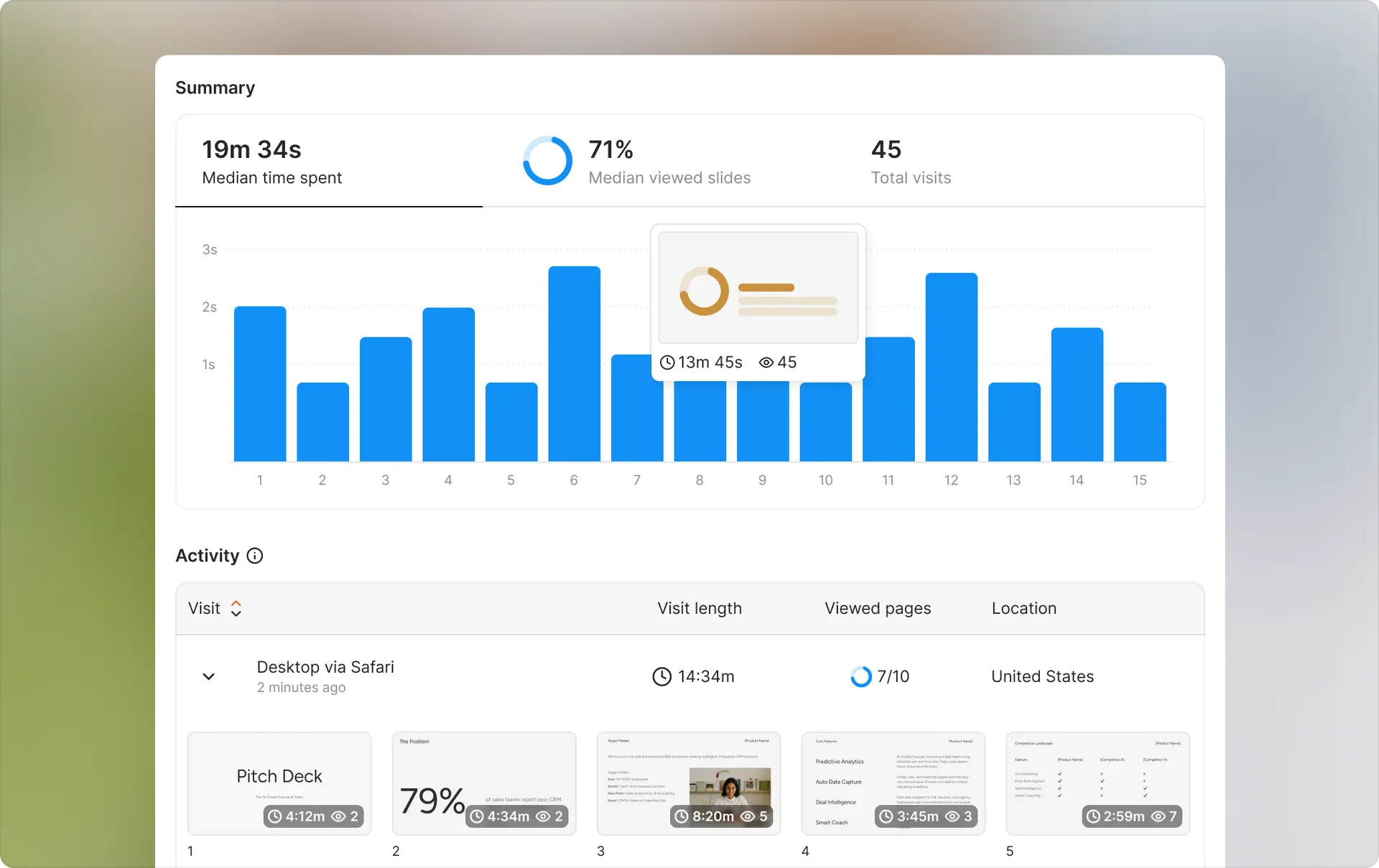
- Page-by-page analytics showing viewing time and engagement
- Real-time notifications when investors view materials
- NDA enforcement before document access
- Simple Q&A for investor questions
- No per-user fees regardless of investor count
- Mobile-friendly interface for investors on the go
Pricing:
- Starter: $0/month - basic analytics, up to 5GB storage, unlimited visitors
- Professional: $24/month - advanced analytics, password protection, unlimited storage, priority support
- Business: $50/month - screenshot protection, dedicated support
All plans allow unlimited users viewing your data room. No setup fees. Month-to-month with no long-term contracts.
Best for: Seed through Series B startups raising from angels, micro VCs, or smaller institutional funds. Founders who want simple setup without project managers. Teams with limited budget where $500+/month isn't justified by deal size. Simple M&A transactions without complex regulatory requirements.
Compared to iDeals:

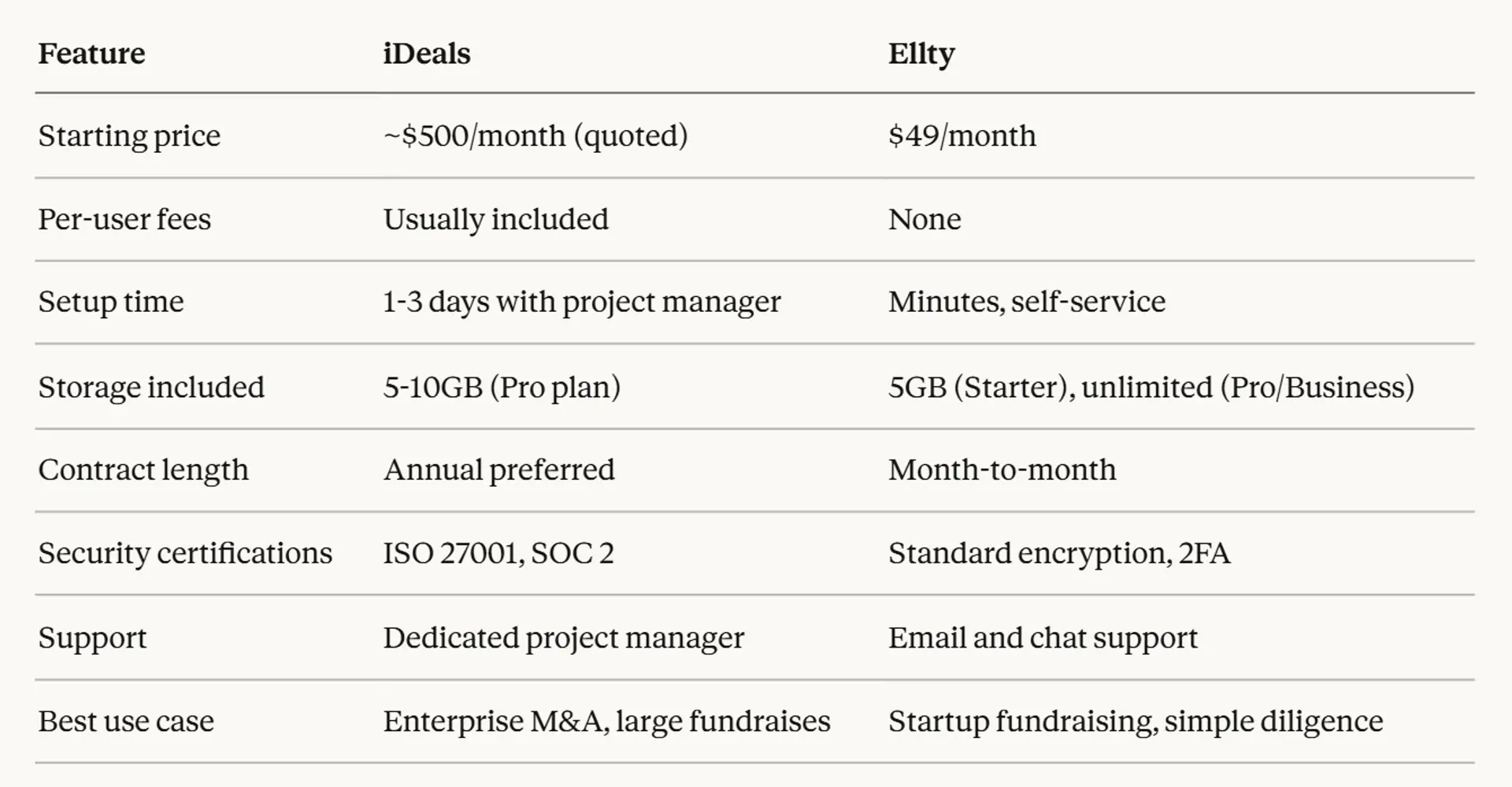
When to choose Ellty:
- You're raising under $10M and investor count is under 20
- Setup urgency matters (need it live today)
- Monthly subscription flexibility is important
- You'll set up the data room yourself without project manager
- Simple permission structure (view/no view) is sufficient
- Budget constraints are real and $500+/month isn't justified
When iDeals still makes more sense:
- You're managing $50M+ transaction or complex M&A
- Investors specifically request enterprise VDR with compliance certs
- You need advanced features like fence view or AI redaction
- Regulatory requirements demand ISO 27001 certified infrastructure
- Budget isn't a concern and you value white-glove support

DealRoom - M&A lifecycle management
What it offers: DealRoom focuses on M&A process management beyond just document sharing. It combines data room functionality with project management, pipeline tracking, and deal workflow tools.
Key features:
- Virtual data room with standard security
- M&A project management and task tracking
- Deal pipeline management for multiple simultaneous deals
- Integration with Salesforce and other CRM tools
- Diligence request management
- Analytics on deal progress, not just document views
Pricing: Starts around $400/month for basic plans. Mid-tier around $1,200/month. Enterprise pricing for multiple deals or large teams.
Best for: M&A advisors, corporate development teams, or private equity firms managing multiple deals simultaneously. Companies that need project management integrated with data room.
Limitation: If you just need document sharing for fundraising, the M&A workflow features are unnecessary complexity.
Datasite (formerly Merrill DataSite) - Enterprise M&A
What it offers: One of the oldest and most established VDR providers, primarily serving investment banks and large corporations in complex M&A transactions.
Key features:
- Extremely robust security and compliance certifications
- Advanced analytics and AI-powered insights
- Global infrastructure with data centers worldwide
- Dedicated support teams for large deals
- Integration with major investment banks' workflows
Pricing: Premium pricing starting around $1,000/month for basic plans, typically $3,000-10,000/month for active M&A processes. Often priced per project rather than monthly subscription.
Best for: Investment banks, large corporate M&A teams, billion-dollar transactions where maximum security and proven track record matter most.
Limitation: Massive overkill and expense for startup fundraising or small deals. Complex interface assumes sophisticated users.
Intralinks - Investment banking standard
What it offers: Another legacy VDR provider dominant in investment banking. Known for handling the largest, most complex global M&A transactions.
Key features:
- Bank-grade security and compliance
- Support for massive document volumes (100,000+ files)
- Advanced permission structures for complex deals
- Integration with major banks and law firms
- 24/7 support for global deal teams
Pricing: Premium tier, typically $1,500-5,000/month for standard deals, up to $20,000+/month for large M&A. Often includes setup fees of $2,000-5,000.
Best for: Major M&A transactions, public company deals, cross-border acquisitions with extensive regulatory requirements.
Limitation: Prohibitively expensive for startups. Sales process is lengthy. Platform complexity requires training.
Google Drive with access controls - Basic sharing
What it offers: Not a true data room, but Google Drive's folder sharing with permissions can work for very simple scenarios.
Key features:
- Familiar interface everyone knows
- Folder-level permissions
- Version history
- Collaboration tools
- Real-time updates
Pricing: Starts free, Google Workspace Business Standard at $12/user/month includes advanced controls.
Best for: Informal document sharing with advisors or very early-stage angel investors who don't require formal data room infrastructure.
Limitation: No detailed analytics on who viewed what. No page-level permissions. No watermarking. Not professional presentation for institutional investors. No audit trail for compliance. Sharing links can be forwarded without your knowledge.
Quick comparison table:

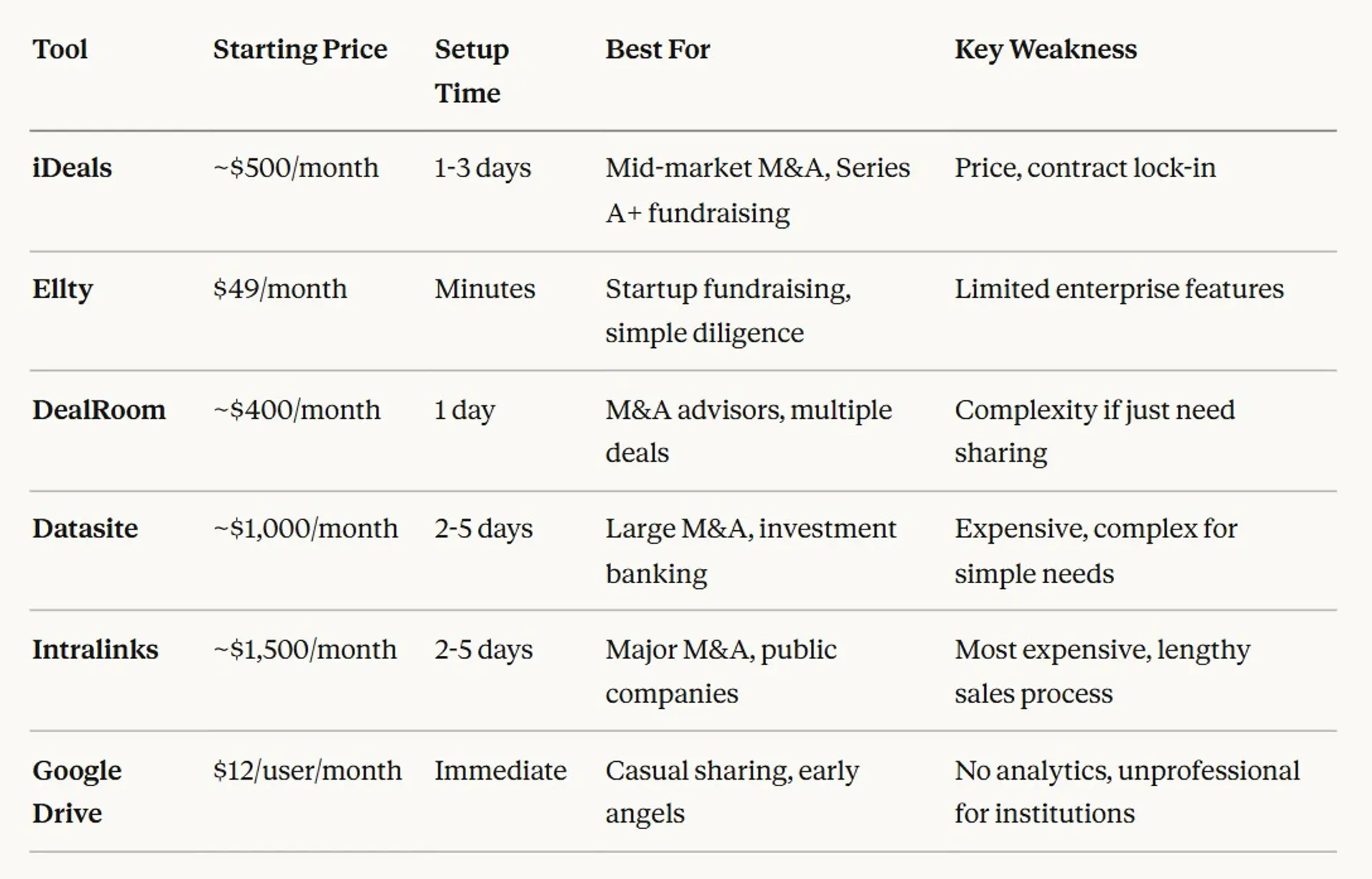
Choosing the right alternative:
If budget is your main constraint: Start with Ellty or Google Drive depending on how professional you need to appear. Ellty gives you data room features at startup pricing. Google Drive works if investors won't scrutinize infrastructure.
If transaction complexity is high: iDeals, Datasite, or Intralinks depending on deal size. Complex M&A with multiple bidders, extensive regulatory requirements, or billion-dollar valuations justify enterprise pricing.
If you're managing multiple deals: DealRoom's pipeline management or enterprise plans from iDeals/Datasite that include multi-deal pricing.
If setup speed matters: Ellty (minutes) or Google Drive (immediate) if you need something live today. iDeals and others require sales cycles and project manager setup.
If investor expectations drive choice: Ask your lead investor what they prefer. Some institutional VCs have specific VDR requirements. Others don't care as long as documents are organized and accessible.
If compliance requirements are strict: iDeals, Datasite, or Intralinks with ISO 27001, SOC 2, and industry-specific certifications. Regulated industries (finance, pharma, healthcare) often mandate certified infrastructure.
The right choice depends entirely on your specific situation. A $50M Series C with multiple corporate VCs probably justifies iDeals or better. A $1M seed round from angels works fine with Ellty or even organized Google Drive folders.
Is iDeals data room right for you?
iDeals makes sense for specific scenarios. Here's how to decide.
Choose iDeals data room if:
You're managing M&A transaction worth $10M+ where deal infrastructure costs are negligible compared to transaction value.
Your investors or buyers specifically request enterprise-grade VDR with compliance certifications.
You're in regulated industry (healthcare, pharma, finance) where ISO 27001 or SOC 2 certification is mandatory.
You need advanced features like fence view, page-level permissions, or AI-powered document processing.
You're managing multiple bidders or investor groups who can't see each other's activity.
Your company has budget for $2,000-10,000+ in data room costs over deal lifecycle.
You value project manager support and don't want to figure out setup yourself.
You need detailed audit trails for regulatory compliance or legal defense.
Deal complexity requires sophisticated permission structures, Q&A workflows, and extensive analytics.
Your transaction timeline allows for 1-3 day setup with sales process and contracting.
Look at alternatives if:
You're raising under $5M and data room costs represent meaningful percentage of raise.
You need something live today, not next week after sales calls and setup.
Your document sharing needs are straightforward without complex permission requirements.
You're sharing with small number of investors (under 10) who don't require enterprise infrastructure.
Budget flexibility matters and you prefer month-to-month over annual contracts.
You'll set up data room yourself without project manager assistance.
Your investors are angels or early-stage funds who won't scrutinize VDR infrastructure.
Deal might close quickly and you don't want to pay for months of unused access.
Simple analytics on document views are sufficient without heat maps or page-level tracking.
Your documents are mostly pitch decks and financial summaries, not thousands of legal files.
Decision framework:
Ask yourself:
About your use case:
- What's the total deal size? (If under $5M, alternatives likely make more sense)
- How many parties need access? (Under 10 users suggests simpler tools work fine)
- What's the document volume? (Under 1,000 pages rarely needs enterprise VDR)
- Do you have regulatory requirements for specific certifications? (If yes, iDeals justified)
About your team:
- Will you set this up yourself or do you need project manager support?
- Does anyone on your team have VDR experience from previous deals?
- How technical is your team with permission structures and security settings?
About your budget:
- Can you allocate $2,000-10,000 to data room over deal lifecycle?
- Would that money be better spent elsewhere (legal, accounting, runway)?
- What percentage of your raise does data room cost represent? (Over 0.5% suggests too high)
About timing:
- When do you need this live? (Today = alternatives, next week = iDeals possible)
- How long will deal process take? (Under 3 months might not justify annual contract)
- Can you commit to annual contract or need month-to-month flexibility?
Honest recommendation:
iDeals is legitimately good at what it does - enterprise-grade secure document sharing with extensive compliance and features. The platform is mature, reliable, and trusted by major institutions globally.
But "good" doesn't mean "right for you."
For most seed through Series A startups raising under $5M, iDeals is more infrastructure than you need at a price that doesn't make sense. Your angels and early VCs don't require ISO 27001 certification. They want organized documents they can review quickly. Simpler tools like Ellty accomplish that at fraction of the cost.
For Series B+ companies, complex M&A, or transactions where regulatory compliance matters, iDeals is worth serious consideration. The cost becomes negligible relative to deal size and the features you actually use justify the complexity.
The decision isn't "iDeals vs alternatives" - it's "how much data room do I actually need?" Start by honestly assessing your requirements, then pick the simplest tool that meets them. You can always upgrade to iDeals later if deal complexity increases.
Frequently asked questions
Does iDeals offer a free trial?
No. iDeals doesn't offer self-service free trials. You need to contact sales for demo and get custom quote. Some competitors like Ellty offer free trials, but iDeals' sales process requires consultation before access.
Can I use iDeals month-to-month or do I need annual contract?
Month-to-month is technically available but pricing is 20-40% higher than annual commitments. Most customers sign 6-12 month contracts to get reasonable rates. If your deal closes early, you're negotiating contract termination rather than just canceling a subscription.
How long does iDeals setup actually take?
1-3 business days from signed contract to launch for straightforward data rooms. Complex setups with custom requirements, extensive document volumes, or special security needs can take a week. This assumes you have documents ready to upload - if you're still organizing materials, add your prep time.
What happens to my data when contract ends?
You can download all documents before contract termination. iDeals provides data export in organized folder structure. After contract ends, data is deleted from their servers according to retention policy (typically 30-90 days depending on plan). Get confirmation of deletion timeline in writing.
Can investors download or print documents?
You control download and print permissions document-by-document or folder-by-folder. You can allow downloads, restrict to view-only, enable printing with watermarks, or disable printing entirely. Most fundraising scenarios allow downloads since investors need to review offline, but M&A often restricts to view-only.
Does iDeals work on mobile?
Yes, they have iOS and Android apps. But the experience is clearly designed for desktop. Reviewing complex financial models, navigating deep folder structures, or managing admin settings is frustrating on mobile. Investors can browse and read documents on phones, but serious review happens on desktop.
What security certifications does iDeals have?
ISO 27001 for information security management, SOC 2 Type II for data security, GDPR compliance for European data protection. They also maintain physical data center security and encryption in transit and at rest. These certifications are legitimate and audited annually.
Can I customize the data room interface with my branding?
Yes, but only on Business or Enterprise plans. You can add your logo, customize colors, and adjust some interface elements. White-label options with complete branding control require Enterprise plan. Entry-level plans use standard iDeals branding.
How does iDeals pricing compare to competitors for Series A fundraising?
For typical Series A ($5-10M raise, 10-15 investors, 4-6 month process), iDeals costs $2,000-4,000 total. Datasite runs $3,000-6,000. Intralinks is $4,000-8,000. DealRoom is $1,600-3,000. Ellty runs $200-600. The price range reflects deal complexity and feature needs.
What if an investor requests a different VDR platform?
Some institutional investors have preferred VDR platforms based on their deal flow systems. If lead investor strongly prefers specific platform, consider accommodating since they're writing the check. But most investors are platform-agnostic as long as documents are organized and accessible.
Can I move my data room from iDeals to another platform mid-process?
Technically yes but practically difficult. You'd need to download all documents, recreate folder structure on new platform, reconfigure permissions, and notify all users of new access location. Easier to finish current deal on iDeals and switch for next transaction.
Does iDeals integrate with DocuSign or other signing tools?
Yes, iDeals integrates with DocuSign for e-signatures. You can send documents directly from data room for signing. Enterprise plans include additional integrations with major document management and workflow tools. API access for custom integrations is enterprise-only.
Author

Anika Tabassum Nionta is a Content Manager at Ellty, where she writes about secure document sharing, virtual data rooms, M&A, due diligence, fundraising, and sales enablement. With over 6 years of writing experience, she helps professionals understand how to share confidential documents securely, track engagement, and manage deals more effectively. Anika holds both a BA and MA in English from Dhaka University. Outside of work, she enjoys reading, exploring new cafes in Dhaka, and connecting with entrepreneurs and dealmakers in her community.

