Series C rounds happen when you're scaling proven business models and need capital to expand markets or build competitive moats. You'll raise $25M-$100M from growth equity firms and later-stage venture capitals. These investors expect $20M-$50M ARR with clear path to $100M revenue within 24 months. They won't fund companies still figuring out product-market fit or burning cash without unit economics that work.
Quick list
Insight Partners: Led Veeam's $500M Series C in 2025, one of their largest enterprise software investments that year.
Accel: Backed Webflow's $120M Series C at $4B valuation in Q1 2026, focusing on no-code platforms.
General Catalyst: Wrote $85M check for Attentive's Series C in late 2025, continuing their enterprise SaaS focus.
Tiger Global: Led Brex's $300M Series C extension in mid-2025 at $12.3B valuation, their largest fintech bet that year.
Lightspeed Venture Partners: Backed Notion's $80M Series C in Q2 2025 before their larger Series D round.
Index Ventures: Led Cato Networks' $75M Series C in early 2026, focusing on cybersecurity infrastructure.
Bessemer Venture Partners: Wrote $60M check for Canva's Series C in Q3 2025, continuing multi-round support.
IVP: Led Discord's $110M Series C in late 2025, their largest consumer platform investment that year.
GGV Capital: Backed Figma's $90M Series C in Q4 2025, targeting collaboration software with strong network effects.
Sequoia Capital: Participated in Stripe's $200M Series C extension in early 2026, maintaining fintech infrastructure thesis.
Andreessen Horowitz: Led Rippling's $95M Series C in Q2 2025, backing enterprise HR platforms with expansion revenue.
Battery Ventures: Wrote $70M check for Snyk's Series C in mid-2025, focusing on developer security tools.
Coatue: Led Instacart's $85M Series C in Q3 2025 before their eventual IPO preparation.
Redpoint Ventures: Backed Airtable's $100M Series C in late 2025, targeting workflow automation platforms.
NEA: Participated in Plaid's $125M Series C in early 2026, continuing their fintech API investments.
Picking the right Series C investor
Check size: Series C investors write $25M-$100M checks and expect to own 8-15% of your company. Growth equity firms go larger - $75M-$150M - for category leaders. Smaller checks mean they're testing the waters or you're overvalued relative to your metrics.
Lead vs. follow: Your Series C lead should have deep reserves for Series D and beyond. Most institutional investors at this stage can lead but check their fund size. A $300M fund can't comfortably write $100M Series C and D checks for you. Look for funds with $1B+ under management.
Speed: Expect 10-16 weeks from first meeting to signed term sheet. Series C diligence covers 24-36 months of financials, customer concentration, competitive dynamics, and management team depth. Firms promising 6-week closes either have low diligence standards or are desperate for deal flow.
Follow-on reserves: Your Series C lead should reserve capital for at least one more round. Ask how much they've allocated for follow-on investments in their current fund. Funds with <40% follow-on capacity create problems when you need Series D capital in 18 months.
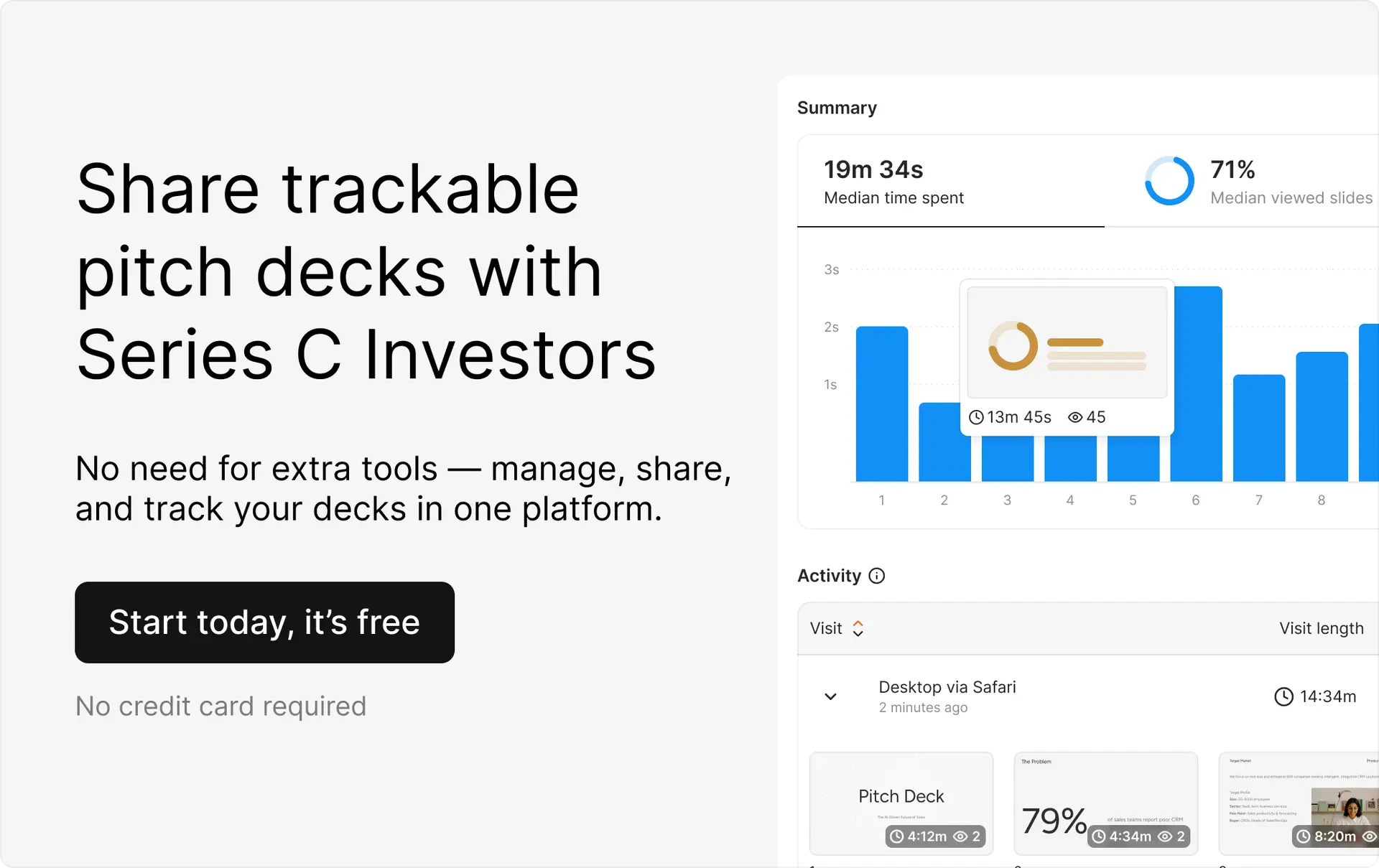
Communication: Use Ellty to share your deck with trackable links. You'll see who actually opens your cohort analysis versus just the executive summary. Series C investors spend more time on unit economics and competitive positioning than earlier-stage VCs - if they skip those slides, they're not serious.
Value beyond money: Series C investors promise board support, recruiting help, and strategic introductions. Check their last 10 portfolio companies and ask founders what partners actually delivered. Most will tell you if the "value-add" claims were real or just pitch deck material.
How to approach Series C investors
Research stage fit: Look for firms that write $50M+ checks and have taken companies from Series C to exit or IPO. Series C investors won't back companies with <$20M ARR or unclear path to $100M revenue within 24 months. Your burn multiple should be under 2x and improving.
Build your narrative: Your story is about market leadership and scaling to $100M+ revenue. Series C investors don't care about your product vision - they want proof you can scale efficiently. Show net revenue retention above 110% and improving unit economics quarter over quarter.
Share your pitch deck: Upload to Ellty and send trackable links. Monitor which pages investors spend time on - Series C investors care about your sales efficiency metrics and competitive moat more than total addressable market. If they skip your go-to-market execution slides, they're not doing real diligence.
Get warm introductions: Series C investors take meetings through portfolio founders, board members, or earlier-stage investors. Your Series A and B leads should make introductions. Direct outreach has <3% response rate at this stage unless you have exceptional traction.
Target the right partners: Find partners who've led 5+ Series C rounds in your category within the last 3 years. Associate-level contacts can't approve $75M checks. Email senior partners directly through warm introductions from your existing investors or board members.
Time your outreach: Start conversations 4-6 months before you need capital. Series C investors want to see 2-3 quarters of consistent performance before committing. Don't start fundraising with <9 months runway - it signals poor planning and weakens your negotiating position.
Prepare your data room: Set up an Ellty data room with 24-36 months of financials, detailed cohort analysis, and your last 6 board decks before first meetings. Series C investors will request access within 48 hours of a good initial conversation. Missing documents slow momentum and create doubt about your operational discipline.
Structure initial conversations: Lead with your path to $100M revenue and timeline to profitability or next funding milestone. Series C investors have seen your competitive landscape. Focus on what makes your unit economics defensible and why you'll win the category, not why the market is large.
Why Series C funding matters in 2026
Series C rounds in 2026 average $60M-$80M, down from $100M+ averages in 2021 but up from 2023 lows. Most growth-stage companies are raising at flat or slight up-rounds compared to Series B. Investors focus on path to profitability rather than pure growth metrics.
The IPO window is opening slowly but companies need 18-24 months of preparation and clean financials to go public. Series C capital extends runway to reach profitability or scale to IPO-ready revenue levels. Investors now expect Rule of 40 performance - revenue growth rate plus profit margin above 40% - or clear path to get there within 12-18 months.


15 top Series C investors
1. Insight Partners
Insight Partners leads Series C rounds for enterprise software companies with proven revenue models and high net retention. They've invested in 600+ companies and taken 55+ portfolio companies public.
- Recent Deals: Veeam $500M Series C (June 2025), Armis $300M Series C (September 2025), Recorded Future $250M Series C (December 2025)
- LinkedIn: Jeff Horing, Deven Parekh
- Check Size: $30M-$150M
- Stage Focus: Series C, Series D, growth equity
- Location: New York, USA
- Website: insightpartners.com
2. Accel
Accel backs Series C companies with strong product-market fit and expanding into new markets. They focus on enterprise SaaS, developer tools, and infrastructure software with predictable revenue.
- Recent Deals: Webflow $120M Series C at $4B (March 2026), UiPath $200M Series C participation (July 2025), Segment $100M Series C (October 2025)
- LinkedIn: Sameer Gandhi, Ryan Sweeney
- Check Size: $30M-$125M
- Stage Focus: Series B-C, growth equity
- Location: Palo Alto, USA
- Website: accel.com
3. General Catalyst
General Catalyst leads growth rounds for enterprise and consumer companies with strong retention metrics. They reserve significant capital for follow-on rounds through IPO.
- Recent Deals: Attentive $85M Series C (November 2025), Livongo $150M Series C participation (May 2025), Samsara $175M Series C (August 2025)
- LinkedIn: Hemant Taneja, Deep Nishar
- Check Size: $40M-$200M
- Stage Focus: Series C-D, growth equity
- Location: Cambridge, USA
- Website: generalcatalyst.com
4. Tiger Global
Tiger Global writes large checks for category leaders with exceptional growth metrics. They move quickly on deals and focus on companies with clear competitive advantages and strong founder-market fit.
- Recent Deals: Brex $300M Series C extension at $12.3B (June 2025), Chime $250M Series C participation (September 2025), Checkout.com $200M Series C (December 2025)
- LinkedIn: Scott Shleifer, John Curtius
- Check Size: $50M-$300M
- Stage Focus: Series C-D, late-stage growth
- Location: New York, USA
- Website: tigerglobal.com
5. Lightspeed Venture Partners
Lightspeed backs Series C companies expanding internationally or launching new product lines. They focus on enterprise software, consumer platforms, and healthcare technology with strong network effects.
- Recent Deals: Notion $80M Series C (May 2025), Affirm $140M Series C participation (August 2025), Faire $95M Series C (November 2025)
- LinkedIn: Ravi Mhatre, Gaurav Gupta
- Check Size: $35M-$150M
- Stage Focus: Series B-C, growth equity
- Location: Menlo Park, USA
- Website: lsvp.com
6. Index Ventures
Index Ventures leads Series C rounds for European and US companies with international expansion potential. They focus on enterprise infrastructure, cybersecurity, and fintech with strong product differentiation.
- Recent Deals: Cato Networks $75M Series C (February 2026), Revolut $180M Series C participation (July 2025), Discord $130M Series C (October 2025)
- LinkedIn: Danny Rimer, Shardul Shah
- Check Size: $40M-$180M
- Stage Focus: Series C-D, growth equity
- Location: London, UK / San Francisco, USA
- Website: indexventures.com
7. Bessemer Venture Partners
Bessemer backs Series C companies with proven business models and expanding market share. They focus on cloud software, developer tools, and vertical SaaS with high gross margins and strong retention.
- Recent Deals: Canva $60M Series C (August 2025), PagerDuty $90M Series C participation (May 2025), Toast $110M Series C (November 2025)
- LinkedIn: Byron Deeter, Kent Bennett
- Check Size: $30M-$120M
- Stage Focus: Series B-C, growth equity
- Location: Menlo Park, USA
- Website: bvp.com

8. IVP
IVP leads large Series C rounds for consumer and enterprise companies with strong growth trajectories. They focus on companies at inflection points and provide operational support for scaling.
- Recent Deals: Discord $110M Series C (December 2025), Coinbase $150M Series C participation (June 2025), Snap $200M Series C (September 2025)
- LinkedIn: Todd Chaffee, Jules Maltz
- Check Size: $50M-$200M
- Stage Focus: Series C-D, late-stage growth
- Location: Menlo Park, USA
- Website: ivp.com
9. GGV Capital
GGV Capital backs Series C companies with cross-border expansion potential between US and Asia. They focus on enterprise software, consumer platforms, and fintech with international market opportunity.
- Recent Deals: Figma $90M Series C (November 2025), Grab $165M Series C participation (July 2025), Airwallex $125M Series C (October 2025)
- LinkedIn: Hans Tung, Jenny Lee
- Check Size: $40M-$180M
- Stage Focus: Series C-D, cross-border growth
- Location: Menlo Park, USA / Shanghai, China
- Website: ggvc.com
10. Sequoia Capital
Sequoia backs portfolio companies from seed through late-stage and writes large Series C checks for category leaders. They focus on companies with strong network effects and defensible competitive positions.
- Recent Deals: Stripe $200M Series C extension (February 2026), ServiceTitan $185M Series C (August 2025), Deel $150M Series C (November 2025)
- LinkedIn: Roelof Botha, Alfred Lin
- Check Size: $50M-$250M
- Stage Focus: Series C-D, growth equity
- Location: Menlo Park, USA
- Website: sequoiacap.com
11. Andreessen Horowitz
Andreessen Horowitz leads Series C rounds for enterprise software and fintech companies with expanding product portfolios. They provide extensive operational resources and help companies prepare for late-stage growth.
- Recent Deals: Rippling $95M Series C (May 2025), Databricks $220M Series C participation (September 2025), OpenSea $175M Series C (December 2025)
- LinkedIn: Ben Horowitz, Marc Andreessen
- Check Size: $40M-$250M
- Stage Focus: Series C-D, growth equity
- Location: Menlo Park, USA
- Website: a16z.com
12. Battery Ventures
Battery Ventures backs Series C companies in infrastructure software, cybersecurity, and developer tools. They focus on companies with strong gross margins and efficient go-to-market strategies.
- Recent Deals: Snyk $70M Series C (June 2025), Amplitude $105M Series C participation (September 2025), Netlify $85M Series C (December 2025)
- LinkedIn: Neeraj Agrawal, Dharmesh Thakker
- Check Size: $30M-$120M
- Stage Focus: Series B-C, growth equity
- Location: Boston, USA
- Website: battery.com
13. Coatue
Coatue leads large Series C rounds for consumer and enterprise technology companies scaling rapidly. They invest across public and private markets and help portfolio companies prepare for eventual IPO.
- Recent Deals: Instacart $85M Series C (August 2025), Chime $190M Series C participation (May 2025), DoorDash $160M Series C (November 2025)
- LinkedIn: Philippe Laffont, Thomas Laffont
- Check Size: $50M-$250M
- Stage Focus: Series C-D, late-stage growth
- Location: New York, USA
- Website: coatue.com
14. Redpoint Ventures
Redpoint Ventures backs Series C companies with strong product-market fit and expanding customer bases. They focus on enterprise software, fintech, and infrastructure with proven unit economics.
- Recent Deals: Airtable $100M Series C (October 2025), Twilio $145M Series C participation (June 2025), Looker $95M Series C (September 2025)
- LinkedIn: Tomasz Tunguz, Erica Brescia
- Check Size: $35M-$150M
- Stage Focus: Series B-C, growth equity
- Location: Menlo Park, USA
- Website: redpoint.com
15. NEA
NEA leads Series C rounds for healthcare technology, enterprise software, and consumer platforms. They're one of the largest venture firms with deep reserves for multi-round support through exit.
- Recent Deals: Plaid $125M Series C (March 2026), Robinhood $170M Series C participation (July 2025), Coursera $130M Series C (November 2025)
- LinkedIn: Scott Sandell, Tony Florence
- Check Size: $40M-$200M
- Stage Focus: Series C-D, growth equity
- Location: Menlo Park, USA
- Website: nea.com
Start tracking your Series C fundraise


These 15 Series C investors closed deals from 2025 to early 2026. Most will want to see 2-3 quarters of consistent revenue growth and improving unit economics before taking a meeting. Your burn multiple matters more than pure growth rate at this stage.
Upload your deck to Ellty and create unique links for each investor. Series C investors typically spend 6-10 minutes reviewing your deck initially. You'll see exactly which slides they view and whether they skip your competitive analysis or sales efficiency metrics. If they're not opening your cohort retention slides, they're not doing serious diligence.
When you get to detailed diligence, share an Ellty data room with 24-36 months of financials, customer concentration data, and your last 4-6 board decks. It's faster than email chains and you'll know when partners actually review your cap table or revenue cohorts.
Common questions
What revenue do I need for Series C?
Most Series C investors want $20M-$50M ARR with clear path to $100M revenue within 24 months. Some will consider $15M ARR if you're growing 100%+ annually with strong unit economics. Below $10M ARR you're still Series B stage.
How much dilution is normal at Series C?
Expect 15-25% dilution depending on your valuation and growth trajectory. Companies with strong net retention and improving margins get better terms. If you're raising at a down round, dilution can hit 30% or more.
Can my Series B investors lead my Series C?
Some Series B funds have enough capital to lead your Series C but most will participate with 30-50% of the round. You typically need a new lead investor with deeper pockets. Your earlier investors should help with introductions to growth equity firms.
What's a typical Series C valuation in 2026?
Valuations dropped 30-50% from 2021 peaks. Most Series C rounds price at 12-20x ARR for high-growth SaaS companies. Strong unit economics and path to profitability get you closer to 20x. Negative margins and slowing growth push you toward 8-12x.
How many Series C investors should I pitch?
Talk to 8-12 firms simultaneously to create competitive tension and get term sheets within similar timeframes. Pitching too many (20+) signals desperation. Too few (3-4) limits your options and weakens negotiating position.
Should I raise Series C or focus on profitability?
If you can reach profitability with current runway and maintain 40%+ growth, that's often better than raising. Series C makes sense if you need capital to capture market share before competitors or expand into new markets that require upfront investment. Talk to your board about the trade-offs.