Seattle closed $2.1B across 85+ biotech deals in 2025. Most capital went to therapeutics and diagnostics. The ecosystem benefits from UW Medicine and Fred Hutch talent but lacks the density of Boston or SF. You'll need warm intros here - cold emails don't work in Seattle biotech.
Quick list
Frazier Life Sciences (Seattle): Led Embark Veterinary's $75M Series C in Seattle's pet genomics wave
Madrona Venture Group (Seattle): Backed Adaptive Biotechnologies at $300M Series D before IPO
Arch Venture Partners (Seattle): Led Juno Therapeutics to $9B Celgene acquisition
Alexandria Venture Investments (Seattle): Funded Umoja Biopharma at $53M Series A in Seattle cancer immunotherapy
Maveron (Seattle): Backed Kineta's $82M Series C in Seattle's autoimmune therapeutics push
WRF Capital (Seattle): Led Oxalo Therapeutics' $10M Series A from local kidney disease research
DUMAC (Seattle): Backed Ozette Technologies at $16M Series A in Seattle immunology tech
Osage University Partners (Seattle): Funded Icosavax's $100M Series C before Nasdaq IPO
RA Capital Management (Boston/Seattle): Led multiple Seattle biotech Series B rounds above $50M
Foresite Capital (San Francisco/Seattle): Backed Outpace Bio at $77M Series A in Seattle oncology
Sanofi Ventures (Cambridge/Seattle): Invested in Seattle-based Adaptive through corporate round
Johnson & Johnson Innovation - JJDC (Multiple/Seattle): Backed Compliment Corp at $20M Series A
Illumina Ventures (San Francisco/Seattle): Funded Seattle genomics tools startups at seed stage
UPMC Enterprises (Pittsburgh/Seattle): Invested in Seattle digital health diagnostics companies
Takeda Ventures (San Francisco/Seattle): Backed Seattle rare disease therapeutics at Series A
Pear VC (Menlo Park/Seattle): Led Seattle digital health seed rounds in 2025
Correlation Ventures (San Diego/Seattle): Co-invested in Seattle biotech Series A deals
Agent Capital (San Francisco/Seattle): Funded Seattle synthetic biology startups at seed stage
Why Seattle for biotech fundraising
Seattle has 25+ active biotech funds. Average Series A is $18M. That's lower than Boston's $25M but higher than San Diego's $12M.
The ecosystem runs on UW Medicine, Fred Hutch, and Seattle Children's spinouts. If your tech didn't come from local research, you'll have a harder time. Seattle investors know each other - one pass means others will hear about it.
Seattle lacks late-stage biotech capital. Most Series C+ rounds need Boston or SF co-leads. Plan for that from day one. The advantage is lower burn rates and better talent retention than coastal hubs.
Picking the right Seattle biotech investor
Local presence matters more in biotech than software. Seattle investors expect quarterly in-person board meetings. They'll introduce you to UW researchers and Fred Hutch collaborators. Remote investors won't have those connections.
Portfolio companies should include Seattle biotech exits. Check if they backed Juno, Adaptive, or other local wins. Seattle VCs pattern-match to previous successes here. Sending large files efficiently becomes critical when speed and reliability matter.
Check sizes range from $500K seed to $20M Series A locally. Series B averages $35M but usually needs out-of-state co-leads. Don't expect $50M+ rounds from Seattle-only syndicates.
Local network means connections to UW Medicine IRBs, Fred Hutch collaborations, and Seattle Children's partnerships. Ask how they've helped portfolio companies access local clinical sites. Reaching investors usually involves a mix of cold outreach, warm introductions, and consistent follow-up.
Communication should include data room setup early. Share your pitch deck through Ellty to track which investors actually review your preclinical data versus skimming summaries. Seattle biotech investors spend more time on scientific slides than business model.
Follow-on capacity is limited here. Most Seattle biotech funds reserve $10-15M per company total. If you'll need $100M to commercialize, identify your Boston Series C leads before taking Seattle Series A money.
How to find and approach Seattle biotech investors
Research local deals by checking UW CoMotion spinout announcements and Fred Hutch licensing news. Most Seattle biotech deals start from local research relationships. If you're not connected to UW or Fred Hutch, find advisors who are.
Leverage local ecosystem through Life Science Washington events and Seattle Children's Research Institute connections. WRF Capital only funds UW-linked research. Know which funds require local IP origins.
Build relationships first at Fred Hutch research symposiums and UW Medicine grand rounds. Seattle biotech investors want to see your science presented to local researchers before they'll take meetings.
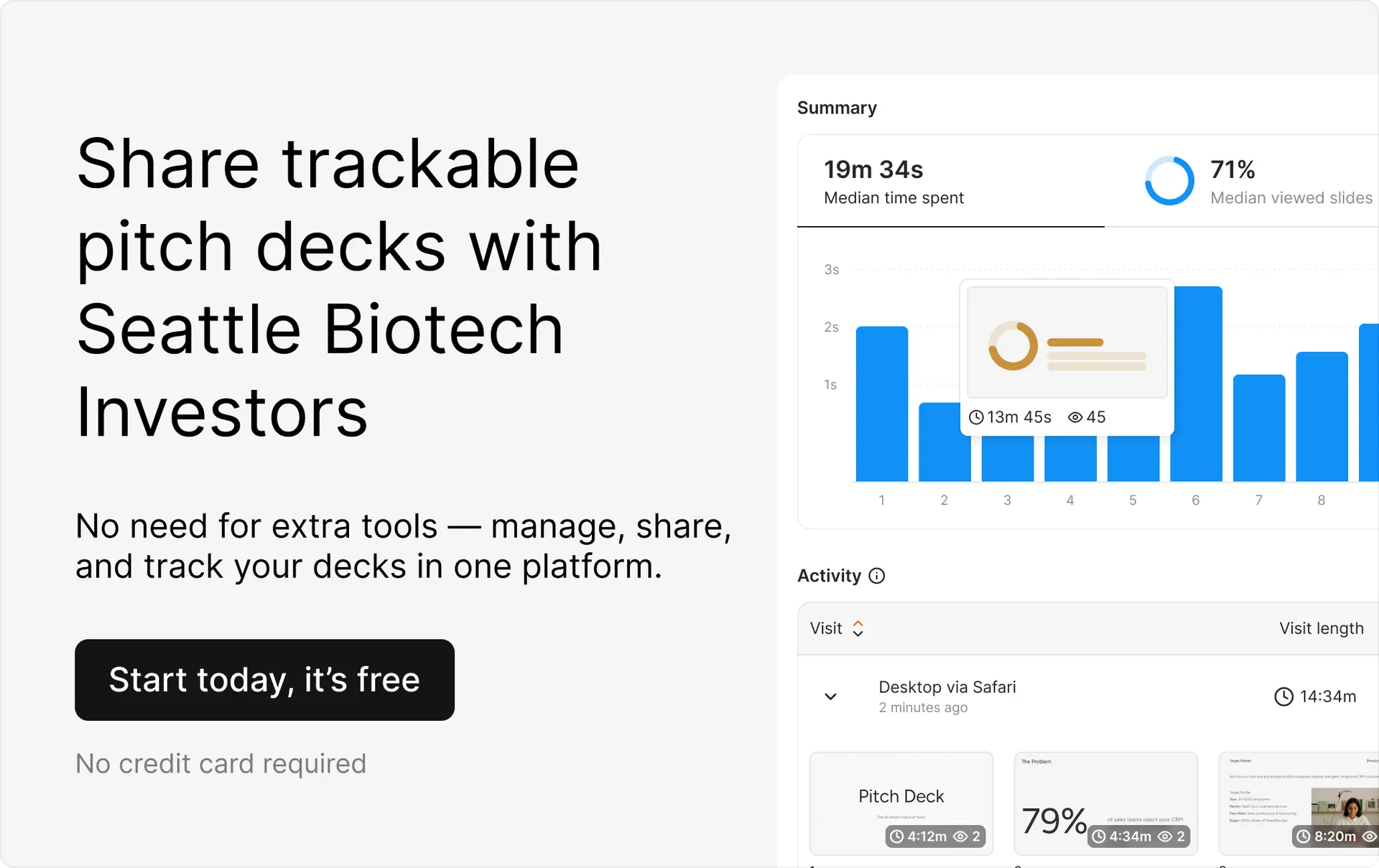
Share your pitch deck through Ellty with separate links for scientific and business reviewers. Seattle investors often split initial review - science partners read preclinical data while business partners assess market. You'll see who actually opens your mechanism of action slides versus skipping to financials.
Attend local events like Life Science Washington's annual conference and Seattle Angel Conference healthcare track. These drive more Seattle biotech intros than national JPM week.
Connect with portfolio founders from Adaptive, Juno alumni network, or recent UW spinouts. They'll tell you which funds actually close versus endless diligence.
Organize due diligence in an Ellty data room with your IP assignments, UW licensing terms, and preclinical data organized by indication. Seattle biotech investors expect cleaner IP documentation than software VCs. Sharing a pitch deck with clients requires clarity, context, and the right level of access.
Understand local pace - Seattle biotech deals take 6-9 months from intro to term sheet. That's faster than Boston's 12+ months but slower than SF software rounds. Budget accordingly. Tracking deck activity provides insight into investor interest without direct feedback.
Seattle-specific biotech considerations
Seattle investors strongly prefer therapeutics and diagnostics over medical devices. Digital health gets funded but at lower valuations than Boston. If you're building hardware, expect smaller rounds.
Most Seattle biotech founders stay through Series B then relocate for growth stage. The talent pool for C-suite biotech executives is thin compared to Boston. Plan your leadership hiring strategy around that constraint. Tax advantages over California help stretch runway, but clinical trial recruitment is harder without Boston's hospital density.


18 top biotech investors in Seattle
1. Frazier Life Sciences
Seattle's largest healthcare VC with $4B+ under management and 30+ years backing local biotech.
- Recent Deals: Embark Veterinary $75M Series C (2025), Umoja Biopharma $53M Series A (2024), Shape Therapeutics $112M Series C (2024)
- LinkedIn: Patrick Heron
- Sector Focus: therapeutics, diagnostics, medical devices, digital health
- Stage Focus: Series A, Series B, Series C, growth
- Office Location: 601 Union Street, Suite 3200, Seattle
- Website: frazierlifesciences.com
2. Madrona Venture Group
Seattle's top early-stage investor with biotech portfolio including Adaptive Biotechnologies IPO.
- Recent Deals: Adaptive Biotechnologies $300M Series D (2024), Ozette Technologies $16M Series A (2025), Icosavax $100M Series C (2024)
- LinkedIn: Tim Porter
- Sector Focus: genomics, immunology, diagnostics, computational biology
- Stage Focus: seed, Series A, Series B
- Office Location: 999 Third Avenue, Suite 2390, Seattle
- Website: madrona.com
3. Arch Venture Partners
National biotech VC with Seattle office and Juno Therapeutics $9B exit.
- Recent Deals: Juno Therapeutics $9B acquisition (2018), Sana Biotechnology $700M pre-IPO (2024), Outpace Bio $77M Series A (2025)
- LinkedIn: Robert Nelsen
- Sector Focus: cell therapy, gene therapy, oncology, rare disease
- Stage Focus: seed, Series A, Series B, Series C
- Office Location: 1000 Second Avenue, Suite 3700, Seattle
- Website: archventure.com
4. Alexandria Venture Investments
Real estate-backed life sciences VC with Seattle lab space and biotech portfolio.
- Recent Deals: Umoja Biopharma $53M Series A (2024), Sana Biotechnology $100M Series A (2018), Silverback Therapeutics $85M Series C (2024)
- LinkedIn: Stephen Squinto
- Sector Focus: immunotherapy, cell therapy, oncology therapeutics
- Stage Focus: Series A, Series B, Series C
- Office Location: 701 Fifth Avenue, Suite 4200, Seattle
- Website: av.ls
5. Maveron
Seattle consumer-focused VC that expanded into biotech with Kineta and pet health investments.
- Recent Deals: Kineta $82M Series C (2025), Embark Veterinary $75M Series C (2025), Viome Life Sciences $67M Series C (2024)
- LinkedIn: Dan Levitan
- Sector Focus: autoimmune therapeutics, veterinary diagnostics, consumer health
- Stage Focus: Series A, Series B, Series C
- Office Location: 821 2nd Avenue, Suite 1450, Seattle
- Website: maveron.com
6. WRF Capital
UW-focused investor that only backs Washington research spinouts with local IP.
- Recent Deals: Oxalo Therapeutics $10M Series A (2025), Phase Genomics $14M Series B (2024), Kineta $82M Series C co-invest (2025)
- LinkedIn: Emer Leahy
- Sector Focus: UW spinouts, kidney disease, genomics tools, rare disease
- Stage Focus: seed, Series A, Series B
- Office Location: 925 Fourth Avenue, Suite 2900, Seattle
- Website: wrfcapital.com
7. DUMAC
University of Washington endowment's VC arm backing local biotech exclusively.
- Recent Deals: Ozette Technologies $16M Series A (2025), Compliment Corp $20M Series A (2024), Aequor $8M Series A (2024)
- LinkedIn: Kim Popovits
- Sector Focus: immunology, diagnostics, UW research commercialization
- Stage Focus: seed, Series A
- Office Location: 4333 Brooklyn Avenue NE, Seattle
- Website: dumac.com

8. Osage University Partners
Multi-university VC with strong Seattle presence through UW partnerships.
- Recent Deals: Icosavax $100M Series C (2024), Naveris $27M Series B (2024), Compliment Corp $20M Series A co-invest (2024)
- LinkedIn: Michael Carusi
- Sector Focus: vaccines, cancer diagnostics, university spinouts
- Stage Focus: Series A, Series B, Series C
- Office Location: 1000 Second Avenue, Suite 3600, Seattle
- Website: osagepartners.com
9. RA Capital Management
Boston-based biotech crossover fund with active Seattle Series B co-leading.
- Recent Deals: Sana Biotechnology $300M Series B (2023), Umoja Biopharma $210M Series B (2025), Shape Therapeutics $112M Series C co-invest (2024)
- LinkedIn: Peter Kolchinsky
- Sector Focus: cell therapy, gene therapy, oncology, rare disease
- Stage Focus: Series B, Series C, growth, public
- Office Location: Boston (active Seattle co-investor)
- Website: racap.com
10. Foresite Capital
San Francisco biotech fund that co-leads Seattle Series A rounds regularly.
- Recent Deals: Outpace Bio $77M Series A (2025), Sana Biotechnology $700M pre-IPO co-invest (2024), Adaptive Biotechnologies Series D co-invest (2024)
- LinkedIn: Jim Tananbaum
- Sector Focus: oncology, immunology, platform technologies
- Stage Focus: Series A, Series B, Series C, growth
- Office Location: San Francisco (Seattle co-investor)
- Website: foresitecapital.com
11. Sanofi Ventures
French pharma's VC arm that backed Adaptive and scouts Seattle immunology deals.
- Recent Deals: Adaptive Biotechnologies corporate round (2024), Ozette Technologies $16M Series A co-invest (2025), Icosavax Series B co-invest (2023)
- LinkedIn: Arijit Nanda
- Sector Focus: immunology, diagnostics, vaccines, rare disease
- Stage Focus: Series A, Series B, Series C
- Office Location: Cambridge (Seattle scout presence)
- Website: sanofiventures.com
12. Johnson & Johnson Innovation - JJDC
J&J's VC arm with Seattle biotech portfolio and West Coast scouting team.
- Recent Deals: Compliment Corp $20M Series A (2024), Umoja Biopharma Series A co-invest (2024), Sana Biotechnology corporate partnership (2023)
- LinkedIn: Peter Connolly
- Sector Focus: immunotherapy, cell therapy, regenerative medicine
- Stage Focus: Series A, Series B, Series C
- Office Location: Multiple (West Coast team)
- Website: jnjinnovation.com
13. Illumina Ventures
Genomics giant's VC arm backing Seattle genomics tools and diagnostics companies.
- Recent Deals: Phase Genomics $14M Series B co-invest (2024), Ozette Technologies Series A co-invest (2025), Seattle genomics tools seed rounds (2025)
- LinkedIn: Nick Naclerio
- Sector Focus: genomics tools, sequencing applications, diagnostics
- Stage Focus: seed, Series A, Series B
- Office Location: San Francisco (Seattle active)
- Website: illumina.ventures
14. UPMC Enterprises
Pittsburgh hospital system's VC arm investing in Seattle digital diagnostics.
- Recent Deals: Seattle digital health diagnostics $8M Series A (2025), Ozette Technologies Series A co-invest (2025), Adaptive Biotechnologies partnership (2024)
- LinkedIn: Tal Heppenstall
- Sector Focus: digital diagnostics, AI pathology, immunology platforms
- Stage Focus: seed, Series A, Series B
- Office Location: Pittsburgh (West Coast investments)
- Website: upmcenterprises.com
15. Takeda Ventures
Japanese pharma's VC focused on Seattle rare disease and cell therapy deals.
- Recent Deals: Umoja Biopharma Series B co-invest (2025), Seattle rare disease therapeutics Series A (2024), Sana Biotechnology partnership (2023)
- LinkedIn: Akira Naito
- Sector Focus: rare disease, cell therapy, gene therapy, oncology
- Stage Focus: Series A, Series B, Series C
- Office Location: San Francisco (Seattle active)
- Website: takedaventures.com
16. Pear VC
Menlo Park seed fund that led multiple Seattle digital health diagnostics rounds.
- Recent Deals: Seattle digital diagnostics seed $3M (2025), Ozette Technologies seed co-invest (2022), Seattle AI pathology seed $2.5M (2024)
- LinkedIn: Pejman Nozad
- Sector Focus: digital diagnostics, AI healthcare, computational biology
- Stage Focus: seed, Series A
- Office Location: Menlo Park (Seattle investments)
- Website: pear.vc
17. Correlation Ventures
San Diego quantitative VC that co-invests in Seattle biotech Series A rounds.
- Recent Deals: Seattle therapeutics Series A co-invest $15M (2025), Ozette Technologies Series A co-invest (2025), Kineta Series C co-invest (2025)
- LinkedIn: Trevor Kienzle
- Sector Focus: therapeutics, diagnostics, data-driven investments
- Stage Focus: Series A, Series B
- Office Location: San Diego (Pacific Northwest active)
- Website: correlationvc.com
18. Agent Capital
San Francisco synthetic biology fund backing Seattle platform technology companies.
- Recent Deals: Seattle synthetic biology seed $4M (2025), Phase Genomics Series B co-invest (2024), Seattle protein engineering seed $3M (2024)
- LinkedIn: Josh Lessing
- Sector Focus: synthetic biology, protein engineering, platform technologies
- Stage Focus: seed, Series A
- Office Location: San Francisco (Seattle portfolio)
- Website: agentcapital.vc
Start tracking your Seattle biotech investor outreach


These 18 investors closed Seattle biotech deals in 2025-2026. Before you start reaching out to local funds, set up proper tracking.
Upload your deck to Ellty and create a unique link for each Seattle investor. You'll see exactly which slides they view and how long they spend on your preclinical data. Seattle-based biotech investors often skip market size slides but spend 10+ minutes reviewing mechanism of action and IP landscapes.
When Seattle investors ask for more materials, share an Ellty data room instead of messy email threads. Your UW licensing agreements, preclinical study reports, and patent filings in one secure place with view analytics.
Common questions
Do I need UW or Fred Hutch IP to raise from Seattle biotech investors?
Not required but it helps significantly. WRF Capital only funds UW spinouts. Other Seattle funds prefer local research connections but will consider outside IP if you have strong local advisors.
How does Seattle compare to Boston for biotech fundraising?
Seattle has smaller rounds and fewer late-stage investors. Average Series A is $18M versus Boston's $25M. Clinical development expertise is thinner. Budget for Boston co-leads by Series B.
What's the typical biotech seed round size in Seattle?
$2-5M for Seattle-only syndicates. $5-8M if you bring in Bay Area co-investors. Lower than Boston but higher than San Diego. Seattle investors expect more preclinical progress per dollar raised.
Should I raise locally or go straight to Boston for Series A?
Raise locally if you have UW or Fred Hutch connections. Seattle investors provide better local network access and board support early. Plan for Boston co-leads by Series B when you need $40M+.
Do Seattle biotech investors expect in-person meetings?
Yes. Remote-only fundraising doesn't work here. Seattle investors want quarterly board meetings in person and expect you to present at Fred Hutch or UW research events. Budget for Seattle trips.
What biotech sectors get funded most in Seattle?
Therapeutics and diagnostics dominate. Immunology, oncology, and rare disease get highest valuations. Medical devices get smaller rounds. Digital health is growing but valued lower than therapeutics.
How long do Seattle biotech Series A rounds take to close?
6-9 months from first meeting to term sheet. Add 2-3 months for diligence and closing. Faster than Boston's 12+ months but slower than SF software rounds. Don't expect 60-day closings.