San Diego's the third-largest biotech cluster in the US. The region raised $4.8B across 180+ biotech deals in 2025. Most capital went to therapeutics and diagnostics, with medtech getting consistent seed funding. The ecosystem runs on relationships built through JLABS, Scripps Research connections, and years of shared lab space. You won't get Series A here without clinical data or a compelling preclinical package. San Diego investors expect more scientific rigor than SF and more realistic timelines than Boston.
Quick list
Alexandria Venture Investments (San Diego): Led Erasca's $200M Series C for precision oncology in their own UTC building
Sofinnova Partners (La Jolla): Backed Outpace Bio's $128M Series B in rare disease gene therapy last year
Avalon Ventures (La Jolla): Seeded Turn Bio at $65M for cellular reprogramming platform
Arch Venture Partners (San Diego): Co-led Synthorx $100M Series B before Sanofi acquisition
RA Capital Management (La Jolla office): Backed Boundless Bio's $127M Series B for cancer therapeutics
5AM Ventures (San Diego): Led Tango Therapeutics $55M Series A in DNA damage response
Versant Ventures (San Diego): Co-founded Beam Therapeutics, now worth $1.4B
Correlation Ventures (San Diego): Backed GenMark's diagnostic platform before Roche acquisition
Sanderling Ventures (San Diego): Led Heron Therapeutics financing, now publicly traded
Novartis Venture Fund (San Diego): Invested in Lyell Immunopharma's $75M round
Johnson & Johnson Innovation (JLABS San Diego): Backed 12 JLABS companies in 2025
Merck Global Health Innovation Fund (San Diego presence): Portfolio includes three local medtech companies
Section 32 (San Diego): Backed Turning Point Therapeutics before $4.1B Bristol Myers acquisition
Deerfield Management (San Diego office): Led Arena Pharmaceuticals financing pre-Pfizer deal
Illumina Ventures (San Diego): Three genomics investments locally in 2025
Takeda Ventures (San Diego): Backed Gossamer Bio at $230M Series D
Foresite Capital (La Jolla): Led multiple oncology platforms in Torrey Pines corridor
Osage University Partners (San Diego focus): Invested in eight UCSD spinouts since 2024
Why San Diego beats Boston for early-stage biotech
San Diego closed 180 biotech deals in 2025 worth $4.8B total. Average seed round is $8M, Series A is $35M. That's lower than Boston's $12M and $55M but higher than SF's biotech averages. The region has 1,400+ life sciences companies and adds 60-80 new biotech startups yearly.
Three things make San Diego different. First, lower burn rates - lab space costs 40% less than Cambridge and talent accepts 20-30% lower comp. Second, clinical expertise is local through Scripps Health, UCSD Medical Center, and Regen Med. Third, nearly every major pharma runs discovery or development here.
The downside is late-stage capital. Most Series B+ rounds need East Coast or European biotech venture capitals. San Diego has deep seed and Series A pools but thins out at $75M+ rounds. Plan to pitch Sofinnova's Boston office or RA Capital's main fund when you hit proof of concept.
Picking the right San Diego biotech investor
Local presence matters more in biotech than software. San Diego investors know which CROs actually deliver, which UCSD labs produce commercial science, and which Scripps professors will join SABs. Funds in UTC, Torrey Pines, or La Jolla can intro you to pharma BD teams at the same building coffee shop.
Portfolio companies tell you what they actually fund. Check if they back therapeutics vs. diagnostics vs. devices. Alexandria only funds companies that'll lease their real estate. Arch wants platform science. 5AM prefers single-asset programs with clear endpoints. Don't pitch a diagnostic to a fund that only does small molecules.
Check sizes range from $500K lab-enabling seed to $8M Series A standard. San Diego seed rounds typically need $3-5M to hit Series A milestones. If you're doing cell therapy or gene editing, expect $12-18M Series A. Platform companies raising $25M+ usually need crossover funds.
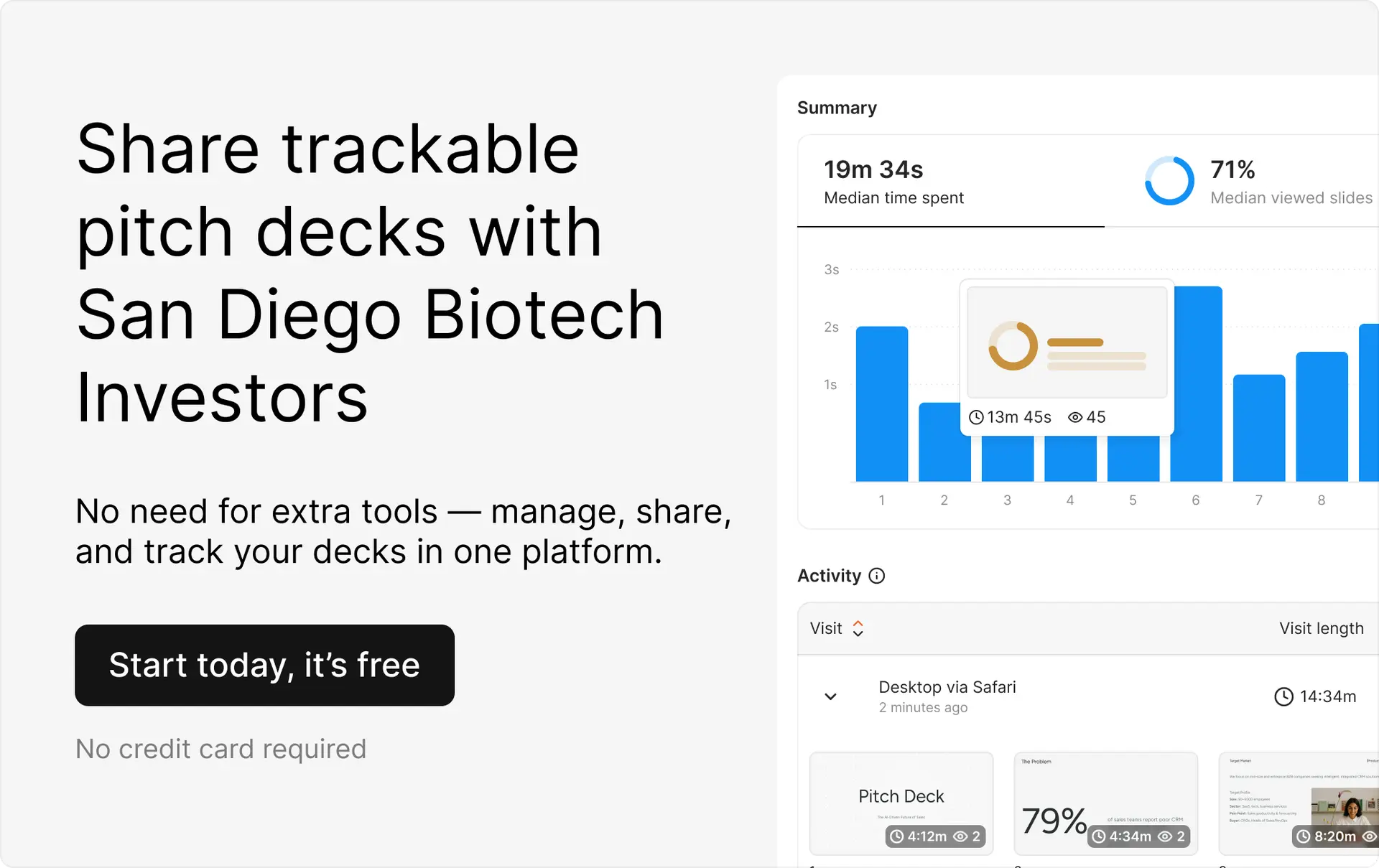
Scientific networks drive deals here. Investors often source through Scripps Research, Salk Institute, Sanford Burnham, or UCSD labs. They want SAB members they know. They'll ask which CRO you're using and actually call them. Use Ellty to share your deck with trackable links - you'll see which investors spend time on your preclinical data vs. skipping to team slides.
Clinical development support varies widely. Some funds just write checks. Others like RA Capital and Sofinnova actively manage trial design and regulatory strategy. Ask portfolio founders how much their investor actually helped with FDA or trial execution. Most won't tell you this until they trust you.
Follow-on capacity is critical in biotech. Your Series A investor needs $20-40M for Series B or strong syndicate relationships. Check if they co-invest with Arch, Versant, or Foresite. Those relationships determine if you raise your next round locally or move to Boston.
How to find and approach San Diego biotech investors
Research local deals through Fierce Biotech San Diego, San Diego Business Journal life sciences coverage, and BioSpace funding announcements. Most San Diego biotech deals get announced in these outlets. Check which funds co-invest together - those relationships matter for syndication.
Leverage JLABS and incubators if you're early. JLABS San Diego, Janssen's incubator at UTC, gets you in front of J&J Innovation and their LP network. EvoNexus biotech track connects to local angels. UC San Diego's von Liebig Center for Entrepreneurism links to university investor networks. These programs matter more here than pitch competitions.
Build relationships through Scripps and institutes before you need money. Most San Diego biotech investors source deals through Scripps Research, Salk, Sanford Burnham, and UCSD collaborations. Attend their symposiums. They're not networking events but investors attend and notice who presents solid science.
Share your pitch deck through Ellty with unique links for each investor. San Diego biotech investors typically take 2-3 weeks to review decks initially. They'll share internally with scientific advisors. You'll see exactly which slides get attention. Most spend significant time on mechanism of action and competitive landscape.
Attend BIO International when it's in San Diego and the local JPM week events in January. Real partnering happens at these conferences. Skip the Biocom mixers unless you're looking for service providers. Funds do deals at partnering tables, not cocktail events. To maintain command over your content’s distribution, implement measures that curb unauthorized PDF forwarding.
Connect with portfolio founders who've raised from your target funds. San Diego biotech is small enough that two intros get you to anyone. Check LinkedIn for which founders are actually in San Diego vs. those who just listed the fund's San Diego office. Talk to them about scientific diligence depth and timeline expectations.
Organize due diligence early with an Ellty data room. Include your lab notebooks, provisional patents, CRO contracts, and founder IP assignments before first meetings. San Diego biotech investors will ask for this immediately after partner meetings. They move faster than Boston once they decide but slower than SF software investors.
Understand the 90-day cycle typical here. First meeting to term sheet usually takes 60-90 days in San Diego biotech. That includes scientific diligence, competitive landscape review, KOL calls, and partnership discussions. It's faster than Boston's 120+ days but slower than software's 30-45 days. Budget accordingly.
San Diego biotech investors want proof, not potential
San Diego biotech investors prefer target validation and animal efficacy over just computational predictions. If you're pre-IND, expect deeper scientific diligence than SF and more realistic endpoint discussions than Boston. Median time to term sheet is 75 days here.
Competition is fierce in oncology and rare disease but lighter in diagnostics and medical devices. Most funds see 400+ biotech decks yearly and fund 2-4. The winnowing happens at scientific diligence, not partner meetings. If you pass science review, your odds jump to 30-40%.
San Diego investors prefer local companies but will fund remote if the science is exceptional. About 60% of funded companies relocate to San Diego within 12 months for lab access and talent. The region offers better early-stage support than late-stage, so plan your Series B strategy before raising Series A.


18 top biotech investors in San Diego
1. Alexandria Venture Investments
They invest in companies that become their real estate tenants, which creates alignment issues but also deep support.
- Recent Deals: Erasca $200M Series C (oncology, 2025), Boundless Bio $127M Series B (cancer therapeutics, 2024), Turning Point Therapeutics Series C pre-acquisition
- LinkedIn: Jill Howe
- Sector Focus: Oncology, rare disease, gene therapy, cell therapy
- Stage Focus: Series A, Series B, Series C
- Office Location: 10210 Campus Point Drive, San Diego (UTC area)
- Website: iav.com
2. Sofinnova Partners
European biotech fund with deep La Jolla presence and scientific diligence that actually improves your programs.
- Recent Deals: Outpace Bio $128M Series B (gene therapy, 2025), Boundless Bio Series B co-investor, Beam Therapeutics Series C
- LinkedIn: James Healy
- Sector Focus: Gene therapy, rare disease, precision medicine, immunology
- Stage Focus: Series A, Series B, Series C
- Office Location: 3206 Camino de la Costa, La Jolla
- Website: sofinnova.com
3. Avalon Ventures
They seed biotech platforms and take board seats early, expect hands-on involvement.
- Recent Deals: Turn Bio $65M founding round (cellular reprogramming, 2025), Beam Therapeutics founding investor, Gossamer Bio early investor
- LinkedIn: Jay Lichter
- Sector Focus: Platform biology, gene editing, cell therapy, novel modalities
- Stage Focus: Seed, Series A
- Office Location: 11975 El Camino Real, San Diego
- Website: avalonventures.com
4. Arch Venture Partners
Platform science specialists who want transformative biology, not incremental improvements.
- Recent Deals: Synthorx $100M Series B pre-acquisition (synthetic biology, 2024), Vividion Series B, Turning Point early investor
- LinkedIn: Robert Nelsen
- Sector Focus: Synthetic biology, protein engineering, gene therapy, platform technologies
- Stage Focus: Seed, Series A, Series B
- Office Location: 10300 Campus Point Drive, San Diego
- Website: archventure.com
5. RA Capital Management
Public-private crossover fund that leads large rounds and manages through clinical development.
- Recent Deals: Boundless Bio $127M Series B (cancer therapeutics, 2025), Lyell Immunopharma Series D, Revolution Medicines Series C
- LinkedIn: Peter Kolchinsky
- Sector Focus: Oncology, immunology, rare disease, precision medicine
- Stage Focus: Series A, Series B, Series C, growth
- Office Location: 11975 El Camino Real, La Jolla
- Website: racap.com
6. 5AM Ventures
Single-asset programs with clear clinical endpoints are their preference over platforms.
- Recent Deals: Tango Therapeutics $55M Series A (DNA damage response, 2024), Kinnate Biopharma Series B, Nurix Therapeutics Series C
- LinkedIn: Andrew Schwab
- Sector Focus: Oncology, targeted therapies, precision medicine
- Stage Focus: Seed, Series A, Series B
- Office Location: 10945 Vista Sorrento Parkway, San Diego
- Website: 5amventures.com
7. Versant Ventures
Company creation specialists who co-found with entrepreneurs and stay involved through exit.
- Recent Deals: Beam Therapeutics co-founder (base editing, now $1.4B market cap), Audentes Therapeutics pre-Astellas acquisition, CRISPR Therapeutics early investor
- LinkedIn: Brad Bolzon
- Sector Focus: Gene therapy, gene editing, cell therapy, novel modalities
- Stage Focus: Seed, Series A, Series B
- Office Location: 3655 Nobel Drive, San Diego
- Website: versantventures.com

8. Correlation Ventures
Data-driven biotech investing with fast decisions but expect multiple data packages.
- Recent Deals: GenMark Diagnostics Series D pre-Roche acquisition (molecular diagnostics, 2024), Biodesix Series C, Interpace Biosciences financing
- LinkedIn: Trevor Kienzle
- Sector Focus: Diagnostics, medical devices, digital health, precision medicine
- Stage Focus: Series A, Series B, Series C
- Office Location: 4747 Executive Drive, San Diego
- Website: correlationvc.com
9. Sanderling Ventures
Later-stage biotech specialists who can write $20-40M checks for clinical development.
- Recent Deals: Heron Therapeutics multiple rounds pre-IPO (pain management), Retrophin early financing, XOMA Series D
- LinkedIn: Fred Middleton
- Sector Focus: Clinical-stage therapeutics, specialty pharma, established platforms
- Stage Focus: Series B, Series C, growth
- Office Location: 7350 Girard Avenue, La Jolla
- Website: sanderling.com
10. Novartis Venture Fund
Corporate VC with partnership pathway but don't expect fast decisions.
- Recent Deals: Lyell Immunopharma $75M round (cell therapy, 2025), Gritstone bio Series C, Chinook Therapeutics Series B
- LinkedIn: Isaac Manke
- Sector Focus: Cell therapy, immunology, oncology, precision medicine
- Stage Focus: Series A, Series B, Series C
- Office Location: 4560 Horton Street, San Diego (through JLABS)
- Website: nvf.com
11. Johnson & Johnson Innovation - JLABS
Incubator model with investor access and potential partnering, no equity taken for lab space.
- Recent Deals: 12 JLABS San Diego companies funded in 2025 across therapeutics and devices, Crinetics Pharmaceuticals early support, Retrotope Series A support
- LinkedIn: Kara Bortone
- Sector Focus: All therapeutic areas, medical devices, diagnostics, digital health
- Stage Focus: Seed, Series A
- Office Location: 3210 Merryfield Row, San Diego (UTC)
- Website: jlabs.jnjinnovation.com
12. Merck Global Health Innovation Fund
Corporate VC focused on technology platforms that fit Merck's therapeutic areas.
- Recent Deals: Three San Diego medtech investments 2024-2025, Cue Health Series D, Hologic strategic investment
- LinkedIn: Bill Taranto
- Sector Focus: Diagnostics, medical devices, health tech, vaccines
- Stage Focus: Series A, Series B, growth
- Office Location: Access through JLABS San Diego
- Website: merckgif.com
13. Section 32
Bio-focused fund that finds companies pre-hype and sells into acquisition waves.
- Recent Deals: Turning Point Therapeutics Series B before $4.1B Bristol Myers acquisition (precision oncology, 2021 exit), Lyell Immunopharma Series C, Crinetics Series B
- LinkedIn: Bill Maris
- Sector Focus: Oncology, immunology, precision medicine, novel targets
- Stage Focus: Series A, Series B
- Office Location: 10300 Campus Point Drive, San Diego
- Website: section32.com
14. Deerfield Management
Structured financings and late-stage capital with partnership discussions built in.
- Recent Deals: Arena Pharmaceuticals multiple rounds pre-Pfizer $6.7B acquisition (immunology), Turning Point Series C co-investor, Gossamer Bio Series C
- LinkedIn: David J. Clark
- Sector Focus: Clinical-stage therapeutics, immunology, oncology, rare disease
- Stage Focus: Series B, Series C, growth, royalty financing
- Office Location: 10945 Vista Sorrento Parkway, San Diego
- Website: deerfieldmgmt.com
15. Illumina Ventures
Genomics-focused fund that invests in companies using or advancing sequencing technology.
- Recent Deals: Three San Diego genomics companies 2025, Singular Genomics Series C, Element Biosciences Series B
- LinkedIn: Nick Naclerio
- Sector Focus: Genomics, diagnostics, precision medicine, sequencing applications
- Stage Focus: Seed, Series A, Series B
- Office Location: 5200 Illumina Way, San Diego
- Website: illumina.ventures
16. Takeda Ventures
Japanese pharma VC with US deal flow and partnership potential.
- Recent Deals: Gossamer Bio $230M Series D (immunology, 2024), Lyell Immunopharma Series C co-investor, Chinook Therapeutics Series B
- LinkedIn: Stephen Rosenfield
- Sector Focus: Immunology, oncology, rare disease, gastroenterology
- Stage Focus: Series A, Series B, Series C
- Office Location: 10410 Science Center Drive, San Diego
- Website: takeda.com/ventures
17. Foresite Capital
Data-driven biotech investing with hands-on clinical development support.
- Recent Deals: Multiple Torrey Pines corridor oncology platforms 2024-2025, Pliant Therapeutics Series C, Revolution Medicines Series B
- LinkedIn: Jim Tananbaum
- Sector Focus: Oncology, immunology, precision medicine, AI-driven drug discovery
- Stage Focus: Series A, Series B, Series C
- Office Location: 11975 El Camino Real, La Jolla
- Website: foresitecapital.com
18. Osage University Partners
University spinout specialists with deep UCSD relationships and tech transfer expertise.
- Recent Deals: Eight UCSD spinouts since 2024 including diagnostics and therapeutics, Crinetics early investor, Retrotope Series A co-investor
- LinkedIn: Brian Halak
- Sector Focus: University spinouts, platform technologies, diagnostics, therapeutics
- Stage Focus: Seed, Series A
- Office Location: 9333 Genesee Avenue, San Diego (focus area)
- Website: osagepartners.com
Start tracking your San Diego biotech investor outreach


These 18 investors closed San Diego biotech deals worth $4.8B in 2025-2026. Before you start reaching out to La Jolla and Torrey Pines funds, set up proper tracking.
Upload your deck to Ellty and create a unique link for each San Diego investor. You'll see exactly which slides they view and how long they spend on your mechanism of action and competitive landscape. San Diego biotech investors typically skip market size slides but spend 5-10 minutes reviewing scientific data and team credentials. You'll know who's actually reading your preclinical package vs. who forwarded it to associates.
When investors ask for due diligence materials, share an Ellty data room instead of email attachments. Your lab notebooks, provisional patents, CRO contracts, and animal study reports in one secure place with view analytics. San Diego investors expect organized data rooms and will judge your operational capability by how you manage information.
Common questions
Do I need to relocate to San Diego to raise from San Diego biotech investors?
No for seed and Series A, but 60% of funded companies move here within 12 months for lab access and talent. If you're doing cell or gene therapy, you'll want San Diego CROs and infrastructure eventually.
How does San Diego compare to Boston for biotech fundraising?
San Diego has deeper seed and Series A capital with lower valuations and burn rates. Boston has more late-stage and crossover capital. Plan Series A in San Diego, Series B+ likely needs Boston or European biotech funds.
What's the average biotech Series A in San Diego?
$35M for therapeutics, $12-18M for diagnostics, $25-40M for gene or cell therapy. That's 30-40% lower than Boston but check sizes are larger than SF biotech rounds.
Should I raise locally or go straight to Boston investors?
Raise locally for seed and Series A. San Diego investors understand regional burn rates and have better local networks. Add Boston funds at Series B when you need $75M+ and clinical development expertise.
Do San Diego biotech investors expect in-person meetings?
Yes for partner meetings and scientific diligence. Video calls for initial screens are fine, but expect to fly out 2-3 times before term sheet. They want to see your lab setup and meet your team.
What gets funded most in San Diego biotech?
Oncology gets 40% of capital, rare disease 25%, immunology 15%, diagnostics 10%, medical devices 10%. Gene therapy and cell therapy get significant seed funding but need crossover capital for clinical trials.
How long does scientific diligence take here?
60-90 days from first partner meeting to term sheet. That includes KOL calls, competitive analysis, patent review, and CRO reference checks. Faster than Boston's 120+ days, slower than SF software's 30 days.