
UK commercial property has three checks that catch buyers off-guard more than anything else: the seller's Option to Tax (which adds 20% VAT to the purchase price), Landlord and Tenant Act 1954 protected tenants who cannot be removed, and MEES EPC compliance that blocks new lettings below Band E.
UK commercial property diligence runs through a well-established process built around Commercial Property Standard Enquiries (CPSEs) - the seller's written answers to a standardised due diligence questionnaire. CPSEs are the starting point; they set the scope for what the buyer's solicitor then investigates in depth via searches and document review.
The Option to Tax (OTT) is the most common financial surprise in UK commercial deals. If the seller has opted to tax the property with HMRC, 20% VAT applies on the purchase price and the ongoing rent. The buyer can reclaim VAT if they're VAT-registered and continue letting, or the deal may qualify for Transfer of Going Concern (TOGC) treatment - but TOGC conditions are precise and must be confirmed in advance. Confirm OTT status before the Heads of Terms are agreed.
The 1954 Act is the other trap. Commercial tenants in UK leases that haven't been validly contracted out of the Landlord and Tenant Act 1954 have a statutory right to renew at the end of their lease. The landlord can only oppose renewal on limited grounds (redevelopment, owner-occupation). Any sitting tenant with 1954 Act protection is a material constraint on value and redevelopment flexibility.
Set up an Ellty data room before solicitors engage. Load CPSEs, title register, lease pack, environmental searches, and building reports before the buyer's request list lands.
Where UK property deals go wrong
Not every check carries the same weight. The table below sorts risks by deal impact - dealbreakers first, then what moves the price, then basic hygiene - so your solicitor and surveyor know what to clear first.
| Area | Documents to pull | UK red flag | Matters most for | Tier | |
|---|---|---|---|---|---|
| Title - HMLR and title register | Title - HMLR and title register | Official copy of HMLR title register and title plan, title deeds if unregistered | Confirm the registered owner at HMLR matches the seller; check the charges register for mortgages, restrictions, and covenants; and confirm no overriding interests | All buyers | Dealbreaker |
| Option to Tax and VAT | Option to Tax and VAT | HMRC OTT notification acknowledgment, CPSE replies section 2, TOGC analysis | If the seller has opted to tax, 20% VAT applies on the purchase price; without TOGC relief or buyer VAT recovery the deal math changes fundamentally | All buyers | Dealbreaker |
| Landlord and Tenant Act 1954 protection | Landlord and Tenant Act 1954 protection | All lease contracts, section 38A contracting-out notices, court orders, CPSE 3 replies | Commercial tenants in leases not contracted out of the 1954 Act have a statutory right to renew; redevelopment or possession requires serving grounds that are difficult to rely on | Assets with refurb or redevelopment plans | Dealbreaker |
| Planning permission and use class | Planning permission and use class | Planning search, listed building status, conservation area check, planning permissions and conditions | UK Use Classes Order 2020 introduced major changes; confirm the current use is lawful and planning permission covers the intended business use; listed building consent is separate | All buyers; critical for change-of-use or redevelopment | Dealbreaker |
| Environmental and contaminated land | Environmental and contaminated land | Argyll Environmental or similar search, EA Flood Map, Phase I ESA for brownfield sites | Contaminated land liability under Part IIA EPA 1990 follows the owner; for brownfield or industrial sites a Phase I desktop study and potentially Phase II investigation are essential | Industrial, brownfield, logistics | Dealbreaker |
| MEES EPC compliance | MEES EPC compliance | EPC certificate and rating, MEES compliance assessment, exemptions register check | Commercial properties with EPC below Band E cannot legally be let in England and Wales since April 2023; the Band B target applies from 2030; sub-E properties are effectively unlettable | All income-producing assets | Price-adjuster |
| Leases - 1954 Act contracting-out | Leases - 1954 Act contracting-out | Lease contracts, section 38A notices, court orders, rent roll, schedules of condition | FRI leases should confirm full tenant repair responsibility; confirm dilapidations exposure at lease end for each tenant; a Schedule of Condition limits what the landlord can claim | All income-producing assets | Price-adjuster |
| Asbestos register | Asbestos register | Asbestos Management Survey, asbestos register, Refurbishment and Demolition Survey if works planned | UK commercial buildings constructed before 2000 are presumed to contain ACMs; Control of Asbestos Regulations 2012 require an asbestos register to be maintained and disclosed | Pre-2000 commercial buildings | Price-adjuster |
| SDLT and acquisition costs | SDLT and acquisition costs | SDLT calculation, TOGC analysis, linked transaction review, Scotland LBTT or Wales LTT | SDLT is progressive at 0%, 2%, 5% for commercial property in England; Scotland uses LBTT; Wales uses LTT; confirm which regime applies and whether TOGC SDLT relief is available | All buyers | Price-adjuster |
| Insurance and building condition | Insurance and building condition | RICS Red Book valuation, building survey, current insurance policies, loss run | Commission a building survey (Level 3 or commercial equivalent) for any pre-1990 property; cladding and fire safety checks are critical post-Grenfell for multi-storey commercial buildings | All | Standard check |
| Seller KYC and AML | Seller KYC and AML | Companies House extract, PSC register, UBO identification, SARs compliance by solicitors | UK solicitors are obligated reporters under POCA 2002 and MLR 2017; PSC (Person with Significant Control) register must be checked; overseas seller entities require beneficial ownership confirmation | All deals | Standard check |
Due diligence on a UK property?
Set up your Ellty data room before solicitors engage.
Start free 14-day trialUK commercial property checklist
The table ranked risks by severity. This is the full list to work through, grouped by area.
Title - HMLR registration
- Pull official copies of the HMLR title register and title plan at Land Registry on day one; these are the authoritative records
- Confirm the registered proprietor in the A Register exactly matches the seller in all contracts
- Review the B Register (charges) for mortgages, restrictions, and conditions; every charge must be discharged on completion
- Review the C Register (easements, covenants, and encumbrances) for any rights or obligations that run with the land
- For unregistered property: title flows through the title deeds; review every deed in the chain back to a good root of title (minimum 15 years)
- For Scottish property: title is held in the Land Register of Scotland or Register of Sasines; Scottish property law is distinct; a Scottish solicitor is required
Option to Tax and VAT
- Before Heads of Terms: request the seller's OTT notification and HMRC acknowledgment letter
- If OTT in place: confirm whether the transaction can qualify as TOGC (Transfer of Going Concern); TOGC conditions include the buyer being VAT-registered, continuing the same kind of business, and notifying HMRC; if conditions are not met, 20% VAT applies on the purchase price
- For a buyer who cannot recover VAT (exempt businesses, charities): TOGC failure is a material deal cost
- If no OTT in place: the sale is VAT-exempt; confirm the seller has not OTT'd land adjacent to the property as this can affect the VAT status of the main property sale
- CPSE 2 (Option to Tax) must be fully completed and verified against HMRC records
Landlord and Tenant Act 1954 - protected tenants
- For every commercial lease: check whether it is contracted out of the 1954 Act (requires Section 38A notice and court order for pre-2004 leases, or simple notice procedure for post-2004)
- Leases not contracted out: the tenant has a statutory right to request a new lease at the end of the term; the landlord can only oppose on specific statutory grounds (redevelopment, owner-occupation, persistent arrears, etc.)
- For any redevelopment plan: non-contracted-out leases materially delay vacant possession; allow 12-18 months for court proceedings if a tenant resists
- Confirm via CPSE 3 whether any 1954 Act notices have been served or proceedings issued
Share the CPSE responses and lease pack in Ellty. Your solicitor's team sees title and lease files. The building surveyor sees the technical reports. The lender sees the valuation. Separate scoped links, no cross-contamination.
Planning permission and use class
- Pull the planning search from the local planning authority (LPA) on day one; it covers planning permissions, enforcement notices, conservation areas, listed building status, and tree preservation orders
- Confirm the current use is lawful under the Use Classes Order; the 2020 reforms merged many retail/office/leisure uses into Class E, but some specific uses remain distinct (F.1, F.2, Sui Generis)
- For listed buildings: listed building consent (LBC) is required separately from planning permission for any works affecting character; check whether any LBC was obtained for historic alterations
- For changes of use: confirm the buyer's intended use falls within the existing planning permission; change of use to Sui Generis (petrol stations, nightclubs, theatres) always requires consent
- Review all planning conditions attached to existing permissions; breaches of conditions create enforcement exposure
- Section 106 agreements and CIL (Community Infrastructure Levy) obligations run with the land; confirm what obligations remain and whether any trigger events are pending
Environmental and contaminated land
- Order the environmental search (Argyll Environmental or Groundsure or Landmark) on day one; it covers contaminated land registers, industrial history, flood risk, and radon
- For any site with industrial history or brownfield status: commission a Phase I Environmental Site Assessment (desktop study) using Environment Agency records and historical Ordnance Survey maps
- Part IIA of the Environmental Protection Act 1990: contaminated land liability follows the owner if the original polluter cannot be found; for industrial legacy sites this is a material buyer risk
- Environment Agency flood maps: confirm the property is not in Flood Zone 2 or 3; flood insurance may be unavailable or very expensive for Zone 3 commercial assets
- For Phase I findings that indicate contamination: proceed to Phase II (intrusive investigation) before any contractual commitment
MEES EPC compliance
- Request the EPC certificate and confirm the rating before any bid
- Properties with EPC below Band E (F or G) cannot be let in England and Wales since April 2023; the exemptions register covers limited cases (listed buildings, consent refused)
- Band B target from 2030: any asset requiring significant capital expenditure to reach Band B must have that capex modelled in the acquisition underwriting
- For multi-let buildings: each self-contained unit requires its own EPC; check every unit
- Scotland and Northern Ireland have different MEES frameworks; confirm the applicable regime for Scottish or Northern Irish assets
Leases - FRI terms and dilapidations
- Confirm every commercial lease is on Full Repairing and Insuring (FRI) terms; the tenant should be responsible for all repair and insurance costs
- Review the Schedule of Condition attached to each lease: it caps what the landlord can claim on dilapidations at lease end
- Check the rent review mechanism in each lease: UK commercial leases typically have upward-only rent reviews; confirm the next review date and the passing rent vs. estimated rental value (ERV)
- For break clauses: confirm the conditions for break notice service; UK commercial lease break clauses often have strict conditions (vacant possession, no material breach) that tenants regularly fail
- Confirm the lease term, expiry dates, and whether any renewal discussions are in progress
Track all document reviews in Ellty. If the buyer's solicitor opens the asbestos register and Phase I report repeatedly, that's where the question is building. Know before the formal query list arrives.
Asbestos register
- For any building constructed before 2000: request the Asbestos Management Survey and the asbestos register
- Control of Asbestos Regulations 2012 requires the duty holder (owner or managing agent) to maintain an up-to-date asbestos register and management plan
- If any refurbishment or demolition is planned: a more intrusive Refurbishment and Demolition Survey (R&D Survey) is required before any works commence
- Missing asbestos register or out-of-date survey: the buyer inherits the duty-holder obligation on completion; commission a new survey immediately
SDLT and acquisition costs
- Model SDLT on the purchase price using the progressive UK commercial SDLT bands: 0% up to £150,000; 2% from £150,000 to £250,000; 5% above £250,000
- For Scottish assets: Land and Buildings Transaction Tax (LBTT) applies; rates differ from SDLT
- For Welsh assets: Land Transaction Tax (LTT) applies; confirm current Welsh bands
- TOGC relief from SDLT: if the TOGC conditions are met for VAT purposes, SDLT may also be relieved on the going concern element; confirm with tax advisors
- For lease premiums: SDLT also applies on lease premiums; for leases, SDLT is calculated on the net present value of rent
- Linked transactions: if buying multiple properties from the same seller in the same deal, SDLT may be aggregated; confirm the linked transaction rules apply correctly
Compare Germany's commercial property diligence process when running European portfolio acquisitions. Germany uses RETT (Real Estate Transfer Tax) at 3.5-6.5% depending on the state, notary fees of approximately 1-2%, and has its own notarized transfer requirement via Notar. The UK's SDLT at 0-5% is typically lower than Germany for larger commercial deals, but the UK's 20% VAT via Option to Tax can add a much larger cost if not structured correctly.
Insurance and building condition
- Commission a RICS-aligned building survey (commercial Level 3 or equivalent) for any pre-1990 building or where condition is uncertain
- For multi-storey buildings: post-Grenfell fire safety and cladding review is mandatory; EWS1 (External Wall System fire assessment) may be required for buildings above 11m with ACM or HPL cladding
- Confirm the building insurance is at full reinstatement cost; RICS reinstatement cost assessments are the standard; underinsurance at lease end can trigger landlord liability
- Loss run: review 3 years of claims history for any pattern of water ingress, subsidence, or structural claims
Seller KYC and AML
- Pull a Companies House certificate of incorporation and PSC (Person with Significant Control) register for any UK entity seller; the PSC register discloses beneficial owners
- For overseas entities owning UK property: ROPA (Register of Overseas Entities) registration with Companies House is now required under the Economic Crime (Transparency and Enforcement) Act 2022; confirm the overseas entity register entry
- UK solicitors are regulated reporters under Proceeds of Crime Act 2002 (POCA) and Money Laundering Regulations 2017; they must perform CDD and report suspicious transactions
- Run OFAC, UN, EU, and UK sanctions checks on all parties before any funds transfer
Share the full document set in Ellty. Lease pack, title register, CPSE responses, EPC certificates, asbestos register - all in one room, each advisor gets a scoped link from day one.
How diligence works in a UK commercial deal
Step 1 - CPSEs and title
The standard UK commercial property transaction opens with the seller's solicitor issuing the CPSE responses alongside the draft contract and title documents. CPSEs cover 20+ areas including Option to Tax, 1954 Act status, planning, building regulations, asbestos, and disputes.
The buyer's solicitor reviews the CPSEs and raises enquiries (REs - Requisitions on Enquiries) on any gaps or concerns. This CPSE/RE cycle is the backbone of UK commercial property diligence and can take 4-8 weeks depending on the complexity of the asset.
Pull official copies of the HMLR title at Land Registry on day one, in parallel with CPSE review. For complex titles with multiple registered titles (e.g. a multi-building campus), instruct the solicitor to pull all registered titles before the CPSE review begins.
Step 2 - OTT, VAT, and SDLT
Confirm the OTT status before any bid is made. If OTT is in place, assess whether TOGC applies. Get a VAT opinion from the tax advisor confirming the TOGC conditions are met if SDLT and VAT relief is to be relied upon.
SDLT is calculated at completion by the buyer's solicitor. For assets above £250,000 commercial, 5% SDLT applies to the slice above that amount. On a £10m commercial asset, SDLT runs approximately £485,000 (the 5% above £250k portion is the dominant cost).
Step 3 - Planning, environment, and EPC
Run the planning search, environmental search, and EPC check in parallel. All three are available within a few days via search providers or the LPA.
For brownfield sites or any industrial history: commission Phase I ESA immediately. Don't wait for the planning search to come back before engaging an environmental consultant; the search is background intelligence, the Phase I is the substantive risk assessment.
Confirm the EPC rating before bidding on any income-producing asset. An EPC below Band E is not an investment risk - it's a prohibition on letting. Build the EPC improvement capex into the underwriting.
Step 4 - Leases, 1954 Act, and dilapidations
Review every lease in the rent roll for: 1954 Act status; rent review mechanism and next review date; break clause conditions; FRI vs. internal repairing terms; and Schedule of Condition coverage.
For any tenant not contracted out of the 1954 Act where vacant possession is needed: a 12+ month timeline for possession must be modelled. This affects the business plan materially.
Step 5 - HMLR registration and completion
UK commercial property transfers complete via exchange of contracts (conditional) followed by completion (unconditional transfer). Legal completion triggers SDLT return filing and payment within 14 days, followed by HMLR title registration.
HMLR registration of a completed commercial transaction currently takes 2-8 months depending on complexity (HMLR has significant processing backlogs). The buyer gets priority protection via the priority search and AP1 submission, even before the title is formally updated.
How to set up your UK data room in Ellty.
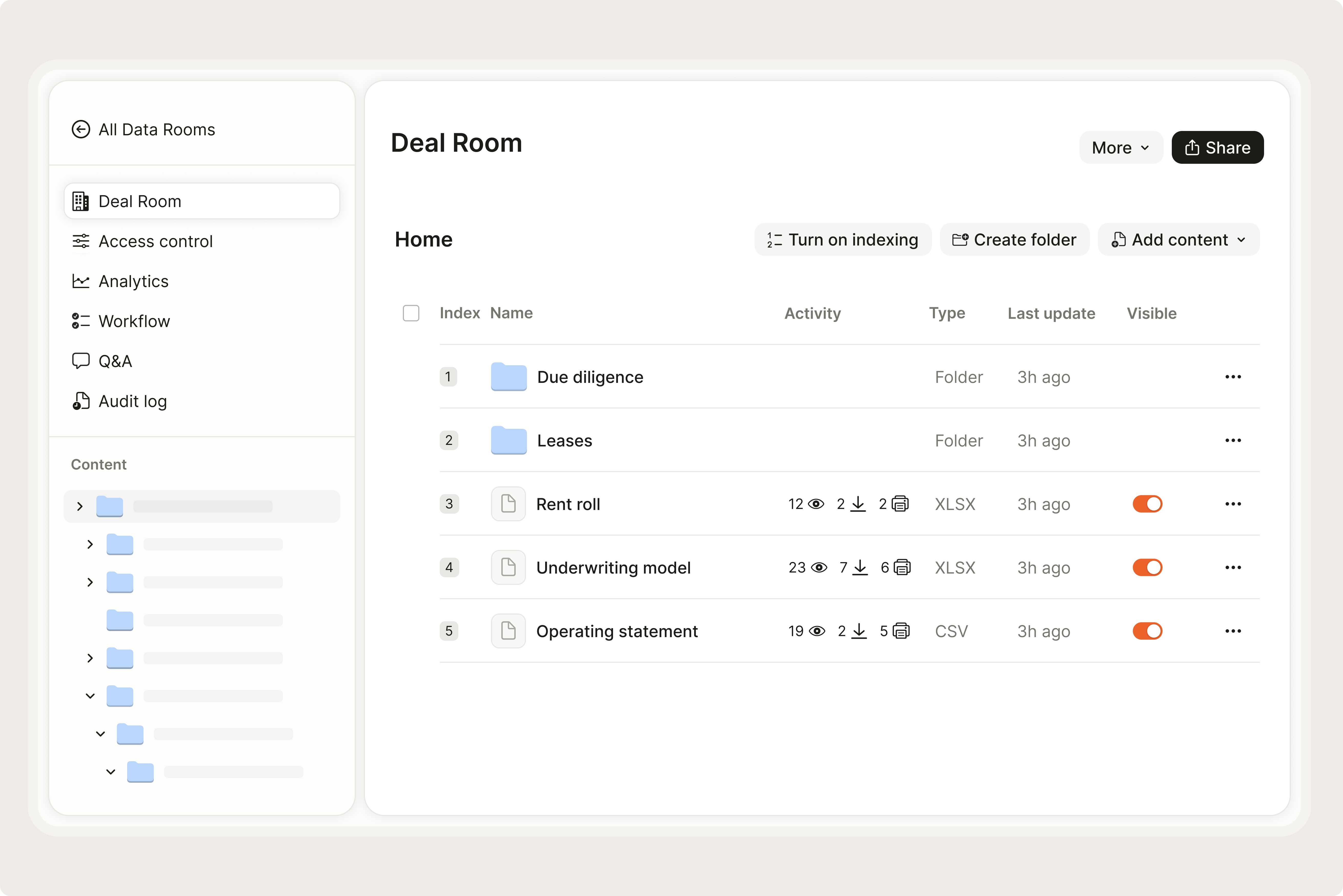
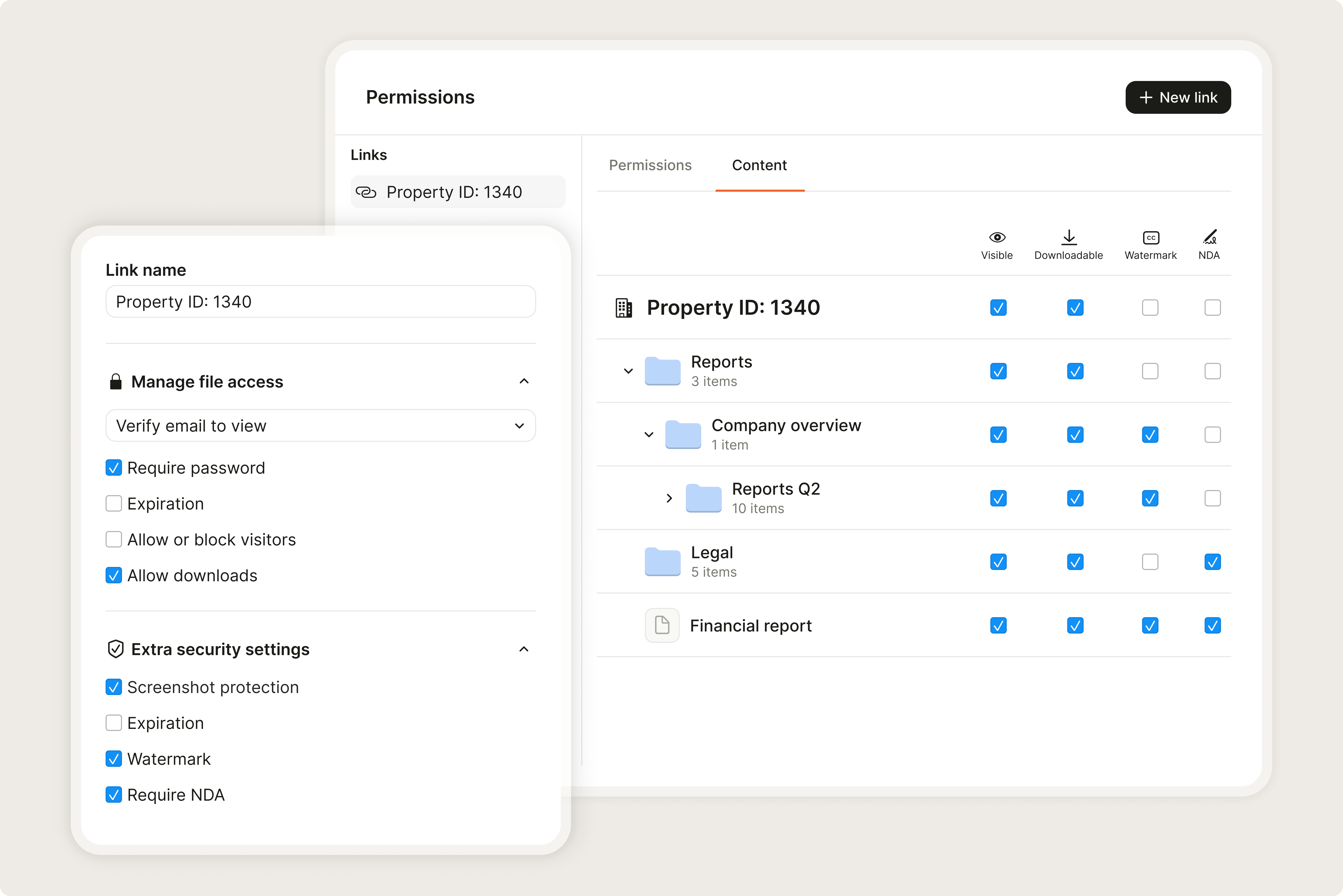
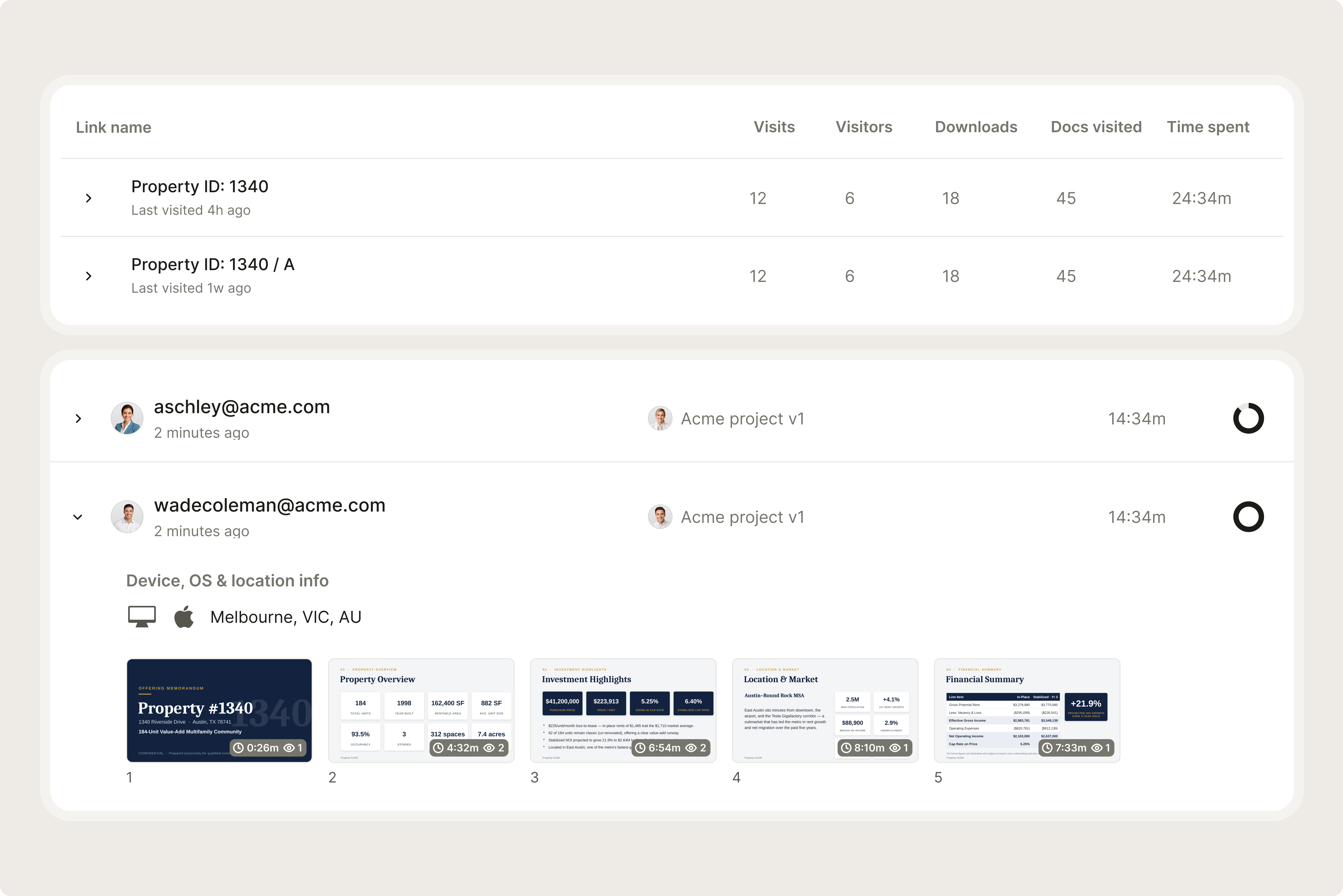
UK commercial deals involve CPSEs, HMLR title, leases, EPC certificates, asbestos registers, Phase I ESA, planning searches, and OTT analysis across multiple weeks. Load files into Ellty before solicitors engage. Each advisor gets a scoped, tracked link from day one.
- 1.Upload UK property files to a secure roomDrop HMLR title, CPSE responses, lease pack, EPC certificates, asbestos register, and planning search into Ellty.
- 2.Give each advisor a scoped, tracked linkSolicitor sees title and lease docs. Building surveyor sees technical reports. Lender sees valuation and EPC. Ellty enforces the scope.
- 3.Monitor who reviews which documentsSee exactly which files each advisor opened and when. Catch delays before they stall the CPSE cycle and push completion back.
What makes UK commercial property different
CPSEs are the framework that most other markets don't have. The UK commercial property market runs on a standardised question-and-answer process; the seller's written replies to CPSEs form part of the contract and create misrepresentation exposure if incorrect. This means the diligence process is more structured than most European markets, but the CPSE cycle still takes time to run and gaps in the replies require follow-up enquiries.
The Option to Tax is the most common financial surprise in UK commercial deals for buyers who haven't done UK transactions before. 20% VAT on top of the purchase price on a £10m asset is £2m in additional cost. TOGC relief removes this entirely if conditions are met - but the conditions are specific and must be confirmed by tax advisors before exchange, not after.
MEES is a structural headwind across the UK commercial income-producing market. The Band E minimum since April 2023 and the Band B target from 2030 mean that commercial assets with poor energy performance either need significant capex or face a period where new lettings are blocked. In 2026, EPC ratings materially affect lease-up assumptions and exit cap rates for UK commercial assets.
Post-Grenfell fire safety is not optional for multi-storey commercial buildings. EWS1 assessments, ACM cladding removal, and fire remediation costs have affected the values of buildings across the country. For any commercial building above 11m with unknown cladding: a fire safety assessment is required before acquisition.
Commercial Property Standard Enquiries (CPSEs) are the standard pre-contract enquiries used in commercial property transactions in England and Wales. They are maintained by the Commercial Property Standard Enquiries working group, a joint initiative of the British Property Federation, the Investment Property Forum, and the Law Society. CPSE responses form part of the contractual documentation; incorrect or misleading replies create misrepresentation exposure for the seller. Buyers should treat CPSE gaps and qualified replies as the starting point for their enquiry list, not the end of their diligence.
Timeline and cost in UK
Weeks 1-2 cover kickoff: HMLR title pull, CPSE responses issued, planning search ordered, environmental search ordered, EPC review, asbestos register request, OTT confirmation, and Phase I ESA engagement for brownfield assets. Solicitor costs in this phase run approximately £5,000-15,000.
Load all documents into Ellty before the buyer's solicitor issues their first enquiry list. Having every document organised and tracked means RE responses can be issued in hours rather than days.
Weeks 2-8 cover deep review: CPSE/RE cycle, 1954 Act status analysis, lease abstraction, dilapidations assessment, building survey, Phase I ESA delivery, SDLT and OTT/TOGC tax structuring. Solicitor and advisor costs in this phase: £15,000-50,000 for mid-market commercial deals.
Weeks 8-14 handle resolution: title issues addressed, planning conditions confirmed, MEES remediation plan agreed (if needed), building survey defects negotiated into the price, and contract exchange.
UK total acquisition costs: SDLT at 0-5% progressive (approximately 4.8% on a £10m asset) + solicitor fees 0.5-1% + RICS survey + environmental Phase I. Total acquisition cost runs approximately 5-7% of purchase price depending on SDLT impact. 20% VAT via OTT is the wildcard - structure correctly or it adds 20% on top.
Running a UK property deal from one room
Hold HMLR title, CPSEs, lease pack, and EPC certificates in one secure, tracked Ellty data room.
Start free 14-day trialCommon questions about due diligence on UK commercial property
- Most UK commercial property deals take 10-16 weeks from Heads of Terms to completion. The CPSE/RE cycle, 1954 Act review, planning search, building survey, and HMLR registration are the main lead-time items. For brownfield sites requiring Phase I and Phase II ESA, add 4-8 weeks.
- An Option to Tax (OTT) is a voluntary election made by the property owner with HMRC. Once in place, all supplies of the property (sale and rental) become subject to 20% VAT. For commercial buyers, OTT status must be confirmed before Heads of Terms. TOGC relief can eliminate VAT and SDLT on qualifying going-concern transactions, but the conditions are strict and must be verified by tax advisors before exchange.
- The Landlord and Tenant Act 1954 gives commercial tenants in England and Wales who haven't contracted out of the Act a statutory right to renew their lease at the end of the term. Landlords can only oppose renewal on limited grounds. For buyers with refurbishment or redevelopment plans, non-contracted-out tenants can delay vacant possession by 12-18 months or more. Always confirm the 1954 Act status of every commercial tenant in the rent roll.
- MEES (Minimum Energy Efficiency Standards) require commercial properties in England and Wales to have an EPC of Band E or above to be let; sub-E properties cannot be rented since April 2023. The UK government's 2030 target is Band B for commercial lettings. Any income-producing commercial asset with an EPC below Band E is effectively unlettable. Check the EPC before bidding and model the capex to reach at least Band E (and ideally Band B) into the underwriting.
- Stamp Duty Land Tax (SDLT) on commercial property in England is progressive: 0% up to £150,000; 2% on the portion from £150,000 to £250,000; 5% on the portion above £250,000. On a £5m commercial purchase, SDLT runs approximately £242,500. Scotland uses LBTT and Wales uses LTT with different rates. TOGC relief can eliminate SDLT on going-concern property transactions; confirm eligibility with your tax advisor before exchange.
- UK commercial buildings constructed before 2000 are presumed to potentially contain Asbestos Containing Materials (ACMs). The Control of Asbestos Regulations 2012 require duty holders to maintain an asbestos register and management plan. A buyer acquiring a pre-2000 commercial building inherits the duty-holder obligation at completion. Always request the current asbestos register and management survey; if works are planned, a more intrusive R&D Survey is required before they commence.


