Philippines commercial property due diligence has one constraint that determines deal structure before any other check: foreigners cannot own land. Every acquisition by a foreign buyer works through a Philippine corporation (60% Filipino-owned), a registered long-term lease, or a condominium unit purchase (40% foreign cap per project). Get the structure wrong and you can't close.
Philippines transfer costs stack quickly: Capital Gains Tax (CGT) at 6% of the higher of the selling price, BIR zonal value, or Tax Declaration fair market value, paid by the seller; Documentary Stamp Tax (DST) at 1.5% paid by the buyer; plus transfer tax (0.5-0.75%) and Registry of Deeds registration fee (~0.25%). Total buyer-side costs: approximately 2-2.5% of assessed or zonal value. Seller bears the largest single cost at 6% CGT.
The Philippines uses the Torrens title system. All registered private land has a Transfer Certificate of Title (TCT) in the Registry of Deeds. A Condominium Certificate of Title (CCT) covers individual condo units. The TCT shows the registered owner, lot description, and all annotations (encumbrances, liens, adverse claims, lis pendens). Any encumbrance that doesn't appear on the title is generally not binding on a buyer in good faith - but that means a thorough title search at the Registry of Deeds is your primary protection.
Property Registration Authority (PRA) oversees the Registry of Deeds network. Title search must be done at the Registry of Deeds for the city or province where the property is located. Request a certified true copy of the TCT directly from the ROD to confirm the latest annotated encumbrances.
Set up a due diligence data room before advisors engage. Load TCT, Tax Declaration, seller's CGT documentation, building permit, occupancy permit, zoning clearance, and lease files before the buyer's request list arrives.
Where Philippines property deals go wrong
Not every check carries the same weight. The table below sorts risks by deal impact - dealbreakers first, then what moves the price, then basic hygiene - so your Philippine attorney and advisor know what to clear first.
| Area | Documents to pull | Philippines red flag | Matters most for | Tier | |
|---|---|---|---|---|---|
| TCT title search and authenticity | TCT title search and authenticity | Certified true copy of Transfer Certificate of Title (TCT) from Registry of Deeds, owner's duplicate TCT, Tax Declaration from City/Municipal Assessor's Office, real property tax (RPT) clearance | Philippines TCT forgery and double title fraud have been documented in key markets including Makati, BGC, and Metro Manila; always request a certified true copy of the TCT directly from the Registry of Deeds (ROD) rather than relying on the owner's duplicate alone; compare both documents for consistency; the ROD certified copy is the authoritative record; fake TCTs replicate the appearance of authentic documents and are only caught by direct ROD verification; annotations on the back of the TCT show all registered encumbrances, adverse claims, notices of lis pendens, and government reservations - review all of these; also match the TCT lot description against the approved survey plan (lot area, boundaries, technical description) | All buyers - foundational check | Dealbreaker |
| Foreign ownership structure | Foreign ownership structure | Philippine corporation articles of incorporation (SEC), shareholder register (at least 60% Filipino ownership), Foreign Investments Act compliance confirmation, Investor's Lease Act confirmation (for leasehold structures) | The 1987 Philippine Constitution, Commonwealth Act 141, and Republic Act 7042 (Foreign Investments Act) collectively prohibit foreigners (individuals and foreign corporations) from owning private land in the Philippines; the available structures are: (1) Philippine corporation: requires at least 60% Filipino shareholders; anti-dummy laws prohibit arrangements where Filipino shareholders hold shares for the benefit of foreign investors; SEC (Securities and Exchange Commission) and LRA (PRA) monitor for nominee structures; (2) Investor's Lease Act (RA 7652): allows long-term lease of private land by qualified foreign investors for up to 50 years, renewable for another 25 years; must register with BOI; (3) Condominium unit purchase under RA 4726: foreigners can own condo units as long as total foreign ownership in the project does not exceed 40% of total floor area; CCT (Condominium Certificate of Title) is issued for individual units | All foreign commercial buyers in Philippines | Dealbreaker |
| DAR clearance - agricultural land conversion | DAR clearance - agricultural land conversion | Department of Agrarian Reform (DAR) land use certification, CLOA (Certificate of Land Ownership Award) checks, DAR conversion order (if commercially classified from agricultural), CARP coverage confirmation | The Comprehensive Agrarian Reform Program (CARP) under RA 6657 covers agricultural land in the Philippines and subjects it to land redistribution; if commercial property was previously classified as agricultural land, confirm that DAR has issued a Land Use Conversion Order (LUC) before acquisition; land still under CARP coverage cannot be freely transferred for commercial use without DAR approval; CLOAs (Certificate of Land Ownership Award) issued to agrarian reform beneficiaries (ARBs) are non-transferable for 10 years and create encumbrances; check for CLOA annotations on the TCT and any CARP-related notices of coverage | Commercial property in provinces, former agricultural zones, industrial commercial in Luzon/Visayas/Mindanao | Dealbreaker |
| Real property tax (RPT) delinquency | Real property tax (RPT) delinquency | RPT clearance from City/Municipal Treasurer's Office, latest RPT receipt, Tax Declaration from City/Municipal Assessor's Office, tax map | Philippines local government units collect Real Property Tax annually at rates of 1-2% of the assessed value (not market value); RPT delinquency creates a lien on the property that encumbers the TCT; a local government can levy and sell the property at public auction to recover delinquent RPT; the Registry of Deeds requires RPT clearance before processing a title transfer; confirm RPT is current (no delinquency for all years) at the City/Municipal Treasurer's Office; also confirm the Tax Declaration at the Assessor's Office matches the TCT lot description - discrepancies between the Tax Declaration and TCT create complications in the BIR CGT process | All Philippines commercial | Dealbreaker |
| Building permit and occupancy certificate | Building permit and occupancy certificate | Building permit from Office of the Building Official (OBO), Certificate of Occupancy (CO) from OBO, FSIC (Fire Safety Inspection Certificate) from BFP, business permit from LGU | All commercial buildings in the Philippines require a building permit from the Office of the Building Official (OBO) at the city or municipality and a Certificate of Occupancy (CO) confirming the building is fit for its intended use; the Fire Safety Inspection Certificate (FSIC) from the Bureau of Fire Protection (BFP) is required for commercial occupancy; buildings without a valid CO are technically illegal for commercial use and cannot obtain FSIC or business permits for tenants; in Metro Manila and major commercial centers, LGU enforcement of CO and FSIC requirements has increased; confirm all three documents: building permit, CO, and current FSIC before commercial closing | All Philippines commercial buildings | Dealbreaker |
| CGT, DST, and transfer taxes | CGT, DST, and transfer taxes | BIR Revenue District Office zonal value for the property location, Tax Declaration fair market value, CGT computation from Philippine tax counsel, DST and transfer tax calculations | Philippines transfer tax structure: (1) Capital Gains Tax (CGT): 6% of the higher of (a) the selling price in the deed of sale, (b) the BIR Revenue District Office zonal value, or (c) the Tax Declaration fair market value; paid by the seller but often subject to negotiation on who bears this at closing; CGT must be paid to BIR before title transfer can be registered; (2) Documentary Stamp Tax (DST): 1.5% of the same valuation basis as CGT; paid by the buyer; (3) Transfer Tax: 0.5-0.75% of valuation basis; paid to the Local Government Unit (LGU); (4) Registration Fee: approximately 0.25% of valuation; paid to Registry of Deeds; BIR zonal values are often lower than market values in hot markets like BGC and Makati, reducing CGT burden; confirm the applicable zonal value from the BIR RDO with jurisdiction over the property address | All buyers - model full cost stack | Price-adjuster |
| Leases and tenancies | Leases and tenancies | All commercial leases, rent roll, lease annotation on TCT (for registered leases), Retail Leasing Act compliance (if retail tenants) | Philippines commercial leases over 1 year should be registered at the Registry of Deeds and annotated on the TCT to be binding on subsequent owners; unregistered commercial leases may still be protected under the Civil Code (Art. 1676 - a buyer in bad faith who knew of the lease is bound) but registration is stronger protection; for retail leasing: RA 11462 (Retail Trade Liberalization Act) and related regulations affect foreign retail tenants' eligibility; confirm all leases over 1 year are annotated on the TCT; review rent roll for current vs. market rent gaps, rent escalation provisions, and lease expiry clustering | Tenanted Philippines commercial | Price-adjuster |
| Zoning and LGU clearances | Zoning and LGU clearances | Zoning Certificate from DHSUD (formerly HLURB) or LGU Zoning Officer, LGU business permit, Comprehensive Land Use Plan (CLUP) confirmation, Locational Clearance from DHSUD | Philippines zoning is regulated by LGU Comprehensive Land Use Plans (CLUPs) approved by DHSUD (Department of Human Settlements and Urban Development); confirm the property's zoning classification is consistent with the intended commercial use; for condominium and subdivision developments: DHSUD registration and license to sell are required; for large commercial projects requiring a locational clearance: confirm DHSUD clearance; LGU-level zoning ordinances control building setbacks, FAR (Floor Area Ratio), and land use compatibility; Metro Manila LGUs (Makati, BGC/Taguig, Pasig, Quezon City) have varying zoning ordinances requiring separate review | All Philippines commercial, development sites | Price-adjuster |
| Environmental - ECC and DENR clearances | Environmental - ECC and DENR clearances | Environmental Compliance Certificate (ECC) from DENR-EMB for projects above thresholds, Certificate of Non-Coverage (CNC) for smaller projects, DENR mining claim searches | Philippines environmental impact assessment is required for commercial projects above defined thresholds under the Philippine Environmental Impact Assessment System (PD 1586); an Environmental Compliance Certificate (ECC) from the DENR Environmental Management Bureau (EMB) is required for covered projects; failure to obtain required ECC before construction makes the project illegal; for smaller commercial projects: a Certificate of Non-Coverage (CNC) from DENR-EMB confirms the project is not covered; also search DENR for mining claims or mineral production sharing agreements covering the land, particularly for provincial commercial; DENR administers protected areas under the NIPAS Act - confirm property is not within protected area boundaries | Large commercial developments, provincial commercial, industrial commercial | Standard check |
| Encumbrances - mortgages and adverse claims | Encumbrances - mortgages and adverse claims | Back of TCT (annotations), ROD encumbrance search, mortgage holder confirmation, lis pendens search from ROD and court records | All Philippines encumbrances - mortgages, adverse claims, notices of lis pendens, easements, government reservations - must be annotated on the TCT to be binding on a subsequent buyer in good faith; review all annotations on the back of the TCT certified true copy; mortgages must be released before or at title transfer; adverse claims (annotated under Sec. 70 of PD 1529) give a claimant protection for 30 days from registration (renewable); lis pendens indicates active litigation affecting the property; all must be resolved before closing; a Notice of Lis Pendens on the TCT is a hard stop for most buyers | All buyers | Standard check |
| Seller KYC and AML | Seller KYC and AML | SEC entity confirmation (for corporate sellers), anti-dummy law review (for Filipino corporations selling to foreign buyers), AMLC (Anti-Money Laundering Council) compliance, OFAC/sanctions screens | Philippines AMLC (Anti-Money Laundering Council) regulates real estate in covered transactions above PHP 7.5 million; covered real estate transactions require reporting by covered institutions; for corporate sellers: confirm at SEC that the seller is validly existing and authorized to sell the property; for Filipino corporations selling to foreign buyers: confirm the Philippine corporation has the required 60% Filipino ownership; run OFAC and relevant sanctions screens on all principals; for BSP (Bangko Sentral ng Pilipinas) remittance: confirm FX outward remittance procedures for any cross-border proceeds repatriation | All deals above PHP 7.5M, all foreign buyer deals | Standard check |
Due diligence on a Philippines property?
Set up your Ellty data room before diligence starts.
Start free 14-day trialPhilippines commercial property due diligence checklist
The table ranked risks by severity. This is the full checklist to work through, grouped by area.
TCT title search and registry verification
- Day one: request a certified true copy of the Transfer Certificate of Title (TCT) from the Registry of Deeds for the city or municipality where the property is located; also request the owner's duplicate copy from the seller for comparison; both should match in every field
- Confirm the registered owner matches the seller; if the title is in the name of a corporation, confirm the corporation is validly registered at SEC and that authorized signatories have current authority to execute the deed of sale
- Review all annotations on the back of the TCT: mortgages, real estate mortgage (REM) annotations, adverse claims, notices of lis pendens, notices of attachment, government reservations; each requires investigation and resolution before closing
- Match the technical description (lot number, area, boundaries) in the TCT against the lot plan or survey plan; any discrepancy between the TCT technical description and the actual survey requires correction at PRA before title transfer
Give each advisor a scoped link in Ellty. Philippines attorney sees TCT, Tax Declaration, and encumbrance search. Building inspector sees building permit and CO. Environmental consultant sees ECC and DENR records. Lender sees title, Tax Declaration, and BIR zonal value documentation.
Foreign ownership structure confirmation
- If the buyer is a foreign individual or foreign corporation: confirm the acquisition structure before any deposit - Philippine corporation (60% Filipino-owned), long-term lease under Investor's Lease Act, or condominium unit under RA 4726
- For Philippine corporation structure: confirm at SEC that the corporation exists, the authorized capital stock and paid-up capital are sufficient, the shareholders of record are at least 60% Filipino nationals, and that no nominee arrangement is in place; the Anti-Dummy Law (CA 108) imposes criminal liability for dummy arrangements
- For Investor's Lease Act structure: confirm the lease term and renewal provisions comply with RA 7652 (50 years initial, 25-year renewal); lease must be notarized and registered at ROD and annotated on the TCT; BOI confirmation of qualified investor status required
- For condominium unit purchase: confirm from the condominium developer or the DHSUD records that current foreign ownership in the project is below the 40% floor area threshold before executing the purchase; once exceeded, a foreign buyer cannot complete the purchase and obtain a CCT
DAR clearance - agricultural and CARP check
- For any commercial property outside Metro Manila or in provinces with agricultural history: request a DAR (Department of Agrarian Reform) certification confirming the land is not subject to CARP coverage and that no CLOA (Certificate of Land Ownership Award) has been issued over the subject lot
- Check the TCT annotations for any CARP-related notices or CLOA annotations; a CLOA annotation on a TCT means the land was distributed under CARP and may still be subject to restrictions
- If the property was formerly agricultural and has been commercially reclassified: confirm the DAR Land Use Conversion Order (LUC Order) exists and is properly annotated or referenced in title; commercial use without a valid conversion order creates enforcement risk
- Mindanao and provincial commercial properties frequently have agricultural conversion histories; never skip the DAR check for provincial deals
Load TCT, Tax Declaration, RPT clearance, DAR certification, building permit, CO, FSIC, ECC/CNC, and lease files into Ellty. Track which advisors review which documents. Watch who reviews the DAR certification and TCT annotation pages most carefully.
CGT, DST, and BIR processing
- Obtain the BIR zonal value for the specific property location from the BIR Revenue District Office with jurisdiction over the property address; zonal values differ by street and zone within the same city; confirm the correct RDO and applicable zonal value before signing the deed of sale
- CGT computation: 6% of the highest of (a) the deed of sale price, (b) BIR zonal value x lot area, or (c) Tax Declaration fair market value; get Philippine tax counsel to compute and confirm before signing; confirm who bears the CGT between buyer and seller (legally the seller's obligation, but negotiable as a practical matter)
- DST computation: 1.5% of the same valuation basis; buyer's statutory obligation; pay to BIR before registration
- BIR processing sequence: submit CGT return and DST return to BIR within 30 days from notarization of the deed of sale; BIR issues CAR (Certificate Authorizing Registration) after CGT and DST payment; CAR is required by the Registry of Deeds before they will register the transfer
- Transfer tax: pay to LGU (City or Municipal Treasurer's Office) separately from BIR; then ROD registration fee; this sequence - BIR CAR first, then LGU transfer tax, then ROD registration - must be followed in order; mistakes in sequencing create delays of weeks at the ROD
Compare Indonesia's commercial property due diligence process for Southeast Asia portfolio strategy. Philippines and Indonesia share similar structural constraints for foreign buyers - both prohibit direct foreign land ownership and use corporation or leasehold structures for foreign commercial investment - but differ on title systems (Philippines Torrens system with centralized TCT vs. Indonesia's Certificate of Land Rights or HGB system), transfer taxes (Philippines CGT 6% plus DST 1.5% vs. Indonesia 2.5% income tax on seller plus BPHTB 5% on buyer), and market depth (Philippines concentrated in Metro Manila vs. Indonesia spread across Java, Bali, Sulawesi).
How due diligence works in the Philippines
Step 1 - TCT title search and structure confirmation
Day one: request certified true copy of TCT from ROD, commission Philippine counsel legal opinion on the proposed acquisition structure (if foreign buyer), request Tax Declaration from Assessor's Office, confirm RPT clearance status.
For foreign buyers: the structure legal opinion is as critical as the title search. Don't pay any substantial deposit before both.
Step 2 - Building permits, DAR, and environmental
Request building permit and CO from seller. Commission FSIC confirmation from BFP. For provincial commercial: request DAR certification. For large commercial developments: confirm ECC from DENR-EMB.
Confirm DHSUD zoning clearance and LGU business permit status for commercial buildings with tenants.
Step 3 - Leases, encumbrances, and AML
Abstract all commercial leases. Confirm which leases over 1 year are annotated on the TCT at ROD. Review all TCT annotations for adverse claims or lis pendens. Run AMLC-compliant AML/KYC and OFAC screens on all principals.
Step 4 - BIR CAR, transfer taxes, and ROD registration
Compute CGT and DST with BIR zonal value. File CGT and DST returns at BIR within 30 days of deed notarization. Obtain BIR CAR. Pay LGU transfer tax. File for ROD registration. Title transfer at ROD completes the transaction.
Load all files into Ellty before advisors engage. Philippines attorney sees TCT and structure documents. Lender sees title, BIR zonal value, and Tax Declaration. Track who opens the DAR certification and FSIC certificates.
How to set up your Philippines data room in Ellty.
Philippines commercial deals involve TCT title, Tax Declaration, RPT clearance, DAR certification, building permit, CO, FSIC, ECC, BIR zonal value documentation, and commercial lease files.
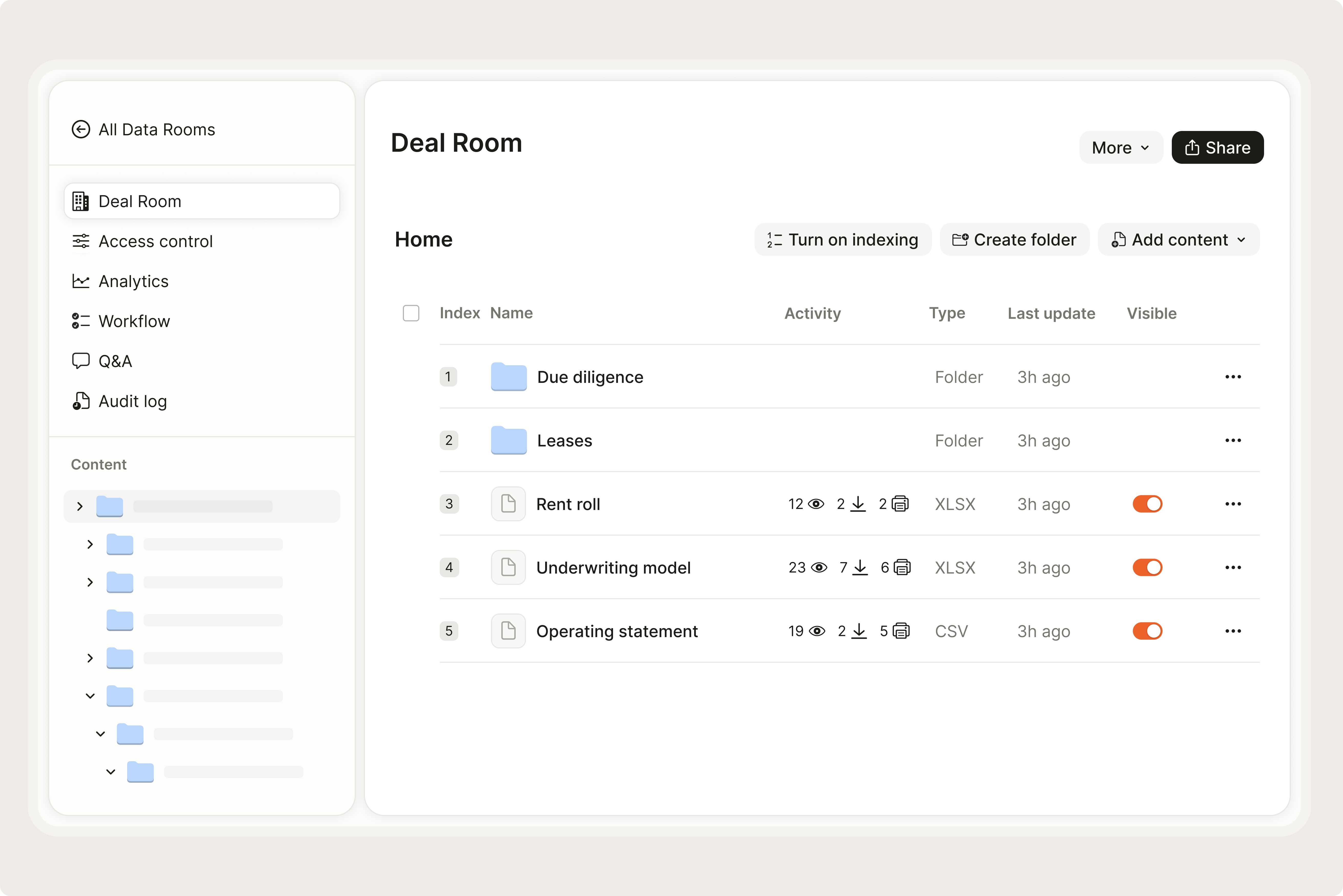
- 1.Upload Philippines property files to a secure roomDrop TCT certified true copy, Tax Declaration, RPT clearance, DAR certification, building permit, Certificate of Occupancy, FSIC, ECC or CNC, BIR zonal value documentation, and lease pack into Ellty.
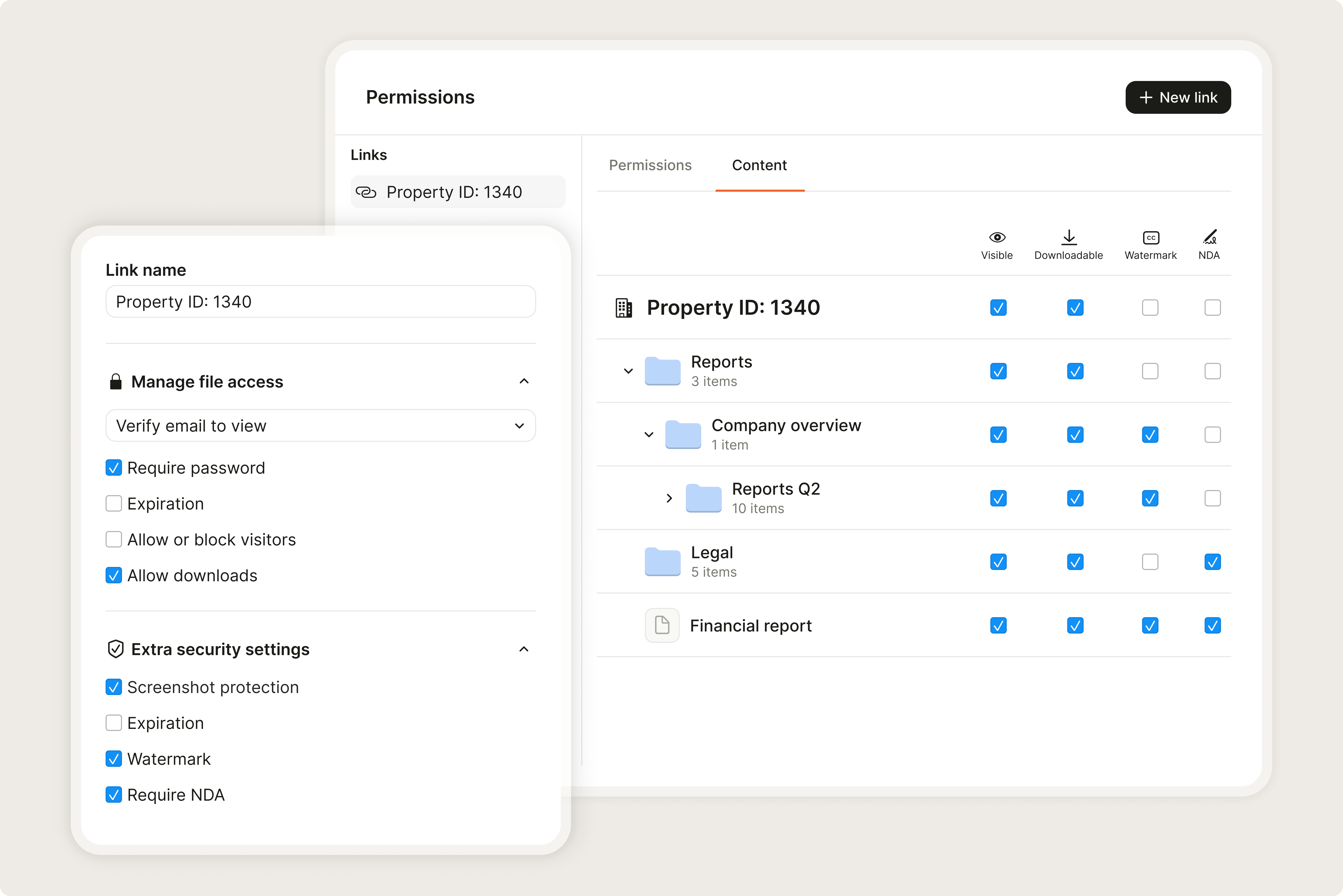
- 2.Give each advisor a scoped, tracked linkPhilippines attorney sees TCT and structure documents. Building inspector sees building permit and CO. DENR environmental consultant sees ECC records. Lender sees title, Tax Declaration, and BIR zonal value. Each party sees only their files.
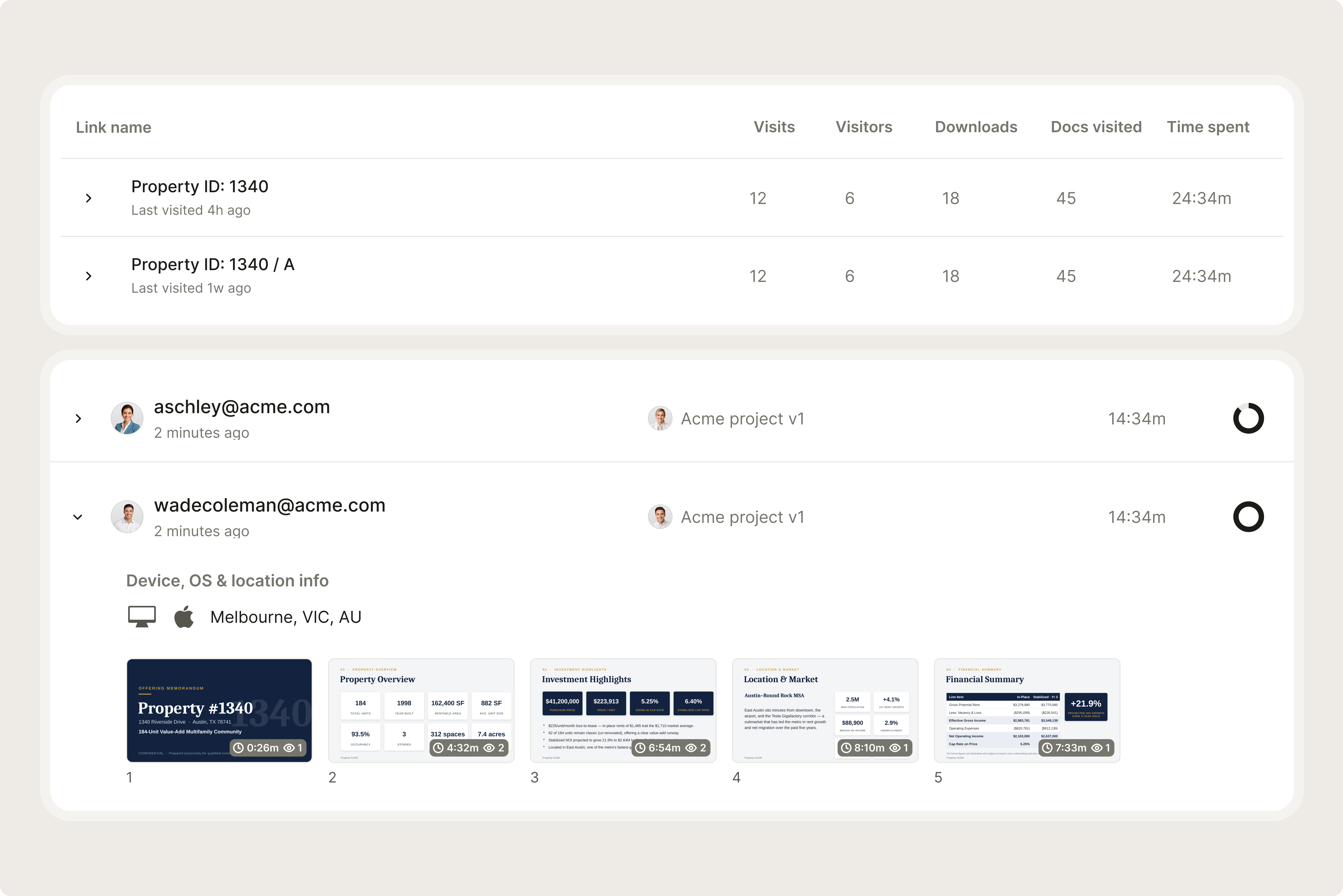
- 3.Monitor who reviews which documentsSee exactly which files each advisor opened and when. Catch TCT annotation issues or DAR clearance gaps before they stall the BIR CAR process.
What makes the Philippines different
The Philippines Torrens title system is one of the most legally protective land title systems in Asia when it functions correctly - a registered owner with a clean TCT, absent fraud, holds an indefeasible title. The problem is that title fraud has been persistent enough in the Philippines that "clean TCT from the Registry of Deeds" has become a necessary but not sufficient diligence step. Double titles, fraudulent reconstituted titles (TCTs supposedly reconstituted after destruction of the original ROD records, often in cases where the original records were not actually destroyed), and fake owner's duplicate copies have all been documented in Philippine commercial real estate transactions. The practical response is straightforward: always request a certified true copy of the TCT directly from the Registry of Deeds, compare it with the owner's duplicate the seller presents, confirm both documents are consistent, and engage a Philippine attorney to verify the title's history at the PRA (Property Registration Authority) level beyond the ROD certified copy alone. For high-value commercial transactions in Metro Manila, institutional buyers routinely commission a title search that includes a review of the ROD's instrument records (the filed documents behind the TCT annotations) rather than just the current certified copy.
The BIR CAR (Certificate Authorizing Registration) process is the most common source of Philippines commercial closing delays that buyers don't anticipate. The sequence is mandatory: notarize the deed of sale, pay CGT and DST at BIR within 30 days, obtain BIR CAR, pay LGU transfer tax, then register at ROD. Each step requires the previous step's document. BIR processing of CGT/DST returns and issuance of CAR typically takes 2-6 weeks at Metro Manila BIR RDOs (Revenue District Offices) under normal conditions; backlogs at certain RDOs have stretched this to 8-12 weeks. The 30-day deadline for CGT/DST return filing runs from the notarization date of the deed of sale, not from the intended closing date - many buyers miss this because they notarize a preliminary deed of sale and then wait for BIR CAR before completing the transaction, not realizing the clock started at notarization. Philippine tax counsel should be engaged before the deed is signed, not after, to plan the BIR filing sequence and avoid penalties for late CGT/DST filing (25% surcharge plus 12% per annum interest on the tax due).
The CARP/DAR risk is frequently underestimated by foreign buyers of Philippine commercial property outside Metro Manila. The Comprehensive Agrarian Reform Program (CARP) under RA 6657 has been in operation since 1988 and has affected millions of hectares of Philippine agricultural land, including land subsequently commercially reclassified. The core problem is that land conversion from agricultural to commercial classification (issued by DAR as a Land Use Conversion Order) is a separate process from TCT title transfer - a piece of land can have a clean TCT in the name of a private corporation with no agricultural annotations, and still be subject to CARP proceedings if a DAR conversion order was never properly obtained. Provincial commercial acquisitions and any land purchase outside established urban commercial zones should be treated as having potential CARP exposure until a DAR certification specifically states otherwise. In practice, this means engaging a Philippine attorney with agrarian reform experience as part of the standard diligence team for any provincial commercial acquisition.
Under Section 7, Article XII of the 1987 Constitution of the Republic of the Philippines, save in cases of hereditary succession, no private lands shall be transferred or conveyed except to individuals, corporations, or associations qualified to acquire or hold lands of the public domain. Section 3 of the same Article defines qualified entities as Filipino citizens and corporations or associations at least sixty per centum of whose capital is owned by such citizens. The Foreign Investments Act (RA 7042, as amended) implements these constitutional restrictions for corporate investors. Republic Act 7652 (Investor's Lease Act) permits qualified foreign investors to lease private land for a term not exceeding 50 years, renewable once for a period not exceeding 25 years, for the establishment of industrial estates, factories, assembly or processing plants, agro-industrial enterprises, land development for industrial or commercial use, tourism complexes and facilities, and similar priority productive endeavors.
Timeline and cost in the Philippines
Weeks 1-2 cover kickoff: TCT certified true copy from ROD, Tax Declaration from Assessor's Office, RPT clearance from Treasurer's Office, DAR certification (for provincial commercial), DHSUD zoning clearance, building permit and CO request, ECC/CNC from DENR-EMB, BIR zonal value confirmation from relevant RDO, lease abstraction, SEC entity confirmation for corporate sellers, AML/KYC, and acquisition structure legal opinion (for foreign buyers). Legal fees in this phase: PHP 150,000-500,000 (approx. USD 2,500-8,500).
Load all files into Ellty before advisors engage. Standard Philippines commercial: 45-90 days. BIR CAR processing: 2-8 weeks. DAR certification: 2-4 weeks. ROD title transfer registration: 2-4 weeks after BIR CAR.
Weeks 2-6 cover deep review: TCT annotation analysis, encumbrance clearance plan, DAR certification review, CARP coverage confirmation, building permit vs. as-built comparison, CO and FSIC status, ECC compliance review, lease registration status at ROD, zoning ordinance compliance, BIR zonal value documentation, CGT and DST computation, AML/KYC completion. Costs in this phase: PHP 300,000-1,000,000 (approx. USD 5,000-17,000).
Weeks 6-12 handle resolution: mortgage releases and ROD encumbrance cancellations, deed of sale preparation and notarization, BIR CGT and DST return filing (within 30 days of notarization), BIR CAR processing, LGU transfer tax payment, ROD registration, and new TCT issuance in buyer's name.
Philippines total buyer-side transaction costs: CGT 6% (seller, often subject to negotiation on how borne) + DST 1.5% (buyer) + LGU transfer tax 0.5-0.75% (buyer) + ROD registration fee ~0.25% (buyer) + Philippine attorney fees + BIR stamp fees. Total effective buyer cost: 2-2.5% of deal value (excluding CGT if fully on seller) or up to 8-9% if buyer agrees to bear all taxes including CGT.
Running a Philippines property deal from one room
Hold TCT title, DAR clearance, BIR CAR records, building permits, and lease files in one secure, tracked Ellty data room.
Start free 14-day trialCommon questions about due diligence on Philippines commercial property
- Standard Philippines commercial deals take 45-90 days. BIR CAR processing after CGT/DST filing: 2-8 weeks (varies by RDO). DAR certification for provincial commercial: 2-4 weeks. DHSUD clearance for development projects: 3-8 weeks. ROD title transfer registration: 2-4 weeks after BIR CAR. For foreign buyers needing an SEC-registered Philippine corporation or BOI approval for Investor's Lease Act registration: 4-12 weeks additional.
- Foreigners cannot own land in the Philippines under the 1987 Constitution. Available structures: (1) Philippine corporation: must have at least 60% Filipino shareholders; anti-dummy law prohibits nominee arrangements; (2) Investor's Lease Act (RA 7652): long-term lease up to 50 years renewable for 25 years for qualified foreign investors in priority activities; must register with BOI; (3) Condominium units: foreigners can own condo units as long as total foreign ownership in the project stays below 40% of total floor area. All structures require specific legal opinion from Philippine counsel before any deposit.
- The BIR CAR (Certificate Authorizing Registration) is issued by the Bureau of Internal Revenue after the seller's Capital Gains Tax (6%) and buyer's Documentary Stamp Tax (1.5%) have been paid and accepted. The Registry of Deeds will not register a title transfer without the BIR CAR. The CGT and DST returns must be filed with BIR within 30 days of the deed of sale's notarization date - missing this deadline triggers a 25% surcharge plus 12% per annum interest. BIR processing of the CAR typically takes 2-8 weeks at Metro Manila RDOs. Plan the BIR filing sequence before signing the deed.
- Philippines property transfer costs: (1) Capital Gains Tax (CGT): 6% of the higher of selling price, BIR zonal value, or Tax Declaration fair market value; seller's obligation, negotiable; (2) Documentary Stamp Tax (DST): 1.5% of same valuation basis; buyer's obligation; (3) LGU Transfer Tax: 0.5-0.75% depending on LGU; buyer; (4) ROD Registration Fee: approximately 0.25% of valuation. Total buyer-side cost: 2-2.5% (if seller fully bears CGT). Total effective cost if buyer absorbs CGT: 8-9% of deal value.
- The Comprehensive Agrarian Reform Program (CARP, RA 6657) subjects agricultural land to redistribution and restricts its transfer. Land converted from agricultural to commercial classification requires a DAR Land Use Conversion Order. Provincial commercial property may have CARP exposure even if the TCT appears clean with no agricultural annotations. Always request a DAR certification specifically confirming the land is not subject to CARP coverage for any Philippine commercial acquisition outside established urban commercial zones. Mindanao and provincial Luzon/Visayas deals are highest risk for undisclosed CARP exposure.
- Large commercial developments in the Philippines require an Environmental Compliance Certificate (ECC) from the DENR Environmental Management Bureau (EMB) under the Philippine EIA System (PD 1586). Projects that fall below the EIA threshold require a Certificate of Non-Coverage (CNC) from DENR-EMB. Acquiring commercial property where the existing development lacks a required ECC is a legal risk - the project can be ordered to stop operations. Also search DENR for mining claims or mineral production sharing agreements affecting the property, particularly for provincial commercial acquisitions.