Lithuania commercial property due diligence is broadly straightforward for EU investors, with two historically specific risks: Soviet-era land restitution claims that affect certain urban parcels, and contamination from former Soviet industrial facilities. The register is public and searchable. Transactions require notarization by a Lithuanian public notary. VAT at 21% applies to new commercial buildings and can be opted into for older commercial.
Lithuania has no real estate transfer tax. The main transaction costs are: notary fees (negotiated but typically 0.1-0.5% of transaction value for commercial, capped by the Ministry of Justice fee schedule); Centre of Registers registration fee; and VAT at 21% on commercial property where the seller is a VAT payer and the transaction is taxable (new commercial buildings are taxable; older commercial may be VAT-exempt unless the seller opts in). No stamp duty on the UK model. Legal and advisory fees add 0.5-2% of transaction value.
Lithuania's State Enterprise Centre of Registers (Registrų centras) maintains the Real Property Register (Nekilnojamojo turto registras, NTR). All registered real property in Lithuania must be in the NTR; registration is constitutive - ownership transfers only upon registration, not just upon signing the notarized deed. The register is publicly searchable at regia.lt; any registered encumbrances (mortgages, seizures, easements, restrictions, including any remaining restitution-linked annotations) appear in the extract.
Lithuania joined the EU in 2004; there are no restrictions on EU citizens or companies owning commercial real estate in Lithuania. Non-EU nationals can also own commercial property; the only restriction is on non-EU nationals and certain foreign companies owning agricultural and forestry land, which requires special permits. For commercial (urban) property: open to all buyers.
Set up a data room before advisors engage. Load the Centre of Registers property extract, cadastral data, building permit, completion act, EPC certificate, environmental records, and lease files before advisors request them.
Where Lithuania property deals go wrong
Not every check carries the same weight. The table below sorts risks by deal impact - dealbreakers first, then what moves the price, then basic hygiene - so your Lithuanian attorney and advisor know what to clear first.
| Area | Documents to pull | Lithuania red flag | Matters most for | Tier | |
|---|---|---|---|---|---|
| Centre of Registers extract and title chain | Centre of Registers extract and title chain | Official NTR extract (Nekilnojamojo turto registro išrašas) from Centre of Registers (regia.lt or in person), cadastral data extract (Kadastro duomenų išrašas), history of ownership (ownership transaction chain) | Lithuania's Centre of Registers (Registrų centras) maintains the Real Property Register (NTR); the register is publicly searchable and extracts can be obtained online or in person; the extract shows: registered owners, plot/building data, all encumbrances (mortgages/hipoteka, seizures/areštai, easements/servitutai, restrictions/apribojimai), any restitution-linked annotations, and registered rights of third parties; review the full extract for the land plot (žemės sklypas) and for the building(s) separately; confirm the registered owner matches the seller; confirm all encumbrances; note any restrictions on use or transfer; also review the cadastral data for the land area, building area, and permitted use classification | All buyers - foundational check | Dealbreaker |
| Restitution risk - Soviet-era claims | Restitution risk - Soviet-era claims | NTR extract (restitution annotations), National Land Service records, Lithuanian court records search for any pending restitution cases, title history from Centre of Registers (previous ownership before 1940) | After Lithuania regained independence in 1990, the Law on Property Restitution granted former owners (and heirs) of land and property nationalized or confiscated during Soviet occupation the right to claim restitution; the restitution process ran primarily through the 1990s and early 2000s; most claims are now resolved but for certain urban parcels in Vilnius and other cities that were historically private before Soviet collectivization, residual restitution-related restrictions or pending court cases may exist; check the NTR for any restitution-linked annotations (žymė, restitucija) and consult Lithuanian real estate attorney to confirm the property's restitution history is clean; a parcel with unresolved restitution claims cannot be freely transferred without resolving the claims | Central Vilnius, older urban commercial, pre-WWII building parcels | Dealbreaker |
| Mortgages and seizures (hipoteka and areštai) | Mortgages and seizures (hipoteka and areštai) | NTR extract (all registered encumbrances), mortgage holder discharge confirmation, court seizure status, bailiff (antstolis) records search | All mortgages (hipoteka) and court seizures (areštai) are registered in the NTR and appear in the extract; a court seizure order (areštas) registered by a bailiff (antstolis) prohibits transfer of the property until the underlying debt or enforcement is resolved; confirm all mortgages will be released at or before closing; for any registered seizures: identify the underlying enforcement proceedings and confirm the timetable for release; seizures in Lithuania are registered by judicial or tax authorities or bailiffs executing enforcement orders; also check with Lithuanian counsel whether any enforcement actions against the seller entity could result in additional seizure orders before the registration of the buyer's title | All buyers | Dealbreaker |
| Building permit and completion act | Building permit and completion act | Building permit (Statybos leidimas) from municipality, completion act (Statinio pripažinimo tinkamu naudoti aktas or Statinio baigties aktas), construction technical regulations compliance, INFOSTATYBA search (building permit register) | Lithuanian construction law requires a building permit (Statybos leidimas) for commercial buildings; after construction, a Completion Act (Statinio pripažinimo tinkamu naudoti aktas) is required for buildings that must be put into operation under state supervision; the completion act is signed by the construction supervisor, designer, and municipality and confirms the building was constructed in compliance with the permit and technical requirements; buildings without a valid completion act are in irregular legal status; the INFOSTATYBA online system (infostatyba.lt) maintains records of building permits and completion acts and is publicly searchable by address or cadastral number; confirm the permit and completion act exist and that the registered building area matches the cadastral data | All Lithuania commercial buildings | Dealbreaker |
| VAT position on the transaction | VAT position on the transaction | Seller's VAT payer status, property's first occupation date (for determining new vs. old commercial), seller's VAT option election (if older commercial), buyer's VAT recoverability analysis | Lithuania VAT Law: commercial property transactions are subject to VAT at 21% if: (1) the building is 'new' (first occupied or substantially renovated within 24 months of the transaction); or (2) the seller elects to charge VAT on a sale of older commercial where the default position would be VAT exemption; for a corporate buyer who is a VAT payer using the property for a taxable business, VAT paid on purchase is recoverable as input VAT; for buyers who are not VAT payers or use the property for VAT-exempt activities, VAT is an irrecoverable cost; confirm the VAT treatment with Lithuanian tax counsel before signing the purchase agreement; an unexpected 21% VAT on the purchase price significantly affects deal economics if not modeled in advance | All Lithuania commercial buyers - especially non-VAT payers | Price-adjuster |
| Environmental - Soviet industrial contamination | Environmental - Soviet industrial contamination | Environmental Protection Agency (Aplinkos apsaugos agentūra) contaminated sites register search, Phase I ESA from licensed environmental consultant, historical site use research (Soviet-era industrial records) | Lithuania's Soviet-era industrial facilities left significant contamination in certain urban industrial areas, particularly in Vilnius (Lazdynai, Naujoji Vilnia), Kaunas (industrial zones), and Klaipeda (port and industrial areas); chemical plants, oil refineries, military facilities, and manufacturing operations from the Soviet period created soil and groundwater contamination that is still being characterized and remediated; the Environmental Protection Agency (Aplinkos apsaugos agentūra) maintains a list of contaminated sites (taršos vietos) and known contamination records; for any former industrial land or commercial adjacent to former Soviet industrial zones: commission Phase I ESA with the AAA register search; Lithuania's EU membership requires compliance with EU Soil Framework Directive obligations | Former industrial, port commercial (Klaipeda), Soviet-era factory site conversions | Price-adjuster |
| Leases and tenancies | Leases and tenancies | All commercial leases, rent roll, NTR registration of leases (for registered leases), Lithuanian Civil Code tenant protection provisions | Lithuania Civil Code tenant protections: a commercial tenant whose lease is registered in the NTR is protected against the property's new owner (the registered lease survives a transfer and the buyer takes the property subject to the registered lease); unregistered leases may still be binding in certain circumstances depending on the buyer's knowledge; review all commercial leases for: term and break rights, rent review provisions, tenant improvement obligations, and any options to purchase (pirkimo teisė) or rights of first refusal; tenant rights of first refusal to purchase are common in Lithuanian commercial leases and must be respected in the transaction process | Tenanted Lithuania commercial | Price-adjuster |
| Zoning and urban planning | Zoning and urban planning | General plan (Bendrasis planas) and detailed plan (Detalusis planas) extracts from municipality, permitted use certificate from municipality, FAR and building coverage limits for the parcel | Lithuania's territorial planning system: each municipality has a general plan (Bendrasis planas) and detailed plans (Detalieji planai) for specific zones; the detailed plan governs permitted use, height, FAR, and coverage for each parcel; commercial use in a residentially zoned area is not permitted without a plan amendment; confirm the parcel's planning status and permitted use at the municipal planning department; Vilnius city is an active redevelopment market with frequent plan amendments for commercial rezoning; any planned infrastructure changes near the property (road widening, metro extensions) that may affect access or value should be confirmed | All Lithuania commercial, development sites | Standard check |
| Energy Performance Certificate (EPC) | Energy Performance Certificate (EPC) | Energy Performance Certificate (Energetinio naudingumo sertifikatas) from licensed energy auditor, SPSC (State Inspectorate for Architecture and Construction) compliance records | Lithuania's Law on Construction (Statybos įstatymas) implementing EU Energy Performance of Buildings Directive (EPBD) requires an Energy Performance Certificate (EPC, Energetinio naudingumo sertifikatas) for all commercial buildings being sold or leased; the EPC must be provided by the seller to the buyer before the sale; absence of a valid EPC is a technical breach that delays or complicates the transaction; EPC class (A++ to G) is increasingly relevant for institutional investors applying ESG criteria; older Soviet-era commercial buildings in Lithuania typically have poor energy performance ratings (E, F, or G); the cost of energy renovation required to meet EU minimum energy performance standards should be modeled for older commercial acquisitions | All Lithuania commercial buildings in any transaction | Standard check |
| Real property and land tax | Real property and land tax | Real property tax payment record from State Tax Inspectorate (VMI), assessed value confirmation from Centre of Registers, land tax rate from municipality | Lithuania imposes Real Property Tax (Nekilnojamojo turto mokestis) on commercial buildings at rates between 0.5-3% of the assessed value annually, with the specific rate determined by each municipality (within the band set by national law); the assessed value for tax purposes is set by the Centre of Registers using a mass valuation method every 5 years; Land Tax (Žemės mokestis) is levied at 0.01-4% of assessed land value annually (municipality rate); both taxes are annual obligations that run with the property; confirm current-year payments are up to date; obtain an outstanding tax clearance certificate (VMI pažyma) confirming no tax arrears before closing | All Lithuania commercial | Standard check |
| Seller KYC and AML | Seller KYC and AML | Lithuanian company registry (JAR - Juridinių asmenų registras) entity confirmation, UBO register search, OFAC/EU sanctions screens, AML compliance (Lithuanian AMLA compliance under notary obligations) | Lithuanian notaries are obligated AML-regulated persons under Lithuania's Anti-Money Laundering Law and conduct customer due diligence on all parties in notarized property transactions; confirm seller entity at JAR (Juridinių asmenų registras - Lithuanian company register); check the Lithuanian UBO register (Tikrojo savininko registro) for beneficial ownership; run OFAC and EU sanctions screens on all principals; Lithuania's Financial Crime Investigation Service (FNTT) oversees AML compliance in real estate transactions; as an EU and NATO member, Lithuania applies EU AML framework; for transactions involving non-EU or non-EEA entities: enhanced due diligence is required | All deals, especially non-EU sellers | Standard check |
Due diligence on a Lithuania property?
Set up your Ellty data room before diligence starts.
Start free 14-day trialLithuania commercial property due diligence checklist
The table ranked risks by severity. This is the full checklist to work through, grouped by area.
Centre of Registers search and title confirmation
- Day one: obtain an official extract from the Real Property Register (NTR) at the Centre of Registers (Registrų centras) for the land plot (žemės sklypas) and for each building (pastatas) separately; the extract is available online at regia.lt or from any Centre of Registers service point
- Land plot extract review: confirm registered owner (savininkas or naudotojas), land area, purpose of use (tikslinė paskirtis), all encumbrances (hipoteka, areštai, servitutai, apribojimai), and any restitution-linked annotations; confirm the land purpose category is consistent with commercial use
- Building extract review: confirm registered owner (usually same as land owner for freehold; may differ if leasehold or superficies), GBA (registered gross building area), number of floors, construction year, and all building-level encumbrances
- Confirm the cadastral data (kadastriniai matavimai) matches the building description in the NTR extract; any discrepancy between cadastral area and NTR registered area requires investigation
Give each advisor a scoped link in Ellty. Lithuanian attorney sees NTR extract, cadastral data, building permit, completion act, and seller's title documentation. Building inspector sees building permit, completion act, and technical condition report. Environmental consultant sees AAA contamination records and Phase I ESA. VAT/tax counsel sees EPC, VAT position analysis, and tax payment records.
Restitution risk review
- For any commercial property in central Vilnius or other pre-WWII urban commercial areas: confirm with Lithuanian real estate counsel whether the property's land was subject to Soviet-era nationalization and whether any restitution claims were filed in the 1990s
- The NTR extract will show any registered restitution-linked notes (žymė) or restrictions; a clean NTR extract for a post-independence constructed building on formerly state-owned land generally means no restitution risk; for buildings that predate 1940 or sit on parcels with a complex ownership history: request the ownership history from the Centre of Registers
- For parcels where restitution was claimed and resolved by in-kind compensation (land returned) rather than alternative compensation: confirm the return was fully registered and the current owner has clear title post-restitution; for parcels where the original claimant chose alternative compensation and the state took ownership: confirm the state's ownership was subsequently properly transferred to the current private owner in the privatization process
- Lithuanian real estate attorneys in Vilnius are well-practiced on restitution title review; this is a standard check and typically adds 1-2 weeks to due diligence, not months
Building permit and completion act
- Request building permit (Statybos leidimas) from seller; verify the permit number in INFOSTATYBA (infostatyba.lt), Lithuania's online building permit and completion register maintained by the State Inspectorate for Architecture and Construction (VTPSI)
- Request Completion Act (Statinio pripažinimo tinkamu naudoti aktas) from seller; verify in INFOSTATYBA; the completion act is required for buildings above defined size thresholds and is the document confirming the building was lawfully completed and can be used for its designated purpose
- Compare the building permit scope with the cadastral data and NTR registered area; if the current building differs from the permitted scope (additional floors added, external extensions), the excess may be unregistered unauthorized construction (savavališka statyba); this creates legal risk and may require legalization or demolition
- For older commercial buildings: ask the seller for the technical condition assessment (techninis inventorizacijos dokumentas) from the State Enterprise Centre of Registers' technical inventory records
Load all files into Ellty before advisors engage. Lithuanian attorney sees NTR extracts, title chain, restitution history, building permit, and completion act. Building inspector sees permit documentation and cadastral data. Environmental consultant sees AAA contaminated site records and Phase I ESA results. Track which files the attorney reviews most carefully for restitution risk indicators.
VAT, notary, and transaction structure
- Confirm the property's "age" for VAT purposes: a commercial building is treated as "new" (nauja) for Lithuanian VAT if it is being sold within 24 months of first occupation or within 24 months of substantial renovation; a new commercial building sale by a VAT-registered seller is mandatorily subject to 21% VAT; confirm first occupation date and any substantial renovation history with seller
- For older commercial buildings: the default VAT position may be exemption, but the seller can elect to apply VAT (seller's election); confirm whether the seller has made or intends to make a VAT option election and the consequences for the buyer
- Notary process: Lithuania requires all real property transfers to be notarized by a Lithuanian public notary (notaras); both parties typically appear before the notary; the notary verifies identities, explains the legal document, confirms there are no encumbrances that prevent the transfer, and executes the deed of transfer (nekilnojamojo turto pirkimo-pardavimo sutartis); the transfer of ownership is then registered at the Centre of Registers by the notary (electronically in most cases)
- Notary fees: set by the Ministry of Justice fee schedule as a percentage of transaction value with maximum caps for commercial; the Lithuanian fee scale is modest by EU standards
Compare Germany's commercial property due diligence process for Central and Eastern European portfolio strategy. Lithuania and Germany share the civil law legal framework and notarization requirements for property transfers, but differ significantly on transaction taxes (Lithuania: no RETT vs. Germany's 3.5-6.5% RETT), market maturity and liquidity (Germany: deep institutional market vs. Lithuania: smaller market dominated by Vilnius office and logistics), and ESG-driven energy performance requirements (EU EPBD applies to both but adoption timelines differ).
How due diligence works in Lithuania
Step 1 - Centre of Registers search and restitution check
Day one: pull NTR extract for land plot and building from Centre of Registers. Verify building permit and completion act in INFOSTATYBA. For central Vilnius or pre-WWII urban commercial: commission Lithuanian counsel restitution history review.
Don't pay any substantial deposit before confirming clean NTR (no seizures, no unresolved restitution), clean building permit and completion act.
Step 2 - Environmental and building condition
For former Soviet industrial or port commercial in Klaipeda: commission Phase I ESA with AAA contaminated site register search. Request technical condition assessment for older buildings.
Confirm EPC is available (or will be obtained before signing); review the energy class and model renovation cost.
Step 3 - VAT position, leases, and AML
Confirm VAT treatment (new vs. old commercial; seller election) with Lithuanian tax counsel. Abstract all commercial leases. Confirm any registered leases in the NTR. Check for tenant rights of first refusal in lease agreements. Confirm seller at JAR and UBO register. Run OFAC and EU sanctions screens.
Step 4 - Notarial deed and registration
The Lithuanian notary handles the closing process: prepares the transfer deed (pirkimo-pardavimo sutartis), confirms NTR status with Centre of Registers before signing, executes the deed in the presence of both parties, and submits for registration at the Centre of Registers electronically. Title transfer completes upon registration.
Load closing files into Ellty before the notarial meeting. Lithuanian attorney sees the complete title and permit file set. Lender sees NTR extract, valuation, and tax clearance certificate.
How to set up your Lithuania data room in Ellty.
Lithuania commercial deals involve Centre of Registers extracts, cadastral data, building permit, completion act, EPC, restitution history, AAA environmental records, tax clearance, and commercial lease files.
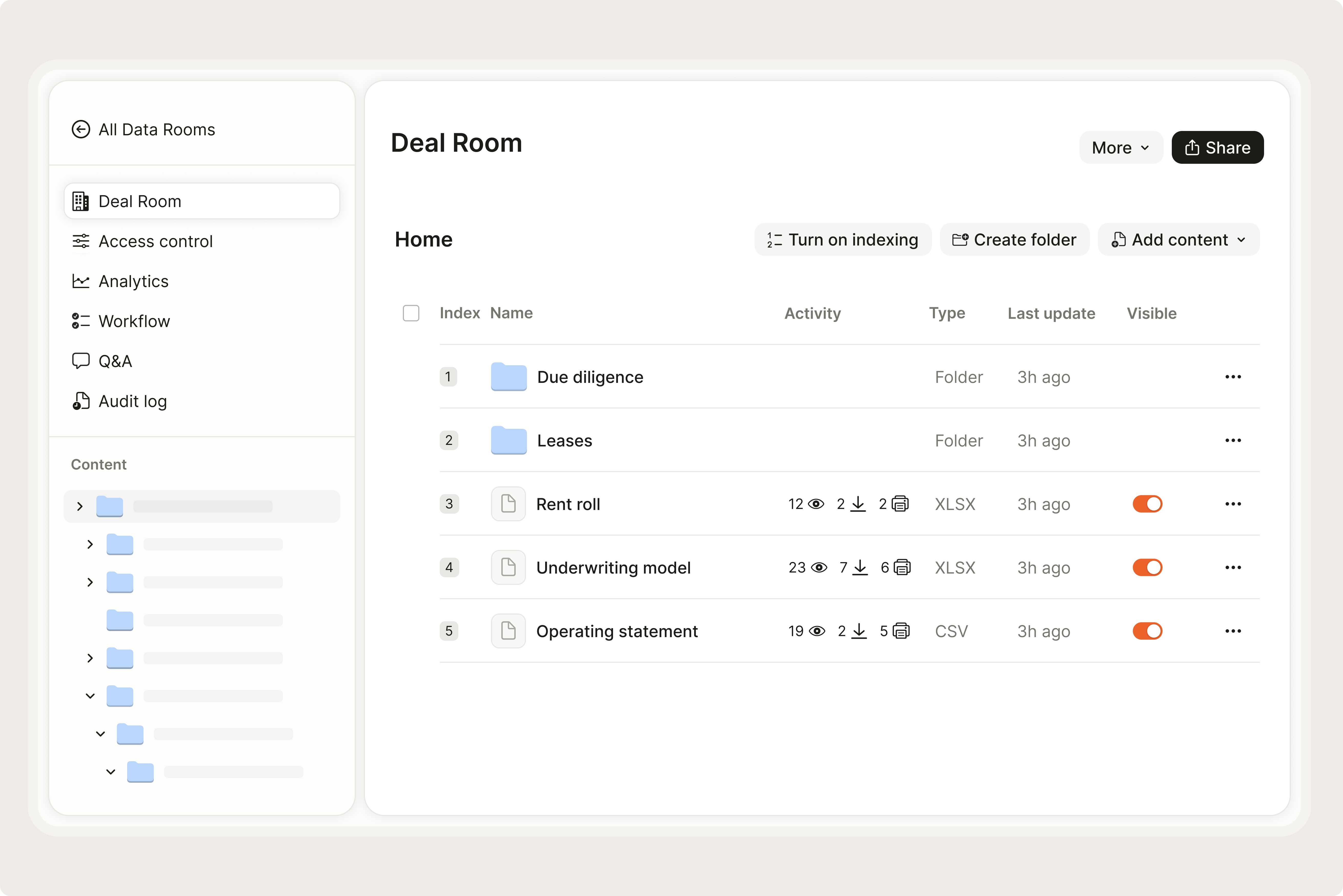
- 1.Upload Lithuania property files to a secure roomDrop NTR extract for land and building, cadastral data, building permit, completion act, EPC, restitution history documentation, environmental records (AAA register, Phase I ESA if applicable), tax clearance certificate, and commercial lease pack into Ellty.
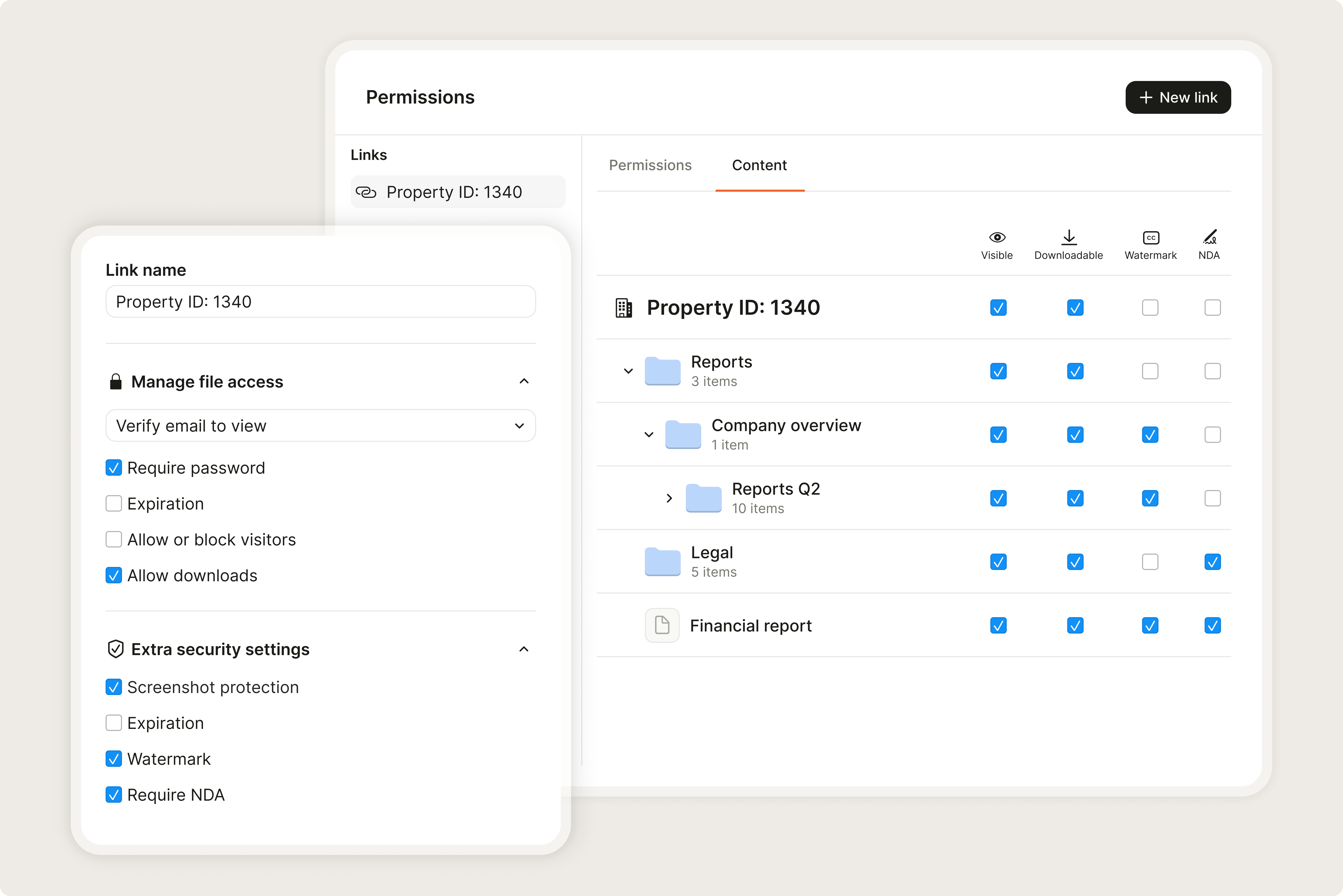
- 2.Give each advisor a scoped, tracked linkLithuanian attorney sees NTR extract, title chain, and building permit. Building inspector sees permit and completion act. Environmental consultant sees AAA records and Phase I ESA. VAT/tax counsel sees EPC and VAT analysis. Each party sees only their files.
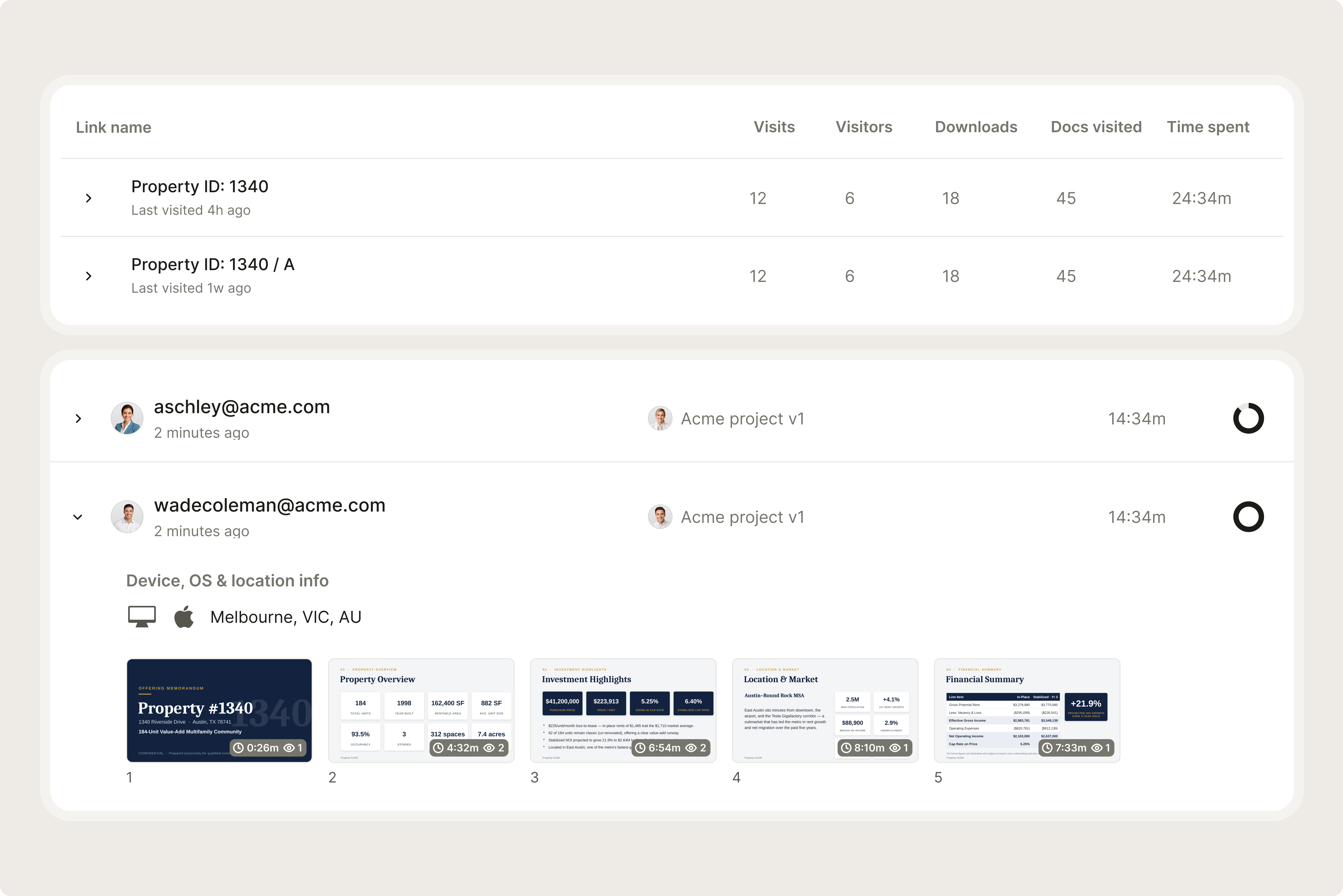
- 3.Monitor who reviews which documentsSee exactly which files each advisor opened and when. Catch restitution annotations or VAT position gaps before they affect deal pricing or notarial closing.
What makes Lithuania different
The Soviet-era land restitution issue is Lithuania-specific and has no equivalent in Western European commercial real estate diligence. When Lithuania declared independence in 1990, the Law on Property Restitution gave former owners and their heirs the right to claim back property that had been nationalized or confiscated by the Soviet regime from 1940 onward. The process was complex: some former owners claimed in-kind restitution (return of the actual parcel), which displaced whatever had been built on it in the Soviet era; others accepted equivalent land elsewhere or cash compensation. The restitution claims process ran from the early 1990s through approximately 2001-2003 when formal claim registration periods expired. Most claims are now resolved and most central Vilnius commercial property has clear post-restitution title chains. However, for buildings or parcels in areas of the city that were historically private and commercially active before Soviet occupation - particularly in Vilnius Old Town and the pre-war commercial streets of Kaunas - Lithuanian attorneys routinely check the pre-occupation ownership records and the restitution history as a standard title examination step. The restitution risk today is not that a new claim can be filed (the claim windows have closed for most categories), but that a claim that was properly filed and resolved may not be fully reflected in the current NTR records - for example, where the title transfer from the state back to the restituted owner happened informally or with incomplete registration documentation. An NTR search that appears clean but has a gap in the ownership chain between 1990 and 1995 should trigger a detailed ownership history review.
Lithuania's position as a Baltic EU member with strong integration into European commercial real estate markets means the diligence process is increasingly aligned with EU standards. EPBD (Energy Performance of Buildings Directive) implementation means EPCs are mandatory; EU AML framework means notaries and real estate agents conduct regulated CDD; EU law governs the regulatory and planning framework. The practical effect for an investor coming from a Western European market is that Lithuanian commercial due diligence is more familiar than most first-time Baltic investors expect. The unique Lithuania-specific elements are: the restitution history check for certain parcels, the Soviet-era contamination screening for former industrial areas, and the relatively thin institutional market outside Vilnius (office and logistics in Vilnius are reasonably liquid; retail and regional commercial outside Vilnius have limited exit market depth). An investor benchmarking Lithuanian commercial against German commercial should expect comparable legal structures but significantly thinner liquidity and smaller institutional buyer universe, which affects cap rate underwriting and exit assumptions.
Lithuania's Vilnius market has evolved significantly since 2020 driven by technology sector expansion, financial services relocation from Western Europe (Revolut, Nord Security, and other fintech companies established significant operations), and continued interest from Scandinavian and pan-European institutional real estate funds. Grade A office in Vilnius CBD (Šnipiškės business quarter and surrounding areas) has seen meaningful rental growth and yield compression from 2020 to 2025, making it the most liquid and institutionally benchmarked commercial segment in Lithuania. Logistics commercial has also been active, supported by Lithuania's position as a transit hub between Western Europe and the Baltic port at Klaipeda. Industrial and logistics parks along the A1 motorway corridor have attracted European logistics operators. For any Lithuanian commercial acquisition: confirm whether the asset is in the Vilnius Grade A office or logistics segment (where exit market depth exists) or in a regional or secondary asset category where exit market depth is thin and longer hold periods may be necessary.
The Law of the Republic of Lithuania on Property Restitution (No. I-1454, 1997, amending original 1990 legislation) established the procedure for restitution of real property to persons who were owners before 1940 and whose property was nationalized by the Soviet regime. Restitution was granted either in natura (return of the original parcel or an equivalent parcel) or by compensation in State securities, cash, or transfer of state-owned housing. The deadline for filing restitution claims was extended multiple times and final resolution of most claims was completed by local land reform commissions by 2001-2003. Article 12 of the Law provides that property restituted in natura and transferred to the former owner or heir is registered in the Real Property Register with a new ownership entry. Article 14 provides that any claim pending at the time of a commercial transfer must be disclosed in the transfer transaction documentation.
Timeline and cost in Lithuania
Weeks 1-2 cover kickoff: Centre of Registers NTR extract for land and building, INFOSTATYBA building permit and completion act verification, restitution history review (for central Vilnius and Kaunas), AAA contaminated site register search, EPC request from seller, VAT position analysis with Lithuanian tax counsel, lease abstraction, JAR entity confirmation, UBO register search, OFAC and EU sanctions screens, and AML/KYC. Lithuanian counsel fees in this phase: EUR 3,000-10,000.
Load all files into Ellty before advisors engage. Standard Lithuania commercial: 30-60 days. Restitution history review: 1-2 weeks additional for complex titles. Phase I ESA: 3-5 weeks.
Weeks 2-4 cover deep review: NTR encumbrance analysis, restitution history conclusion, building permit vs. cadastral area comparison, completion act confirmation, EPC energy class review and renovation cost estimate, Phase I ESA delivery (if ordered), lease registration status at NTR, VAT treatment confirmation with tax counsel, real property and land tax arrears confirmation, and lender pre-approval process. Costs in this phase: EUR 5,000-20,000.
Weeks 4-8 handle resolution: mortgage releases, seizure clearances, lease tenant first refusal notice period (where applicable), notarial deed preparation, joint review of transfer deed with Lithuanian notary, final NTR confirmation on day of signing, notarial closing, and Centre of Registers registration.
Lithuania total buyer transaction costs: notary fee (typically EUR 1,000-5,000 for commercial, set by Ministry of Justice schedule) + Centre of Registers registration fee (small, under EUR 100-200) + VAT 21% on new commercial building (if applicable, buyer recovers as input VAT if a VAT payer) + legal and advisory fees (1-2% of transaction value). No real estate transfer tax. Total effective buyer-side cost excluding VAT: 1-3% of transaction value. Total effective cost including irrecoverable VAT for a non-VAT payer: up to 24% of transaction value - confirm VAT position early.
Running a Lithuania property deal from one room
Hold Centre of Registers extracts, restitution docs, building permits, EPC certificates, and lease files in one secure, tracked Ellty data room.
Start free 14-day trialCommon questions about due diligence on Lithuania commercial property
- Standard Lithuania commercial deals take 30-60 days. Centre of Registers NTR search: 1-2 days online. Restitution history review for complex titles: 1-2 weeks. Building permit and completion act verification in INFOSTATYBA: 1-2 days. Phase I ESA with AAA register search (if ordered): 3-5 weeks. Notarial deed preparation: 1-2 weeks. Centre of Registers registration after notarial closing: 1-5 business days (electronic submission by notary is standard).
- After independence in 1990, Lithuania allowed former owners (and heirs) of Soviet-nationalized property to claim restitution. Most claims were resolved by 2001-2003. The risk today is not new claims (windows have closed) but incomplete registration of restitution outcomes in the NTR - a gap in the ownership chain between 1990 and 1995 should trigger detailed review. Highest risk areas: central Vilnius Old Town, Kaunas pre-war commercial streets, and parcels with historical private ownership before Soviet occupation. Standard NTR search plus ownership history review by Lithuanian counsel covers this risk.
- No. Lithuania has no real estate transfer tax (unlike the RETT in Germany or stamp duty in the UK). The main transaction costs are: notary fee (set by Ministry of Justice fee schedule, typically EUR 1,000-5,000 for commercial); Centre of Registers registration fee (modest, under EUR 200); and VAT at 21% if applicable on new commercial buildings. Legal and advisory fees add 1-2% of transaction value. Total buyer-side costs excluding VAT are typically 1-3% of transaction value.
- Lithuanian VAT at 21% applies to commercial property transactions when: (1) the building is 'new' - sold within 24 months of first occupation or within 24 months of substantial renovation; the seller is VAT-registered. For older commercial (more than 24 months since first occupation): the default is VAT exemption, but the seller can elect to charge VAT. For a VAT-registered buyer using the property for a taxable business: VAT paid on purchase is recoverable as input VAT. For non-VAT payer buyers: 21% VAT is an irrecoverable cost. Confirm VAT treatment with Lithuanian tax counsel before signing.
- Yes. EU citizens and EU-registered companies can own Lithuanian commercial real estate without any restrictions. Non-EU nationals and companies can also own commercial (urban) real estate. The only restriction applies to agricultural and forestry land, where non-EU nationals and certain foreign companies need to meet specific conditions or obtain permits. Lithuania is an EU and NATO member with a transparent land registry, stable legal system, and no currency risk (Euro since 2015).
- The main environmental risk in Lithuanian commercial real estate is contamination from Soviet-era industrial facilities. Former chemical plants, oil refineries, military facilities, and manufacturing operations left soil and groundwater contamination in certain industrial zones of Vilnius (Lazdynai, Naujoji Vilnia), Kaunas, and Klaipeda's port and industrial areas. The Environmental Protection Agency (Aplinkos apsaugos agentūra) maintains a contaminated sites register. Phase I ESA with AAA register search is recommended for any former industrial or port commercial acquisition. Lithuania as an EU member implements EU soil contamination remediation standards, which can make remediation cost requirements substantial.