Israel CRE deals have two surprises that catch non-Israeli buyers: over 93% of Israeli land is state-owned and held by the Israel Land Authority (ILA) on long-term leases, not in freehold; and a significant portion of older Israeli commercial buildings lack a valid Tofes 4 occupancy permit, making them technically non-compliant.
The Israeli land registry is called the Tabu (טאבו). All property rights, mortgages, and encumbrances are registered there. Tabu registration is the authoritative source of ownership.
For ILA leasehold assets - which is most of Israel - you're also dealing with the Israel Land Authority. Any lease assignment, sublease, or significant change of use may require ILA approval.
Purchase tax (mas rechisha) is 6% for commercial property, payable by the buyer within 30 days of signing. Model it before you bid - it's non-negotiable and non-recoverable.
Load all Tabu extracts, ILA lease documents, building permits, and Tofes 4 certificates into an Ellty data room before diligence opens. Each advisor gets a scoped, tracked link from day one.
Where Israeli deals actually go wrong
Not every check carries the same weight. The table below sorts risks by deal impact - dealbreakers first, then what moves the price, then basic hygiene - so your Israeli attorney and technical advisor know what to clear first.
| Area | Documents to pull | Israel red flag | Matters most for | Tier | |
|---|---|---|---|---|---|
| Title and Tabu search | Title and Tabu search | Tabu extract (נסח טאבו), chain of ownership, mortgage and lien search, registered rights | Tabu is the authoritative Israeli land registry; pull the Tabu extract and confirm all registered rights before any contract | All buyers | Dealbreaker |
| ILA land lease | ILA land lease | ILA lease contract, canon amount, lease term, renewal conditions, ILA approval requirements | 93% of Israeli land is ILA leasehold; any assignment or major use change may require ILA consent and fees | All buyers - most Israeli CRE | Dealbreaker |
| Tofes 4 - occupancy permit | Tofes 4 - occupancy permit | Tofes 4 certificate (טופס 4), building permit history, local municipality building files | Many Israeli commercial buildings lack valid Tofes 4; buildings without it cannot be legally occupied or insured | All asset types - office, retail, industrial | Dealbreaker |
| Zoning - Taba (תב"ע) | Zoning - Taba | Local detailed plan (תב"ע), building permit, local planning committee approval | Israeli zoning is via Taba (Tochnit Binyan VeIshur); confirm intended use is permitted under the current approved Taba | Development, repositioning | Dealbreaker |
| Environmental - contamination | Environmental - contamination | Phase I ESA, Ministry of Environment contaminated site register, underground tank records | Haifa Bay petrochemical zone, Kiryat Gat, and Ashdod port area carry significant industrial contamination | Industrial, logistics | Dealbreaker |
| Leases and tenancies | Leases and tenancies | All leases, rent roll, Israeli Landlord and Tenant Law compliance, bank guarantees, sublease consents | Israeli commercial tenants have statutory protection under the Landlord and Tenant Law; check protection status for each tenant | Income-producing assets | Price-adjuster |
| Betterment levy - heitel hashbacha | Betterment levy - heitel hashbacha | Municipality betterment levy notice, planning committee records, levy calculation | Israeli municipalities levy 50% of value increase when zoning improves; confirm seller has paid before closing | Development sites, rezoned land | Price-adjuster |
| Purchase tax and VAT structure | Purchase tax and VAT structure | Mas rechisha calculation, seller VAT dealer status, 30-day payment deadline, closing statement | 6% purchase tax on commercial property; if seller is a registered VAT dealer, 17% Israeli VAT also applies | All deals | Price-adjuster |
| Earthquake risk and asbestos | Earthquake risk and asbestos | Structural engineering report, seismic zone designation, asbestos survey (for pre-1994 buildings) | Israel sits on the Dead Sea Transform fault; asbestos is very common in Israeli buildings built before 1994 | All | Price-adjuster |
| Insurance and valuation | Insurance and valuation | Current policies, loss run, earthquake coverage confirmation, independent appraisal | Standard Israeli commercial policies often exclude earthquake damage; confirm earthquake coverage explicitly | All | Standard check |
| Seller KYC and AML | Seller KYC and AML | Israeli company registration (Rasham Hacvadot), UBO identification, sanctions check, attorney compliance | Israeli attorney AML compliance requires KYC verification; attorneys can refuse to act if AML concerns arise | All deals | Standard check |
Due diligence on an Israeli property?
Set up your Ellty data room before diligence starts.
Start free 14-day trialIsrael CRE checklist
The table ranked risks by severity. This is the full list to work through, grouped by area.
Title and Tabu search
- Pull the Tabu (טאבו) extract (נסח טאבו) for the property parcel before any contract is signed
- Confirm the registered owner matches the seller entity in all sale documents exactly
- Search for mortgages (משכנתאות), liens, and registered rights (זכויות רשומות) on the Tabu extract
- For co-owned properties (שיתוף): confirm the fractional ownership and any co-owner consent requirements
- Check for apartment rights (זכויות דייר מוגן - protected tenants) registered on the Tabu
- Run the full Tabu history to identify any chains of title gaps or unresolved inheritance transfers
ILA land lease
- Confirm whether the land is ILA leasehold (חכירה) or private freehold (בעלות פרטית) via the Tabu
- Pull the ILA lease contract and confirm the lease term, current canon (חכירה fee), and renewal conditions
- For commercial ILA leases: confirm the permitted use under the lease matches the intended commercial activity
- Determine if ILA approval is required for the transfer; ILA may charge a transfer fee (דמי הסכמה) of 1-3% of value
- For older ILA leases: check whether the lease has been capitalized (היוון) and confirm the impact on canon obligations
- Contact the ILA (רשות מקרקעי ישראל) directly for confirmation of outstanding obligations and transfer approval status
Tofes 4 - occupancy permit
- Confirm the Tofes 4 (טופס 4) certificate is valid and covers all current uses in the building
- Pull the full building permit (היתר בניה) history from the local municipality (ועדה מקומית לתכנון ובניה)
- For buildings without a valid Tofes 4: obtain a legal opinion on the cost and timeline to regularize
- Confirm any building extensions or modifications have their own permits and Tofes 4 coverage
- A building without Tofes 4 cannot be legally occupied; confirm tenants are not at regulatory risk
- Check for open enforcement orders from the local planning committee against the building
Zoning - Taba (תב"ע)
- Confirm the current approved detailed building plan (תוכנית בנייה ועיצוב - Taba) for the parcel
- Check the permissible uses, floor area ratios, setbacks, and building heights under the current Taba
- For Tel Aviv: confirm the specific detailed plan; Tel Aviv has hundreds of overlapping Taba plans
- Check for pending Taba amendments or rezoning at the local or district planning committee
- For development sites: confirm available building rights (זכויות בניה) and betterment levy (היטל השבחה) exposure
Environmental - contamination
- Commission a Phase I ESA for the site; confirm the environmental consultant is registered with the Ministry of Environmental Protection
- Search the Israeli Ministry of Environmental Protection contaminated site register for the parcel
- For Haifa Bay, Kiryat Gat, and Ashdod port-adjacent sites: order Phase II investigation immediately
- Check for underground storage tanks (USTs) at petrol, chemical, or industrial heritage sites
- Budget Phase II ESA and remediation costs early for any former industrial site in an Israeli urban area
Leases and tenancies
- Collect all leases and identify any protected tenants (דיירות מוגנת) with statutory protection under Israeli law
- Protected tenants (diyur muggan) have near-permanent occupancy rights and extremely limited ground rent; they can't simply be evicted
- Cross-reference the rent roll against 12 months of actual bank receipts from the seller
- Check bank guarantees (ערבות בנקאית) and personal guarantees backing each commercial lease
- Confirm the lease terms comply with Israeli commercial lease law and the Planning and Building Law permits
Issue NDA-tracked links in Ellty when sharing lease files with multiple advisors. Each party gets a watermarked, scoped link; you see who opened what file and when.
Betterment levy - heitel hashbacha (היטל השבחה)
- Request the betterment levy status from the local municipality planning committee
- Confirm the seller has paid all outstanding betterment levy before closing; unpaid levies transfer to the buyer
- For rezoned or recently permitted development sites: calculate the potential levy exposure (50% of value uplift)
- Confirm whether any betterment levy exemptions apply (e.g., social housing, public use)
Purchase tax and VAT structure
- Confirm the purchase tax (mas rechisha) rate: 6% for commercial property for both individuals and corporates
- Determine whether the seller is a registered VAT (מע"מ) dealer; if so, 17% Israeli VAT applies to the transaction
- For buyer who is a VAT-registered company: input VAT on the purchase may be deductible
- Purchase tax must be declared and paid to the Israeli Tax Authority within 30 days of contract signing
- Model the total acquisition cost: 6% purchase tax + attorney fees (1-1.5%) + ILA transfer fee (if applicable)
Earthquake risk and asbestos
- Commission a structural engineering report for all commercial buildings; confirm seismic zone classification
- Israel sits on the Dead Sea Transform fault; northern regions (Galilee, Golan) carry highest seismic exposure
- For buildings constructed before 1994: commission an asbestos survey; asbestos is extremely prevalent in Israeli commercial construction of that era
- Confirm earthquake insurance coverage; many standard Israeli commercial policies have earthquake exclusions
Insurance and valuation
- Pull current insurance policies and 3-year loss run from the seller
- Confirm earthquake damage is explicitly covered; Israeli commercial insurers often exclude it by default
- Order an independent appraisal from a licensed Israeli appraiser (שמאי מקרקעין מוסמך) for lender requirements
- Confirm war and security risk coverage if the property is in border regions or near conflict-exposed areas
Seller KYC and AML
- Pull a Rasham Hacvadot (Companies Registrar) extract confirming the selling entity is in good standing
- Identify all beneficial owners; Israeli AML law requires attorney and broker KYC verification
- Run a sanctions and PEP check against the seller and all beneficial owners before committing
- Confirm the seller's attorney has performed their own AML compliance review; attorney duty applies under Israeli law
How due diligence in Israel works
Step 1 - Tabu search and ILA confirmation
Pull the Tabu extract and the ILA lease contract on day one. For ILA leasehold assets, confirm the lease term, canon amount, and whether ILA transfer approval is required before you commit to any price.
ILA transfer fees (דמי הסכמה) can run 1-3% of the assessed land value - a significant additional cost on top of purchase tax. Get the ILA fee estimate from the authority in writing before bidding.
Step 2 - Tofes 4 and building permits
Tofes 4 is the single most common technical dealbreaker in Israeli CRE. Confirm it's valid and covers all current uses. Many Israeli commercial buildings - particularly in older urban areas of Tel Aviv and Jerusalem - have additions built without permits that haven't been regularized.
Pull the full building permit history from the local planning committee. An unpermitted extension adds regularization cost and time; in some cases it's not regularizable at all under the current Taba.
Step 3 - Leases and protected tenants
The biggest income risk in Israeli commercial real estate after Tofes 4 is undisclosed protected tenants (diyur muggan). Protected tenants pay nominal ground rent and have near-permanent occupancy rights. They don't appear on a standard rent roll. Physical inspection and direct interviews with all building occupants are essential.
Compare Jordan's protected tenancy risk if you work across MENA markets. Both countries have legacy occupancy protection laws that allow verbal or long-standing occupants to claim statutory rights that survive ownership transfer.
Step 4 - Environmental review
Commission the Phase I ESA before contract if possible. Israeli industrial heritage is concentrated in Haifa Bay, Kiryat Gat, Ashdod, and the outskirts of Tel Aviv; sites in these areas carry high contamination probability.
Load all environmental documents into Ellty. Environmental consultants, the lender's team, and the legal team each get tracked access. You see who reviewed each finding and when - critical for keeping a multi-advisor Israeli diligence process on schedule.
Step 5 - Closing via Israeli attorney
Israeli commercial property transactions close via licensed Israeli attorneys. There is no civil law notary system in Israel. Both buyer and seller use their own attorneys; the seller's attorney typically prepares the sale deed.
Purchase tax payment to the Israeli Tax Authority must occur within 30 days of contract signing. Missing this deadline triggers penalties. The buyer's attorney handles the Tabu registration filing after closing.
How to set up your Israel data room in Ellty.
Israeli CRE deals involve the Tabu, ILA, local planning committees, and the tax authority across multiple weeks. Load files into Ellty before advisors arrive. Each party gets a scoped, tracked link from day one.
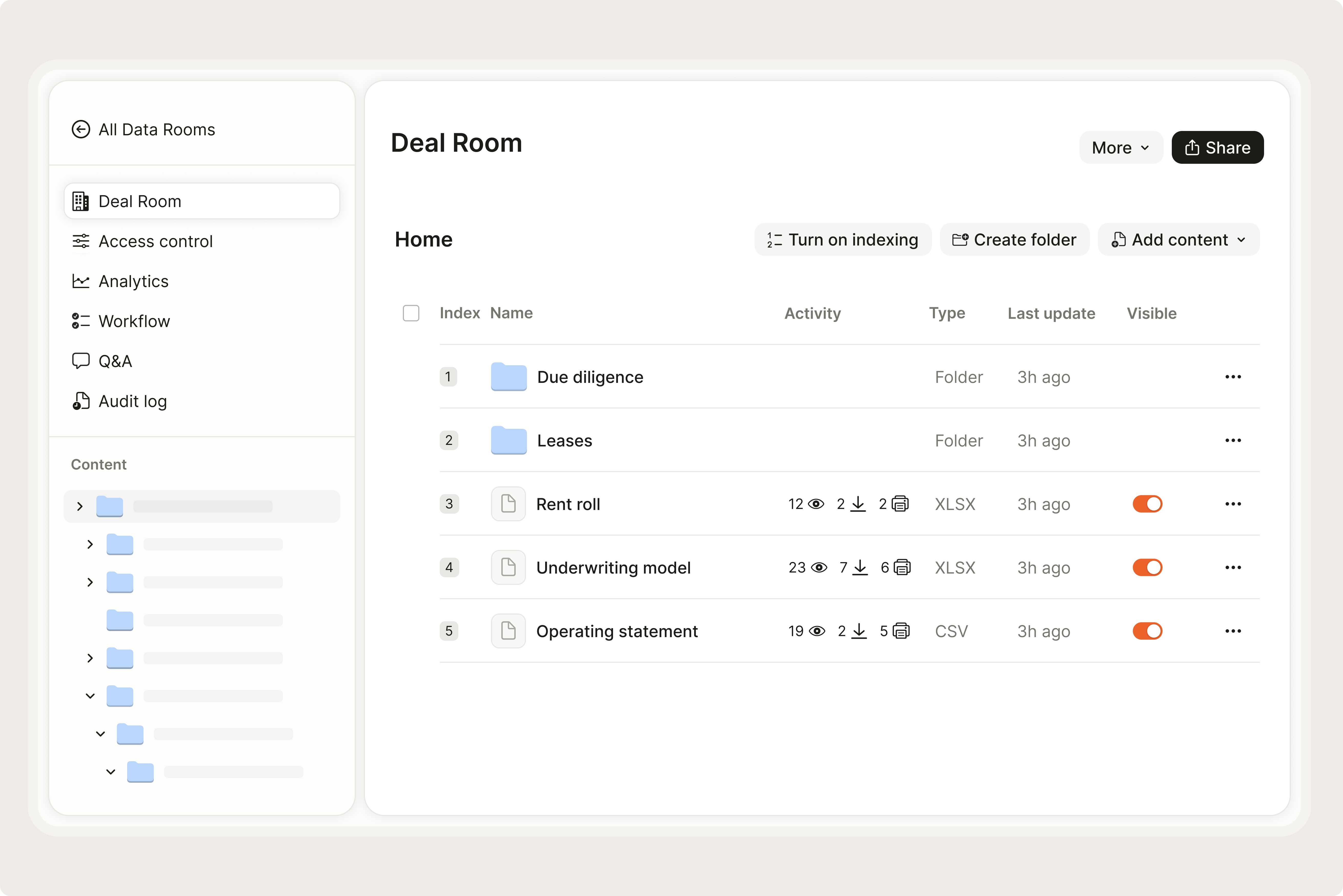
- 1.Upload Israeli property files to a secure roomDrop Tabu extracts, ILA lease docs, building permits, Tofes 4, leases, and Phase I ESA into Ellty. Each folder maps to a diligence area.
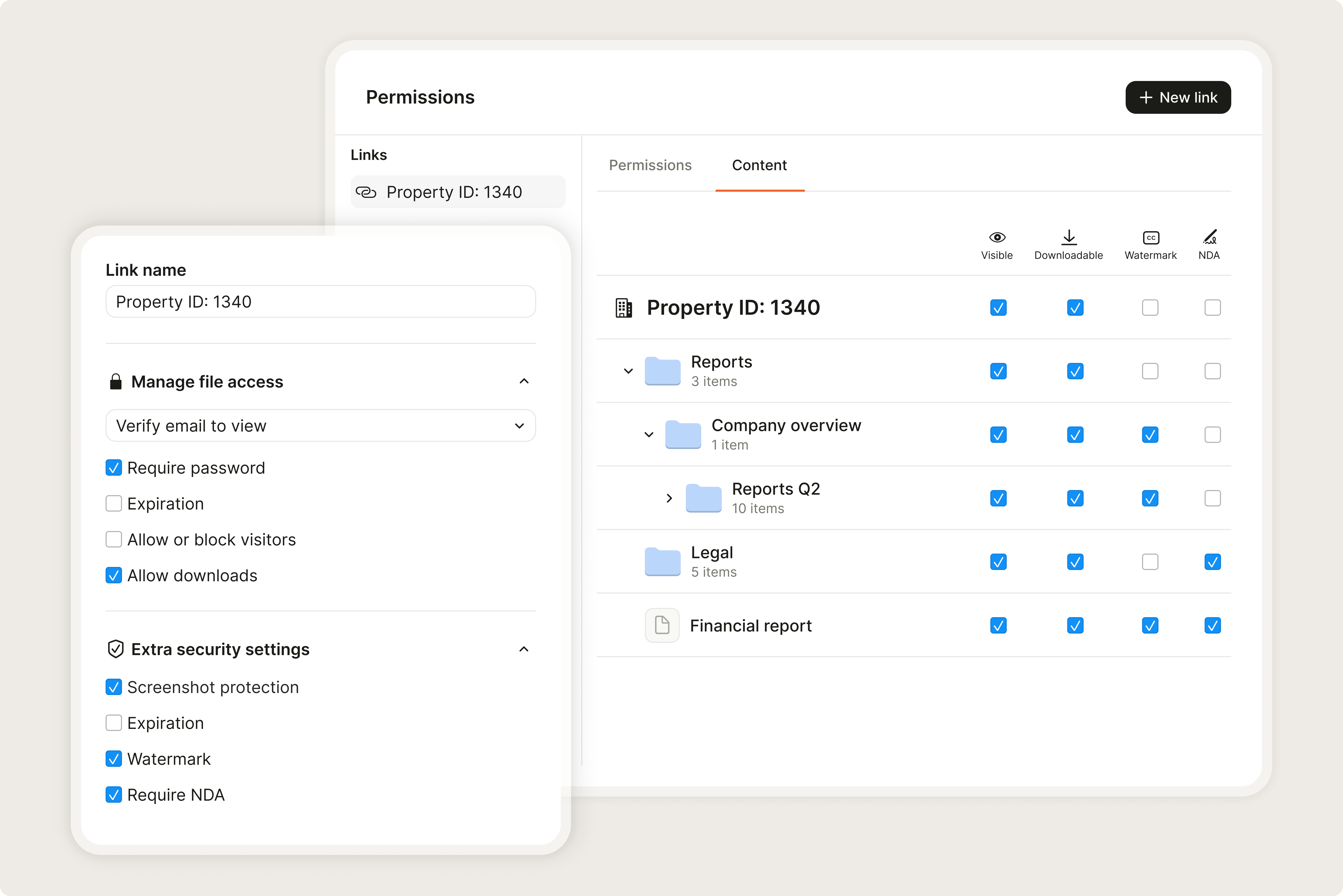
- 2.Give each advisor a scoped, tracked linkYour attorney sees Tabu and title docs. Your environmental consultant sees Phase I reports. Your tax advisor sees purchase tax analysis. Ellty enforces the scope.
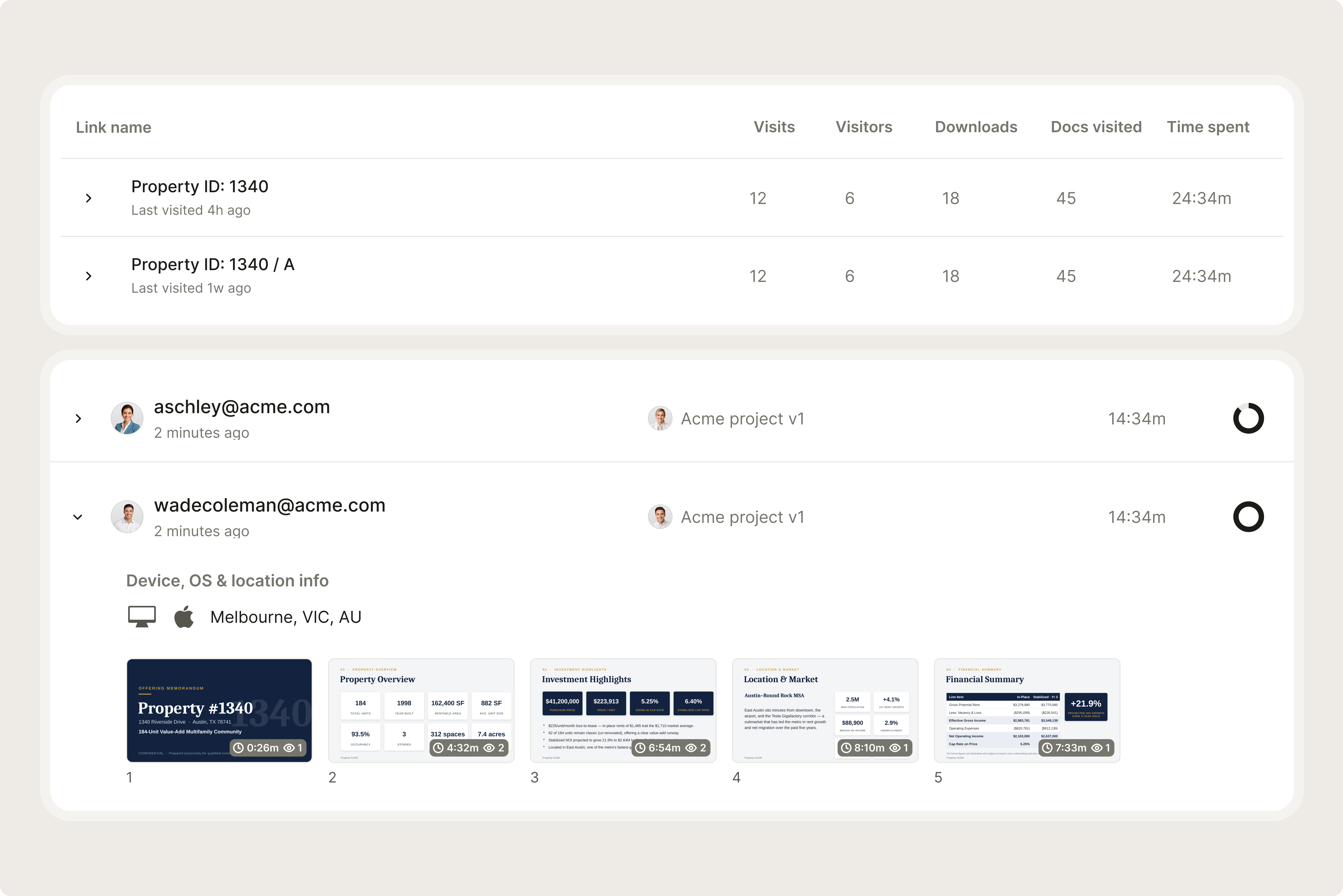
- 3.Monitor who reviews which documentsSee exactly which files each advisor opened and when. Catch delays before they affect the 30-day purchase tax deadline.
What makes Israel different
The ILA leasehold structure catches almost every non-Israeli buyer the first time. Over 93% of Israeli land is state-owned. You're not buying freehold - you're buying a long-term lease from the Israel Land Authority. The ILA has rights over assignment, sublease, and change of use. Factor in the ILA transfer fee before bidding.
Tofes 4 is non-negotiable. A building without a valid occupancy permit cannot legally be used. Banks won't lend on it, tenants can be forced to vacate by the municipality, and insurance coverage is void. The prevalence of missing or expired Tofes 4 in Israeli commercial buildings is genuinely high.
Protected tenants (diyur muggan) represent the most underreported income risk in Israeli CRE. They exist predominantly in older urban properties and are not listed on rent rolls. You find them by walking the building. Any building with legacy residential or commercial occupants from before the 1980s should be physically inspected before signing.
Betterment levy applies when zoning improves - and in Israel, with active rezoning in Tel Aviv, Jerusalem, and other urban markets, that's not rare. Confirm the seller has paid it before closing. It doesn't automatically show up in the seller's disclosure.
The Israel Land Administration (now Israel Land Authority) was established to manage state lands, which constitute approximately 93 percent of all land in Israel. Land is leased to individuals and entities on long-term capitalized or annual lease arrangements. The lessee holds real property rights registered in the Land Registry, but the state retains ultimate ownership of the land. Transfer of leasehold rights generally requires ILA consent and may be subject to a transfer fee.
Timeline and cost in Israel
Weeks 1-2 cover kickoff: Tabu extract, ILA lease review, ILA transfer fee inquiry, building permit and Tofes 4 check, Taba zoning confirmation, and purchase tax calculation. Budget ILS 20,000-50,000 for this phase.
Load all files into Ellty before advisors arrive. Scoped, tracked links for each party remove at least one week of document request emails from a standard Israeli diligence process.
Weeks 2-4 cover deep review: Phase I ESA, protected tenant identification via site visit, lease abstraction, betterment levy clearance from the municipality, and ILA approval confirmation. Cost runs ILS 30,000-80,000 depending on complexity.
For sites with Tofes 4 issues: get a legal opinion and municipality estimate immediately. Regularization can take 6-18 months and cost ILS 50,000-500,000 depending on the scope of non-permitted works.
Weeks 4-6 handle resolution: Phase II if triggered, Tofes 4 regularization timeline, ILA approval receipt, purchase tax payment deadline management, and Tabu registration filing. Tabu registration completes within 2-4 weeks of filing.
Total acquisition cost in Israel: 6% purchase tax + attorney fees (1-1.5% buyer-side) + ILA transfer fee (0-3% if applicable). For a commercial deal in Tel Aviv, expect 8-11% total acquisition cost on top of the purchase price.
Running an Israeli property deal from one room
Hold Tabu extracts, ILA lease docs, and building permits in one secure, tracked Ellty data room.
Start free 14-day trialCommon questions about due diligence on Israeli property
- Most Israeli CRE deals complete in 4-8 weeks. ILA transfer approval and Tofes 4 regularization (if required) are the longest lead-time items.
- The Israel Land Authority (ILA) manages over 93% of Israeli state land. Most Israeli commercial property sits on long-term ILA leaseholds, not freehold title. Any sale, sublease, or major use change may require ILA consent and trigger a transfer fee of 1-3% of assessed land value.
- Tofes 4 (Form 4) is the Israeli occupancy certificate issued by the local planning committee after a building passes its final inspection. Without a valid Tofes 4, a building cannot be legally occupied, insured, or mortgaged. Many older Israeli commercial buildings have missing or expired Tofes 4 certificates.
- Purchase tax (mas rechisha) on commercial property is 6% for both individuals and corporate buyers. It must be declared and paid to the Israeli Tax Authority within 30 days of contract signing. Missing this deadline triggers penalties.
- Protected tenants (diyur muggan) are occupants with statutory occupancy rights under the Israeli Landlord and Tenant Law. They pay nominal ground rent and cannot simply be evicted. They are common in older Israeli commercial buildings and don't always appear on rent rolls. Physical inspection is essential.
- Yes. There are no foreign ownership restrictions on commercial real estate in Israel. Non-residents can buy freely. However, if the land is ILA leasehold (which is most Israeli commercial land), ILA approval for the transfer is still required regardless of buyer nationality.