France commercial property has two timeline risks most non-French buyers miss: the droit de préemption urbain (the municipality's right of first refusal, which can delay closing by 2 months) and the amiante (asbestos) technical diagnostic - mandatory for all commercial buildings built before 1997, and invariably complex in older assets.
France uses a civil law system; all property transfers require a notaire (notary public). The notaire searches title at the SPF (Service de Publicité Foncière), prepares the acte de vente, and registers the transfer. Both buyer and seller typically have separate notaires in commercial transactions.
Transfer taxes (DMTO - Droits de Mutation à Titre Onéreux) run approximately 5.8% of the purchase price for commercial property, plus notaire emoluments of around 0.8-1%. Total transfer friction runs 6.5-7% before legal fees. For new commercial buildings (under 5 years from first transfer), TVA at 20% applies instead of DMTO.
French commercial leases (baux commerciaux) are heavily regulated under the Code de Commerce. The standard term is 9 years with tenant break rights every 3 years. At the end of the term, the tenant has a statutory renewal right; if the landlord refuses, it owes an indemnité d'éviction.
Set up an Ellty data room before diligence opens. Load SPF title extracts, technical diagnostics, PLU planning documents, and bail commercial files before advisors arrive. Each advisor gets a scoped link from day one.
Where France property deals go wrong
Not every check carries the same weight. The table below sorts risks by deal impact - dealbreakers first, then what moves the price, then basic hygiene - so your notaire and technical advisor know what to clear first.
| Area | Documents to pull | France red flag | Matters most for | Tier | |
|---|---|---|---|---|---|
| Title - SPF fichier immobilier | Title - SPF fichier immobilier | SPF title extract (état hypothécaire), titre de propriété, servitudes, hypothèques | French title is registered with SPF (Service de Publicité Foncière); the état hypothécaire confirms ownership, mortgages, and registered charges | All buyers | Dealbreaker |
| Droit de préemption urbain (DPU) | Droit de préemption urbain (DPU) | DIA (Déclaration d'Intention d'Aliéner), DPU zone maps, commune response | French municipalities have a statutory right of first refusal (DPU) to buy urban commercial property; the DIA must be filed and the commune has 2 months to preempt | All commercial urban assets | Dealbreaker |
| ICPE classification - contamination | ICPE classification - contamination | ICPE register, BASIAS database, BASOL contaminated sites, Phase I ESA, ARS records | Former ICPE (classified installation) sites carry residual remediation obligations that can bind subsequent owners; BASIAS and BASOL must both be searched | Industrial, brownfield | Dealbreaker |
| Amiante (asbestos) - DTA | Amiante (asbestos) - DTA | DTA (Dossier Technique Amiante), DAPP (Dossier Amiante Parties Privatives), asbestos survey report | All French commercial buildings built before 1997 require a current DTA; asbestos in ceilings, floor tiles, and insulation is common; removal costs can be significant | Pre-1997 buildings | Dealbreaker |
| Bail commercial and renewal rights | Bail commercial and renewal rights | All baux commerciaux, droit au bail, pas-de-porte records, indemnité d'éviction estimates | French commercial tenants have a statutory right to renew at the end of their 9-year term; refusing renewal triggers an indemnité d'éviction that can equal several years of rent | Income-producing assets | Price-adjuster |
| DMTO, TVA, and fiscal structure | DMTO, TVA, and fiscal structure | Building age, first transfer date, TVA option analysis, DMTO calculation, notaire emoluments | France: DMTO (~5.8%) applies to used commercial buildings; TVA (20%) replaces DMTO for new buildings within 5 years of first transfer; structure affects the total acquisition cost materially | All deals | Price-adjuster |
| PLU planning and permits | PLU planning and permits | PLU extract (certificat d'urbanisme), PC (permis de construire), DAACT conformity certificate | French buildings must have a DAACT (déclaration d'achèvement et conformité) confirming works comply with the building permit; missing DAACT creates regularization risk | All buildings | Price-adjuster |
| DPE and diagnostics bundle | DPE and diagnostics bundle | DPE (Diagnostic de Performance Energétique), ERP, DTA, plomb diagnostic, ERNMT | France requires a full bundle of technical diagnostics for all commercial property transactions; an incomplete or outdated DPE blocks the acte de vente | All commercial buildings | Price-adjuster |
| Insurance and valuation | Insurance and valuation | Current policies, loss run, RICS or FSMA-approved appraisal, flood risk (GEORISQUES) | Georisques (georisques.gouv.fr) shows flood zones, seismic risk, industrial risk, and radon for any French property; the ERP declaration must reference it | All | Standard check |
| Utilities and charges de copropriété | Utilities and charges de copropriété | EDF/GDF contracts, water accounts, charges de copropriété 3-year history, syndic reports | For properties in a copropriété (strata/condominium structure): unpaid charges de copropriété create a charge on the lot; request 3 years of syndic accounts and confirm no arrears | Multi-unit buildings | Standard check |
| Seller KYC and AML | Seller KYC and AML | Extrait Kbis (company registry), RBE (UBO register), Tracfin AML obligations, sanctions screen | French notaires and avocats are required under AMLD5 to perform KYC and RBE (Registre des Bénéficiaires Effectifs) verification on all property transactions | All deals | Standard check |
Due diligence on a France property?
Set up your Ellty data room before diligence starts.
Start free 14-day trialFrance CRE checklist
The table ranked risks by severity. This is the full list to work through, grouped by area.
Title - SPF fichier immobilier
- Request the état hypothécaire from the SPF (Service de Publicité Foncière) for the property; this confirms current ownership, registered mortgages, and encumbrances
- Confirm the titre de propriété matches the seller entity exactly; French title can be held in SCI (Société Civile Immobilière) structures
- Check all registered hypothèques (mortgages); the notaire will confirm discharge on closing as a condition of the acte de vente
- Confirm all servitudes (easements) and restrictions registered on the title; right-of-way and utility easements can affect redevelopment plans
- Check for any registered gage (pledge) or antichrèse affecting the property
Droit de préemption urbain (DPU)
- Confirm whether the property is in a DPU zone via the PLU or the mairie; most urban commercial property in France is within a DPU zone
- The seller must file a DIA (Déclaration d'Intention d'Aliéner) with the commune before signing; the commune has 2 months to exercise preemption
- Factor the 2-month DPU period into the deal schedule; it cannot be waived contractually between buyer and seller
- Confirm the mairie has issued a renonciation (non-preemption) before the acte de vente
- In Paris: the City of Paris exercises DPU actively, particularly for large commercial assets in priority zones; preemption risk is real
ICPE classification - contamination
- Search the BASIAS (historical industrial activities) database for all prior industrial or commercial use on the site
- Search BASOL (active contaminated sites) for any current remediation obligation attached to the property address
- Confirm via the ICPE register whether the site currently holds or historically held an ICPE (classified installation) authorization
- Former ICPE operators have specific cessation and remediation obligations; confirm whether these obligations transferred to a current or previous property owner
- For industrial sites in the Paris basin, Seine-Saint-Denis, Hauts-de-France, and Rhône valley: ICPE exposure is significant; Phase I and II ESA are required
- Engage an ICPE-specialist environmental consultant; general property surveyors often lack the ICPE expertise to assess the risk correctly
Amiante (asbestos) - DTA
- Confirm the DTA (Dossier Technique Amiante) exists and is current for all pre-1997 commercial buildings
- Asbestos in pre-1997 French commercial buildings is ubiquitous: faux plafonds (suspended ceilings), dalles de sol (floor tiles), calorifugeage (pipe insulation), and colle (adhesives)
- Review the DTA for the presence and condition of asbestos materials and their containment status
- For any planned works, an asbestos survey (repérage avant travaux) by a certified diagnostiqueur is required before any contractor commences
- Budget asbestos management and removal as a significant capex item for pre-1990 French commercial buildings
Bail commercial and renewal rights
- Collect all baux commerciaux; confirm the 3-6-9 structure, rent review provisions, and any remaining fixed term
- Identify which tenants have completed 9 years and therefore have vested droit au bail (renewal rights)
- For prime tenants in Paris or major French cities: the indemnité d'éviction is calculated based on the tenant's fonds de commerce value; for major occupiers, it can equal several years of rent
- Confirm any existing pas-de-porte (key money) paid by tenants; this affects the true yield calculation
- Check rent indexation: French commercial leases use the ILC (Indice des Loyers Commerciaux) or ILAT index; confirm the applicable index and last review date
Give each advisor a scoped link in Ellty. Your notaire sees SPF title documents. Environmental consultants see BASIAS and ICPE reports. Technical advisors see DTA and building reports. No overlap, no access creep.
DMTO, TVA, and fiscal structure
- Confirm the building's age and first transfer date; if the first transfer of a new building occurred within 5 years, TVA (20%) applies instead of DMTO
- Calculate DMTO at approximately 5.8% on the purchase price; add notaire emoluments of 0.8-1%
- For VAT-registered buyers of TVA-liable commercial property: confirm the TVA is recoverable and the timing of recovery with the French tax advisor
- Option to tax: for second-hand commercial buildings, seller and buyer can elect TVA treatment; useful if buyer is fully VAT-registered and TVA recovery is immediate
- Confirm with the French tax advisor whether any TVA clawback obligation (régularisation) applies from a previous TVA election on the property
PLU planning and permits
- Request the certificat d'urbanisme (CU) from the mairie to confirm the planning designation and any preemption zones
- Pull the permis de construire (PC) and all subsequent modifications (permis modificatif)
- Confirm the DAACT (Déclaration Attestant l'Achèvement et la Conformité des Travaux) was filed and approved; this is the French completion certificate confirming works match the permit
- For any unauthorized works identified: assess the risk of mairie enforcement action and budget the regularization cost
- For Paris and IDF (Ile-de-France): check the PLU bioclimatique (adopted 2023 for Paris) and its implications for any conversion or repositioning plans
DPE and diagnostics bundle
- Confirm the DPE (Diagnostic de Performance Energétique) is current and in the SCE system; mandatory for all commercial property sales since July 2022
- Check the energy class; France is implementing EU minimum energy performance requirements; commercial buildings rated F or G face restrictions and mandatory upgrade timelines
- Confirm the ERP (État des Risques et Pollutions) declaration is current; it references Georisques data and must be included in the sale file
- For pre-1949 buildings: confirm the plomb (lead) diagnostic is up to date
- The complete diagnostics file (dossier de diagnostic technique) must be annexed to the preliminary contract and the acte de vente
ICPE and environmental review - broader check
- Use the Georisques portal to check flood risk zones, seismic zones, industrial technology risk, radon, and soil movement risk for the property address
- For Alsace and Lorraine: former mining areas (potasse, charbon) carry specific subsidence and contamination risk; check BRGM BDMIN records
- For the Atlantic coast: coastal erosion risk maps (SRTM) for logistics or industrial assets near the coast
- For Rhône-Alpes and Lyon industrial zone: chemical industry contamination is common along the Rhône valley
Load all Phase I ESA, BASIAS, BASOL, and ICPE reports into Ellty. Environmental specialists, lenders, and notaires each get tracked, watermarked access from one secure link.
Insurance and valuation
- Confirm current insurance coverage includes the current commercial use class; verify the policy is in the seller's entity name
- Confirm the policy includes assurance décennale (10-year construction liability) for any recent major works
- Commission an independent valuation from a RICS-qualified or AMF-accredited valuator for lender requirements
- For Paris assets: confirm the property is not in an airspace restriction zone (ZPP) around Charles de Gaulle or Orly airports affecting height
Utilities and charges de copropriété
- Confirm EDF/ENEDIS electricity and GDF/GRDF gas account details; outstanding arrears should be confirmed with the relevant supplier
- For properties in a copropriété: request 3 years of syndic accounts; confirm no outstanding charges and no major voted works in the pipeline
- Confirm the diagnostics électricité and diagnostics gaz if required for the specific property type
Seller KYC and AML
- Pull the Extrait Kbis from Infogreffe confirming the selling entity is in good standing
- Pull the RBE (Registre des Bénéficiaires Effectifs) extract confirming UBO disclosure
- French notaires are Tracfin-designated entities; they perform KYC and report suspicious transactions; confirm your notaire is meeting this obligation
- Run OFAC, UN, EU, and OFAC France sanctions checks against the seller and all UBOs
How due diligence in France works
Step 1 - SPF title and DPU
Pull the état hypothécaire from SPF and confirm whether the property is in a DPU zone on day one. If DPU applies, file the DIA with the mairie as early as possible. The 2-month preemption period runs from DIA filing; it cannot be shortened. It must be factored into every French CRE timeline.
Obtain the certificat d'urbanisme simultaneously. The CU confirms the planning designation, preemption zones, and any outstanding urban planning obligations for the site.
Step 2 - Asbestos and diagnostics
Commission the DTA review and the full diagnostics bundle early. For any pre-1997 building - which is most commercial property in France - the DTA is non-negotiable. Asbestos is present in virtually all pre-1997 French commercial assets; the question is where, what condition, and what it costs to manage or remove.
Review the DPE energy class alongside the DTA. French commercial buildings rated F or G face upcoming mandatory upgrade timelines under EU Directive 2010/31/EU as amended. Budget the energy improvement capex and model its impact on the NOI.
Step 3 - ICPE and environmental
Run BASIAS and BASOL searches. For any site with former industrial use, commission Phase I ESA. The ICPE register is critical: if the site was ever a classified installation, the remediation obligations chain must be traced. In French law, a buyer of contaminated land can inherit remediation obligations in certain circumstances even without contractual assumption.
Compare Luxembourg's CRE diligence process if you hold Benelux and French portfolio assets. Both are civil law notary systems with separate title registration and fiscal databases. Luxembourg's transfer tax (6-7% total) runs similar to France's DMTO structure; however, Luxembourg has no DPU preemption equivalent, which is a meaningful process difference.
Step 4 - Bail commercial review
Review all baux commerciaux and identify which tenants are in their renewal window. The 9-year bail commercial structure creates predictable decision points every 3 years. Tenants who have been in place for 9+ years have strong renewal rights and potentially significant indemnité d'éviction claims if you want to reposition.
Track each advisor's document access in Ellty. If the environmental consultant is reviewing the ICPE register three times, that's where the question will come from. Address it before the report is issued.
Step 5 - Acte de vente and notaire closing
French commercial closings are completed at the notaire's office with both parties or their representatives present. DMTO is paid by the notaire to the relevant tax authorities from the closing funds. The SPF registers the transfer within weeks; provisional title dates from the acte de vente execution.
For larger transactions, a compromis de vente or promesse de vente is signed before the acte; this creates binding obligations before the DPU period has run. Confirm the DPU renonciation is received before the acte de vente date is confirmed.
How to set up your France data room in Ellty.
France CRE deals involve SPF title, DPU, diagnostics, ICPE, PLU planning, and bail commercial across multiple weeks. Load files into Ellty before advisors arrive. Each party gets a scoped, tracked link from day one.
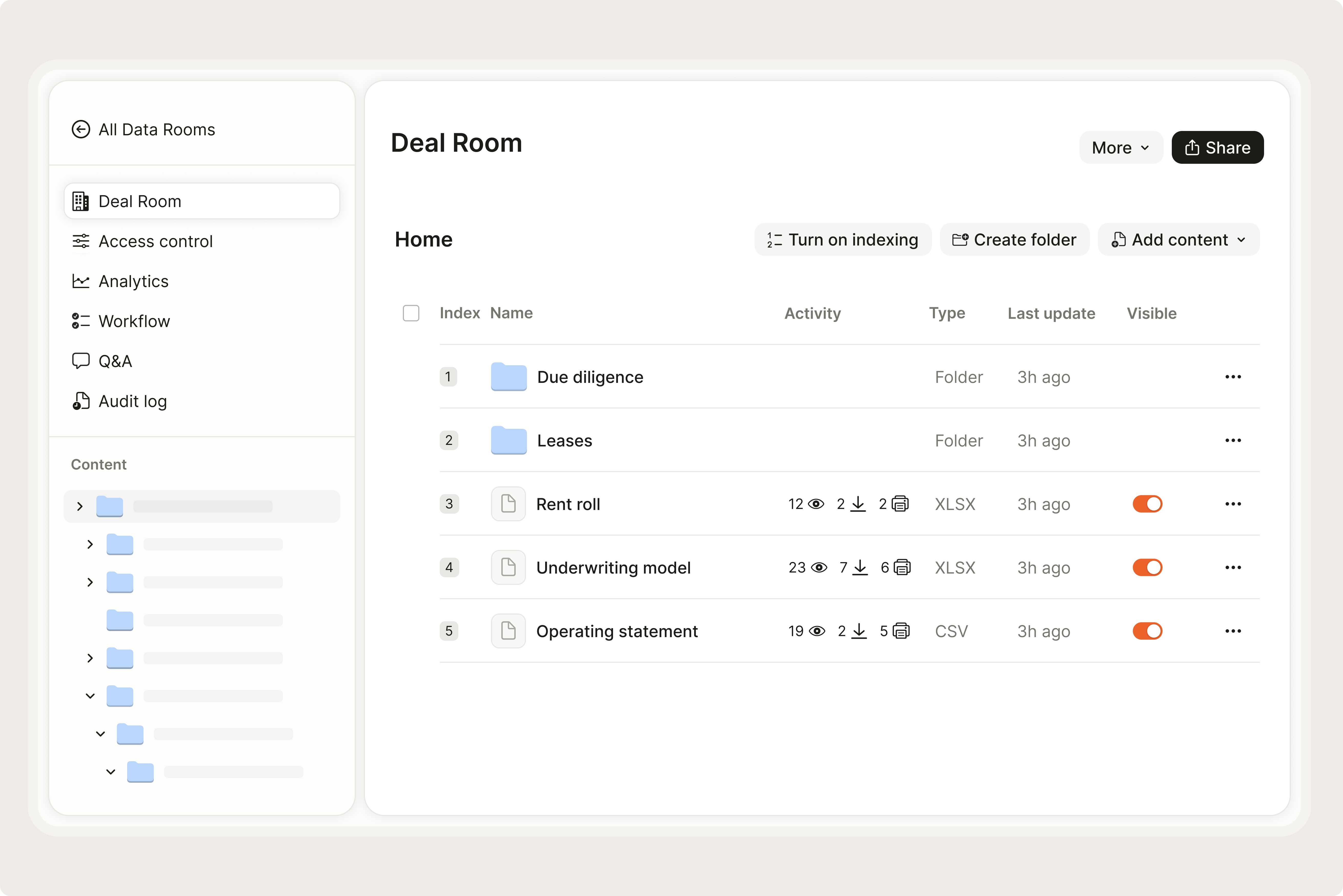
- 1.Upload France property files to a secure roomDrop SPF état hypothécaire, DTA, DPE, ERP, PLU extract, bail commercial, and Phase I ESA into Ellty.
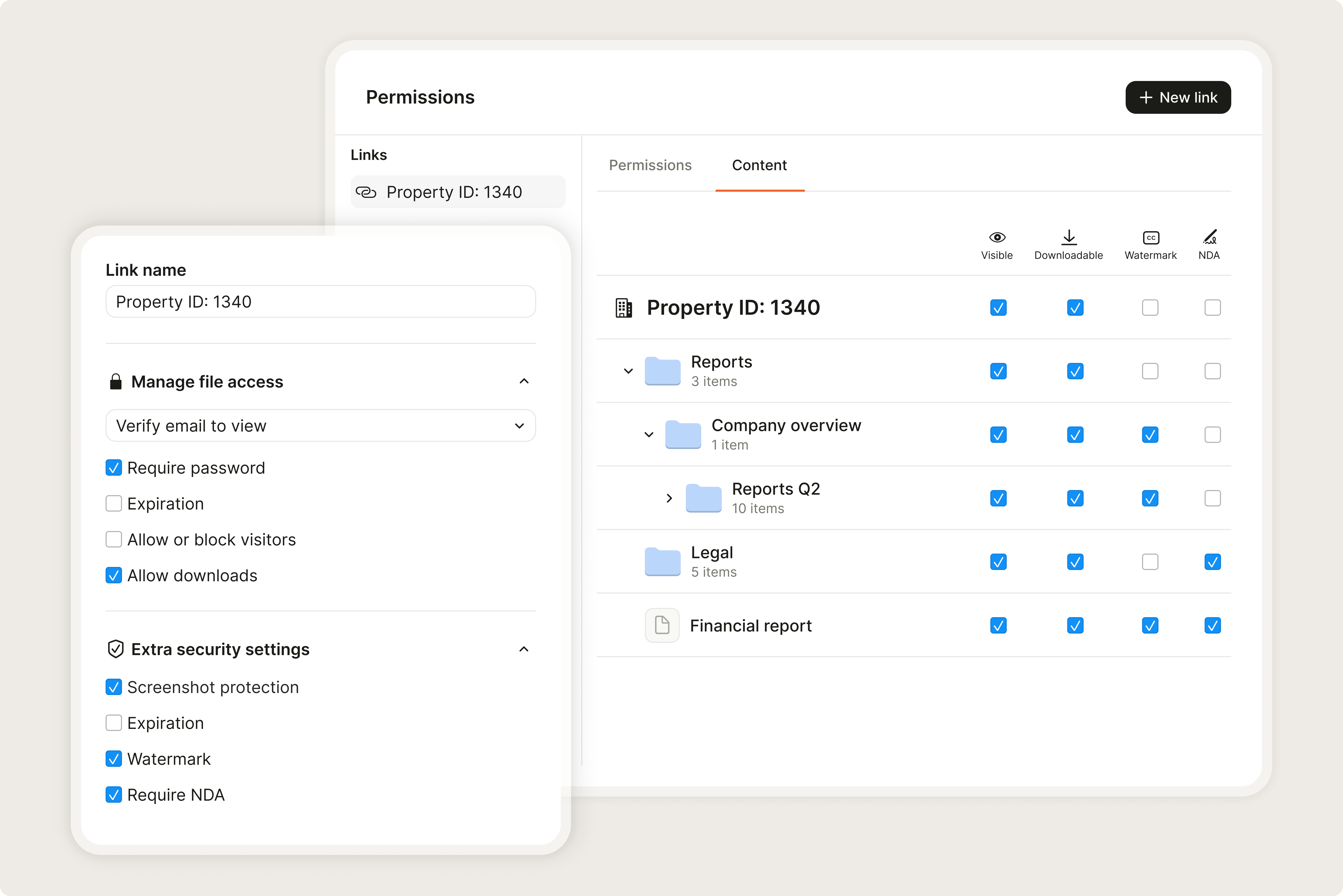
- 2.Give each advisor a scoped, tracked linkNotaire sees SPF title and DAACT. Environmental consultants see BASIAS, BASOL, and ICPE. Lease advisors see baux commerciaux. Ellty enforces the scope.
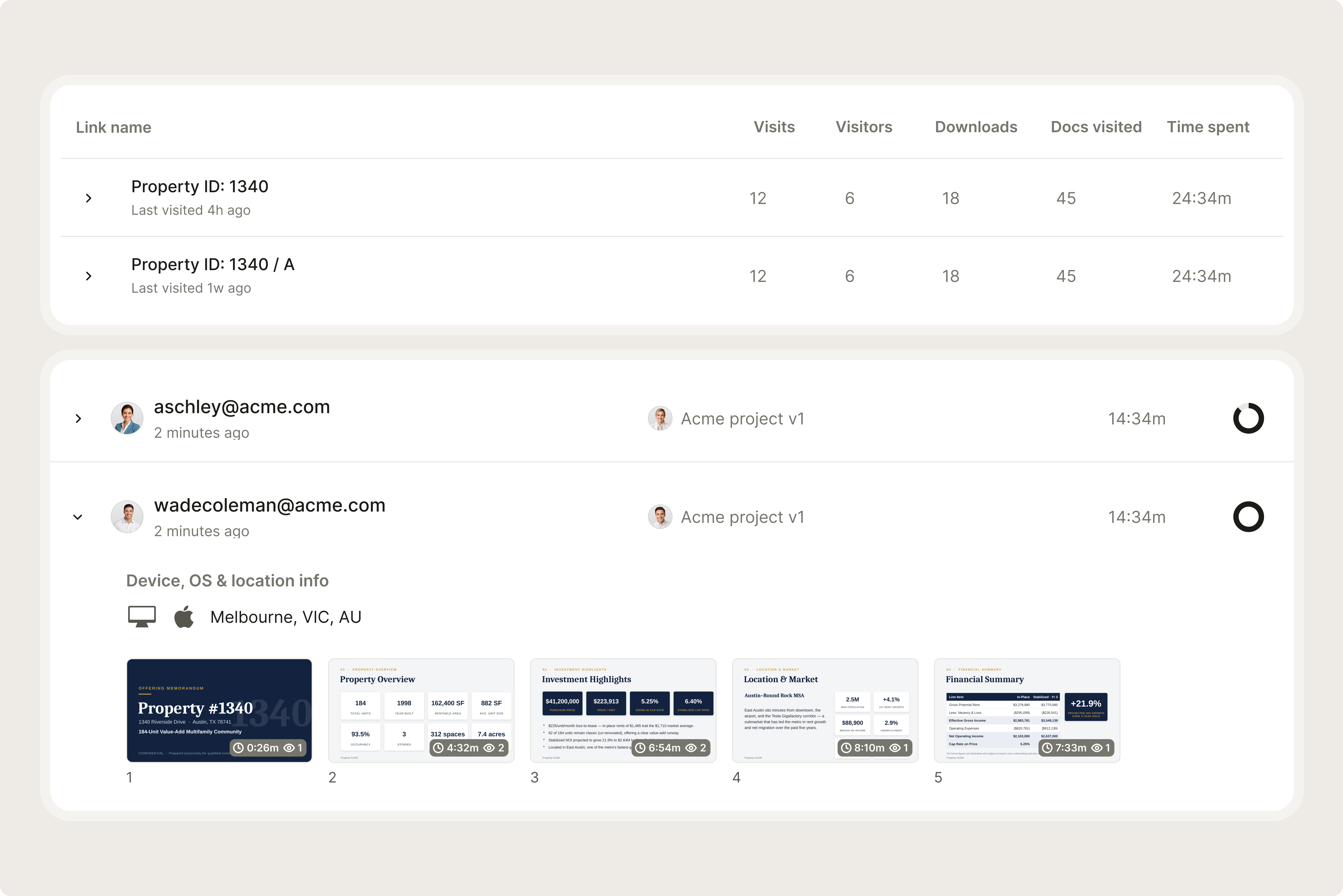
- 3.Monitor who reviews which documentsSee exactly which files each advisor opened and when. Catch delays before they affect the DPU period or the acte de vente appointment.
What makes France different
The DPU (droit de préemption urbain) is a standard 2-month delay built into every French commercial CRE deal. The municipality receives the DIA (notification of intent to sell), can match the agreed price, and acquires the property instead of the agreed buyer. Preemption is rare, but the 2-month waiting period is mandatory. It cannot be structured away. Model it in from day one.
Amiante is France's biggest hidden capex item in commercial property. The DTA (Dossier Technique Amiante) documents asbestos presence in all pre-1997 buildings. In most older French commercial buildings - Paris Haussmannian offices, 1970s industrial warehouses, 1980s retail centres - asbestos is in the ceilings, floors, and insulation. It's not automatically a dealbreaker but it's almost always a cost item. Commission the DTA survey early and model the management or removal cost.
ICPE classification is the environmental red flag specific to France. Any site that was a classified installation - a chemical plant, a fuel depot, a waste treatment facility, even a historic dry cleaner at sufficient scale - carries ongoing regulatory obligations. These can survive multiple ownership changes. The BASIAS, BASOL, and ICPE register search is not optional; it's the starting point for any commercial environmental review in France.
French commercial lease law heavily favors tenants. The 9-year bail commercial, the right to terminate every 3 years, and the statutory renewal right mean that a French commercial landlord has limited ability to reclaim space without either waiting for the right break or paying a substantial indemnité d'éviction. For prime Paris office or retail assets, the eviction indemnity can be material.
The Droit de Préemption Urbain (DPU), governed by Articles L211-1 to L213-20 of the Code de l'Urbanisme, grants French communes the statutory right to acquire urban real property offered for sale within a designated DPU zone. The seller is required to file a Déclaration d'Intention d'Aliéner (DIA) with the commune prior to entering into any binding sale agreement. The commune has two months from receipt of the DIA to exercise its right of preemption at the declared price. No binding acte de vente may be executed until either the DPU period has expired or the commune has formally renounced its preemption right.
Timeline and cost in France
Weeks 1-2 cover kickoff: SPF état hypothécaire, certificat d'urbanisme, DIA filing for DPU, DTA commission for pre-1997 buildings, DPE and full diagnostics bundle, BASIAS and BASOL search, ICPE register search, and Phase I ESA engagement. Budget EUR 8,000-20,000 for legal and advisory fees in this phase.
Load all files into Ellty before advisors start. Scoped, tracked links remove at least one week of document exchange from a standard French CRE diligence timeline.
Weeks 2-8 cover DPU waiting period and deep review: bail commercial abstraction, ICPE review and Phase II ESA if triggered, DTA detailed review and asbestos cost modeling, PLU compliance check, and DMTO/TVA structure confirmation. Cost runs EUR 15,000-50,000 depending on complexity.
Phase II ESA and ICPE closure documentation: if ICPE exposure is identified, add 4-8 additional weeks for Phase II and regulatory consultation with the prefecture.
Weeks 8-12 handle resolution: all diagnostics confirmed, DPU renonciation received, acte de vente executed by notaire, DMTO paid, and SPF registration initiated.
France total acquisition cost: ~5.8% DMTO + ~1% notaire emoluments + legal fees EUR 15,000-50,000 + diagnostics + environmental review. Total acquisition cost on a French commercial deal runs approximately 7-8% of purchase price. For TVA-liable transactions: 20% TVA replaces DMTO but is recoverable by VAT-registered buyers.
Running a France property deal from one room
Hold SPF title docs, diagnostics, and bail commercial files in one secure, tracked Ellty data room.
Start free 14-day trialCommon questions about due diligence on France property
- Most French CRE deals complete in 8-12 weeks, dominated by the 2-month DPU (droit de préemption) period. The DIA must be filed with the commune before any binding sale; the 2-month waiting period cannot be shortened regardless of deal timeline.
- DMTO (Droits de Mutation à Titre Onéreux) are French transfer taxes on property purchases. For commercial property, the effective rate is approximately 5.8% of the purchase price, plus notaire emoluments of around 0.8-1%. Total transfer costs run 6.5-7%. For new commercial buildings (first transfer within 5 years), TVA at 20% applies instead of DMTO.
- The DPU is a French municipality's statutory right of first refusal to acquire urban commercial property at the agreed sale price. Before any binding sale agreement, the seller must file a DIA (Déclaration d'Intention d'Aliéner) with the commune. The commune has 2 months to exercise preemption. No acte de vente can be signed until the DPU period has passed or the commune formally renounces its right.
- The DTA (Dossier Technique Amiante) is the mandatory asbestos technical file required for all French commercial buildings built before 1997. Asbestos is present in the overwhelming majority of pre-1997 French commercial buildings. The DTA documents where asbestos is present, its condition, and containment status. It must be updated before any works and provided to buyers at sale.
- A bail commercial is a French commercial lease governed by the Code de Commerce. The standard term is 9 years, with the tenant having the right to terminate every 3 years. At the end of the 9-year term, tenants have a statutory renewal right (droit au bail). If the landlord refuses renewal, it must pay an indemnité d'éviction - compensation for the loss of the tenant's business location - which can be equivalent to several years of rent.
- ICPE (Installations Classées pour la Protection de l'Environnement) is France's classified industrial installation register. Sites that operated as classified installations (chemical plants, fuel depots, waste facilities, etc.) carry ongoing environmental obligations. Former ICPE status can bind subsequent property owners. Always search the ICPE register, BASIAS, and BASOL for any commercial site with prior industrial use.