Egypt commercial property has one structural issue that exists nowhere else in the region at this scale: a large proportion of Egyptian commercial property is not formally registered in the Shahr Aqari (Real Estate Publicity Department), meaning the seller holds only contractual rights - not registered legal title - and the chain may go back years through unregistered preliminary contracts.
Egypt's property registration system under Law No. 114 of 1946 requires Shahr Aqari registration for full title. But enforcement has been incomplete for decades; many commercial owners hold a chain of notarized preliminary contracts (aqd bay) rather than formal title. Formal title transfer only occurs at registration.
The other issue that moves the price on income-producing Egyptian commercial assets: pre-1996 commercial leases under the Old Rent Law (Law No. 49 of 1977 and Law No. 136 of 1981) are subject to controlled rents that cannot be increased and tenants who have near-permanent occupancy rights. Any pre-1996 commercial tenant in the building must be identified and assessed.
Egypt introduced VAT at 14% in 2017. Commercial lease income is subject to 14% VAT if the landlord is VAT-registered. New commercial units sold by developers also attract 14% VAT on first sale. USD-denominated leases are common in Cairo commercial real estate, given EGP devaluation history since 2022.
Set up an Ellty data room before diligence opens. Load Shahr Aqari certificates, title chain contracts, lease files, and building permits before advisors arrive. Each advisor gets a scoped link from day one.
Where Egypt deals go wrong
Not every check carries the same weight. The table below sorts risks by deal impact - dealbreakers first, then what moves the price, then basic hygiene - so your Egyptian lawyer and technical advisor know what to clear first.
| Area | Documents to pull | Egypt red flag | Matters most for | Tier | |
|---|---|---|---|---|---|
| Shahr Aqari registration and title chain | Shahr Aqari registration and title chain | Shahr Aqari certificate (Mustakhraj), full chain of title documents, notarized contracts chain | Egypt's most fundamental risk: many commercial properties have no Shahr Aqari registration; the seller may hold only a chain of unregistered preliminary contracts, not formal legal title | All buyers | Dealbreaker |
| Sinai peninsula restriction | Sinai peninsula restriction | Property location confirmation, Sinai zone maps, Ministry of Defense clearance records | Foreigners cannot own property in the Sinai Peninsula; the restriction applies to the entire Sinai and is enforced on security grounds | All foreign buyers | Dealbreaker |
| Pre-1996 controlled rent tenants | Pre-1996 controlled rent tenants | All lease contracts and dates, Old Rent Law (Law 49/1977) applicability analysis, rent roll | Egyptian commercial leases signed before 1996 are subject to controlled rents that cannot be increased; tenants have near-permanent occupancy rights; they effectively cannot be terminated | Income-producing assets | Dealbreaker |
| Environmental - Helwan and industrial | Environmental - Helwan and industrial | EEAA environmental records, Phase I ESA, historical industrial maps for Helwan and Alexandria | Helwan (iron and steel, cement, fertilizer) and Alexandria's Ameria industrial zone carry significant legacy contamination; Phase I ESA is mandatory for any adjacent commercial site | Industrial, brownfield | Dealbreaker |
| VAT and EGP FX risk | VAT and EGP FX risk | ETA VAT registration, lease VAT invoicing, lease currency terms (EGP vs USD), EGP exposure model | Egypt VAT is 14% on commercial lease income; significant EGP devaluation since 2022 creates FX risk; confirm whether commercial leases are EGP or USD-denominated | All income-producing assets | Price-adjuster |
| Building permits and planning | Building permits and planning | Building permit, occupancy certificate, use permit from local governorate or municipality | Egyptian commercial buildings often have unauthorized additional floors or extensions; governorate enforcement is increasing; confirm all built area is permitted | All commercial buildings | Price-adjuster |
| New Administrative Capital (NAC) compliance | New Administrative Capital (NAC) compliance | ACUD (Administrative Capital for Urban Development) sale contract, title documents, delivery schedule | NAC commercial units are sold by ACUD (state developer); the developer holds title until delivery; confirm unit delivery status, title transfer timeline, and any ACUD conditions | NAC commercial assets | Price-adjuster |
| Leases - New Rent Law compliance | Leases - New Rent Law compliance | All lease contracts and dates, Old vs New Rent Law classification, tenancy roll | Post-1996 commercial leases in Egypt are governed by market terms; but misclassification (treating a pre-1996 lease as post-1996) creates a title and rental income error | All income-producing assets | Price-adjuster |
| Insurance and valuation | Insurance and valuation | Current policies, loss run, valuation in both EGP and USD, Cairo flood risk check | Egyptian commercial insurance is typically EGP-denominated; with ongoing EGP devaluation, USD replacement cost coverage must be confirmed separately | All | Standard check |
| Utilities and connections | Utilities and connections | EEHC electricity account, Cairo Water and Sanitation Authority water account, arrears | Egyptian electricity supply capacity limitations in some industrial zones can restrict commercial operations; confirm the connection capacity covers the building's requirements | All | Standard check |
| Seller KYC and AML | Seller KYC and AML | Commercial Registry extract, UBO identification, EMLCU AML obligations, sanctions screen | Egypt's AML Law (Law No. 80 of 2002) requires KYC on all real estate transactions; lawyers and notaries must report suspicious transactions to EMLCU (Financial Intelligence Unit) | All deals | Standard check |
Due diligence on an Egypt property?
Set up your Ellty data room before diligence starts.
Start free 14-day trialEgypt CRE checklist
The table ranked risks by severity. This is the full list to work through, grouped by area.
Shahr Aqari registration and title chain
- Request the Shahr Aqari Mustakhraj (land registry extract) from the Real Estate Publicity Department on day one
- If the property has formal Shahr Aqari registration: confirm the current registered owner matches the seller exactly
- If the property is NOT registered (common in Egypt): request the full chain of notarized preliminary contracts (aqd bay or Agd istidadi) from the original registered owner to the seller
- Review each contract in the chain: confirm they are notarized (tawtheeq), properly executed, and in sequence
- Under Law No. 186 of 2020: mandatory Shahr Aqari registration is required; confirm whether the seller intends to register before sale or whether the buyer will handle first registration at closing
- First Shahr Aqari registration of an unregistered property can take several months; budget time for this in the deal schedule
Sinai peninsula restriction
- Confirm the property is not in the Sinai Peninsula before any commercial discussion
- The Sinai restriction applies to the entire Sinai governorates; it is enforced on national security grounds
- Foreign companies as well as individuals cannot own Sinai property; there are no exemptions for commercial investors
- For Red Sea coastal assets near the Sinai border: confirm the exact governorate (South Sinai vs. Red Sea governorate); Red Sea governorate (Hurghada) is not Sinai
Pre-1996 controlled rent tenants
- Identify the execution date of every commercial lease in the building; any lease signed before 1996 may be subject to Old Rent Law
- Pre-1996 commercial leases under Law No. 49 of 1977 and Law No. 136 of 1981: controlled rents that cannot be increased beyond fixed percentages; near-permanent tenancy rights
- The Economic Court Law No. 120 of 2008 modified some aspects but pre-1996 commercial tenant protection remains strong
- For any pre-1996 tenant: get a legal opinion on their specific protection level and the estimated controlled rent vs. market rent gap
- Any building with pre-1996 commercial tenants should be valued as a controlled-rent asset, not at market rents; the income profile is permanently impaired
Environmental - Helwan and industrial
- Helwan: Egypt's most contaminated industrial zone; iron and steel (EZDK/Ezzsteel site), cement (Helwan Portland Cement), fertilizers, and power generation created decades of air and soil contamination
- For any commercial asset in or adjacent to Helwan governorate: Phase I ESA is mandatory; Phase II is likely
- Alexandria: Ameria industrial area (petroleum refining, chemicals, heavy industry) and the eastern harbor area carry significant contamination risk
- Search EEAA (Egyptian Environmental Affairs Agency) records and historical Ordnance Survey/satellite imagery for the property address
- 10th of Ramadan City (east of Cairo): major industrial satellite city; manufacturing and chemical industries; Phase I ESA required for any industrial or logistics site
VAT and EGP FX risk
- Confirm the seller's ETA (Egyptian Tax Authority) VAT registration and compliance status
- Review 3 years of lease VAT invoices at 14%; confirm correct invoicing and ETA return filing
- Assess the currency denomination of all leases: large Egyptian commercial tenants (multinational companies, major banks) often have USD-denominated leases; smaller tenants pay in EGP
- EGP has devalued significantly: from approximately EGP 7/USD in 2016, to EGP 30-50/USD by 2024-2026 (multiple devaluations)
- For EGP-denominated income assets: model the USD equivalent income and sensitivity to further EGP devaluation; Egypt's inflationary environment makes EGP-denominated yields compress in USD terms
Building permits and planning
- Request the building permit (Rukhsat al-Bina) and occupancy certificate from the local governorate or municipality
- Egyptian commercial buildings frequently have unauthorized additional floors; Egypt has conducted demolition campaigns against illegal constructions
- Confirm the number of stories and total built area in the permit matches the physical building
- For Cairo: building permits are issued by Cairo Governorate or local district authorities; processing records are often manual and slow
Give each advisor a scoped link in Ellty. Your Egyptian lawyer sees the Shahr Aqari chain and lease files. Environmental consultants see Phase I reports. Technical advisors see building permits. No overlap, no access creep.
New Administrative Capital (NAC) compliance
- For NAC commercial assets: confirm the ACUD (Administrative Capital for Urban Development) sales contract and delivery status
- ACUD is the state developer for NAC; it holds title to all NAC land until transferred to buyers on delivery
- Confirm the unit delivery date, title transfer timeline, and any outstanding installment payments to ACUD before completion of title transfer
- Check for any ACUD conditions on use, subletting, or mortgage that run with the commercial unit
- NAC is Egypt's largest active commercial real estate development; its infrastructure delivery timeline has been phased; confirm which utilities and services are fully operational
Leases - New Rent Law compliance
- Classify every commercial lease: pre-1996 (Old Rent Law) or post-1996 (New Rent Law)
- Post-1996 commercial leases have market terms; confirm the rent review and termination provisions in each lease
- Confirm 14% VAT invoicing on all post-1996 commercial lease invoices from the seller
- For post-1996 leases: confirm the lease term, renewal terms, and landlord termination rights
Helwan and industrial environmental review
- For any asset in Greater Cairo with pre-1980 industrial or manufacturing use history: commission Phase I ESA
- Check historical aerial photography (available via Google Earth historical imagery) to identify any prior industrial use on or adjacent to the site
- EEAA permit records can confirm whether any industrial IPPC-equivalent license was ever held for the site
- For Nile waterfront commercial assets in industrial areas of Shubra or Imbaba: check for historical industrial contamination from prior riverside manufacturing
Load all Phase I ESA, Shahr Aqari chain documents, and building permits into Ellty. Environmental advisors, lenders, and technical consultants each get tracked, watermarked access from one secure link.
Insurance and valuation
- Commission an independent valuation in both EGP and USD equivalent; EGP devaluation risk makes USD-denominated valuation important for international investors
- Confirm the building insurance is at full USD replacement cost; EGP-denominated policies at pre-devaluation sums insured are systematically underinsured
- For Cairo commercial assets: check flood risk from Alexandria Road corridor drainage; recent infrastructure investment has reduced but not eliminated flash flood risk in some areas
Utilities and connections
- Confirm the EEHC (Egyptian Electricity Holding Company) electricity account is active and free of arrears
- For NAC: confirm ACUD has connected utilities including electricity, water, and telecommunications to the specific commercial unit
- For industrial or logistics assets: confirm the electrical load capacity is sufficient for the intended use; some Egyptian industrial zones have capacity constraints
Seller KYC and AML
- Pull a Commercial Registry extract from the General Authority for Investment (GAFI) or Ministry of Commerce confirming the selling entity is active
- Identify all beneficial owners; EMLCU (Egyptian Money Laundering Combating Unit) requires UBO disclosure on real estate transactions
- Egypt lawyers are required to perform KYC and report suspicious transactions under AML Law No. 80 of 2002
- Run OFAC, UN, EU, and US sanctions checks on all parties before any funds transfer
How due diligence in Egypt works
Step 1 - Title chain and Shahr Aqari
Day one: request the Shahr Aqari Mustakhraj and the full contract chain simultaneously. Egyptian commercial property title review is the most complex element of the diligence. Your Egyptian lawyer must trace the chain from the Shahr Aqari registered title backward through every subsequent unregistered contract to the seller.
A clean title chain with no gaps, all notarized, all in sequence, with the same property description throughout: that's the target. Any gap - a missing intermediate contract, a description mismatch, a partially signed document - is a title defect that must be resolved before closing.
Step 2 - Controlled rent identification
List every commercial tenant in the building with their lease execution date. Any tenant with a lease dated before 1996 needs individual legal analysis. Controlled rent tenants in Egypt's Old Rent Law framework have a dramatically different risk profile than market-rate tenants; they affect the asset value materially.
For buildings with a mix of pre-1996 and post-1996 tenants: value the two groups separately. The pre-1996 component is a fixed-income stream at controlled rates; the post-1996 component is market-priced.
Step 3 - Environmental and building compliance
For any asset near Helwan, 10th of Ramadan, or Alexandria's Ameria zone: commission Phase I ESA immediately. Egyptian environmental assessors with local government database access are essential; generic international ESA consultants rarely have EEAA database access.
Check the building permit floor count against the physical building. Egyptian authorities have been actively demolishing unauthorized floors; this is not a theoretical risk.
Compare Jordan's commercial property diligence process if you run MENA CRE portfolios. Both Jordan and Egypt use civil law notarization systems and have similar registry-based title structures. Key difference: Jordan's land registry (Dairat al-Amanat al-Amma) has better formal registration rates than Egypt's Shahr Aqari, and Jordan lacks Egypt's controlled rent legacy problem.
Step 4 - VAT and FX
Confirm VAT compliance and model the EGP/USD FX exposure. Egyptian commercial real estate investment by international investors requires a clear view of USD-equivalent returns; EGP-denominated lease income at 14% VAT with ongoing devaluation risk is materially different from a Dubai or Saudi transaction.
Track all advisor document access in Ellty. If your environmental consultant is reviewing the Shahr Aqari chain documents repeatedly, that signals a title question before the report lands.
Step 5 - Notarized sale contract and Shahr Aqari registration
Egyptian commercial property transfers are completed via a notarized sale contract (Uqood al-Bai) at a Notary Public office, followed by Shahr Aqari registration. The registration fee runs approximately 2-3.5% of the declared value.
For mandatory registration: the seller must submit all original chain documents to the Shahr Aqari office. This can take 2-4 months for complex title chains.
How to set up your Egypt data room in Ellty.
Egypt CRE deals involve Shahr Aqari title chains, Old Rent Law lease classification, EEAA environmental records, building permit history, and ETA VAT compliance across multiple weeks. Load files into Ellty before advisors arrive. Each advisor gets a scoped, tracked link from day one.
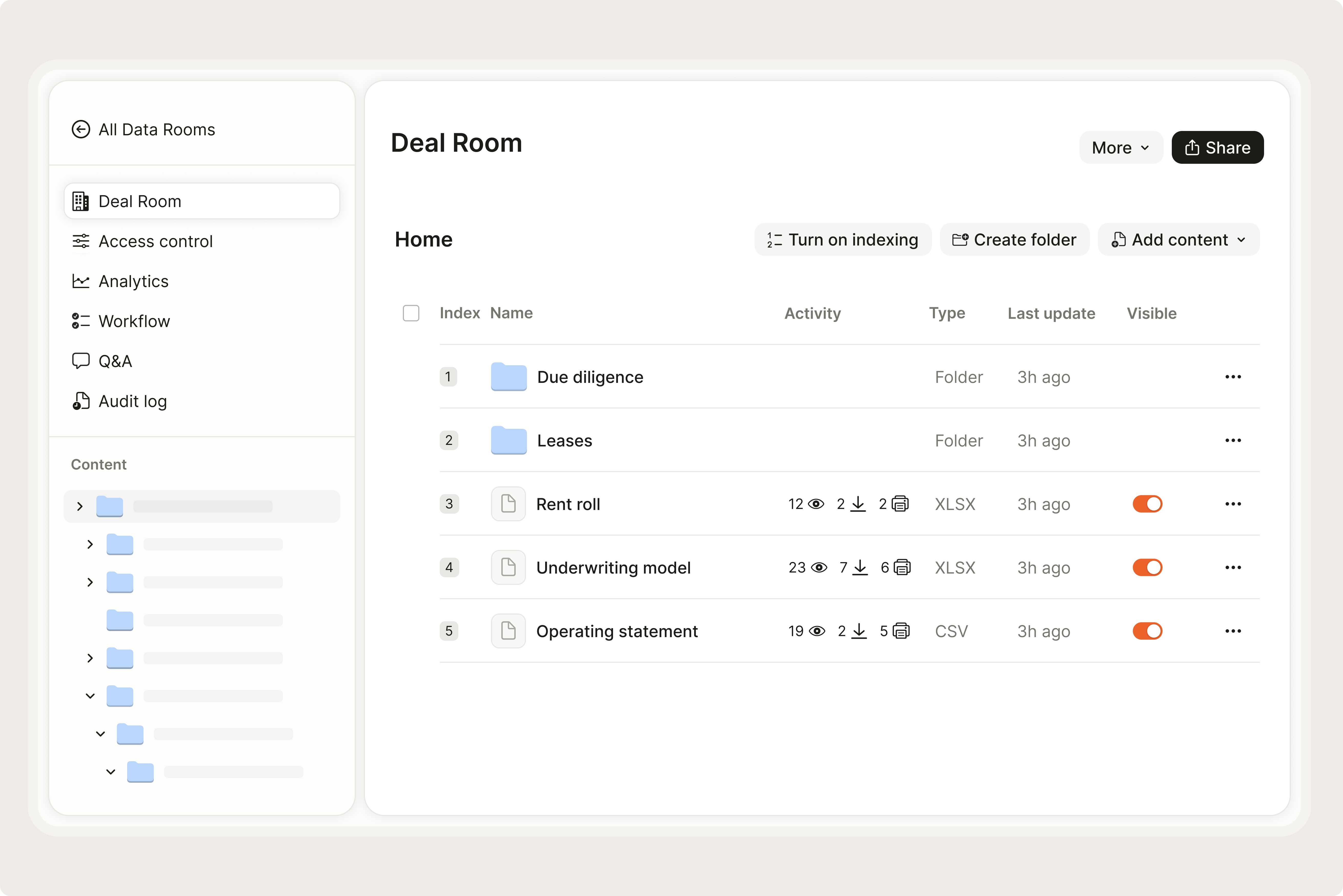
- 1.Upload Egypt property files to a secure roomDrop Shahr Aqari Mustakhraj, title chain contracts, building permit, lease files, VAT invoices, and Phase I ESA into Ellty.
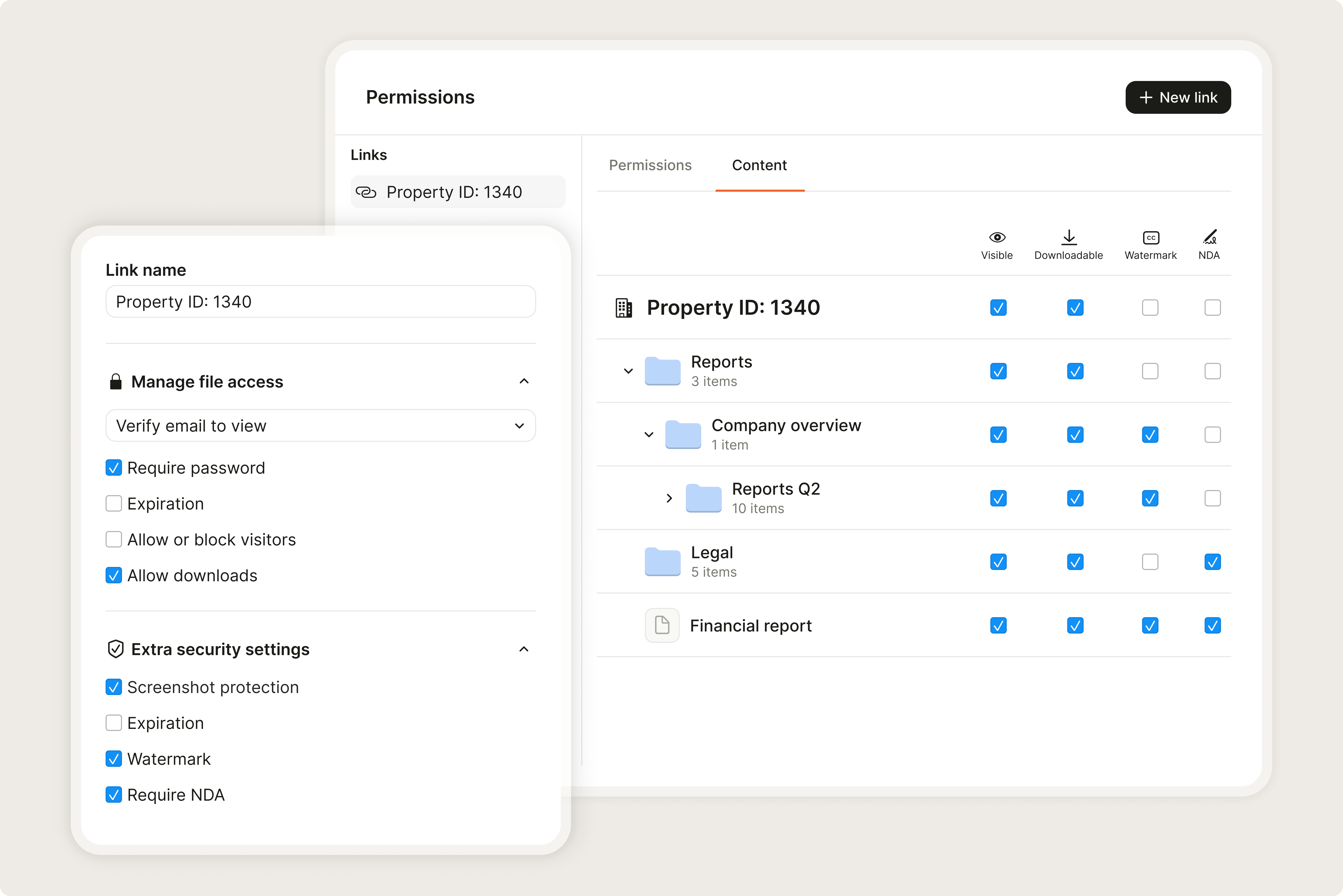
- 2.Give each advisor a scoped, tracked linkEgyptian lawyer sees Shahr Aqari and lease docs. Environmental consultants see Phase I reports. Tax advisors see ETA VAT records. Ellty enforces the scope.
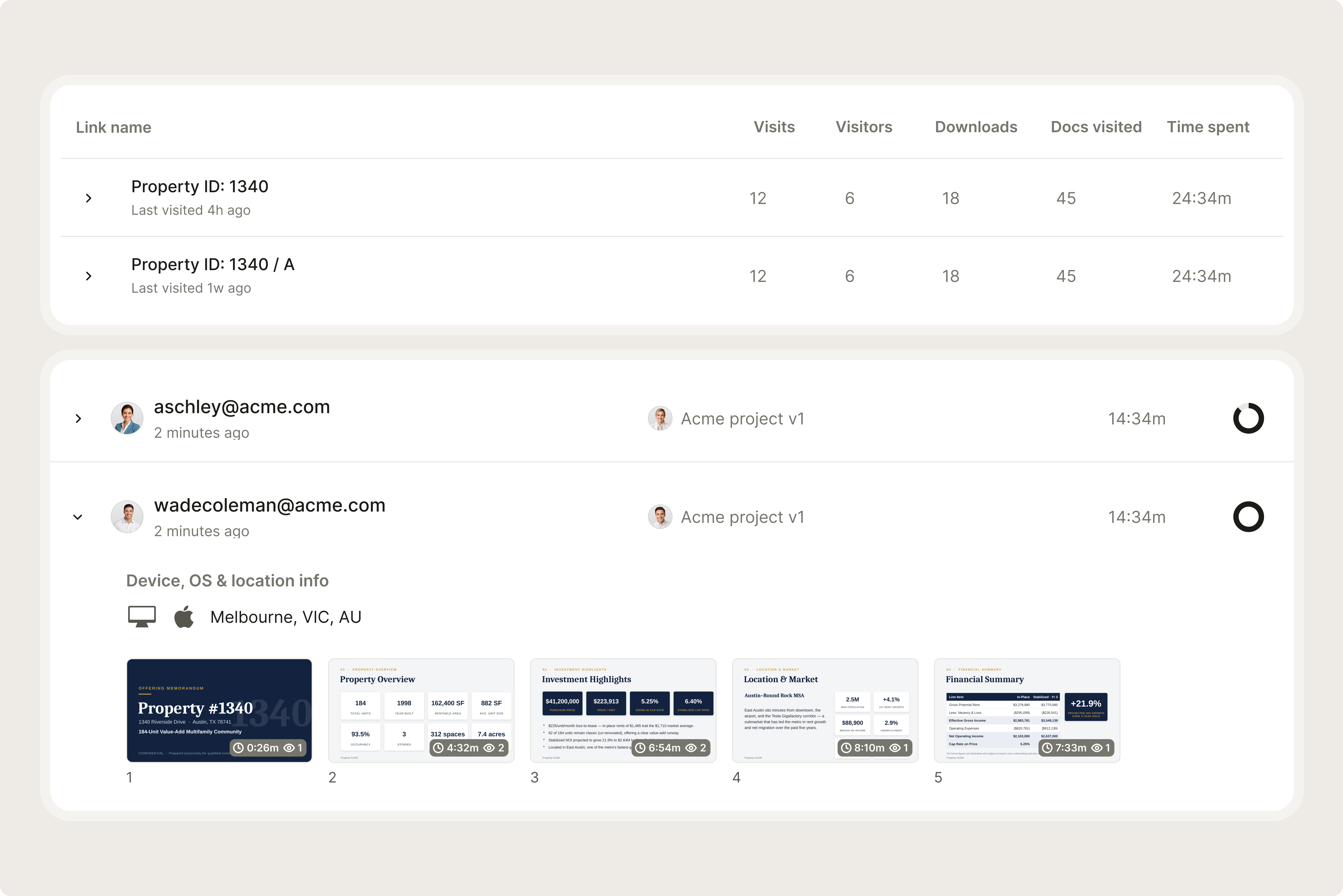
- 3.Monitor who reviews which documentsSee exactly which files each advisor opened and when. Catch delays before they affect the Shahr Aqari registration submission.
What makes Egypt different
Egypt's title registration gap is the structural issue that doesn't exist at this scale in any other major CRE market. A large proportion of Egyptian commercial property - estimates range from 40-70% of urban property - has no formal Shahr Aqari registration. The owner holds a chain of notarized preliminary contracts, not a registered title deed. The law requires registration; enforcement has been gradual. For any commercial acquisition, the title chain review and formalization plan are the first and most important diligence deliverable.
The Old Rent Law controlled tenant problem is endemic in older Egyptian commercial buildings. Tenants who signed commercial leases before 1996 are protected under laws that freeze rents at nominal 1970s-1980s levels and give near-permanent occupancy rights. A floor of a Cairo commercial building occupied by a pre-1996 tenant at EGP 100/month controlled rent (in a building where current market rents are EGP 5,000/month) is not the same asset as the vacant floors above it. Identify every pre-1996 tenant and get a legal assessment of their status before bidding.
The EGP devaluation risk is not a one-time event. Egypt has devalued the EGP multiple times since 2016, moving from approximately EGP 7/USD to EGP 30-50+/USD by 2025-2026. For international investors, EGP-denominated commercial income in a USD return model is a fundamental FX problem. The better-quality Cairo commercial assets (Grade A office, prime retail) often have USD-denominated leases specifically to address this; older mixed-income assets do not.
Helwan contamination is Egypt's most severe documented industrial contamination zone. The iron and steel, cement, and chemical facilities that operated in Helwan since the 1950s created multi-decade soil, air, and groundwater contamination. Phase I ESA and site-specific Phase II investigation are required for any commercial asset within the Helwan zone.
The Egyptian Real Estate Publicity Law (Law No. 114 of 1946 and its amendments) establishes the Shahr Aqari (Real Estate Publicity Department) as the sole authority for the registration of real property rights in Egypt. Under this Law, only registered property rights are effective against third parties. A buyer who acquires property via a notarized preliminary contract without Shahr Aqari registration acquires enforceable contractual rights against the seller but does not acquire a registered property right. The Mandatory Registration Law (Law No. 186 of 2020) requires all property transfers to be registered within a specified period, but transitional implementation remains ongoing.
Timeline and cost in Egypt
Weeks 1-3 cover kickoff: Shahr Aqari Mustakhraj request, full title chain collection, controlled rent tenant identification (by lease date), EEAA environmental search, building permit check, ETA VAT compliance review, and Phase I ESA engagement for Helwan or Alexandria adjacent assets. Budget EGP 80,000-250,000 for legal and advisory fees in this phase (USD equivalent varies with EGP rate).
Load all files into Ellty before advisors start. Scoped, tracked links for each advisor avoid the document chase that adds weeks to Egyptian CRE diligence; multiple government offices are involved (Shahr Aqari, governorate municipality, EEAA, ETA) and digital document management is critical.
Weeks 3-6 cover deep review: full title chain legal opinion, pre-1996 tenant legal assessment, building compliance investigation, Phase I ESA delivery, VAT invoicing audit, and Shahr Aqari registration strategy determination. Cost runs EGP 150,000-500,000 depending on complexity.
Shahr Aqari registration: if mandatory first registration is required, allow 2-4 additional months. This is the biggest timeline risk in Egyptian commercial property transactions.
Weeks 6-10 handle resolution: title regularization if needed, notarized sale contract execution, Shahr Aqari registration submission, and closing. Registration fee payment to the Shahr Aqari office at submission.
Egypt total acquisition cost: 2-3.5% Shahr Aqari registration and notarization fees + legal fees + Phase I ESA. Total acquisition cost runs approximately 3-5% of purchase price. 14% VAT on commercial lease income is the key ongoing operating cost; model it correctly in all NOI projections.
Running an Egypt property deal from one room
Hold Shahr Aqari docs, title chain contracts, and lease files in one secure, tracked Ellty data room.
Start free 14-day trialCommon questions about due diligence on Egypt property
- Egypt CRE deals typically take 8-14 weeks when title regularization is required. The Shahr Aqari title chain review, pre-1996 controlled rent tenant legal assessment, and first registration (if required) are the main lead-time items. First Shahr Aqari registration of an unregistered property can take 2-4 months.
- The Shahr Aqari (Real Estate Publicity Department) is Egypt's formal property registry. Only Shahr Aqari-registered rights are effective against third parties under Egyptian law. Many Egyptian commercial properties are not formally registered; the owner holds a chain of notarized preliminary contracts instead. A buyer relying only on preliminary contracts acquires contractual rights against the seller, not a registered property right. Always confirm Shahr Aqari status before any commercial commitment.
- Commercial leases signed before 1996 in Egypt are governed by the Old Rent Law (Law No. 49 of 1977 and Law No. 136 of 1981). These leases have controlled rents frozen at historical levels that cannot be increased materially, and tenants have near-permanent occupancy rights. A building with pre-1996 commercial tenants must be valued as a controlled-rent asset, not at current market rents. This can dramatically reduce the income value of the affected floors.
- Generally yes, subject to restrictions. Foreign nationals may own commercial property in Egypt as part of a licensed business activity. The key restriction is the Sinai Peninsula: foreigners cannot own property in any Sinai governorate. Outside Sinai, foreign companies can own commercial property in Egypt subject to applicable investment law and business licensing requirements.
- Egypt's pound (EGP) has undergone multiple significant devaluations since 2016, moving from approximately EGP 7/USD to EGP 30-50+/USD by 2025-2026. For international investors with USD-denominated return targets, EGP-denominated commercial rental income carries significant FX risk. Grade A Cairo commercial assets often have USD-denominated leases to hedge this risk; older mixed-income assets do not. Always model both EGP and USD-equivalent income in the underwriting.
- Helwan is Egypt's most contaminated industrial zone, located south of Cairo. Decades of iron and steel production (EZDK/Ezzsteel), cement manufacturing, fertilizer production, and power generation created significant soil, air, and groundwater contamination. Phase I ESA and often Phase II subsurface investigation are required for any commercial asset in or adjacent to Helwan governorate. Alexandria's Ameria industrial zone carries similar legacy contamination risk.