Denmark commercial property has one of the lowest transfer taxes in Europe - 0.6% tinglysningsafgift - but two checks that catch non-Danish buyers off guard: the V1/V2 contamination classification system (mandatory for most development uses) and the BBR building register discrepancy (older Danish commercial buildings often don't match their registered profile).
Danish property title is managed through Tingbogen (the Land Registry), administered electronically via Tinglysning.dk by the Tinglysningsretten. All encumbrances, mortgages, and transfers must be registered (tinglyst) in Tingbogen to have legal effect against third parties.
There is no notary system in Denmark for property transactions. Advokater (lawyers) handle all conveyancing and register transfers on Tinglysning.dk. The skøde (deed of conveyancing) is the title document.
Danish MOMS (VAT) at 25% applies to new commercial buildings and significant renovations. If the seller has voluntarily registered for MOMS on commercial rental income, a transfer triggers MOMS adjustment (regulering) obligations. This is a tax structuring issue that must be resolved in the deal documents.
Set up an Ellty data room before diligence opens. Load Tingbogen extracts, BBR records, contamination classification documents, and lease files before advisors arrive. Each advisor gets a scoped link from day one.
Where Denmark property deals go wrong
Not every check carries the same weight. The table below sorts risks by deal impact - dealbreakers first, then what moves the price, then basic hygiene - so your Danish advokat and technical advisor know what to clear first.
| Area | Documents to pull | Denmark red flag | Matters most for | Tier | |
|---|---|---|---|---|---|
| Tingbogen title and encumbrances | Tingbogen title and encumbrances | Tingbogen (Land Registry) extract, skøde, registered mortgages, pantebrev, deklarationer | Danish title is registered electronically in Tingbogen; all encumbrances (deklarationer), mortgages (pantebreve), and servitudes must be confirmed before closing | All buyers | Dealbreaker |
| V1/V2 contamination classification | V1/V2 contamination classification | Miljøstyrelsen kortlægning database, V1/V2 certificates, Phase I and II ESA | Denmark classifies contaminated sites as V1 (potential) or V2 (confirmed); V2 classification triggers mandatory remediation before development or use change | Industrial, brownfield, redevelopment | Dealbreaker |
| BBR building register discrepancy | BBR building register discrepancy | BBR extract (Bygnings og Boligregistret), as-built drawings, municipal building permit history | The Danish BBR register contains all registered building characteristics; older commercial buildings often have unauthorized extensions, use changes, or area discrepancies not recorded in BBR | Older buildings | Dealbreaker |
| Zoning - lokalplan compliance | Zoning - lokalplan compliance | Lokalplan extract, kommuneplan, byggetilladelse, byggesagstilladelse | Danish lokalplaner are binding land use plans; a change of use inconsistent with the lokalplan requires a new lokalplan process, which takes 6-18 months | Repositioning, change of use | Dealbreaker |
| MOMS regulering and tax structure | MOMS regulering and tax structure | MOMS registration status, voluntær momsregistrering documents, reguleringsforpligtelse period | If the seller voluntarily registered for MOMS on commercial rent, there are MOMS adjustment obligations (reguleringsforpligtelse) for 10 years that transfer to the buyer | All deals with MOMS-registered leases | Price-adjuster |
| Leases and erhvervslejeloven | Leases and erhvervslejeloven | All lease contracts, notice period confirmation, deposit accounts, rent review clauses | Danish commercial leases under Erhvervslejeloven have notice-period requirements; confirm the opsigelsesvarsel (notice period) and any time-limited lease terms for each tenancy | Income-producing assets | Price-adjuster |
| Energimærke (energy label) | Energimærke (energy label) | Energimærke certificate, Energistyrelsen register check, rating class | Denmark's mandatory energy label (energimærke) is required for commercial buildings over 1,000 sqm at point of sale; missing energimærke delays the skøde registration | All commercial buildings | Price-adjuster |
| Groundwater protection zones | Groundwater protection zones | Grundvandsbeskyttelsesområde maps, BNBO (Boringsnære Beskyttelsesområder), municipal plan extract | Over 75% of Danish drinking water comes from groundwater; contamination within BNBO (wellhead protection areas) triggers more stringent remediation requirements | Industrial, any contaminated site | Price-adjuster |
| Building and technical condition | Building and technical condition | Technical report (tilstandsrapport), roof and facade condition, building systems inspection | Danish commercial buildings often use flat roofs with bitumen membrane; deferred maintenance on these is common and expensive to remediate | Industrial, office, retail | Price-adjuster |
| Insurance and valuation | Insurance and valuation | Current policies, loss run, RICS or Danish valuer appraisal, flooding risk maps | Copenhagen flood risk from storm surges and heavy rain is increasingly significant; confirm insurance availability and premium for assets in low-lying Copenhagen harbor areas | All | Standard check |
| Seller KYC and AML | Seller KYC and AML | CVR company extract, RUT register, Hvidvask (AML) compliance, sanctions screen | Danish advokater are designated under the Hvidvaskloven (AML Act); they must perform KYC on all property transactions above DKK 50,000 | All deals | Standard check |
Due diligence on a Denmark property?
Set up your Ellty data room before diligence starts.
Start free 14-day trialDenmark CRE checklist
The table ranked risks by severity. This is the full list to work through, grouped by area.
Tingbogen title and encumbrances
- Pull the Tingbogen extract from Tinglysning.dk on day one; it shows current owner, registered mortgages (pantebreve), and all deklarationer (declarations/encumbrances)
- Confirm the registered owner on the Tingbogen exactly matches the seller in all contracts and correspondence
- Check all pantebreve for registered mortgage amounts and confirm the seller's bank will provide a release on closing
- Review all deklarationer: servitudes, right-of-way easements, and restrictions on use can limit redevelopment options
- Check for any registered rettigheder (third-party rights) that may affect the property's use or transfer
- The Tingbogen is fully electronic; the advokat handles all registration on Tinglysning.dk on closing day
V1/V2 contamination classification
- Search the Miljøstyrelsen (Environmental Protection Agency) database for the property's kortlægning status on day one
- V1 classification: indicates the site had previous activities that may have caused contamination; further investigation is required before sensitive uses
- V2 classification: confirmed contamination; development and change of use typically require approved remediation plan before approval
- For industrial, logistics, or brownfield assets in Copenhagen, Aarhus, Odense, or Aalborg: V1 or V2 classification is common
- Commission Phase I ESA for any site with prior industrial, petrol, dry cleaning, or printing use
- Budget Phase II ESA (borehole investigation) if V1 or V2 status is confirmed; cost runs DKK 100,000-500,000+
BBR building register discrepancy
- Pull the BBR (Bygnings og Boligregistret) extract for the property; it shows registered use, gross floor area, construction year, and building systems
- Compare the BBR data against the as-built drawings and physical inspection; discrepancies signal unauthorized works
- For any unauthorized extension or change of use not recorded in BBR: assess the risk of municipal enforcement and budget the legalization cost
- BBR discrepancies affect insurance, financing, and planning compliance; they must be disclosed to the advokat before signing
- Request the building permit history (byggesager) from the municipality to confirm all works have required authorizations
Zoning - lokalplan compliance
- Pull the lokalplan for the property from the relevant municipality's planning portal
- Confirm the current use of the building is consistent with the lokalplan designation; inconsistent uses create regulatory risk
- For any repositioning or development plan: check the kommuneplan (municipal development plan) to confirm the planned use is supported at the municipal level
- A new lokalplan requires public consultation and approval; the process takes 6-18 months and is not guaranteed
- For Copenhagen Nordhavn, Carlsberg Byen, and other active development zones: check the specific lokalplan designation as they are frequently updated
MOMS regulering and tax structure
- Confirm the seller's MOMS (VAT) registration status for the property; specifically whether the commercial leases are under voluntary MOMS registration
- If MOMS registration exists: identify the reguleringsforpligtelse (adjustment obligation) period remaining; the 10-year MOMS adjustment obligation transfers to the buyer
- If the buyer wants to continue MOMS registration: confirm it can be transferred as part of the deal and what the annual MOMS reporting obligations are
- If the buyer will not be MOMS-registered: model the cost of the MOMS clawback obligation that falls on the seller at transfer
- Engage a Danish tax advisor specializing in commercial property MOMS; this is a specialized area that general corporate tax advisors often underestimate
Give each advisor a scoped link in Ellty. Your advokat sees Tingbogen and lease documents. Environmental consultants see V1/V2 documentation and Phase I reports. Technical advisors see BBR and building reports. No overlap.
Leases and erhvervslejeloven
- Collect all lease contracts (lejekontrakter) and confirm each complies with the Erhvervslejeloven (Commercial Leases Act)
- Confirm the opsigelsesvarsel (notice period) required for both landlord and tenant; commercial leases under Danish law have relatively flexible terms by European standards
- Check for time-limited lease terms (tidsbestemt lejekontrakt); these have different rules on renewal and termination
- Cross-reference the rent roll against 12 months of actual receipts; confirm any deposit (depositum) accounts and their amounts
- For Copenhagen office: confirm whether the lease includes a regulation (indeksregulering) clause using NPI (Net Price Index)
Energimærke (energy label)
- Confirm the energimærke (energy label) is current and registered with Energistyrelsen (Danish Energy Agency)
- Energy labels for Danish commercial buildings over 1,000 sqm are mandatory at point of sale; missing labels delay Tingbogen registration
- Check the energy class (A2020, A2015, A2010, B through G); Danish buildings commonly rate C or D
- For buildings with low energy ratings: model the upgrade investment required under EU minimum energy performance requirements
Groundwater protection zones
- Check whether the property falls within a grundvandsbeskyttelsesområde (groundwater protection area) or within a BNBO (boringsnære beskyttelsesområde / wellhead protection area) zone
- Contamination within BNBO zones triggers more stringent remediation requirements and monitoring obligations
- More than 75% of Danish drinking water comes from groundwater; Danish municipalities take groundwater protection seriously
- For industrial and logistics assets in areas with V1 or V2 classification near wellheads: Phase II ESA with groundwater monitoring is standard
Load all V1/V2 classification certificates, Phase I ESA reports, and BBR extracts into Ellty. Environmental advisors, lenders, and technical consultants each get tracked, watermarked access from one secure link.
Building and technical condition
- Commission a technical inspection (teknisk gennemgang) of the building by a Danish building consultant
- For flat-roof commercial buildings: specific inspection of the bitumen membrane, drainage, and roof penetrations is essential
- Check heating systems: many Danish commercial buildings use district heating (fjernvarme); confirm the fjernvarme connection capacity and annual cost
- For older industrial buildings: check for signs of asbestos and confirm whether a survey has been conducted; Denmark has similar pre-1986 asbestos risk to other Scandinavian markets
Insurance and valuation
- Confirm current insurance coverage for the commercial use; confirm fire, building, and contents coverage is adequate
- Check Copenhagen flood risk maps; storm surges and climate-related flooding are increasing in low-lying harbor areas
- Commission an independent valuation from a Danish Statsautoriseret Ejendomsmægler (licensed property appraiser) or RICS-qualified valuer for lender requirements
Seller KYC and AML
- Pull the CVR (Central Business Register) extract confirming the selling entity is active and in good standing
- Confirm beneficial ownership under Danish company law requirements
- Danish advokater are designated under the Hvidvaskloven (Anti-Money Laundering Act); they must perform KYC on all real estate transactions above DKK 50,000
- Run OFAC, UN, and EU sanctions checks against all parties before any funds transfer
How due diligence in Denmark works
Step 1 - Tingbogen and BBR check
Pull the Tingbogen extract and BBR register simultaneously on day one. Both are accessible online immediately. The Tingbogen gives you title; the BBR tells you what the municipality has on record for the building. Compare them against the physical inspection results.
BBR discrepancies are the most common first-week finding in Danish commercial due diligence. Unauthorized extensions, unregistered floor area increases, or change of use without building permit are all routine - particularly in older Copenhagen or Aarhus commercial buildings.
Step 2 - V1/V2 and environmental
Search the Miljøstyrelsen database for contamination classification immediately. V1 or V2 classification is not a dealbreaker in itself, but it determines the timeline and cost of any development plans. A V2-classified site cannot be developed or significantly changed in use without an approved remediation plan.
For any industrial or logistics asset: check whether the site is within a grundvandsbeskyttelsesområde. Groundwater protection zones significantly increase the remediation requirements and monitoring obligations for any identified contamination.
Step 3 - MOMS and lease review
Confirm the MOMS status of the commercial leases before signing anything. If the seller has voluntarily registered for MOMS on commercial rent, the reguleringsforpligtelse follows the property. A non-MOMS-registered buyer who inherits a MOMS-registered lease portfolio faces a structural tax problem that must be solved in the deal documents.
Compare Sweden's commercial property diligence process if you run Nordic portfolio acquisitions. Both Sweden and Denmark have Scandinavian-low transfer taxes (Sweden's stamp duty at 4.25% for companies is higher than Denmark's 0.6%); however, Sweden has no equivalent to Denmark's V1/V2 contamination classification system, so environmental diligence structures differently.
Step 4 - Energimærke and building condition
Confirm the energimærke is current. Commission the technical inspection alongside it. Danish commercial buildings, particularly 1970s-1990s industrial and office stock, often have deferred maintenance on roofing, facades, and HVAC.
Track each advisor's document review via Ellty. If the advokat is reviewing the lease documents repeatedly, flag it before the report is issued. Know the question before the call.
Step 5 - Tinglysning and closing
Danish commercial closings are handled by the advokat. The skøde (deed) is drafted, signed by both parties, and registered on Tinglysning.dk on closing day. The tinglysningsafgift (0.6%) is paid electronically at registration.
There is no physical closing meeting at a notary; registration is digital. Title transfer takes effect at the time of Tingbogen registration, not at signing. The advokat typically handles registration immediately after signing.
How to set up your Denmark data room in Ellty.
Denmark CRE deals involve Tingbogen title, BBR register, V1/V2 contamination, MOMS analysis, lokalplan planning, and energimærke across multiple weeks. Load files into Ellty before advisors arrive. Each advisor gets a scoped, tracked link from day one.
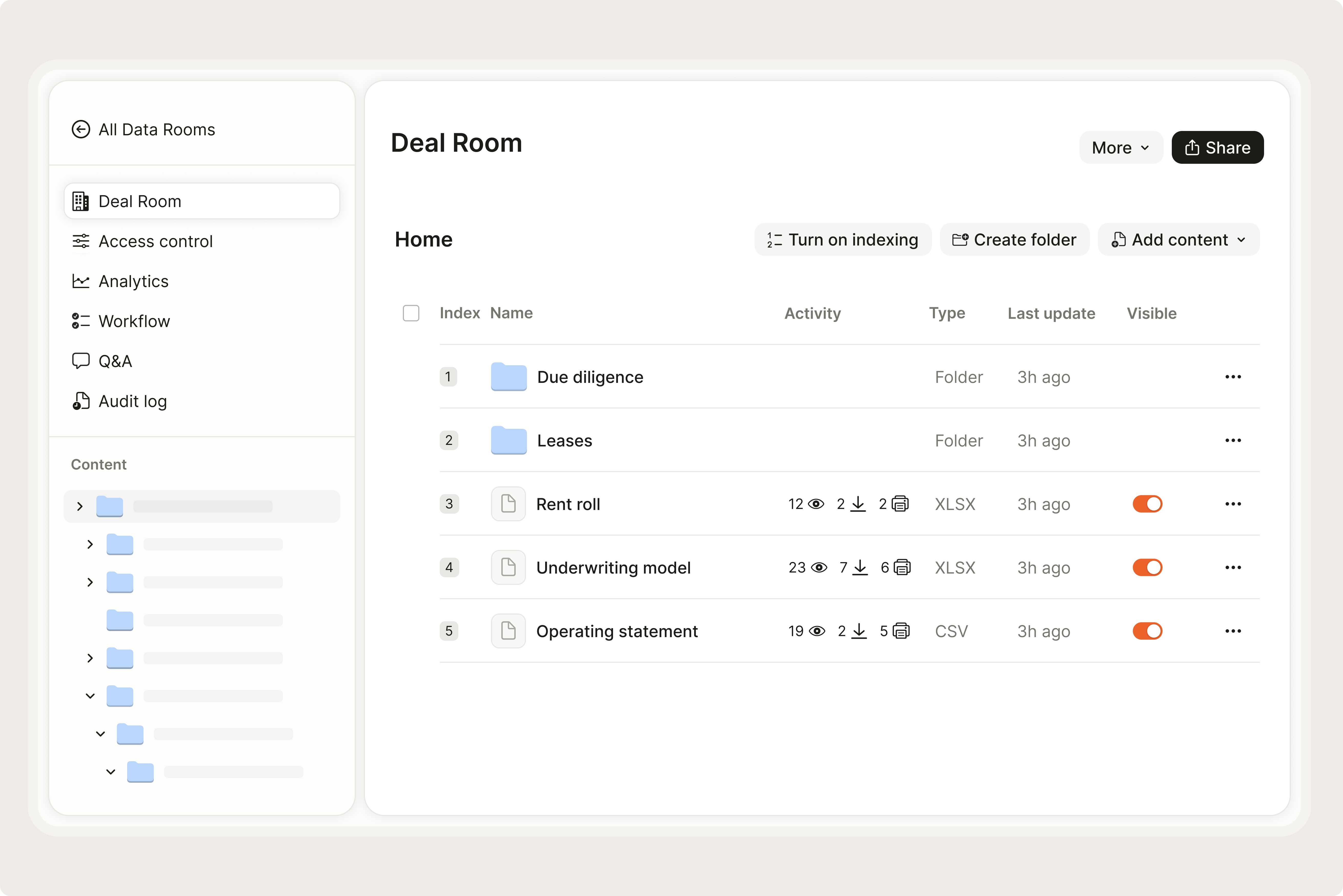
- 1.Upload Denmark property files to a secure roomDrop Tingbogen extract, BBR records, V1/V2 classification, lokalplan, energimærke, and leases into Ellty.
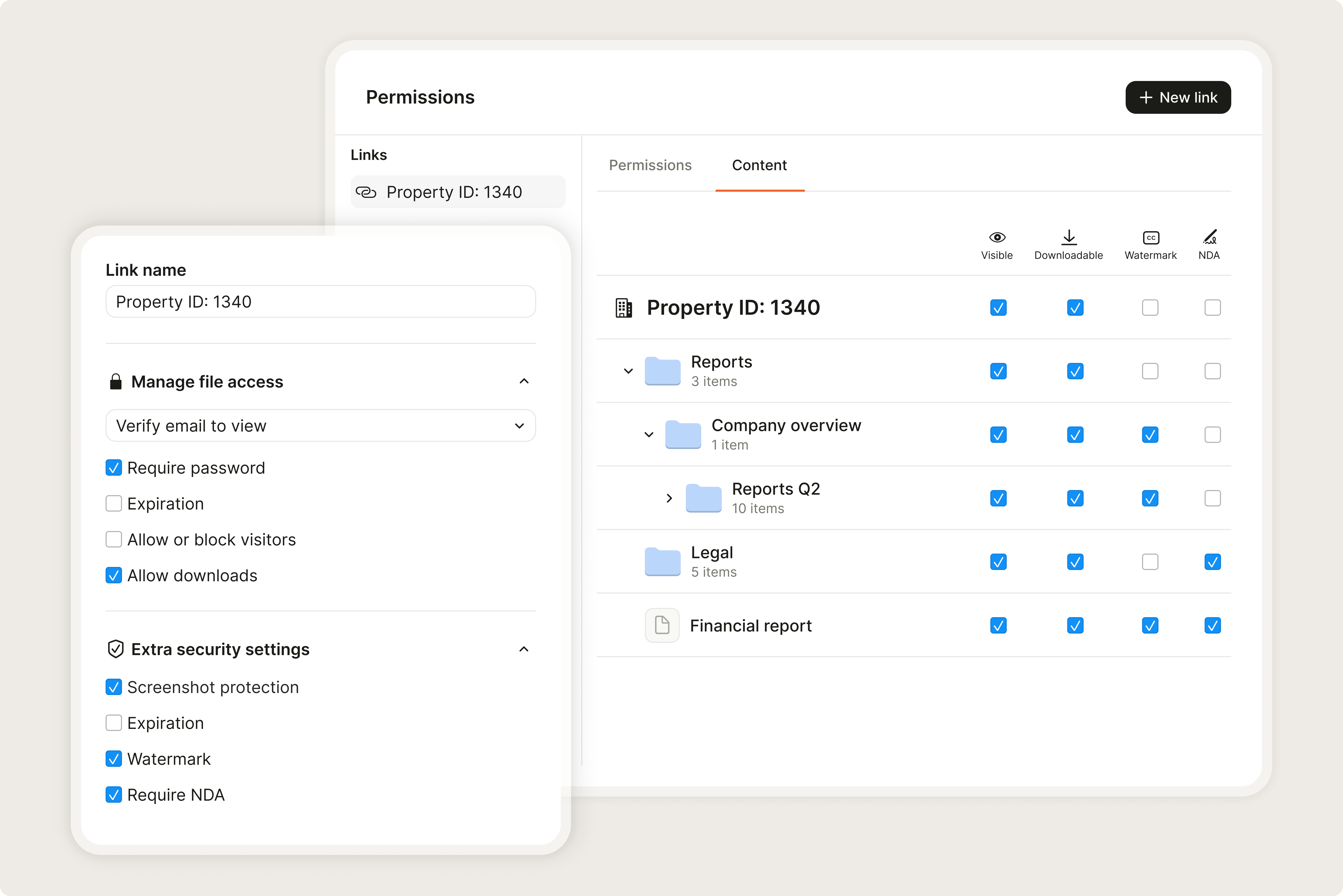
- 2.Give each advisor a scoped, tracked linkAdvokat sees Tingbogen and lease documents. Environmental consultants see V1/V2 and Phase I reports. Technical advisors see BBR and building inspection. Ellty enforces the scope.
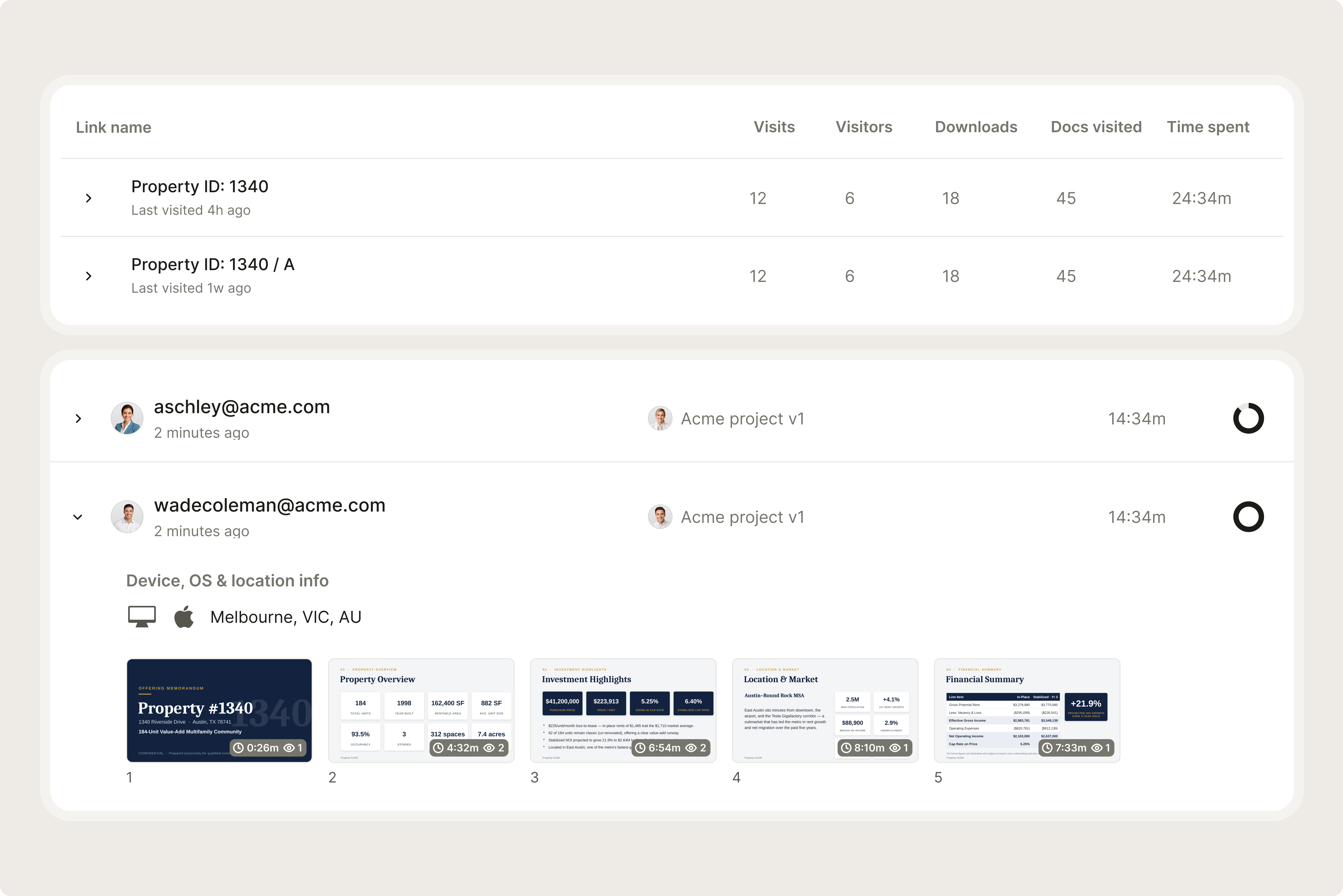
- 3.Monitor who reviews which documentsSee exactly which files each advisor opened and when. Catch delays before they affect the signing date and Tinglysning registration.
What makes Denmark different
The tinglysningsafgift at 0.6% is one of the lowest transfer taxes in Europe. There is no stamp duty, no documentary tax, no municipal transfer levy. For a DKK 100M commercial asset, the registration fee runs approximately DKK 600,000. Compare that to France at 5.8% or Germany at 3.5-6.5%.
The V1/V2 contamination classification is Denmark's most important environmental diligence framework. It's a mandatory state register, not an optional advisory system. Municipalities check the kortlægning status in planning and building permit applications; a V2-classified site cannot be developed without an approved remediation program. For any industrial or brownfield asset, the V1/V2 check must happen before any commercial commitment.
BBR discrepancies are endemic in older Danish commercial buildings. The BBR (building and housing register) is supposed to be an accurate record of every building's characteristics, but many owners have added floors, changed uses, or extended buildings without updating the register. The discrepancy between BBR and physical reality creates compliance risk, affects insurance valuations, and must be corrected before sale.
MOMS structure matters more in Denmark than many buyers expect. Danish commercial property with voluntary MOMS registration generates a 10-year adjustment obligation (reguleringsforpligtelse). If the buyer doesn't continue the MOMS registration, the seller faces a MOMS clawback. The deal documents must address who bears this cost. Non-Danish buyers sometimes assume MOMS is a pass-through; in Denmark's commercial property context, it's a structural tax item.
The Land Registry (Tingbogen) in Denmark is administered digitally by the Tinglysningsretten as part of the Danish Court system. All registrations are made electronically via the Tinglysning.dk portal. A registration produces full priority from the moment it is submitted, provided it is subsequently processed without objection. Rights not registered in Tingbogen are not binding on a subsequent purchaser in good faith. The tinglysningsafgift for real property transfers is 0.6% of the purchase price plus a flat fee of DKK 1,825, paid at the time of registration.
Timeline and cost in Denmark
Weeks 1-2 cover kickoff: Tingbogen extract, BBR register check, Miljøstyrelsen V1/V2 database search, lokalplan extract, energimærke confirmation, MOMS status analysis, and Phase I ESA engagement for relevant assets. Budget DKK 50,000-150,000 for advisory fees in this phase.
Load all files into Ellty before advisors start. Scoped, tracked links for each party remove at least one week from a standard Denmark CRE diligence timeline.
Weeks 2-4 cover deep review: lease abstraction and Erhvervslejeloven compliance, BBR discrepancy investigation and municipal permit review, Phase I ESA delivery, V2 remediation cost modeling if required, and technical building inspection. Cost runs DKK 100,000-300,000 depending on complexity.
Phase II ESA and V2 remediation: if V2 status is confirmed, add 4-8 weeks for Phase II and MSTS (municipal environmental authority) remediation plan approval.
Weeks 4-6 handle resolution: MOMS structure confirmed in deal documents, outstanding BBR items addressed, energimærke confirmed, and Tinglysning registration. Digital closing via Tinglysning.dk is fast once all documents are in order.
Denmark total acquisition cost: 0.6% tinglysningsafgift + advokat fees DKK 80,000-200,000 + Phase I ESA + technical inspection + valuation. Total acquisition cost on a Danish commercial deal runs approximately 1-2% of purchase price (excluding MOMS restructuring costs if applicable). The low tinglysningsafgift makes Denmark one of the most tax-efficient CRE markets in Europe at the transaction level.
Running a Denmark property deal from one room
Hold Tingbogen docs, V1/V2 classification, and lease files in one secure, tracked Ellty data room.
Start free 14-day trialCommon questions about due diligence on Denmark property
- Most Denmark CRE deals complete in 4-8 weeks. V1/V2 contamination classification review, BBR discrepancy investigation, and MOMS structure analysis are the typical lead-time items. Digital Tingbogen registration is fast; the delay comes from the diligence process, not the closing mechanics.
- The tinglysningsafgift (land registration fee) for commercial property in Denmark is 0.6% of the purchase price plus DKK 1,825. There is no separate stamp duty or municipal transfer tax. Denmark has one of the lowest property transfer tax rates in Europe.
- Denmark classifies land contamination using a two-tier system. V1 indicates potential contamination based on historical activities (e.g. former petrol station, dry cleaner, industrial use); V2 indicates confirmed contamination based on investigation. V2 status triggers mandatory remediation requirements before development or change of use. Both classifications are maintained by Miljøstyrelsen (EPA) and must be searched before any commercial property acquisition.
- The BBR (Bygnings og Boligregistret) is the Danish national building and housing register, maintained by municipalities. It records each building's registered use, gross floor area, construction year, and systems. Older Danish commercial buildings often have unauthorized extensions, unregistered use changes, or area discrepancies not recorded in BBR. These create compliance risk, affect financing, and must be resolved or disclosed before sale.
- If a Danish commercial property seller has voluntarily registered for MOMS (VAT) on commercial rental income, a 10-year MOMS adjustment obligation (reguleringsforpligtelse) attaches to the property. If the buyer does not continue MOMS registration, the seller incurs a MOMS clawback cost. The deal documents must address who bears this cost and how MOMS registration is handled post-transfer.
- No. Denmark has no notary system for property transactions. Conveyancing is handled by advokater (lawyers), who draft the skøde (deed) and register the transfer electronically on Tinglysning.dk. Title transfers from the moment the Tingbogen registration is processed.