Croatia commercial property due diligence has three structurally distinct risks: a dual property records system (Land Register and Cadastre) that often doesn't match and can hide encumbrances; a coastal maritime domain where state ownership overrides private title within defined zones; and widespread unpermitted construction that requires legalization documents before any commercial use is confirmed.
Croatia's Real Property Acquisition Tax (Porez na promet nekretninama, PPN): 3% of the agreed consideration or tax administration-assessed market value, whichever is higher; paid by the buyer; due within 30 days of the certified sale agreement. For commercial property where the seller is VAT-registered and the transaction is subject to Croatian VAT (25%), PPN does not apply (VAT applies instead via reverse charge for business buyers). In practice, most commercial-to-commercial transactions between VAT-registered parties use the VAT mechanism; confirm with Croatian tax counsel.
Croatia joined the EU in 2013; EU citizens can purchase commercial property freely. Non-EU citizens from countries with bilateral reciprocity agreements with Croatia can purchase; non-EU citizens from other countries need approval from the Ministry of Justice, which is a process that takes time and is not guaranteed. Confirm buyer nationality and applicable purchase rights before any deposit.
The Croatian Land Register (Zemljišna knjiga) is maintained by Municipal Courts and records ownership rights, encumbrances (mortgages, servitudes), and other real rights. The Cadastre (Katastar) is maintained by the State Geodetic Administration and records physical parcel boundaries and surface areas. These two systems were historically separate and often have inconsistencies; both must be checked, and discrepancies between them must be resolved before closing.
Set up a real estate data room before diligence starts. Load land register extracts, cadastre records, building permits, legalization documents, maritime domain maps, and lease files before advisors engage.
Where Croatia property deals go wrong
Not every check carries the same weight. The table below sorts risks by deal impact - dealbreakers first, then what moves the price, then basic hygiene - so your Croatian attorney and notary know what to clear first.
| Area | Documents to pull | HR red flag | Matters most for | Tier | |
|---|---|---|---|---|---|
| Land register and cadastre - title verification | Land register and cadastre - title verification | Land Register extract (Zemljišnoknjižni izvadak) from competent Municipal Court, Cadastre extract (Posjedovni list) from State Geodetic Administration, cadastre plan, OIB confirmation of all title holders | Croatian commercial title must be verified from BOTH the Land Register (ownership, encumbrances, mortgages, pre-emption rights, servitudes) and the Cadastre (physical parcel, boundaries, area, land use classification); discrepancies between Land Register and Cadastre are common and must be investigated - they can indicate unresolved boundary disputes, ownership gaps, illegal changes of parcel boundaries, or outdated records; always get current extracts from both systems; a stale extract is not reliable as encumbrances can be registered at any time | All buyers | Dealbreaker |
| Maritime domain - coastal state ownership | Maritime domain - coastal state ownership | Maritime Domain and Seaports Act (Zakon o pomorskom dobru i lukama) maritime domain maps, State Geodetic Administration coastal zone records, Harbour Master's Office records, applicable County Sea Offices (Lučka kapetanija) records | The Croatian Adriatic coast is maritime domain (pomorsko dobro) - state-owned territory that cannot be privately owned; maritime domain extends from the seabed to the highest high-water mark plus any additional area defined by the Maritime Domain Act; private title within the maritime domain is legally invalid regardless of what the land register says; commercial hotel, resort, marina, and coastal retail properties in Dalmatia, Istria, and Kvarner must specifically confirm whether any portion of the commercial parcel is within the maritime domain boundary; maritime domain maps must be obtained from the State Geodetic Administration and verified against the commercial parcel boundaries | All Adriatic coastal commercial; hotels, resorts, marinas, waterfront retail | Dealbreaker |
| Building permits and legalization | Building permits and legalization | Building permit (Dozvola za gradnju) or legalization document, Use permit (Uporabna dozvola), building inspection records, State Geodetic Administration legalization database | Croatia had widespread unpermitted construction; the Law on Legalization of Illegally Constructed Buildings (2012, amended multiple times) allowed unauthorized buildings to be regularized; a legalized building should have a legalization document (Rjesenje o legalizaciji) and be registered in the cadastre; many commercial buildings in Croatia were built without permits or with permits that don't match the actual constructed building; verify that: (1) the commercial building has a valid building permit or legalization document; (2) the building as constructed matches the permits; (3) a valid Use Permit (Uporabna dozvola) exists; a commercial building without a Use Permit cannot be legally used for commercial purposes | All Croatia commercial - especially older commercial buildings, tourist facilities, rural commercial | Dealbreaker |
| Pre-emption rights | Pre-emption rights | Land Register encumbrance section (section B) pre-emption rights, co-ownership records, agricultural pre-emption waiver letters | Croatian law recognizes multiple types of pre-emption rights (pravo prvokupa): co-owners of shared property have first right to purchase; agricultural land neighbors have statutory pre-emption rights; certain protected areas (national parks, nature parks, certain heritage zones) give the state pre-emption rights; some commercial properties may have contractual pre-emption rights registered in the Land Register; all applicable pre-emption right holders must formally waive their right (or be offered the purchase on the same terms and decline) before the sale can be completed; failure to do so can result in the transaction being challenged by the pre-emption right holder | All commercial especially agricultural-adjacent, national park-adjacent, co-owned | Dealbreaker |
| Non-EU buyer - purchase approval | Non-EU buyer - purchase approval | Buyer nationality confirmation, bilateral reciprocity agreement status, Ministry of Justice approval application (if required) | EU/EEA citizens and companies incorporated in EU/EEA member states can purchase Croatian commercial property freely; non-EU citizens from countries with bilateral reciprocity agreements with Croatia can also purchase commercial property; non-EU citizens from other countries must apply to the Croatian Ministry of Justice for approval; Ministry of Justice approval can take months and is not guaranteed for all property types; confirm buyer eligibility before committing to any deposit | Non-EU buyers | Dealbreaker |
| PPN / VAT and transfer tax | PPN / VAT and transfer tax | Seller VAT registration status, Croatian Tax Administration (Porezna uprava) confirmation of applicable tax regime, PPN calculation at 3% or VAT invoice (25%) as applicable | The applicable transfer tax mechanism depends on the seller's VAT status: if the seller is not VAT-registered or the transaction is exempt from VAT, the buyer pays 3% PPN (Real Property Acquisition Tax) on the consideration or tax administration market value, whichever is higher; if the seller is VAT-registered and the commercial property is subject to VAT (25%), PPN does not apply and the business buyer accounts for VAT via reverse charge; confirm the applicable tax mechanism with Croatian tax counsel before finalizing transaction structure | All buyers - affects deal economics | Price-adjuster |
| Encumbrances - mortgages, servitudes | Encumbrances - mortgages, servitudes | Land Register section C (encumbrances) extract, mortgage holder confirmation letter, utility servitude records, enforcement (ovrha) records | Land Register section C lists mortgages (hipoteke), real servitudes (stvarne sluznosti), personal servitudes (osobne sluznosti), and other encumbrances; mortgages must be released before or at closing; utility servitudes (pipelines, cables, access roads) may affect commercial use; also check enforcement proceedings (ovrha) - enforcement liens can attach to immovable property and rank ahead of contractual buyers; confirm Land Register is clean of all encumbrances or that releases are in place before deposit | All buyers | Price-adjuster |
| Leases and tenancies | Leases and tenancies | All commercial leases, rent roll, estoppel equivalents (Croatian commercial tenancy doesn't have formal estoppels but written confirmation from tenants), maritime domain concession records (if coastal commercial) | Croatian commercial tenancy law (Zakon o zakupu i kupoprodaji poslovnih prostora) provides some commercial tenant protections including rights to continued occupation; coastal commercial operating on maritime domain will typically operate under a maritime concession (Koncesija) rather than ownership; a coastal hotel or marina operated under a maritime concession is not owned - it's operated under a state-granted time-limited concession; confirm whether coastal commercial assets are owned freehold or operated under maritime concession | Coastal hospitality commercial; all tenanted commercial | Price-adjuster |
| Zoning and spatial planning | Zoning and spatial planning | Applicable Spatial Plan (Prostorni plan zupanija/opcine/grada), physical planning documents, certificate of zoning conformity (Lokacijska informacija), Ministry of Physical Planning records | Croatian spatial planning operates at state, county (zupanija), city/municipality (grad/opcina) levels; a Lokacijska informacija (location information certificate) from the competent city/municipal authority confirms the permitted uses, building conditions, and any planning restrictions for a specific parcel; for Adriatic coastal commercial: coastal spatial plans often have strict height limits, setback requirements from the sea, and density restrictions designed to protect the visual landscape and maritime domain; obtain a Lokacijska informacija before any commercial bid | All commercial, especially Adriatic coastal | Standard check |
| Environmental and physical condition | Environmental and physical condition | Phase I ESA, Croatian Environment Agency (HAOP) contaminated sites records, asbestos survey (pre-1990 commercial buildings), building structural assessment | Croatia has significant industrial legacy contamination in former Yugoslav industrial zones (Sisak, Rijeka, Slavonski Brod, Split industrial areas); the HAOP maintains records of contaminated sites; Phase I ESA using Croatian environmental data is standard for any former-industrial commercial; asbestos was widely used in Yugoslav-era construction; commission asbestos survey for any commercial building constructed before 1990 | Former Yugoslav industrial commercial, older commercial buildings | Standard check |
| Seller KYC and AML | Seller KYC and AML | Croatian Commercial Court Registry (sudski registar) entity records, UBO confirmation, OFAC screen, EU sanctions screen | Croatian commercial sellers include domestic private and corporate owners; significant foreign-held coastal commercial from pre-EU era; confirm seller entity status at Croatian Commercial Court Registry; run OFAC and EU sanctions screens on all principals; confirm OIB (Croatian personal/entity identification number) for all parties - all Croatian property transactions require OIB; foreign buyers must obtain OIB before completing any Croatian property transaction | All deals | Standard check |
Due diligence on a Croatia property?
Set up your Ellty data room before diligence starts.
Start free 14-day trialCroatia commercial property due diligence checklist
The table ranked risks by severity. This is the full checklist to work through, grouped by area.
Title - land register and cadastre
- Pull current Land Register extract (Zemljišnoknjižni izvadak) from the competent Municipal Court on day one; pull current Cadastre extract (Posjedovni list) from the State Geodetic Administration simultaneously; compare both
- Land Register section A: confirms parcel identification, area, and cadastre reference; compare with cadastre to identify discrepancies
- Land Register section B: confirms ownership (vlasnistvo) - registered owner, co-ownership shares, and any real rights (sluznosti, stvarna prava); confirm the seller is the registered owner and has full title
- Land Register section C: lists encumbrances (teret) - mortgages (hipoteke), real servitudes, personal servitudes, enforcement proceedings, and other encumbrances; ALL must be addressed before closing
- Cadastre vs. Land Register discrepancies: common discrepancies include: different parcel area in each system; different boundaries; parcel in Land Register but not in Cadastre (or vice versa); different building footprint; each discrepancy must be investigated and resolved before title can be confirmed as clean
- For coastal commercial: additionally confirm maritime domain status (separate from Land Register - maritime domain maps are maintained by the State Geodetic Administration with input from Harbour Masters)
Load land register extracts, cadastre records, building permits, legalization documents, maritime domain maps, and all lease files into Ellty. Title attorney sees land register and cadastre files. Maritime law specialist sees coastal zone records. PA/planning specialist sees building permits and spatial plans. Lender sees clean title confirmation and valuation.
Maritime domain - coastal commercial clearance
- For any Croatia commercial property on or near the Adriatic coast: obtain maritime domain maps from the State Geodetic Administration (DGU) for the property's coastal area; maritime domain maps (Pomorski kataster) show the maritime domain boundary
- Maritime domain boundary: the maritime domain includes the sea, seabed, and coastal land from the lowest low-water mark to the highest high-water mark, plus any additional area defined by the Maritime Domain and Seaports Act; the definition can include areas that appear to be private land based on visual inspection
- Parcel-by-parcel analysis: for each cadastral parcel in a coastal commercial acquisition, confirm whether any part of the parcel is within the maritime domain boundary; maritime domain parts of a parcel cannot be privately owned regardless of what the land register shows; a land register entry showing private ownership of maritime domain land is invalid
- Maritime concession: commercial uses within the maritime domain (beach restaurants, marinas, beach clubs, boat storage) require a maritime concession (Koncesija na pomorskom dobru) granted by the relevant County authority; confirm whether any part of the commercial operation relies on a maritime concession; if so, confirm the concession terms, expiry date, renewal rights, and whether the concession transfers with the commercial acquisition
- Harbour Master zone: the Harbour Master (Lucka kapetanija) has jurisdiction over the maritime domain in its area; obtain confirmation from the applicable Harbour Master that the intended commercial use is compatible with the maritime domain classification of the coastal area
Building permits and legalization
- Request all building permits (Dozvole za gradnju), use permits (Uporabne dozvole), and any legalization documents (Rjesenja o legalizaciji) from the seller; these should be available for every structure on the commercial parcel
- Building permit cross-check: compare the building as constructed with the building permit (or legalization document); any unauthorized additions or alterations must either be legalized or demolished; confirm with the competent building inspection authority
- Use permit (Uporabna dozvola): a commercial building without a valid use permit cannot be legally used for commercial purposes; if no use permit exists, the commercial property is in an irregular status that must be resolved before closing or reflected in a significant price adjustment
- Energy performance: Croatia requires an Energy Performance Certificate (Energetski certifikat) for commercial property sale; obtain from the seller or commission independently
- Older Yugoslav-era commercial: buildings constructed under Yugoslav-era permits (pre-1991) may have permits issued under the former Yugoslav system; confirm that the post-independence Croatian authorities have either reissued or accepted the original permits; some Yugoslav-era buildings were never properly registered in Croatian systems after 1991
Give each advisor a scoped link in Ellty. Title attorney sees land register and cadastre. Maritime law specialist sees coastal maps and concession records. Building inspector sees permit chain. Environmental consultant sees HAOP records and Phase I. Lender sees use permit, title extract, and valuation. No one sees files outside their scope.
Pre-emption rights and purchase restrictions
- Identify all pre-emption right holders from the Land Register section C and from legal review: co-owners, agricultural neighbors (if any agricultural parcels are included), national park/nature park authorities (if applicable), and any contractual pre-emption rights
- Pre-emption waiver procedure: all pre-emption right holders must be formally offered the property on the same terms as the intended buyer and given a statutory period to exercise or waive their right; the waiver (or confirmation of no exercise) must be documented before closing
- Non-EU buyer approval: if the buyer is non-EU from a country without a bilateral reciprocity agreement with Croatia, submit the Ministry of Justice approval application early; this runs parallel to title examination and does not have a guaranteed approval timeline; all commercial activity including paying deposits is at risk if Ministry of Justice approval is ultimately denied
- OIB registration: foreign buyers must obtain a Croatian OIB (personal/entity identification number) from the Croatian Tax Administration before completing any Croatian property transaction; OIB registration for foreign individuals takes 1-3 weeks; for foreign companies it takes longer; start OIB registration in parallel with title examination
Transfer tax - PPN or VAT
- Confirm seller's VAT status with Croatian tax counsel on day one; the applicable tax mechanism (3% PPN or 25% VAT with buyer reverse charge) depends on whether the seller is a Croatian VAT payer and whether the transaction qualifies for VAT
- PPN calculation: if PPN applies, the 3% rate is applied to the agreed consideration or the Croatian Tax Administration's assessed market value (Tržišna vrijednost po TU), whichever is higher; the Tax Administration may assess a higher value than the agreed price, particularly for coastal commercial where market values are closely monitored
- PPN payment: buyer pays PPN within 30 days of the certified sale agreement; the Croatian notary typically files the tax return with the Tax Administration on behalf of the parties; confirm the notary's procedure for your transaction
- VAT transaction structure: where VAT applies, the buyer (if VAT-registered business) accounts for 25% Croatian VAT via reverse charge and recovers it from Croatian tax credits; the 3% PPN does not apply; net cost to the buyer is zero (input VAT recovery), but the VAT must be reported and recovered, which requires Croatian VAT registration
Compare Slovenia's commercial property due diligence process for Adriatic/Central European portfolio work. Slovenia and Croatia share Yugoslav-era building permit heritage issues and civil law notarial systems, but differ significantly on the maritime domain issue (Slovenia has a small Adriatic coastline vs. Croatia's 1,800km Adriatic coast), transfer taxes (Slovenia land transfer tax vs. Croatian 3% PPN/VAT), and administrative complexity (Croatia's EU accession in 2013 is more recent than Slovenia's 2004 accession).
How due diligence works in Croatia
Step 1 - Land register, cadastre, and maritime domain
Day one: pull Land Register extract and Cadastre extract simultaneously, compare both for discrepancies. For any coastal commercial: obtain maritime domain maps from DGU in parallel.
The land register and cadastre comparison can take 1-2 weeks for simple commercial; longer for complex multi-parcel coastal commercial with maritime domain overlap questions.
Step 2 - Building permits, environmental, and buyer status
Request building permit chain and use permit from seller. Commission Phase I ESA for former-industrial or urban commercial. Commission asbestos survey for pre-1990 buildings.
Confirm buyer eligibility to purchase in Croatia. Start OIB registration if not already held. For non-EU buyers needing Ministry of Justice approval: submit application immediately.
Step 3 - Pre-emption rights, leases, and zoning
Identify all pre-emption right holders and initiate formal waiver process. Abstract all commercial leases. For coastal commercial: confirm maritime concession terms (if any). Obtain Lokacijska informacija from competent municipality.
Step 4 - PPN/VAT and closing
Confirm PPN or VAT treatment with Croatian tax counsel. Calculate 3% PPN on consideration (or assess whether VAT structure applies). The Croatian notary coordinates the transfer documentation, tax filings, and Land Register registration.
Load all files into Ellty. Title attorney sees land register and cadastre. Maritime specialist sees coastal records. Building inspector sees permit chain. Environmental consultant sees HAOP data. Lender sees clean title, use permit, and valuation.
How to set up your Croatia data room in Ellty.
Croatia commercial deals involve Land Register extracts, Cadastre records, building permits, legalization docs, maritime domain maps, maritime concession records, HAOP environmental records, and lease files.
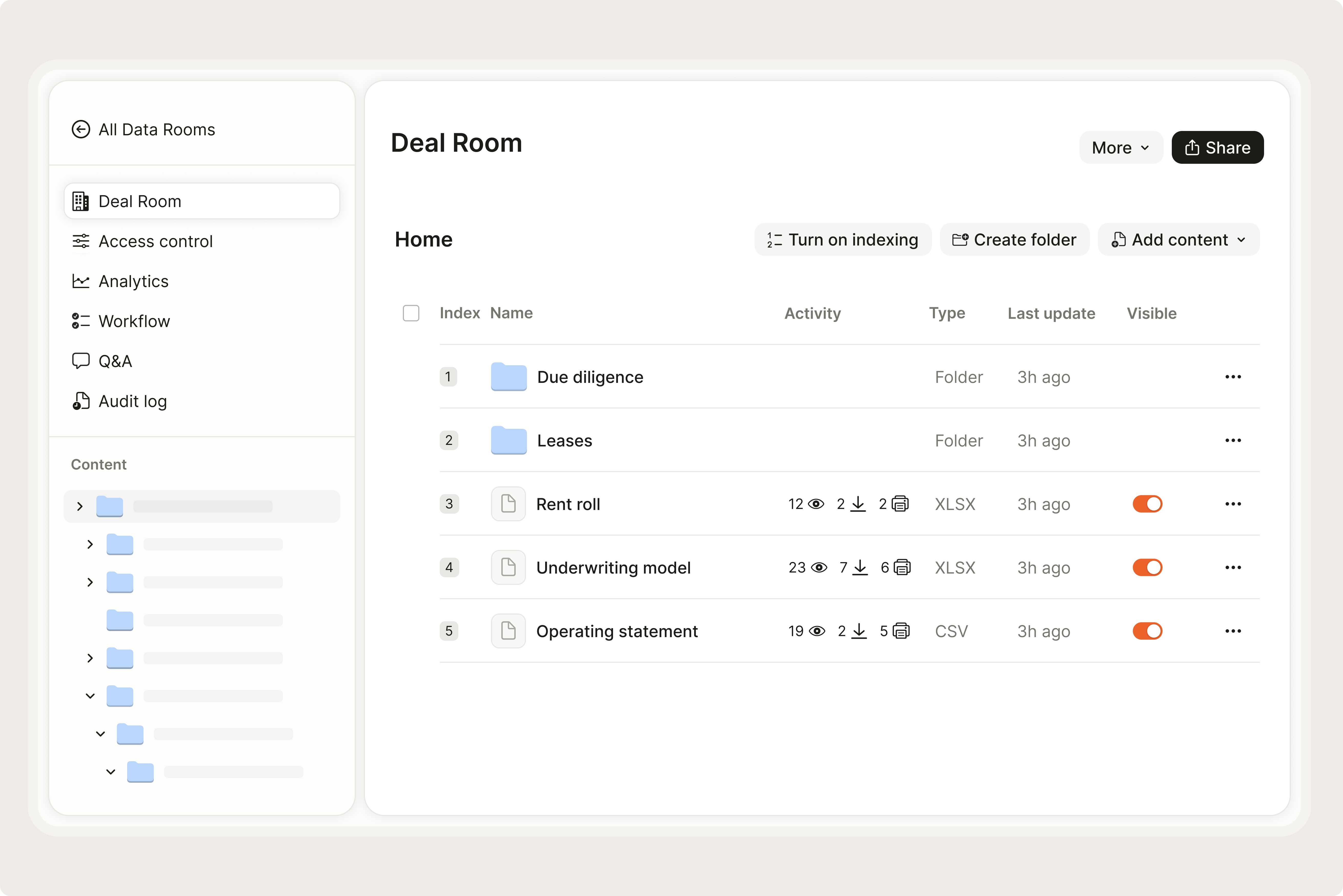
- 1.Upload Croatia property files to a secure roomDrop Land Register extract, Cadastre extract, building permits, legalization documents, use permit, maritime domain maps, maritime concession records, Phase I ESA, Energy Performance Certificate, spatial plan extracts, and lease pack into Ellty.
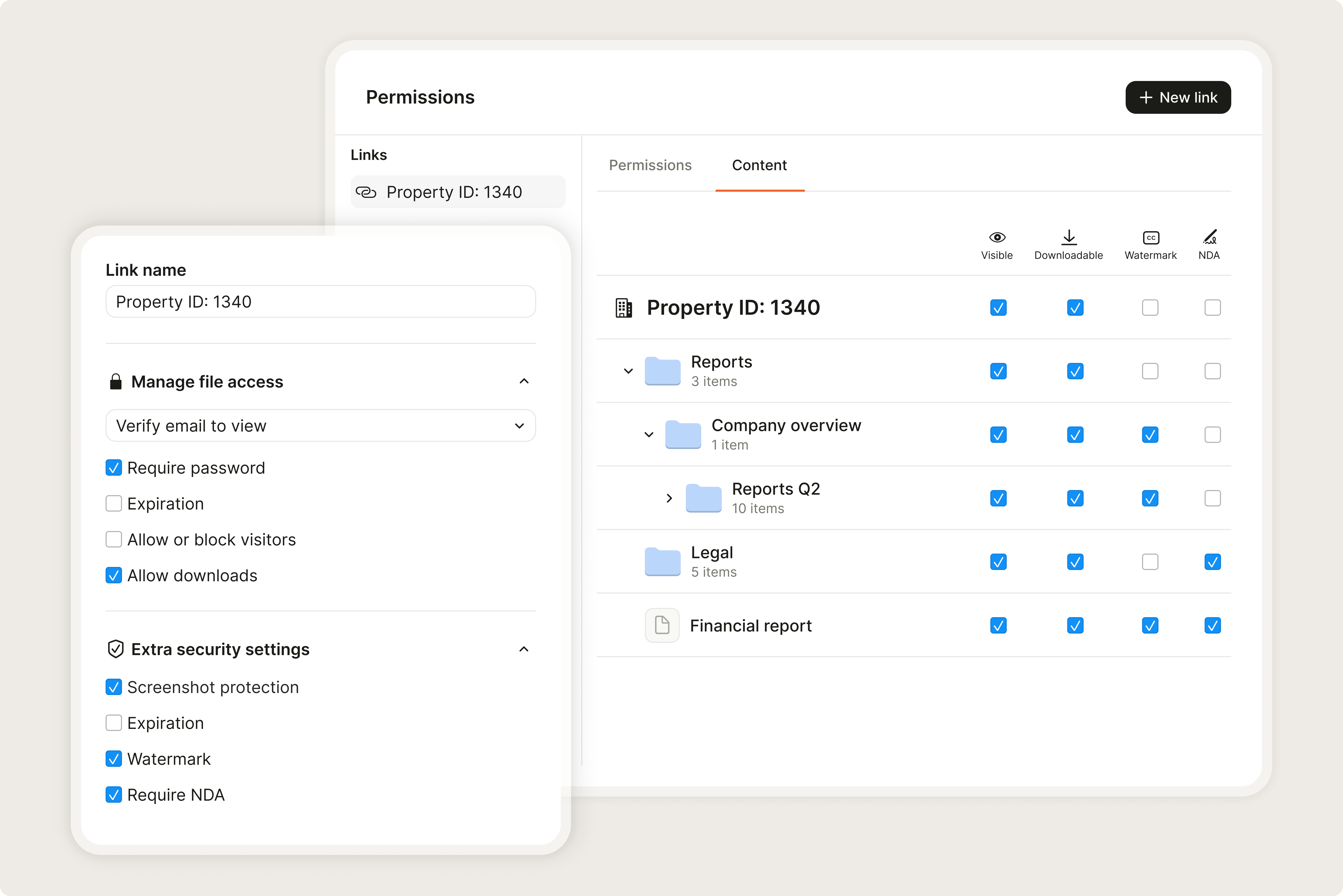
- 2.Give each advisor a scoped, tracked linkTitle attorney sees land register and cadastre files. Maritime law specialist sees coastal zone maps and concession records. Building inspector sees permit chain. Environmental consultant sees HAOP records and Phase I. Lender sees use permit, clean title, and valuation.
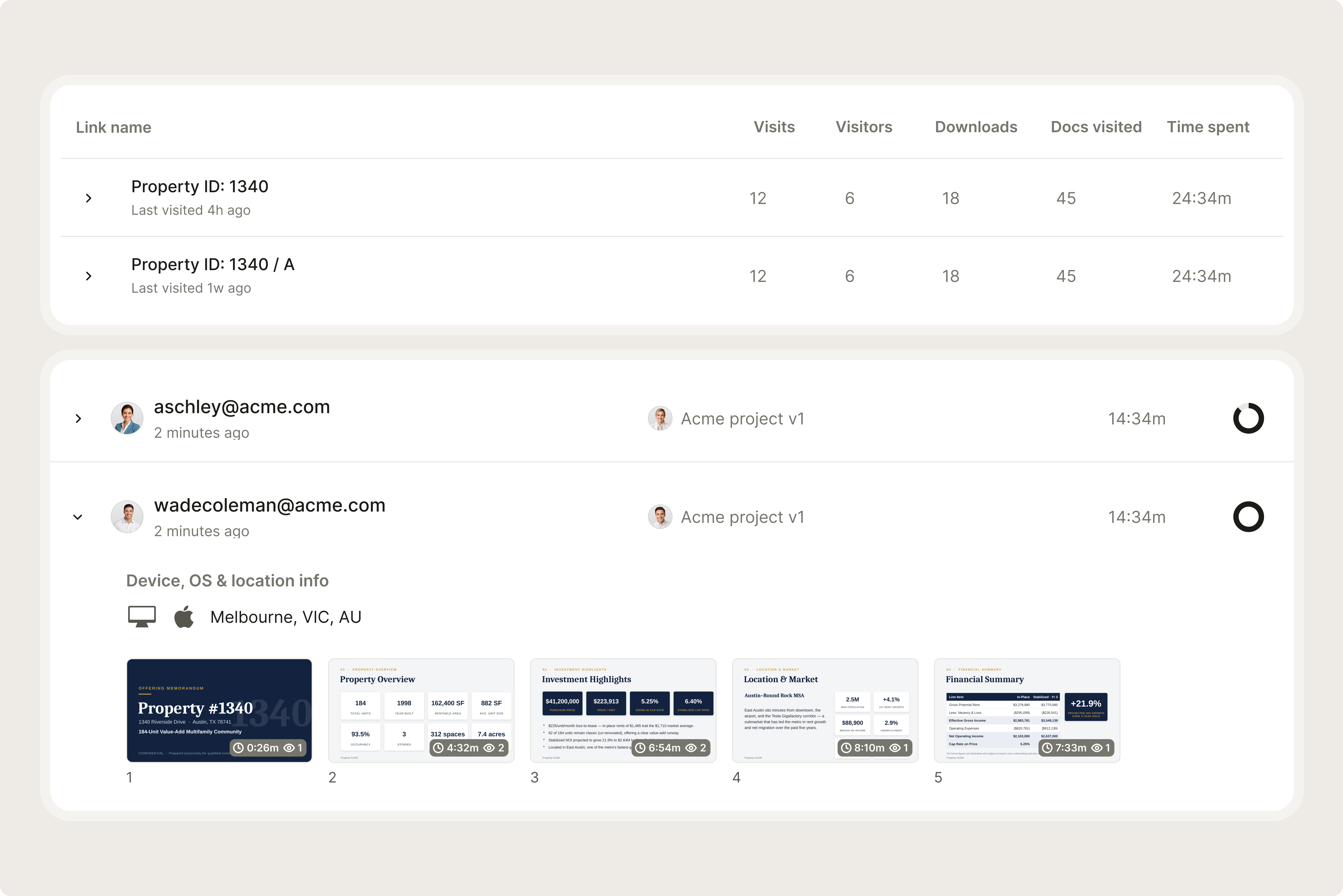
- 3.Monitor who reviews which documentsSee exactly which files each advisor opened and when. Catch maritime domain encroachment or building permit gaps before they affect deal pricing or closing.
What makes Croatia different
The maritime domain (pomorsko dobro) is the defining structural feature of Croatian Adriatic coastal commercial real estate that has no equivalent in most EU jurisdictions. Under Croatian law, the entire Croatian Adriatic coastline - from the seabed to the highest natural high-water mark, plus any area necessary for coastal public use - is state-owned maritime domain that cannot be privately owned, sold, or mortgaged. This boundary is not a setback line or a planning restriction: it is a property law ownership boundary. Private title within the maritime domain is legally void regardless of what the land register records. A hotel that has been privately owned, operated, mortgaged, and sold repeatedly for 40 years may still have a portion of its beach area legally in the maritime domain, with any purported private ownership invalid from the original acquisition. The maritime domain maps maintained by the State Geodetic Administration are the authoritative source; they must be obtained and overlaid against the cadastral parcel boundaries for any Adriatic coastal commercial acquisition. For coastal resort commercial, this check is as fundamental as the land register title examination.
Croatia's building permit situation reflects a broader Yugoslav-era and post-independence legacy that predates Croatia's EU accession. Yugoslavia had a formal permit system, but enforcement was inconsistent, and many citizens built extensively without permits or significantly beyond permitted footprints. After independence, Croatia inherited a commercial building stock where a significant proportion had irregular permit status. The legalization law (2012 and subsequent amendments) addressed most pre-June 21, 2011 unpermitted construction, but the legalization process is complex, and many commercial properties went through it with partial regularization - some structures legalized, others not, or legalization documents that don't match the actual building. For commercial buyers: verify each structure on the parcel against its permit or legalization document; commission a licensed Croatian surveyor and architect to compare the as-built against the permitted; and treat any structure without a valid use permit as a price-adjustment event, not merely a documentation gap.
Croatia's dual registration system - the Land Register at Municipal Courts for ownership records and the Cadastre at the State Geodetic Administration for physical records - is a legacy of separate administration by different authorities over decades. The harmonization between the two systems has been ongoing since the 1990s and has advanced significantly, but in 2026 many rural commercial properties and some older urban properties still have discrepancies. These discrepancies range from minor (slightly different parcel area) to significant (different ownership, unregistered division of parcels, buildings in cadastre but not in land register). Croatian real estate practice requires checking both systems and reconciling the results; buyers who check only the land register are missing half the picture.
Maritime domain (pomorsko dobro) under the Maritime Domain and Seaports Act (Zakon o pomorskom dobru i lukama, Official Gazette 158/03, 100/04, 141/06, 38/09, 123/11, 56/16, 98/19) comprises the internal sea waters and territorial sea of the Republic of Croatia, the seabed and subsoil thereof, the coast and offshore islands, rocks and reefs, as well as artificial marine structures permanently connected to the seabed. Maritime domain is public good, belongs to the Republic of Croatia, and cannot be the subject of ownership or other real rights. Use of maritime domain for economic purposes requires a maritime concession granted by a county or the central government depending on the type and scope of use. Land register entries showing private ownership of maritime domain are legally void and do not create valid title.
Timeline and cost in Croatia
Weeks 1-2 cover kickoff: Land Register and Cadastre extract comparison, maritime domain map check (coastal commercial), seller building permit and use permit request, Phase I ESA commission (former-industrial), spatial plan Lokacijska informacija request, buyer OIB registration (if not held), Ministry of Justice application (non-EU buyers without bilateral agreement), pre-emption right holder identification, lease abstraction, AML/KYC, and seller entity check at Commercial Court Registry. Legal fees in this phase: EUR 3,000-10,000.
Load all files into Ellty before advisors engage. Standard Croatia commercial: 45-90 days. Non-EU Ministry of Justice approval: 3-12 months additional. Maritime concession confirmation: 2-6 weeks.
Weeks 2-6 cover deep review: Land Register-Cadastre discrepancy resolution (if any), maritime domain boundary analysis for coastal commercial, building permit verification by licensed Croatian surveyor/architect, use permit confirmation, pre-emption right waiver process (3-6 weeks), Phase I ESA delivery, HAOP environmental records, Lokacijska informacija review, lease abstraction, Energy Performance Certificate, PPN/VAT structure confirmation with Croatian tax counsel, and encumbrance clearance preparation. Costs in this phase: EUR 5,000-25,000.
Weeks 6-12 handle resolution: Phase II ESA (if triggered), maritime domain boundary formalization (if any overlap), building legalization (if needed), pre-emption waiver completion, mortgage releases, OIB registration completion, Ministry of Justice approval (non-EU), and closing at Croatian notary with Land Register registration.
Croatia total buyer acquisition costs: 3% PPN on consideration (or VAT, if applicable) + notary fees (approximately 0.5-1% of consideration) + legal fees + Croatian Land Register registration fee (nominal). Total buyer closing overhead: approximately 4-5% for PPN-subject transactions.
Running a Croatia property deal from one room
Hold land register, cadastre, permits, maritime domain records, and lease files in one secure, tracked Ellty data room.
Start free 14-day trialCommon questions about due diligence on Croatia commercial property
- Standard Croatia commercial property deals take 45-90 days. Non-EU buyer Ministry of Justice approval (for countries without bilateral reciprocity agreements): 3-12 months in addition. Maritime concession review for coastal commercial: 2-6 weeks. Building legalization (if needed): 3-12 months. OIB registration for foreign buyers: 1-3 weeks for individuals; longer for foreign companies.
- The Croatian maritime domain (pomorsko dobro) is state-owned territory covering the Adriatic coast from the seabed to the highest natural high-water mark plus any area needed for coastal public use. Under the Maritime Domain and Seaports Act, maritime domain cannot be privately owned regardless of what the land register shows. Private title within the maritime domain is legally void. Adriatic coastal commercial properties must be verified against maritime domain maps from the State Geodetic Administration to confirm no part of the parcel falls within the maritime domain. Coastal hotels, resorts, marinas, and beach operations that use maritime domain typically operate under a maritime concession granted by the county or state - not freehold ownership.
- If the seller is not VAT-registered or the transaction is exempt from Croatian VAT: the buyer pays Real Property Acquisition Tax (PPN - Porez na promet nekretninama) at 3% of the agreed consideration or the Croatian Tax Administration's assessed market value, whichever is higher. PPN is paid within 30 days of the certified sale agreement. If the seller is a Croatian VAT-registered business and the commercial property is subject to Croatian VAT (25%): PPN does not apply and the VAT-registered buyer accounts for 25% VAT via reverse charge (fully recoverable as input VAT). Confirm the applicable tax mechanism with Croatian tax counsel before finalizing transaction structure.
- Croatia maintains two separate property records systems: the Land Register (Zemljišna knjiga) at Municipal Courts records ownership and encumbrances; the Cadastre (Katastar) at the State Geodetic Administration records physical parcel boundaries and areas. These systems were administered separately and often have inconsistencies including different parcel areas, different boundary descriptions, buildings in one system but not the other, or unregistered parcel divisions. Both must be checked and reconciled. A buyer who checks only the Land Register is missing the cadastral physical reality; discrepancies can indicate boundary disputes, unresolved divisions, or unregistered changes that affect commercial use.
- Croatia had widespread unpermitted construction, especially before EU accession. The 2012 Law on Legalization of Illegally Constructed Buildings allowed unauthorized buildings built before June 21, 2011 to be regularized. Legalized buildings should have a Rjesenje o legalizaciji (legalization decision) and be registered in the cadastre. Any commercial building without a valid building permit or legalization document AND without a Use Permit (Uporabna dozvola) is in an irregular status that prevents legal commercial use. Verify each structure against its permit or legalization document; commission a licensed Croatian surveyor/architect to compare as-built against permitted.
- EU/EEA citizens and EU/EEA-incorporated companies can purchase Croatian commercial property freely after Croatia's EU accession in 2013. Non-EU citizens from countries with bilateral reciprocity agreements with Croatia can also purchase commercial property without additional approval. Non-EU citizens from other countries must apply to the Croatian Ministry of Justice for purchase approval; this process can take months and approval is not guaranteed for all property types. All foreign buyers must obtain a Croatian OIB (personal/entity identification number) before completing any Croatian property transaction.