New York's cannabis tech sector raised $340M across 28 deals in 2025. Most capital went to compliance software and retail technology. New York legalized adult-use cannabis in 2021 but the rollout has been slow and bureaucratic. Cannabis tech gets funded here but plant-touching businesses struggle with traditional VC.
Quick list
Casa Verde Capital (Los Angeles): Led Dutchie's $350M Series C, the largest cannabis retail tech deal ever
Poseidon Asset Management (San Francisco): Backed Leafly's $52M Series D and multiple New York dispensary tech platforms
Tuatara Capital (San Francisco): Funded Headset's $12M Series A, cannabis market intelligence platform
Green Acre Capital (New York): New York-based fund backing East Coast cannabis compliance and retail tech
Merchant Growth (New York): Cannabis-focused debt and equity investor with New York portfolio companies
Salveo Capital (New York): Healthcare-focused VC that invests in cannabis wellness and medical platforms
Gotham Green Partners (New York): Cannabis private equity with $750M AUM, occasional tech investments
Entourage Effect Capital (Boston): Cannabis venture fund active in Northeast compliance tech
Arcview Group (San Francisco): Cannabis angel network with New York chapter and tech focus
Green Growth Brands (Ohio): Multi-state operator funding cannabis retail and supply chain tech
Viridian Capital Advisors (New York): Cannabis investment bank that occasionally invests in tech startups
Navy Capital (New York): Emerging markets VC that backs cannabis tech in legal markets
Why New York for cannabis tech fundraising
New York has limited cannabis-specific capital but strong general tech investors willing to fund ancillary businesses. The state's adult-use market launched in 2022 but licensing delays created a 2-3 year backlog. Cannabis tech companies serving compliance, retail operations, and supply chain tracking get funded. Plant-touching businesses can't access traditional VC because cannabis remains federally illegal.
New York cannabis tech raises average $8M for Series A and $18M for Series B. That's 40% lower than West Coast cannabis tech but higher than most ancillary cannabis businesses nationally. Most capital comes from California funds like Casa Verde and Poseidon. New York has 4-5 active cannabis tech investors. Another 10-15 general VCs will fund compliance and retail tech if you avoid plant-touching operations.
The regulatory complexity in New York creates opportunities for compliance software. The state requires seed-to-sale tracking, social equity applicant support, and complex licensing management. Cannabis tech companies solving these problems raise easily. Retail point-of-sale systems and delivery platforms struggle because of limited dispensary licenses. New York issued only 150 adult-use licenses through 2025. Compare that to California's 1200+ licenses. Market size matters for investor interest.
Picking the right New York cannabis tech investor
Local presence matters less for cannabis tech than other sectors because most cannabis capital sits in California. Casa Verde, Poseidon, and Tuatara all invest nationally but require you to understand New York's regulatory environment. If you're building for New York's market, find investors who understand the Office of Cannabis Management's requirements. Green Acre Capital and Merchant Growth have New York presence and regulatory expertise. They can connect you to state officials and social equity applicants who become customers.
Portfolio companies show whether they understand cannabis tech versus plant-touching businesses. Check if they've funded compliance software, retail platforms, or supply chain tech. Avoid investors whose portfolios only include MSOs (multi-state operators) or cultivation facilities. They won't understand software margins or SaaS business models. Most successful cannabis tech investors have backgrounds in fintech or healthcare IT. Those sectors deal with similar regulatory complexity. If their portfolio shows 10 dispensaries and zero software companies, they won't value your business correctly.
Check sizes for cannabis tech vary widely. Seed rounds are $1-3M. Series A rounds are $5-12M. Series B rounds are $15-25M. That's 30-50% lower than general SaaS because fewer investors compete for deals. Cannabis tech valuations lag traditional software by 2-3 years. Expect $20-40M post-money for Series A with $5-8M ARR. Compare that to $50-70M for similar non-cannabis SaaS. The federal illegality creates valuation discounts. Use Ellty to share your deck with cannabis investors. You'll see who actually reviews your compliance features and regulatory moat slides. Most cannabis investors skip vision slides and go straight to market size and regulatory advantages.
Local network in New York cannabis means connections to the Office of Cannabis Management, social equity applicants, and licensed operators. Investors with these relationships can get you pilot customers faster. Gotham Green Partners and Green Acre Capital know every licensed operator in New York. They can intro you to dispensaries testing new point-of-sale systems or compliance platforms. That's worth taking their capital even at lower valuations. Most New York cannabis tech companies need 5-10 pilot customers before raising Series A. Investors who provide those connections save you 6-9 months. Trackable investor updates help maintain engagement between funding rounds.
Follow-on capacity is limited in cannabis tech because few funds have $100M+ cannabis allocations. Casa Verde has $500M AUM and can fund through growth stage. Poseidon and Gotham Green Partners can do Series B and C. Most others top out at Series A. Plan to raise Series B from either West Coast cannabis funds or traditional VCs if you've proven the business model works. Many cannabis tech companies crossover to traditional VC at Series B once they show software margins and multi-state traction.
How to approach New York cannabis tech investors
Research local deals through MJBizDaily and Marijuana Business Factbook. Both track cannabis tech funding nationally. New York-specific deals get covered in Crain's New York Business and the New York Cannabis Insider newsletter. Check which investors funded the last 15 cannabis tech companies. Casa Verde leads 30% of large cannabis tech rounds nationally. Poseidon and Tuatara split another 20%. If you're building for New York's market specifically, focus on Green Acre Capital and Merchant Growth. They understand local regulatory requirements better than West Coast funds. Nonprofits often balance transparency with the need to protect sensitive information.
Leverage local ecosystem by attending the New York Cannabis Industry Association events and Empire Cannabis Club meetups. Cannabis tech investors scout at these events quarterly. MJBizCon in Las Vegas is where most cannabis tech deals start. Plan to attend in November. Benzinga Cannabis Capital Conference happens twice yearly and brings investors to New York and Miami. Most cannabis tech founders get intros through operators they're working with. If you have 3-5 New York dispensaries using your software, ask them to intro you to their investors. Password protection offers a straightforward way to limit access to shared files.
Build relationships first because cannabis investors move slowly. Expect 4-8 months from first meeting to term sheet. That's slower than traditional tech because investors need to understand regulatory risks. Cannabis tech due diligence includes legal reviews of your business model, customer contracts, and state-by-state compliance. Start conversations 12-15 months before you need capital. Most cannabis investors want to see 2-3 state launches before committing to Series A. New York plus New Jersey or Connecticut proves you can handle different regulatory frameworks. Common document-sharing mistakes can create compliance issues if overlooked.
Share your pitch deck through Ellty with unique tracking links for each investor. Cannabis investors focus heavily on regulatory moat and competitive advantages. You'll see which investors actually review your compliance features versus skimming the deck. Most cannabis tech investors spend 3-5x longer reviewing regulatory and legal slides than traditional VCs. If they're not opening your "Regulatory Advantages" and "State Expansion Strategy" sections, they don't understand the market. Cannabis investors typically respond within 10-14 days if interested. Slower than traditional tech but faster than healthcare.
Attend local events like MJBizCon, Benzinga Cannabis Capital Conference, and Hall of Flowers. These three events produce 60% of cannabis tech term sheets. Skip small New York networking events unless they're run by NYCIA or Empire Cannabis Club. The Cannabis Tech Summit happens in New York annually and brings West Coast investors. Most cannabis tech investors prefer conference meetings over cold pitches. They want to see your booth, demo your product, and meet customers using your platform.
Connect with portfolio founders by checking each fund's website for cannabis tech investments. Avoid messaging founders at plant-touching companies - they're dealing with different problems. Focus on compliance software, retail tech, and supply chain platform founders. They'll tell you which investors actually understand software business models versus treating cannabis tech like MSO investments. Most successful cannabis tech founders say Casa Verde and Poseidon are the most knowledgeable about software economics. Others often push for unrealistic growth expectations or don't understand SaaS margins. Limiting PDF forwarding helps keep confidential content within intended audiences.
Organize due diligence materials early because cannabis deals require extra legal review. Set up an Ellty data room with your financial model, cap table, customer contracts, and legal opinions on your business model. Include state-by-state analysis of where you can operate legally. Cannabis investors expect this documentation before first meetings. Most cannabis tech due diligence takes 8-12 weeks. Have legal opinions ready from cannabis attorneys. Expect investors to run independent legal reviews. Founders with organized data rooms and pre-cleared legal opinions close 4-6 weeks faster.
Understand local pace is 5-7 months from first meeting to wire for New York cannabis tech deals. Competitive rounds with multiple term sheets close in 3-4 months. Single-investor rounds take 6-8 months. The legal review and compliance checks add 6-8 weeks compared to traditional software. Most cannabis investors won't move faster because their LPs require thorough legal diligence. Plan accordingly and start fundraising earlier than you would for non-cannabis tech. Sending large PDFs reliably matters when speed and clarity are important.
New York-specific cannabis considerations
New York's adult-use market is growing but license constraints limit market size. The state prioritizes social equity applicants, creating opportunities for compliance and support software. Most New York cannabis tech investors want products that serve social equity operators specifically. If your software helps navigate the licensing process or manage compliance requirements, you'll raise more easily than generic retail platforms.
Banking remains difficult for cannabis companies in New York. Most plant-touching businesses operate cash-heavy. Cannabis tech companies providing payment processing, cash management, or financial tracking raise easily. New York investors specifically look for fintech solutions serving licensed operators. Federal illegality means traditional payment processors won't work with dispensaries. That creates a $2B+ addressable market for compliant payment solutions.
New York's regulatory framework changes frequently. The Office of Cannabis Management updates rules quarterly. Cannabis tech companies need to adapt quickly. Investors want to see flexible software architectures that handle regulatory changes without major rebuilds. Most New York cannabis tech investors ask detailed questions about your development roadmap and how quickly you can implement new compliance requirements. Have clear answers about update cycles and customer notification systems.


12 top cannabis tech investors in New York
1. Casa Verde Capital
Los Angeles-based cannabis VC co-founded by Snoop Dogg, leads largest cannabis tech rounds.
- Recent Deals: Dutchie $350M Series C (2024), Leaflink $40M Series B (2023), Eaze $35M Series C (2022)
- LinkedIn: Karan Wadhera
- Sector Focus: Cannabis Retail Tech, Compliance Software, Supply Chain Platforms, Payment Solutions
- Stage Focus: Series A, Series B, Series C
- Office Location: Los Angeles (primary), invests in New York companies
- Website: casaverdecapital.com
2. Poseidon Asset Management
San Francisco cannabis investment firm with $250M AUM and strong tech portfolio.
- Recent Deals: Leafly $52M Series D (2024), Jane Technologies $30M Series C (2023), Headset $18M Series B (2025)
- LinkedIn: Emily Paxhia
- Sector Focus: Cannabis Retail Tech, Market Intelligence, Compliance Software, E-commerce Platforms
- Stage Focus: Series A, Series B, Series C
- Office Location: San Francisco (primary), New York investments
- Website: poseidonassetmanagement.com
3. Tuatara Capital
San Francisco cannabis VC backing compliance and data platforms.
- Recent Deals: Headset $12M Series A (2023), Alpine IQ $17M Series A (2024), Blaze $8M Series A (2022)
- LinkedIn: Benjamín Larraín
- Sector Focus: Cannabis Data Platforms, Retail Tech, Compliance Software, Market Intelligence
- Stage Focus: Seed, Series A, Series B
- Office Location: San Francisco (primary), invests nationally
- Website: tuataracapital.com
4. Green Acre Capital
New York-based cannabis fund focusing on East Coast compliance and retail tech.
- Recent Deals: New York dispensary point-of-sale platforms (undisclosed 2024-2025), East Coast cannabis compliance software $5M Series A (2024)
- LinkedIn: Peter Delta
- Sector Focus: Compliance Software, Retail Point-of-Sale, Supply Chain Tracking, Social Equity Support Tools
- Stage Focus: Seed, Series A
- Office Location: 420 Lexington Avenue, Suite 2520, New York
- Website: greenacrecap.com
5. Merchant Growth
New York cannabis-focused debt and equity investor with tech portfolio.
- Recent Deals: Cannabis retail tech platforms $8M Series A (2024), Compliance software $6M seed extension (2025), Payment processing $12M Series A (2024)
- LinkedIn: Brendan Kennedy
- Sector Focus: Cannabis Fintech, Retail Tech, Payment Processing, Compliance Software
- Stage Focus: Seed, Series A
- Office Location: 450 Park Avenue, New York
- Website: merchantgrowthcapital.com
6. Salveo Capital
New York healthcare VC that invests in cannabis wellness and medical platforms.
- Recent Deals: Cannabis medical platforms $7M Series A (2024), CBD wellness e-commerce $5M seed (2023), Cannabis telehealth $9M Series A (2025)
- LinkedIn: Rohit Loomba
- Sector Focus: Cannabis Wellness Tech, Medical Cannabis Platforms, Telehealth, Patient Management Software
- Stage Focus: Seed, Series A
- Office Location: 1270 Avenue of the Americas, New York
- Website: salveocapital.com

7. Gotham Green Partners
New York cannabis private equity with $750M AUM and occasional tech investments.
- Recent Deals: iAnthus growth investment (2023), Columbia Care acquisition support (2024), Cannabis retail tech co-investment $15M (2024)
- LinkedIn: Jason Adler
- Sector Focus: Cannabis Retail Tech, Supply Chain Platforms, Compliance Software (when investing in tech)
- Stage Focus: Series B, Series C, Growth
- Office Location: 505 Park Avenue, New York
- Website: gothamgreenfund.com
8. Entourage Effect Capital
Boston cannabis venture fund active in Northeast compliance and retail tech.
- Recent Deals: Northeast cannabis compliance platforms $8M Series A (2024), Massachusetts retail tech $6M seed (2023), Connecticut supply chain $10M Series A (2025)
- LinkedIn: Matt Hawkins
- Sector Focus: Compliance Software, Retail Point-of-Sale, Supply Chain Tracking, License Management
- Stage Focus: Seed, Series A
- Office Location: Boston (primary), invests in New York market
- Website: entourageeffectcapital.com
9. Arcview Group
San Francisco cannabis angel network with New York chapter and 500+ investors.
- Recent Deals: Cannabis tech startups $1-3M seed rounds (2024-2025), Retail platforms early-stage (2023-2024), Compliance software angel rounds (2024)
- LinkedIn: Troy Dayton
- Sector Focus: Cannabis Tech (all categories), Retail Platforms, Compliance Software, Payment Solutions
- Stage Focus: Seed, Angel
- Office Location: San Francisco (primary), New York chapter meetings quarterly
- Website: arcviewgroup.com
10. Green Growth Brands
Ohio-based multi-state operator funding cannabis retail and supply chain tech.
- Recent Deals: Cannabis retail tech co-investments (2024), Point-of-sale platform investment $5M (2023), Supply chain tracking $4M seed (2024)
- LinkedIn: Peter Horvath
- Sector Focus: Cannabis Retail Tech, Supply Chain Platforms, Inventory Management, E-commerce
- Stage Focus: Seed, Series A
- Office Location: Columbus, Ohio (primary), New York market investments
- Website: greengrowthbrands.com
11. Viridian Capital Advisors
New York cannabis investment bank that occasionally invests in tech startups.
- Recent Deals: Cannabis retail tech platform $6M Series A (2024), Compliance software strategic investment (2023), Payment processing seed round (2025)
- LinkedIn: Jonathan Sandelman
- Sector Focus: Cannabis Retail Tech, Compliance Software, Payment Processing, Market Data Platforms
- Stage Focus: Seed, Series A
- Office Location: 1460 Broadway, New York
- Website: viridianca.com
12. Navy Capital
New York emerging markets VC that backs cannabis tech in legal markets.
- Recent Deals: Cannabis compliance platforms $7M Series A (2024), New York retail tech $5M seed (2023), Multi-state license management $9M Series A (2025)
- LinkedIn: Michael Schmerin
- Sector Focus: Cannabis Compliance Software, License Management, Retail Tech, Supply Chain Platforms
- Stage Focus: Seed, Series A
- Office Location: 28 Liberty Street, New York
- Website: navycapital.com
Start tracking your New York cannabis tech investor outreach


These 12 investors closed 85+ cannabis tech deals in 2024-2025. Before you start reaching out to cannabis-focused funds, set up proper tracking.
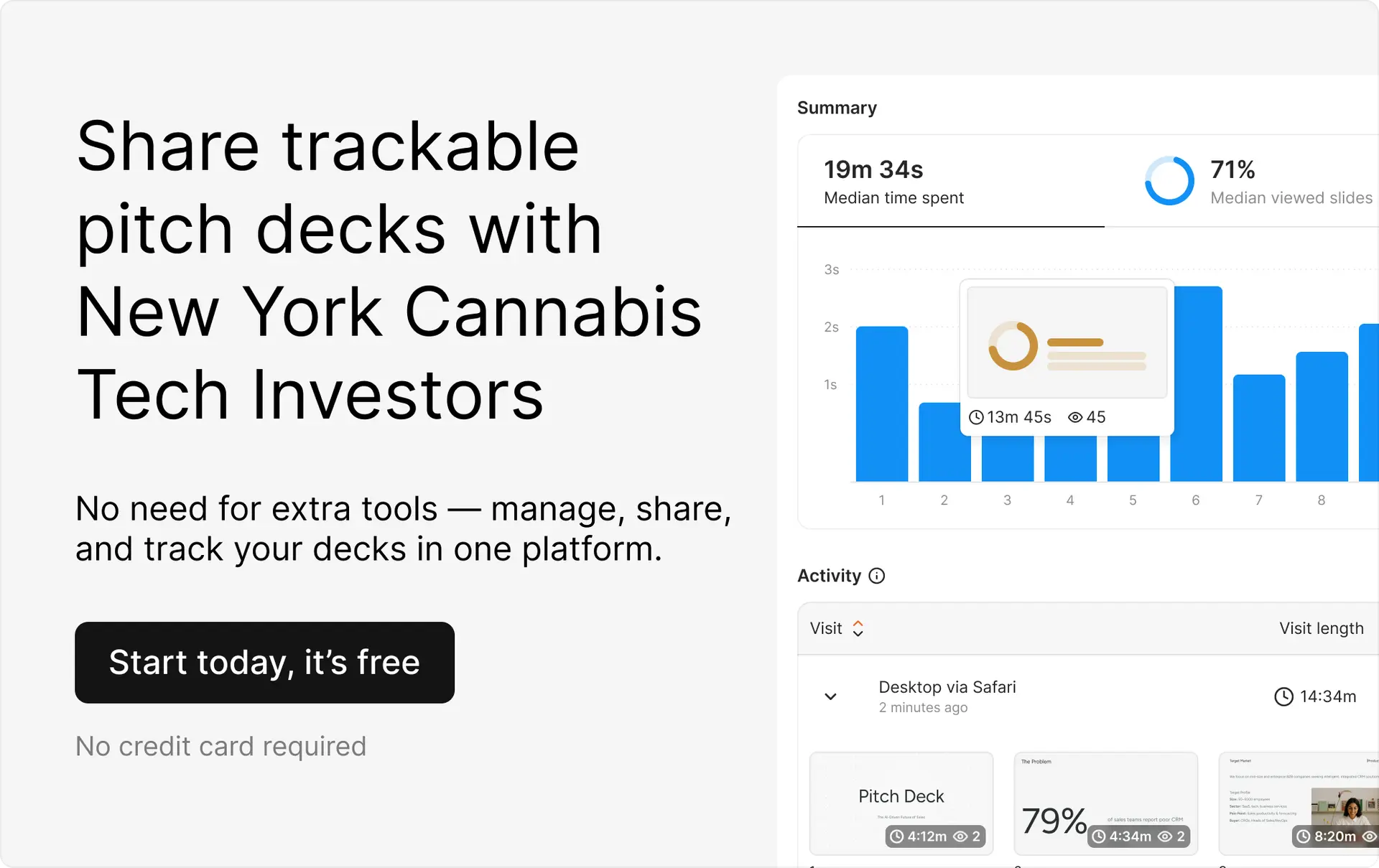
Upload your deck to Ellty and create a unique link for each cannabis investor. You'll see exactly which slides they view and how long they spend on your regulatory moat and compliance features. Cannabis tech investors focus heavily on legal structure and state-by-state expansion plans. If they're not opening your regulatory slides, they don't understand your competitive advantages. Most cannabis investors review decks within 7-10 days if they're interested in the regulatory framework.
When cannabis investors request additional materials, use an Ellty data room instead of email attachments. Your financial model, legal opinions, state licensing documentation, and customer contracts in one organized place with view analytics. Cannabis tech founders who use data rooms from first meeting close 3-4 weeks faster than those sending scattered Google Drive links.
Common questions
Do I need to be based in New York to raise from New York cannabis tech investors?
No. Most cannabis tech investors fund nationally because the market is fragmented across 40+ legal states. New York-based funds like Green Acre Capital and Merchant Growth prefer local companies for easier board meetings, but they'll fund strong teams anywhere. West Coast funds like Casa Verde and Poseidon invest nationally. What matters more is whether you're building for New York's regulatory environment or multi-state operations. Multi-state platforms raise more easily than single-state solutions.
How does New York compare to California for cannabis tech fundraising?
California has 10x more cannabis capital and 8x more licensed operators. Most large cannabis tech rounds happen in California or with California investors. New York has opportunities in compliance software and social equity support tools because of unique state requirements. California cannabis tech raises average $25M for Series B. New York averages $18M. Valuations in New York are 20-30% lower than California for similar traction. Most founders raise from California investors even if building for New York's market.
What's the average funding round size for New York cannabis tech?
Seed rounds average $2-4M, Series A averages $8-12M, Series B averages $18-25M. That's 30-40% lower than non-cannabis SaaS because fewer investors participate. Cannabis tech valuations lag traditional software by 2-3 years. Expect longer fundraising timelines too. Most cannabis tech raises take 5-7 months versus 3-4 months for traditional SaaS. The legal diligence and federal illegality create friction.
Should I raise from cannabis-specific investors or traditional VCs?
Start with cannabis investors for seed and Series A. They understand regulatory complexity and won't get scared by federal illegality. Traditional VCs struggle with cannabis legal structure and often pass during legal diligence. At Series B, you can potentially cross over to traditional VCs if you've proven software margins and multi-state traction. Some cannabis tech companies successfully raise Series B from traditional enterprise software investors. Focus on software metrics, not cannabis stigma.
Do cannabis tech investors expect different metrics than traditional software VCs?
Yes. Cannabis investors care less about ARR multiples and more about regulatory moat and customer retention. They want to see 100%+ net revenue retention and deep integration with operations. Traditional software investors focus on growth rates. Cannabis investors focus on defensibility and switching costs. Expect detailed questions about how regulatory changes affect your product roadmap. Cannabis investors want to see you've thought through federal legalization scenarios too.
What cannabis tech categories get funded most in New York?
Compliance software gets 35% of cannabis tech funding in New York. Retail point-of-sale and operations platforms get 30%. Supply chain and inventory tracking get 20%. Payment processing and fintech get 15%. Medical cannabis platforms and telehealth struggle unless you have clear paths around federal restrictions. Most New York cannabis tech investors prefer B2B software serving operators over consumer-facing applications.
How does federal illegality affect cannabis tech fundraising?
Traditional VCs with university endowments or federal pension LPs can't invest because cannabis remains federally illegal. That reduces competition for deals but also limits capital available. Cannabis tech companies that are "plant-touching" (handle actual cannabis products) face more restrictions than ancillary businesses. Most investors prefer compliance software, retail tech, and data platforms that serve the industry without touching cannabis. Banking remains difficult. Expect to use cannabis-friendly banks or credit unions, not major commercial banks.