Micro VCs manage $10M-$150M funds and write $100k-$1M initial checks at pre-seed and seed stage. They move faster than traditional VCs because they have 1-3 partners making decisions. You'll get term sheets in 2-3 weeks instead of 8-12 weeks. Most micro VCs won't lead your round but they'll commit quickly once you have a lead investor.
The best micro VCs punch above their weight with network access and operational support. They're former operators who built products or ran growth teams. Don't expect them to sit on your board for a $250k check, but they'll make useful intros and give honest feedback.
Quick list
Hustle Fund: Elizabeth Yin's fund writing $25k-$250k checks across 150+ companies per fund with strong pre-seed focus
Basecase Capital: Former founders backing technical teams with $500k-$1M checks and hands-on product help
Precursor Ventures: Charles Hudson writing $100k-$500k first checks with 60%+ follow-on rate to Series A
Also Capital: Ali Hamed's quantitative micro VC investing $250k-$750k across broad portfolio strategy
Fuel Capital: Jeff Ransdell backing B2B SaaS founders with $500k-$2M seed checks and strong enterprise sales help
Lerer Hippeau: NYC-based consumer and media micro VC writing $500k-$2M with demo day twice yearly
Serena Ventures: Serena Williams backing diverse founders with $100k-$1M checks across consumer and tech
Village Global: Network-driven fund backed by tech executives writing $100k-$500k with strong community
Backstage Capital: Arlan Hamilton's fund investing in underrepresented founders with $100k-$1M checks
M13: Courtney Reum's consumer-focused micro VC writing $500k-$2M with CPG and DTC expertise
Remarkable Ventures: Kevin Spain backing enterprise software with $500k-$1M checks and Fortune 500 connections
boldstart ventures: Ed Sim writing $500k-$1M in enterprise infrastructure with strong technical diligence
South Park Commons: Ruchi Sanghvi's community-first fund investing $100k-$500k in member companies
Weekend Fund: Ryan Hoover writing $100k-$250k ultra-early checks with Product Hunt network access
Screendoor: Maren Bannon backing underestimated founders with $100k-$500k checks and community support
Picking the right micro VC
Check size and ownership: Micro venture capitals write $100k-$1M checks targeting 1-5% ownership at entry. They won't lead your $3M seed round but they'll fill it out quickly. If you need $2M total, you'll talk to 4-6 micro VCs plus one lead investor.
Lead vs follow strategy: Most micro VCs are followers. They wait for a credible lead investor to set terms, then commit within 48 hours. A few like Precursor or boldstart will lead small rounds under $2M. Ask upfront if they lead or follow so you don't waste time.
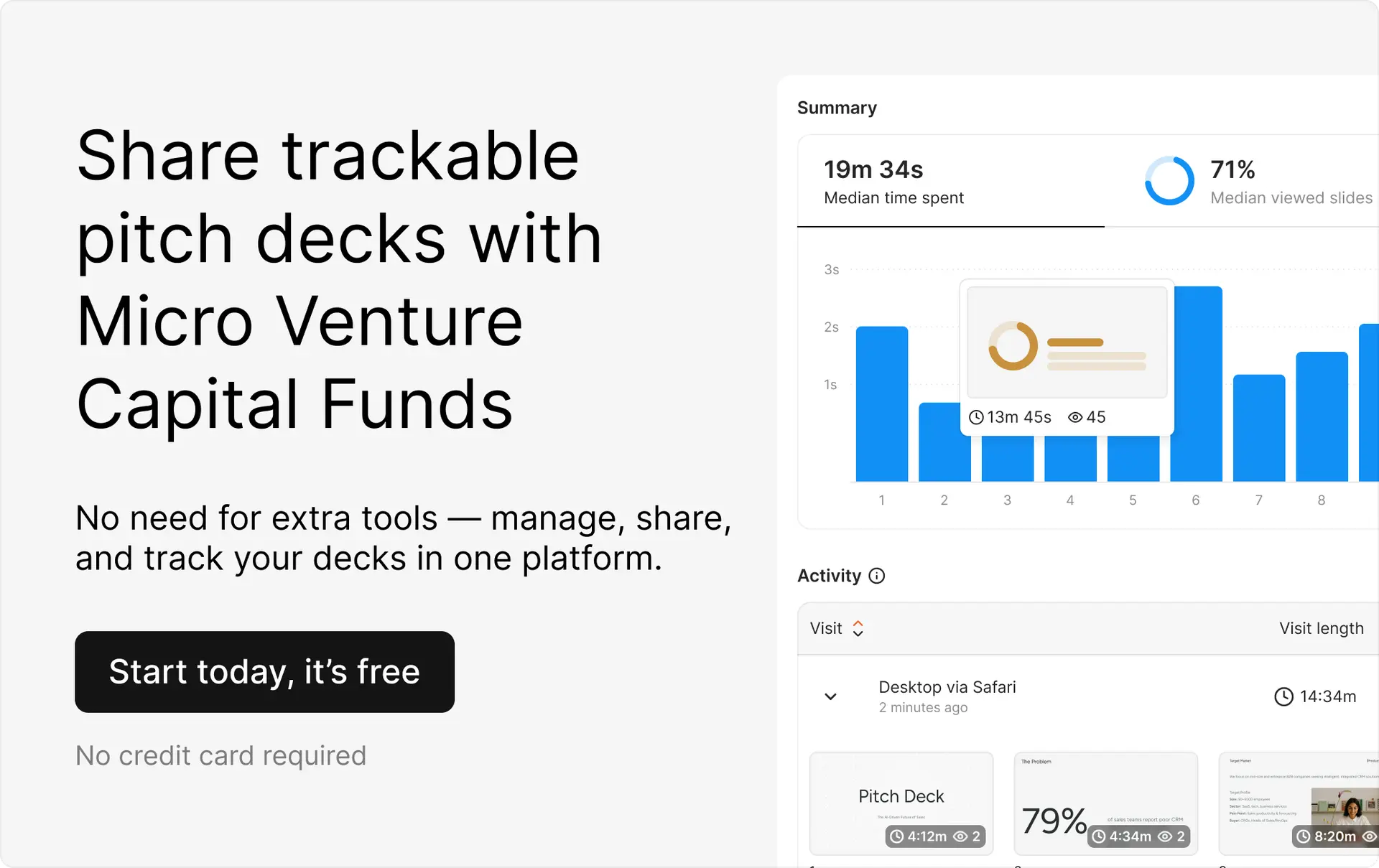
Decision speed: Micro VCs move in 1-3 weeks from first meeting to wire transfer. They don't have Monday partner meetings with 15 people voting. You'll meet 1-2 partners who make the call. Upload your deck to Ellty with trackable links - micro VCs spend 4-6 minutes reviewing initially and you'll see if they actually opened your traction slides.
Portfolio construction: Micro VCs invest in 20-40 companies per fund vs. 10-15 for traditional seed funds. They're playing a numbers game with smaller checks. Some funds like Hustle invest in 150+ companies. Don't expect deep operational support with a $100k check in a 150-company portfolio.
Follow-on reserves: Check if they reserve capital for Series A. Funds under $50M typically don't have enough to do meaningful follow-on at $10M+ Series A rounds. Your micro VC from pre-seed probably won't participate in Series B. That's fine if you just need the first check.
Value add reality: Former operators provide better help than pure investors. If your micro VC ran growth at a similar company, they'll make useful intros. Generic "we're hands-on" promises don't matter. Ask their portfolio companies directly about response time and actual help provided.
How to approach micro VC investors
Target the right fund size: Don't pitch $150M micro VCs for a $100k check. They need to deploy $30M-$40M per fund and won't spend time on tiny investments. Funds under $50M are your target for pre-seed. Funds over $75M focus on seed rounds with $500k+ checks.
Show early traction: Micro VCs want to see something working before they invest. You don't need revenue but you need users, signups, or validated demand. Pre-product ideas get rejected unless you have exceptional background. Show week-over-week growth in something.
Build your narrative clearly: Micro VCs see 2,000+ companies per year and invest in 20-40. Your pitch needs to explain the problem in 30 seconds. If they don't understand your market immediately, they'll pass. Skip the 10-slide market size buildup.
Get warm introductions: Micro VCs take cold emails but warm intros convert 5-10x better. Ask their portfolio companies for intros if you know the founders. Tweet at partners who are active on Twitter. Most micro VC partners respond to DMs from founders with traction. Many founders now send controlled files using secure confidential sharing to maintain discipline over who accesses what.
Share your deck strategically: Upload to Ellty and send trackable links to each fund. Micro VCs typically review decks within 24-48 hours of intro. You'll see which ones actually opened your financials vs. just replied with a pass. Follow up with engaged funds first.
Prepare basic financials: Micro VCs don't need full data rooms at pre-seed but they want to see your unit economics. Have a simple financial model showing customer acquisition cost, lifetime value, and burn rate. Set up an Ellty data room with your model and cap table for funds that get serious.
Time your outreach properly: Micro VCs invest year-round but many slow down in late November through December. Start fundraising conversations 6-8 weeks before you need capital. If you're running out of money in 6 weeks, you're too late for micro VCs.
Understand their thesis: Every micro VC has sector preferences even if they say they're generalist. Read their blog posts and recent investments. Don't pitch consumer social to an enterprise infrastructure fund. You'll get rejected in the intro call. If you’re sharing decks broadly, tools similar to DocSend alternatives with tracking and control can help you manage who sees what.
Why micro VC funding matters in 2026
Seed rounds are getting split into pre-seed and seed stages. Pre-seed is now $500k-$1.5M at $3M-$8M valuations. Seed is $2M-$4M at $10M-$20M valuations. Micro VCs fill the pre-seed stage that traditional seed funds used to cover.
Traditional seed funds raised larger vehicles in 2024-2025. Funds that wrote $1M-$2M checks now write $3M-$5M minimums. They moved upmarket to Series A. This created a gap at pre-seed that micro VCs filled. If you're raising under $2M, micro VCs are your primary funding source.
Micro VCs also move faster in 2026 markets. When macro conditions tighten, decision speed matters. You can close a $1M round from 5-6 micro VCs in 4-6 weeks vs. 12+ weeks for traditional seed funds. Speed keeps your burn rate manageable and lets you get back to building.


15 top micro VC funds
1. Hustle Fund
Elizabeth Yin's fund writing small checks across 150+ companies per fund with strong pre-seed portfolio strategy.
- Recent Deals: Shimmer (2025) raised $2M seed after $100k pre-seed, Freshpaint (2024) $15M Series A after $150k initial
- LinkedIn: Elizabeth Yin
- Check Size: $25k-$250k
- Stage Focus: Pre-seed to seed
- Location: San Francisco, USA
- Website: hustlefund.vc
2. Basecase Capital
Former founders backing technical teams with product expertise and $500k-$1M checks at early seed.
- Recent Deals: Zip (2024) $43M Series B after $750k seed, Brex (2025) $300M Series D after early backing
- LinkedIn: Cyan Banister
- Check Size: $500k-$1M
- Stage Focus: Seed
- Location: San Francisco, USA
- Website: basecase.vc
3. Precursor Ventures
Charles Hudson writing first checks with strong follow-on discipline and 60%+ Series A participation rate.
- Recent Deals: Narvar (2024) $50M Series D, Cameo (2025) $100M Series C after $500k seed
- LinkedIn: Charles Hudson
- Check Size: $100k-$500k
- Stage Focus: Pre-seed to seed
- Location: San Francisco, USA
- Website: precursorvc.com
4. Also Capital
Ali Hamed's quantitative micro VC investing across 100+ companies using data-driven portfolio construction.
- Recent Deals: Truebill (2024) acquired by Rocket Companies for $1.3B, Step (2025) $100M Series C
- LinkedIn: Ali Hamed
- Check Size: $250k-$750k
- Stage Focus: Pre-seed to seed
- Location: Los Angeles, USA
- Website: also.capital
5. Fuel Capital
Jeff Ransdell backing B2B SaaS founders with enterprise sales expertise and $500k-$2M checks.
- Recent Deals: Netlify (2024) $105M Series D, Segment (acquired 2020) $3.2B by Twilio after early backing
- LinkedIn: Jeff Ransdell
- Check Size: $500k-$2M
- Stage Focus: Seed to Series A
- Location: San Francisco, USA
- Website: fuelcapital.com
6. Lerer Hippeau
NYC-based consumer and media micro VC writing $500k-$2M with demo day connections twice yearly.
- Recent Deals: Allbirds (2024) IPO at $2.1B, Casper (2025) $100M Series D before acquisition
- LinkedIn: Ben Lerer
- Check Size: $500k-$2M
- Stage Focus: Seed to Series A
- Location: New York, USA
- Website: lererhippeau.com
7. Serena Ventures
Serena Williams backing diverse founders across consumer, health, and technology with $100k-$1M checks.
- Recent Deals: Tonal (2025) $250M Series E fitness, Daily Harvest (2024) $125M Series D food delivery
- LinkedIn: Serena Williams
- Check Size: $100k-$1M
- Stage Focus: Pre-seed to seed
- Location: Los Angeles, USA
- Website: serenaventures.com

8. Village Global
Network-driven micro VC backed by tech executives writing $100k-$500k with strong community access.
- Recent Deals: Airtable (2024) $735M Series F, Faire (2025) $400M Series G wholesale marketplace
- LinkedIn: Erik Torenberg
- Check Size: $100k-$500k
- Stage Focus: Pre-seed to seed
- Location: San Francisco, USA
- Website: villageglobal.vc
9. Backstage Capital
Arlan Hamilton's fund investing in underrepresented founders with $100k-$1M checks across all sectors.
- Recent Deals: Mahmee (2024) $9M Series A maternal health, Kairos (2025) $7M Series A facial recognition
- LinkedIn: Arlan Hamilton
- Check Size: $100k-$1M
- Stage Focus: Pre-seed to seed
- Location: Los Angeles, USA
- Website: backstagecapital.com
10. M13
Courtney Reum's consumer-focused micro VC writing $500k-$2M with CPG and direct-to-consumer expertise.
- Recent Deals: Lyft (2024) $100M growth round, Ring (acquired 2018) $1B by Amazon after early backing
- LinkedIn: Courtney Reum
- Check Size: $500k-$2M
- Stage Focus: Seed to Series A
- Location: Los Angeles, USA
- Website: m13.co
11. Remarkable Ventures
Kevin Spain backing enterprise software with Fortune 500 customer development connections and $500k-$1M checks.
- Recent Deals: Clari (2024) $150M Series E, Verkada (2025) $205M Series D enterprise security
- LinkedIn: Kevin Spain
- Check Size: $500k-$1M
- Stage Focus: Seed
- Location: San Francisco, USA
- Website: remarkable.vc
12. boldstart ventures
Ed Sim writing $500k-$1M in enterprise infrastructure with deep technical diligence and dev tools focus.
- Recent Deals: Snyk (2024) $530M Series F security, BigID (2025) $70M Series D data privacy
- LinkedIn: Ed Sim
- Check Size: $500k-$1M
- Stage Focus: Pre-seed to seed
- Location: New York, USA
- Website: boldstart.vc
13. South Park Commons
Ruchi Sanghvi's community-first fund investing $100k-$500k in member companies with strong peer support.
- Recent Deals: Levels (2024) $38M Series A metabolic health, Gather (2025) $50M Series B virtual spaces
- LinkedIn: Ruchi Sanghvi
- Check Size: $100k-$500k
- Stage Focus: Pre-seed to seed
- Location: San Francisco, USA
- Website: southparkcommons.com
14. Weekend Fund
Ryan Hoover writing $100k-$250k ultra-early checks with Product Hunt community and consumer tech focus.
- Recent Deals: Substack (2024) $65M Series B, Lambda School (2025) $74M Series C after early backing
- LinkedIn: Ryan Hoover
- Check Size: $100k-$250k
- Stage Focus: Pre-seed
- Location: San Francisco, USA
- Website: weekend.fund
15. Screendoor
Maren Bannon backing underestimated founders with $100k-$500k checks and hands-on community support.
- Recent Deals: Stytch (2024) $90M Series B authentication, Zoba (2025) $12M Series A logistics optimization
- LinkedIn: Maren Bannon
- Check Size: $100k-$500k
- Stage Focus: Pre-seed to seed
- Location: San Francisco, USA
- Website: screendoor.vc
Start tracking your micro VC outreach


These 15 micro VC funds invested in 300+ companies from 2025 into 2026. Most write checks within 2-4 weeks once they see traction.
Upload your pitch deck to Ellty before reaching out to micro VCs. Create unique tracking links for each fund partner. Pre-seed investors typically spend 3-5 minutes on initial review. You'll see exactly which funds opened your deck and whether they skipped your financial projections or actually reviewed them.
When micro VCs request additional information like customer references or unit economics breakdown, share an Ellty data room instead of sending email attachments. You'll know when they accessed your documents and which materials they focused on during diligence.
Common questions
What's the difference between micro VCs and angel investors?
Micro VCs manage institutional funds with LP capital and invest across 20-40+ companies. Angels invest personal money and typically do 5-10 deals per year. Micro VCs have consistent check sizes and formal processes. Angels write anywhere from $10k to $500k based on personal interest.
Do micro VCs lead seed rounds?
Most micro VCs follow rather than lead. They wait for a lead investor to set terms and close quickly after. A few funds like Precursor, boldstart, or Fuel will lead rounds under $2M. Ask about lead vs follow strategy in your first conversation.
How long does micro VC fundraising take?
Expect 2-4 weeks from first meeting to signed term sheet if you have traction. Decision-making is faster than traditional VCs because there are fewer partners. Some micro VCs move in 1 week for the right deal. Others take 4-6 weeks if they need to see more progress.
Can I raise a full seed round from micro VCs?
Yes, but you'll need 4-8 different micro VCs writing $250k-$500k each to hit $2M-$3M total. This creates a messy cap table with many small investors. Better strategy is one lead investor writing $1M-$1.5M plus 2-4 micro VCs filling out the round.
What ownership do micro VCs target?
Most micro VCs target 1-3% ownership at entry for $100k-$500k checks. They're not trying to own 20% of your company. They build portfolio returns through volume of investments, not concentration. Don't worry about dilution from micro VCs - worry about your lead investor's ownership ask.
Should I take money from multiple micro VCs?
Yes, if they bring different value. Taking 4-5 micro VC checks of $250k-$500k each is normal for seed rounds. Make sure each brings specific expertise or network access. Don't take 10 micro VC checks just to hit your target - cap table gets unmanageable.