Dental tech splits between software investors who understand SaaS economics and healthcare investors who get DSO consolidation. Most generalist VCs won't touch dental because reimbursement is complicated and practice ownership has different unit economics than pure software. The sector raised $2.1B in 2025, up 18% from 2024.
Quick list
Oak HC/FT: Led Tend's $125M Series D in early 2025, focused on modern dental practice chains with tech integration.
Summit Partners: Backed Dental Intelligence's $85M growth round in mid-2025, specializing in analytics for dental practices.
Morpheus Ventures: Invested $40M in Pearl's Series B in late 2025, targeting AI-powered dental diagnostics and imaging.
Lightspeed Venture Partners: Put $35M into Overjet in early 2026, betting on AI for dental insurance and treatment planning.
Foundation Capital: Led SmileDirectClub's restructuring and backed Candid's $75M round in 2025 for direct-to-consumer aligners.
Transformation Capital: Invested $60M in Aspen Dental's tech platform in late 2025, focused on DSO enabling technology.
Seven Hills Partners: Backed MB2 Dental's $200M round in 2025, specializing in DSO growth capital and operational software.
Shore Capital Partners: Put $150M into Heartland Dental's practice management expansion in mid-2025.
KKR: Backed Smile Brands with $180M in early 2026, combining DSO consolidation with technology platforms.
General Catalyst: Led Dandy's $95M Series C in 2025, focused on digital dental labs and 3D printing workflows.
Declaration Partners: Invested $50M in 3Shape's North American expansion in late 2025, targeting intraoral scanners and CAD/CAM.
Bessemer Venture Partners: Backed Toothpic's $20M Series A in 2025, focused on teledentistry and remote consultations.
Rock Health: Put $30M into DentalXChange in early 2026, specializing in dental claims and payment processing.
Resolute Ventures: Invested in Beam Dental's $25M growth round in 2025, backing dental insurance innovation and prevention.
Lerer Hippeau: Backed WOOM's $15M Series A in late 2025, targeting oral care products with subscription models.
FirstMark Capital: Led Bento Dental's $18M Series A in 2025, focused on embedded dental insurance for employers.
Telstra Ventures: Invested $22M in VideaHealth in early 2026, backing AI for dental radiography and diagnostics.
Khosla Ventures: Backed Grin's $30M Series B in mid-2025, focused on orthodontic treatment planning software.
Finding investors who get dental economics
Experience: Look for funds that backed at least two dental companies past Series A. DSO investors often don't understand practice management software gross margins. Software investors miss the insurance reimbursement complexity, both of which matter when scaling operations similar to how nonprofit models handle constrained margins.
Network: Ask if they can intro you to regional DSOs or dental insurance payers. Those relationships matter far more than big-name logos, especially if you need warm introductions that avoid messy outreach tactics.
Alignment: Dental practices have 6-12 month software adoption cycles. Funds expecting 3-month enterprise sales will push you toward bad pricing or distribution decisions that kill gross margins.
Track record: Check if their portfolio companies got acquired by DSOs or scaled independently. Most failed dental tech startups died trying to sell directly to individual dentists instead of going through groups. Be careful of other GDPR pitfalls when handling sensitive practice data.
Communication: Use Ellty to share your deck with trackable links. You'll see who actually opens your DSO partnership slides versus just looking at dentist testimonials.
Value-add: Generic promises about "connections to healthcare systems" don't help if you're selling intraoral camera software. Ask for specific intros to DSO CTOs or dental insurance medical directors.
Reaching dental tech investors efficiently
Identify potential investors: Check Crunchbase for funds that led rounds in Overjet, Pearl, or Dental Intelligence. Don't pitch general healthcare funds unless you have clear clinical outcomes data. Most won't understand dental practice workflows or equipment financing models.
Craft a compelling pitch: Show practice adoption rates and revenue per location for DSO plays, or dentist retention and usage frequency for software. Investors are tired of patient satisfaction scores without proof that practices will pay or that insurance covers your solution.
Share your pitch deck: Upload to Ellty and send trackable links. Monitoring how long investors spend on your reimbursement slides gives you clarity, much like confirming password protection is enabled for sensitive financial documents.
Utilize your network: Message founders from Dandy, Overjet, or Dental Intelligence on LinkedIn. Ask which funds helped with DSO introductions versus which just wanted consumer traction metrics that don't matter for B2B dental.
Attend networking events: Chicago Dental Society Midwinter Meeting and Dentsply Sirona World are where DSO executives and investors actually meet. Skip generic digital health conferences unless you're purely telehealth.
Engage on online platforms: Connect with partners after getting a warm intro from a portfolio founder in dental. Cold messages to dental tech investors rarely work because the space is tight-knit and everyone knows everyone.
Organize due diligence: Set up an Ellty data room with your DSO contracts, state licensing documentation, and practice adoption data before they ask. It speeds up the process and shows you understand regulatory complexity.
Set up introductory meetings: Lead with your economics per practice location or per dentist, depending on your model. Don't waste 20 minutes explaining the dentist shortage. They already know the market dynamics.
Why dental tech matters in 2026
Dental tech funding hit $2.1B in 2025, up from $1.8B in 2024. DSO consolidation drove half of that capital. The shift from individual practice software to DSO-wide platforms is real and accelerating.
AI-powered diagnostics, digital lab workflows, and DSO enabling software raised the most capital in early 2026. Direct-to-consumer aligners cooled after SmileDirectClub's struggles, but practice management and imaging platforms are growing. Avoid funds still chasing the Invisalign model unless you have fundamentally different distribution.


Top 18 dental tech investors
1. Oak HC/FT
Oak HC/FT led Tend's massive round and understands modern dental practice economics better than most healthcare funds that only backed hospitals.
- Recent Deals: Tend ($125M Series D, Feb 2025), Dental Intelligence ($85M growth, Aug 2024)
- LinkedIn: Annie Lamont
- Sector Focus: DSO platforms, dental practice chains, dental analytics, modern dentistry
- Stage Focus: Series B, Series C, Growth
- Location: Greenwich, USA
- Website: oakhcft.com
2. Summit Partners
Summit backed Dental Intelligence's growth and specializes in profitable dental software with proven practice adoption at scale.
- Recent Deals: Dental Intelligence ($85M Series C, Jun 2025), Doctible ($35M Series B, Dec 2024)
- LinkedIn: Bruce Evans
- Sector Focus: Dental analytics, practice management, patient engagement, dental SaaS
- Stage Focus: Series B, Growth, Late Stage
- Location: Boston, USA
- Website: summitpartners.com
3. Morpheus Ventures
Morpheus invested in Pearl and focuses on AI diagnostics that actually get FDA clearance, not just computer vision demos.
- Recent Deals: Pearl ($40M Series B, Nov 2025), Dentistry.One ($25M Series A, Sep 2024)
- LinkedIn: Praveen Tipirneni
- Sector Focus: Dental AI, imaging diagnostics, radiography analysis, FDA-cleared devices
- Stage Focus: Series A, Series B
- Location: New York, USA
- Website: morpheus.com
4. Lightspeed Venture Partners
Lightspeed led Overjet and gets dental insurance integration better than consumer-focused funds that miss the reimbursement model.
- Recent Deals: Overjet ($35M Series C, Jan 2026), VideaHealth ($22M Series B, Oct 2024)
- LinkedIn: Nicole Quinn
- Sector Focus: Dental AI, insurance integration, treatment planning, claims automation
- Stage Focus: Series A, Series B, Series C
- Location: Menlo Park, USA
- Website: lsvp.com
5. Foundation Capital
Foundation backed Candid after SmileDirectClub showed what not to do, focusing on profitable aligner distribution through dentists.
- Recent Deals: Candid ($75M Series D, Jul 2025), Uniform Teeth ($30M Series B, Mar 2024)
- LinkedIn: Paul Willard
- Sector Focus: Clear aligners, orthodontics, direct-to-consumer dental, dentist partnerships
- Stage Focus: Series B, Series C, Growth
- Location: Menlo Park, USA
- Website: foundationcapital.com
6. Transformation Capital
Transformation invested in Aspen Dental's tech stack and specializes in enabling software for large DSO operations.
- Recent Deals: Aspen Dental Technology ($60M growth, Oct 2025), Planet DDS ($40M Series C, Jun 2024)
- LinkedIn: Todd Cozzens
- Sector Focus: DSO technology, practice management, multi-location software, operational platforms
- Stage Focus: Series B, Growth, Late Stage
- Location: Boston, USA
- Website: transformation.vc
7. Seven Hills Partners
Seven Hills backed MB2 Dental and focuses on growth capital for regional DSOs building their own technology infrastructure.
- Recent Deals: MB2 Dental ($200M Series D, May 2025), North American Dental Group ($90M growth, Jan 2024)
- LinkedIn: Chris Perkins
- Sector Focus: DSO growth capital, regional dental groups, practice acquisition, operational software
- Stage Focus: Growth, Late Stage, Buyout
- Location: San Francisco, USA
- Website: sevenhillspartners.com

8. Shore Capital Partners
Shore put serious money into Heartland Dental and understands the economics of dental practice roll-ups with integrated technology.
- Recent Deals: Heartland Dental ($150M expansion, Aug 2025), Beacon Orthopaedics & Sports Medicine ($75M, Apr 2024)
- LinkedIn: Alex Soltani
- Sector Focus: DSO platforms, multi-site practice management, healthcare services with tech
- Stage Focus: Growth, Buyout, Recapitalization
- Location: Chicago, USA
- Website: shorecp.com
9. KKR
KKR backed Smile Brands and brings late-stage growth capital plus operational expertise to DSO technology buildouts.
- Recent Deals: Smile Brands ($180M growth, Feb 2026), Heartland Dental (participation, Aug 2025)
- LinkedIn: Gaurav Trehan
- Sector Focus: DSO consolidation, dental practice chains, healthcare services platforms
- Stage Focus: Growth, Late Stage, Buyout
- Location: New York, USA
- Website: kkr.com
10. General Catalyst
General Catalyst led Dandy's round and understands digital dental lab economics better than investors who think it's just 3D printing.
- Recent Deals: Dandy ($95M Series C, Sep 2025), Carbon Health Dental ($40M Series B, May 2024)
- LinkedIn: Hemant Taneja
- Sector Focus: Digital dental labs, 3D printing, CAD/CAM workflows, dental manufacturing
- Stage Focus: Series A, Series B, Series C
- Location: Cambridge, USA
- Website: generalcatalyst.com
11. Declaration Partners
Declaration invested in 3Shape's expansion and focuses on dental equipment software with high switching costs and strong margins.
- Recent Deals: 3Shape North America ($50M expansion, Dec 2025), Align Technology (participation, Jul 2024)
- LinkedIn: David Bonderman
- Sector Focus: Intraoral scanners, CAD/CAM software, dental imaging hardware, lab equipment
- Stage Focus: Growth, Late Stage, Expansion
- Location: Menlo Park, USA
- Website: declarationpartners.com
12. Bessemer Venture Partners
Bessemer backed Toothpic early and gets teledentistry unit economics in a way that consumer telehealth investors don't.
- Recent Deals: Toothpic ($20M Series A, Apr 2025), MouthWatch ($12M Series B, Nov 2023)
- LinkedIn: Byron Deeter
- Sector Focus: Teledentistry, remote consultations, dental triage, virtual orthodontics
- Stage Focus: Seed, Series A, Series B
- Location: San Francisco, USA
- Website: bvp.com
13. Rock Health
Rock Health backed DentalXChange and applies digital health payment expertise to dental claims processing complexity.
- Recent Deals: DentalXChange ($30M Series C, Mar 2026), Beam Dental ($25M growth, Dec 2024)
- LinkedIn: Halle Tecco
- Sector Focus: Dental claims processing, payment platforms, insurance integration, clearinghouses
- Stage Focus: Series B, Series C, Growth
- Location: San Francisco, USA
- Website: rockhealth.com
14. Resolute Ventures
Resolute funded Beam Dental and understands dental insurance innovation better than traditional insurance investors.
- Recent Deals: Beam Dental ($25M Series D, Dec 2025), DentaQuest (participation, Aug 2024)
- LinkedIn: Mike Hirshland
- Sector Focus: Dental insurance, preventive care, employer benefits, smart toothbrushes
- Stage Focus: Series A, Series B, Series C
- Location: New York, USA
- Website: resolute.vc
15. Lerer Hippeau
Lerer Hippeau backed WOOM and focuses on oral care DTC brands that can build subscription revenue before selling to practices.
- Recent Deals: WOOM ($15M Series A, Nov 2025), Quip ($10M Series B, Jun 2024)
- LinkedIn: Ben Lerer
- Sector Focus: Oral care products, DTC dental, subscription models, preventive care
- Stage Focus: Seed, Series A
- Location: New York, USA
- Website: lererhippeau.com
16. FirstMark Capital
FirstMark led Bento Dental and gets embedded insurance distribution through employers better than traditional dental insurance VCs.
- Recent Deals: Bento Dental ($18M Series A, Oct 2025), Included Health Dental ($22M Series B, Apr 2024)
- LinkedIn: Matt Turck
- Sector Focus: Embedded dental insurance, employer benefits, B2B2C models, preventive care
- Stage Focus: Seed, Series A, Series B
- Location: New York, USA
- Website: firstmarkcap.com
17. Telstra Ventures
Telstra invested in VideaHealth and brings international dental AI expertise to North American diagnostic platforms.
- Recent Deals: VideaHealth ($22M Series B, Feb 2026), Denti.AI ($12M Series A, Sep 2024)
- LinkedIn: Yash Patel
- Sector Focus: Dental AI diagnostics, radiography analysis, treatment detection, imaging software
- Stage Focus: Series A, Series B
- Location: San Francisco, USA
- Website: telstraventures.com
18. Khosla Ventures
Khosla backed Grin and focuses on orthodontic software that changes treatment planning workflows, not just patient communication.
- Recent Deals: Grin ($30M Series B, Aug 2025), SureSmile ($20M Series A, Mar 2024)
- LinkedIn: Vinod Khosla
- Sector Focus: Orthodontic planning, treatment simulation, 3D modeling, aligner workflows
- Stage Focus: Series A, Series B
- Location: Menlo Park, USA
- Website: khoslaventures.com
Track which investors understand your distribution model


These 18 investors closed dental tech deals from 2025 to early 2026. Before you start outreach, set up tracking so you know who's interested in your specific model, whether that's DSO software, AI diagnostics, or direct distribution.
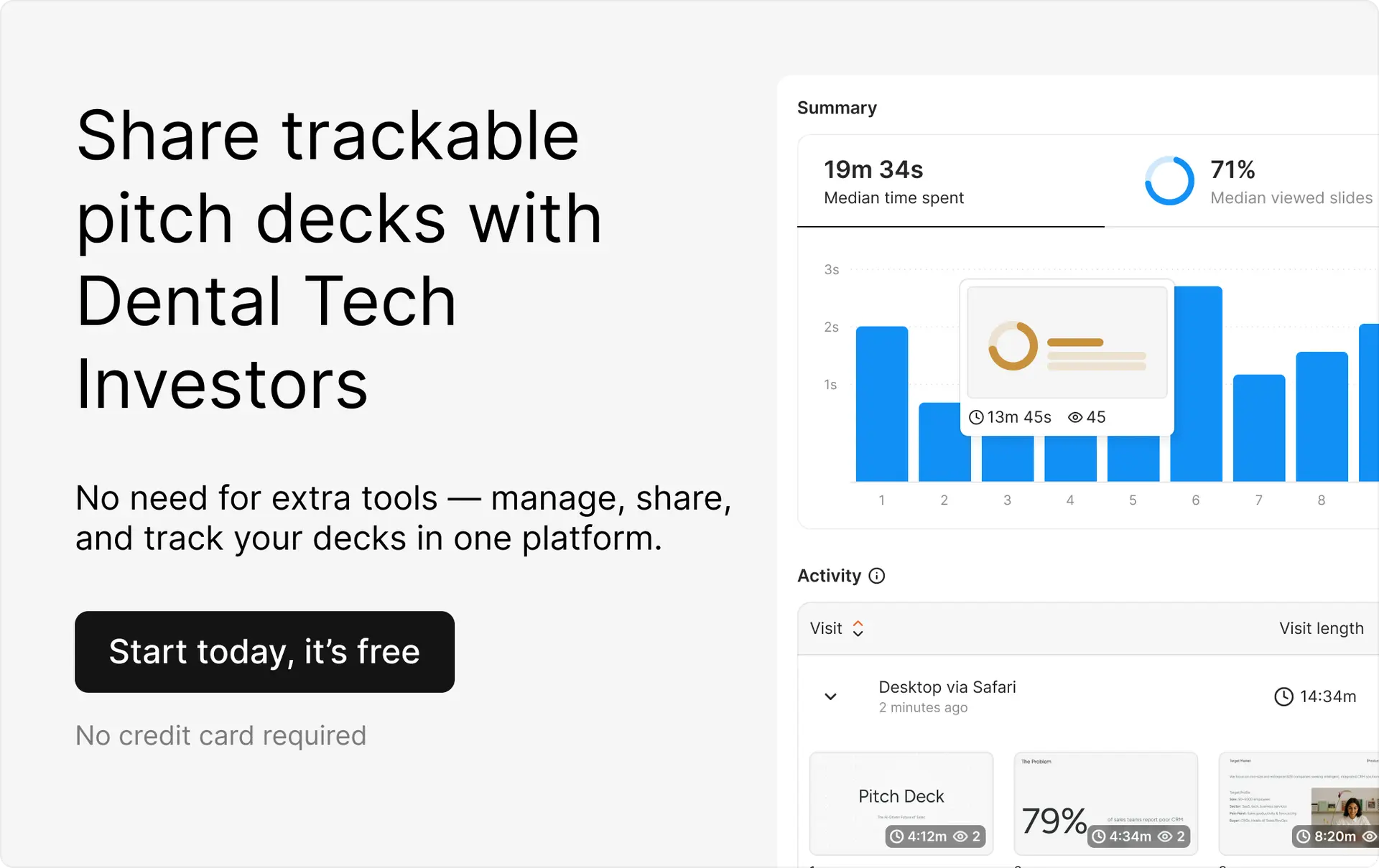
Upload your deck to Ellty and create a unique link for each investor. You'll see exactly which slides they view and how long they spend on your DSO partnership strategy versus your direct-to-dentist metrics. Most founders are surprised when investors skip the technology slides but spend 10 minutes on reimbursement and practice adoption rates.
When investors ask for your DSO contracts or state licensing documentation, share an Ellty data room instead of scattered Dropbox folders. Your practice agreements, regulatory filings, and unit economics model in one secure place with view analytics that show what they actually care about.
Common questions
How do I know if an investor understands DSO versus direct-to-dentist models?
Check their portfolio mix. If they only backed consumer dental brands, they won't understand DSO procurement cycles or the difference between selling to 500 locations versus 500 individual dentists.
Should I pitch investors who backed failed aligner companies?
Yes, if you're doing aligners differently. They learned expensive lessons about distribution and patient acquisition costs. Just be ready to explain why your model won't repeat SmileDirectClub's mistakes.
What's the difference between seed and Series A investors in dental tech?
Seed investors will back you with 20-30 practice pilots and some revenue. Series A investors want proof of DSO adoption or 200+ practices at scale, usually $2M+ ARR with expansion revenue from existing customers.
How many dental tech investors should I reach out to?
Start with 12-15 who led recent deals in your specific category, whether that's AI, DSO software, or lab tech. Dental is too specialized for spray-and-pray. Most funds haven't done any dental deals or did one and passed on follow-ons.
When should I set up a data room?
Before your first partner meeting if you're doing anything with patient data or state licensing. Dental regulatory diligence includes HIPAA, state dental board approvals, and sometimes FDA clearance. Having this organized saves weeks.
Do investors actually care about dental reimbursement details?
Absolutely. If insurance doesn't cover your solution and practices have to pay out of pocket, your sales cycle and price point change completely. Investors who've done dental deals before will dig into this immediately.