Seed investors in Toronto are writing $500K to $3M first checks into tech, AI, fintech, and SaaS startups in 2025 and 2026. Golden Ventures backed Pillar Security in a $9M seed round in April 2025. These 12 seed investors are actively reviewing deals right now.
Raising a seed round in Toronto is harder than it was three years ago. Investors who wrote checks on decks alone in 2021 now want early traction before they'll take a first meeting. That's not a reason to stall - it's a reason to know which 12 seed investors are still actively deploying and exactly what they want to see.
Toronto's seed market is concentrated around a handful of funds that do most of the work. Golden Ventures, Panache Ventures, and Radical Ventures account for a disproportionate share of Canadian seed deals each year. If you're raising in Toronto, you'll probably end up talking to at least two of these three funds at some point during your process.
The check size at seed in 2026 runs $500K to $3M for a first institutional round. That's the range where Toronto's dedicated seed funds operate. If you're raising less than $500K, you're in angel territory. If you need $5M or more from a single investor, you're looking at Series A funds. Read the seed round data room guide before you build your materials.
Toronto's seed investors are connected to each other in ways that matter. Golden Ventures and Garage Capital co-invest regularly. Panache and Inovia feed into each other's deal flow. BDC Capital participates in almost every Canadian institutional seed round as a co-investor. That syndication culture means getting one "yes" often opens the door to filling out your round faster.
Before you approach any investor on this list, build your data room first. Use Ellty to upload your pitch deck, financial model, and cap table into a trackable data room. When you send materials to seed investors, you'll see who opened your deck and which slides they spent the most time reviewing.
| Stage | Check | Sector Focus | Contact | |
|---|---|---|---|---|
| Golden Ventures | Seed | $500K-$3M | Sector-agnostic, AI, SaaS, fintech, B2B | golden.ventures |
| Panache Ventures | Pre-seed, Seed | Up to $1.5M | AI, fintech, digital health, enterprise software | panache.vc |
| Radical Ventures | Seed, Series A | $1M-$5M | AI-native companies, deep tech, ML infrastructure | radical.vc |
| Garage Capital | Seed | $500K-$2M | B2B SaaS, fintech, enterprise software | garage.capital |
| BDC Capital (Seed Fund) | Pre-seed, Seed | $250K-$1.5M | Canadian tech, AI, SaaS, deep tech, cleantech | bdc.ca |
| Relay Ventures | Seed, Series A | $500K-$3M | Fintech, healthtech, proptech, mobile-first | relay.vc |
| Highline Beta | Pre-seed, Seed | $250K-$1M | B2B, enterprise SaaS, corporate innovation | highlinebeta.com |
| Version One Ventures | Pre-seed, Seed | $250K-$2M | B2B SaaS, consumer tech, deep tech, marketplaces | versionone.vc |
| Mantella Venture Partners | Pre-seed, Seed | Up to $1M | Mobile, internet software, SaaS, e-commerce | mantellavp.com |
| Inovia Capital (Discovery) | Pre-seed, Seed | $500K-$2M | AI, SaaS, enterprise software, fintech | inovia.vc |
| Staircase Ventures | Seed, Series A | $1M-$5M | Enterprise software, AI, B2B platforms | staircaseventures.com |
| MaRS IAF | Seed, Series A | $500K-$2M | Ontario tech, AI, cleantech, health, SaaS | marsdd.com |
Know who reads your seed deck
Upload your deck to Ellty and send each investor a trackable link before you start outreach.
Start free 14-day trialWhat is a Toronto seed investor?
A Toronto seed investor is a fund that writes the first institutional check into a startup - typically $500K to $3M in exchange for 10-20% equity. They're distinct from angel investors because they deploy LP capital on a fund timeline, not personal money.
Toronto seed funds operate on 10-year fund lifecycles with 5-year deployment windows. That timeline matters because it determines whether a fund is actively writing first checks now or saving reserves for follow-on investments in existing portfolio companies.
What Toronto seed investors bring beyond capital varies by fund. Golden Ventures and Panache Ventures have deep networks of downstream investors who introduce portfolio companies to Series A VCs. BDC Capital co-invests on most Canadian institutional seed rounds, which means a BDC "yes" signals credibility to every other investor in the syndicate. Read the startup fundraising guide before you approach any of them.
The standard seed thesis in Toronto has shifted since 2021. Most Toronto seed investors now want to see at least $10K-$50K in monthly recurring revenue, a signed pilot customer, or a clear technical differentiation before committing. Prepare your ARR breakdown and customer list with the data room setup guide before any first meeting.
Canada is entering its builder era. Founders are back, more experienced, globally connected, and building fast.
12 seed investors writing checks in Toronto
1. Golden Ventures
Toronto's most consistent seed fund - sector-agnostic, founder-led, and the reference point for most Canadian seed rounds from Waterloo to Vancouver.
- Recent Deals: Backed Pillar Security $9M seed (April 2025, with Shield Capital); backed swXtch.io (April 2026); co-invested in Cybrid Series A alongside BDC Capital and Panache; 145 companies backed with 10 new investments in the last 12 months
- LinkedIn: Golden Ventures LinkedIn
- Sector Focus: Sector-agnostic, AI, SaaS, B2B software, fintech, web3, logistics, marketplaces
- Stage Focus: Seed
- Location: Toronto, ON
- Website: golden.ventures
2. Panache Ventures
Canada's most active pre-seed and seed fund - they write first checks up to $1.5M and have offices in Montreal, Toronto, Calgary, and Vancouver.
- Recent Deals: Backed Dominion Dynamics pre-seed $4M alongside Garage Capital and BDC (January 2026); co-invested in Cybrid Series A alongside Golden and BDC (2025); portfolio companies have collectively raised $3.3B+; 130+ companies backed
- LinkedIn: Panache Ventures LinkedIn
- Sector Focus: AI, fintech, digital health, enterprise software, blockchain, B2B SaaS
- Stage Focus: Pre-seed, Seed
- Location: Montreal, QC / Toronto, ON / Calgary, AB / Vancouver, BC
- Website: panache.vc
3. Radical Ventures
Toronto's leading AI-specialist seed fund - founded by Jordan Jacobs and Tomi Poutanen who co-founded Layer 6 AI (sold to TD Bank), now deploying from a $650M Fund III.
- Recent Deals: Fund III closed at $650M (October 2025, with $75M from CPP Investment Board); backed Inherent (May 2026); backed Attuned Intelligence $13M seed (October 2025); portfolio includes Cohere (valued at $7B) and Waabi; 6 unicorns in portfolio
- LinkedIn: Radical Ventures LinkedIn
- Sector Focus: AI-native companies, generative AI infrastructure, applied AI, machine learning platforms
- Stage Focus: Seed, Series A
- Location: Toronto, ON
- Website: radical.vc
4. Garage Capital
Kitchener-based seed fund that co-invests closely with Golden Ventures - one of the most active Canadian seed investors with 134 portfolio companies and 10 unicorns including Substack and Humi.
- Recent Deals: Backed Dominion Dynamics pre-seed $4M (January 2026) alongside Panache and BDC; backed Loon seed (2025); backed Cartage $3.3M alongside Y Combinator (October 2024); 6 new investments in the last 12 months
- LinkedIn: Garage Capital LinkedIn
- Sector Focus: B2B SaaS, fintech, enterprise software, marketplaces, consumer tech
- Stage Focus: Seed
- Location: Kitchener, ON (active across Toronto and Waterloo)
- Website: garage.capital
5. BDC Capital (Seed Venture Fund)
Canada's most active early-stage investor - they co-invest on most Canadian institutional seed rounds and deployed a dedicated $50M Seed Venture Fund to write $250K-$1.5M first checks into Canadian software startups.
- Recent Deals: Participated in Precision AI Series A (May 2025); co-invested in Dominion Dynamics pre-seed (January 2026) alongside Panache and Garage; co-invested in Cybrid Series A alongside Golden and Panache (2025)
- LinkedIn: BDC Capital LinkedIn
- Sector Focus: Canadian tech, AI, SaaS, deep tech, cleantech, software
- Stage Focus: Pre-seed, Seed
- Location: Toronto, ON (national presence)
- Website: bdc.ca
Organize your seed documents now
Set up an Ellty data room with your deck, financials, and cap table before your first investor call.
Start free 14-day trial6. Relay Ventures
One of Toronto's oldest thematic seed funds - active since 1996 and currently deploying from Fund V with a focus on fintech, healthtech, and proptech.
- Recent Deals: Backed Mave AI seed $5M (January 2026); backed Trusty $1M alongside Graphite Ventures (July 2025); backed Ownright $4.5M (March 2025); Fund V actively deploying with 3 new investments in the last 12 months
- LinkedIn: Relay Ventures LinkedIn
- Sector Focus: Fintech, healthtech, proptech, mobile-first platforms, IoT, sportstech
- Stage Focus: Seed, Series A
- Location: Toronto, ON
- Website: relay.vc
7. Highline Beta
Toronto-based venture studio and seed fund - they write first institutional checks into B2B companies, often pairing them with corporate partners who become early customers or pilot partners.
- Recent Deals: Led Flora seed $1.1M alongside Everywhere and Cartography Capital; backed Walnut Insurance $4M seed; launched Highline Beta ETH for Ethereum-focused startups (May 2025); active with 2 new investments in the last 12 months
- LinkedIn: Highline Beta LinkedIn
- Sector Focus: B2B, enterprise SaaS, insurtech, fintech, corporate innovation
- Stage Focus: Pre-seed, Seed
- Location: Toronto, ON
- Website: highlinebeta.com
8. Version One Ventures
Vancouver-based but deeply active across Canadian tech deals - they wrote 6 investments in 2025 and 3 in the first four months of 2026, making them one of the most active seed funds backing Canadian founders.
- Recent Deals: Backed Pluto $2M seed (February 2026, with gradCapital); backed Eeva $6M seed (December 2025); backed Arctus Aerospace pre-seed $2.6M (November 2025); 116 companies backed total
- LinkedIn: Version One Ventures LinkedIn
- Sector Focus: B2B SaaS, consumer tech, deep tech, marketplaces, enterprise software
- Stage Focus: Pre-seed, Seed
- Location: Vancouver, BC (active across Canada including Toronto)
- Website: versionone.vc
9. Mantella Venture Partners
Toronto's most hands-on early-stage software fund - they invest pre-product and pre-revenue into software founders in Ontario's high-growth markets, writing up to $1M at inception.
- Recent Deals: Portfolio company Ritual acquired (April 2025); backed Enso Connect seed $2M alongside Mistral (November 2021); third $35M fund currently deploying into Ontario-based software ventures; 29 companies backed total
- LinkedIn: Mantella Venture Partners LinkedIn
- Sector Focus: Mobile software, internet applications, SaaS, e-commerce, fintech, healthcare software
- Stage Focus: Pre-seed, Seed
- Location: Toronto, ON
- Website: mantellavp.com
10. Inovia Capital (Discovery Fund)
Canada's full-stack VC with $2.5B AUM - their Discovery Fund backs founders at pre-seed and seed before the main fund engages, giving early-stage founders a path into Inovia's downstream capital network.
- Recent Deals: Co-founded Venture Scientist Fund with Mila to boost Canadian AI research (January 2026); opened Abu Dhabi office (November 2025); backed Bench IQ $5.3M (August 2025); portfolio includes Lightspeed, Mejuri, and Hopper; 10 unicorns in portfolio
- LinkedIn: Inovia Capital LinkedIn
- Sector Focus: AI, SaaS, fintech, enterprise software, deep tech
- Stage Focus: Pre-seed, Seed (via Discovery Fund)
- Location: Toronto, ON / Montreal, QC / Calgary, AB
- Website: inovia.vc
11. Staircase Ventures
Toronto's newest institutional seed fund led by Janet Bannister - smaller portfolio but meaningful board involvement from day one, shown when she joined Mave AI's board after leading their $5M seed round in January 2026.
- Recent Deals: Led Mave AI $5M seed with Janet Bannister joining the board (January 2026); led Vero FP&A $13M seed (February 2026); active at seed stage across Toronto throughout 2025-2026
- LinkedIn: Staircase Ventures LinkedIn
- Sector Focus: Enterprise software, AI, B2B platforms, SaaS
- Stage Focus: Seed, Series A
- Location: Toronto, ON
- Website: staircaseventures.com
12. MaRS Investment Accelerator Fund
Ontario government-backed technology investor - useful for Toronto founders who need an institutional first check and access to MaRS's corporate network for pilot customers before approaching larger private funds.
- Recent Deals: 9+ investments in the last 12 months; active across Ontario in AI, healthtech, and cleantech; connected to MaRS Discovery District's 1,300+ companies and corporate partners; regular co-investor alongside BDC and OMERS Ventures
- LinkedIn: MaRS Discovery District LinkedIn
- Sector Focus: AI, cleantech, healthtech, SaaS, Ontario-based tech
- Stage Focus: Seed, Series A
- Location: Toronto, ON
- Website: marsdd.com
How to get a warm intro to a seed VC
Cold outreach to seed investors works about 1-3% of the time. Warm introductions from portfolio founders convert at 30% or higher. That pattern holds across most Toronto seed funds and is publicly described by most partners when asked how they prefer to source deals.
The fastest intro path is a previous investor or accelerator connection. If you've been through CDL, DMZ, or Next Canada, your program coordinator likely has direct relationships with the seed investors on this list. If you haven't, map 5-10 portfolio founders from your target funds and send short, specific LinkedIn messages asking for 15 minutes to learn about their fundraising experience.
Seed investors in Toronto are active at events. Toronto Tech Week (held annually in late May), the CIX Summit, and Next Canada's demo day all put founders in the same room as seed investors. Panache Ventures delivered the CIX Summit 2026 opening remarks - attending in person is worth more than most cold email campaigns. After any event, use Ellty's pitch deck tracking to share materials with investors you've met - a trackable link shows you who follows up before you do.
The highest-leverage move is finding a portfolio founder from your target fund who has a specific connection to you. One email from that person changes your entire timeline. Map this before you start outreach, not after your first cold email goes unanswered.
What seed investors check before a term sheet
Seed investors start diligence the moment you walk out of a first meeting. They're checking three things: your cap table, your founding team's background, and whether your early numbers hold up to basic scrutiny. A clean cap table and a founding team with relevant domain experience gets you to a second meeting faster than any deck.
The reference check happens before you know it's happening. Toronto's seed ecosystem is small enough that a partner at Garage Capital knows five people who've worked with your co-founder. If there's a complicated story from your last company, address it proactively in the first meeting rather than letting investors find it on their own.
Revenue expectations at seed have tightened in 2026. Some funds - like Mantella and Highline Beta - still back pre-revenue founders if the team and market are compelling. Most Toronto seed investors now want $10K-$50K in monthly recurring revenue or a signed pilot customer before they'll commit. Use Ellty's secure data room to send your ARR breakdown and customer list the same day an investor requests materials - sending within hours signals execution speed.
Technical diligence at seed is lighter than at Series A, but it still happens. For AI companies pitching Radical Ventures or Inovia's Discovery Fund, expect questions about your training data, model architecture, and differentiation from open-source alternatives. Prepare those answers before the first meeting, not after the investor asks.
How to tell if a seed fund is still deploying
The easiest check is Crunchbase or LinkedIn - look for investments in the past six months with named companies and confirmed dates. Any seed fund that claims to be active but hasn't announced a new investment in four months is either between funds, saving reserves for follow-ons, or too selective for a first meeting to be worth your time.
Fund timing matters more than most founders realize. A fund in year three of a five-year deployment window is your best target - they've deployed enough capital to know their thesis works but still have room for new companies. A fund in year five is almost certainly not writing first checks. Ask any investor which fund they're currently deploying from and what year of deployment they're in. Most will answer directly.
For the 12 seed investors on this list, all signals as of June 2026 point to active deployment. Golden Ventures is deploying Fund V (closed at $100M+ in 2024). Radical Ventures closed Fund III at $650M in October 2025. Panache closed Fund II at $100M. Staircase Ventures has two public 2026 deals. Build your investor-facing data room before you reach out to any of them - the funds actively deploying move fast once they find a deal they like.
How to pitch a Toronto seed investor
Specific steps for founders raising a $500K-$3M seed round from Toronto-based VCs in 2026.
- 1.Confirm the fund is actively deploying firstCheck Crunchbase for deals in the past six months with confirmed dates and named companies. A fund with no new investments since 2024 is almost certainly not writing first checks right now.
- 2.Map your warm intro path before you cold emailIdentify one portfolio founder at each target fund and send a short LinkedIn message. A founder referral converts at 30 percent versus under 3 percent for cold outreach - spend two weeks on this first.
- 3.Lead with your best traction metric in the first 60 secondsOpen with your strongest number: ARR, pilot customer count, or month-on-month growth. Toronto seed investors in 2026 pattern-match on traction signals before anything else in your pitch.
- 4.Send a trackable link within 24 hours of any meetingUpload your deck and one-pager to Ellty and send a link the same day as any investor conversation. You'll know who opens it and which slides they spend time on before you follow up.
- 5.Have your full data room ready before outreach startsBuild your Ellty data room with your financial model, cap table, and formation documents before the first meeting. Sending materials within hours of a request signals that you execute fast.
How Ellty helps you land a Toronto seed investor
You have the investor list. Now make sure your materials are ready before you reach out to any of them. Upload your seed round documents to Ellty and share a trackable link with each investor you contact.
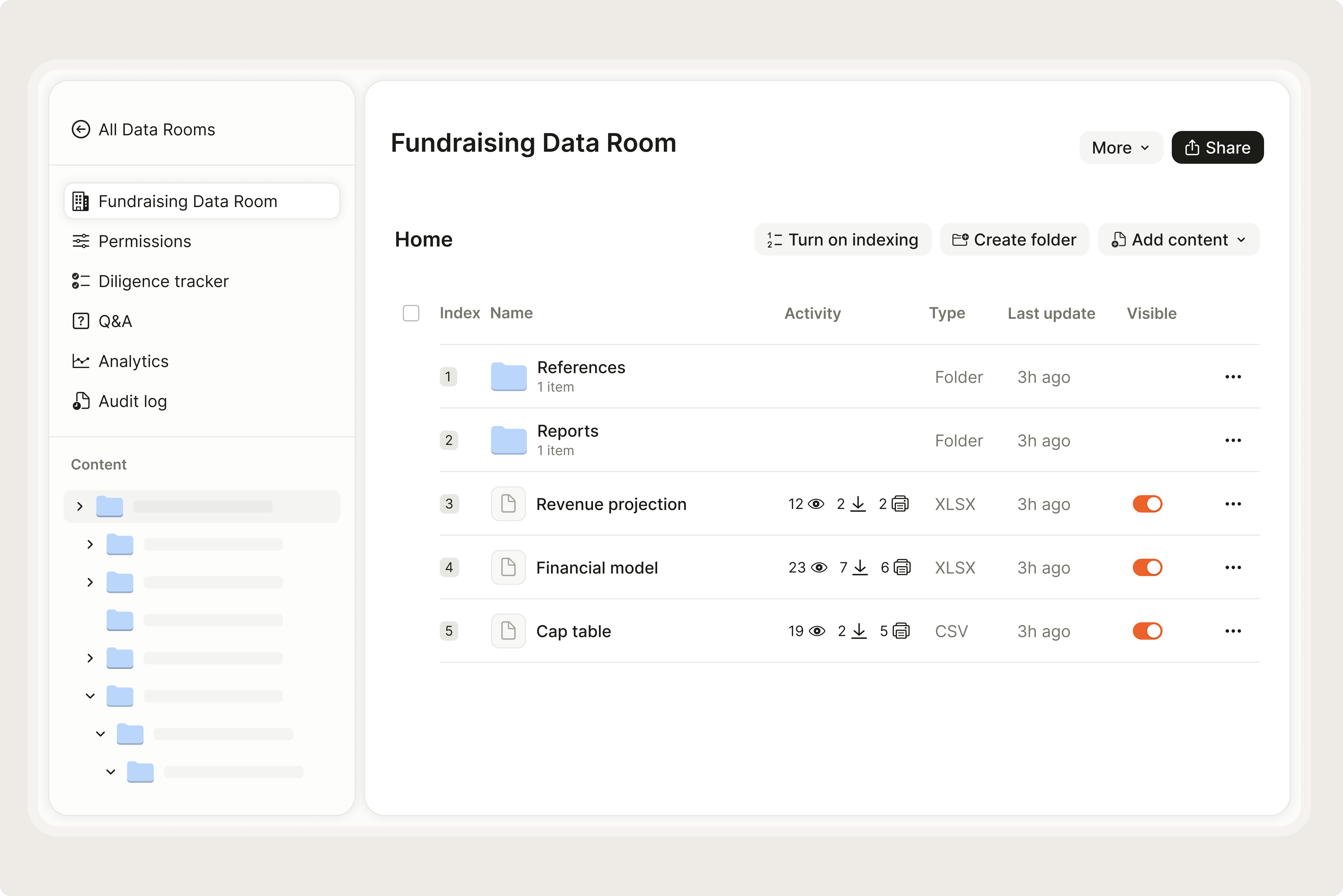
- 1.Build your seed data room before any outreachCreate an Ellty data room and upload your deck, financial model, and cap table. Toronto seed VCs ask for these within 24-48 hours of a first meeting - having them organized in advance signals you execute fast.
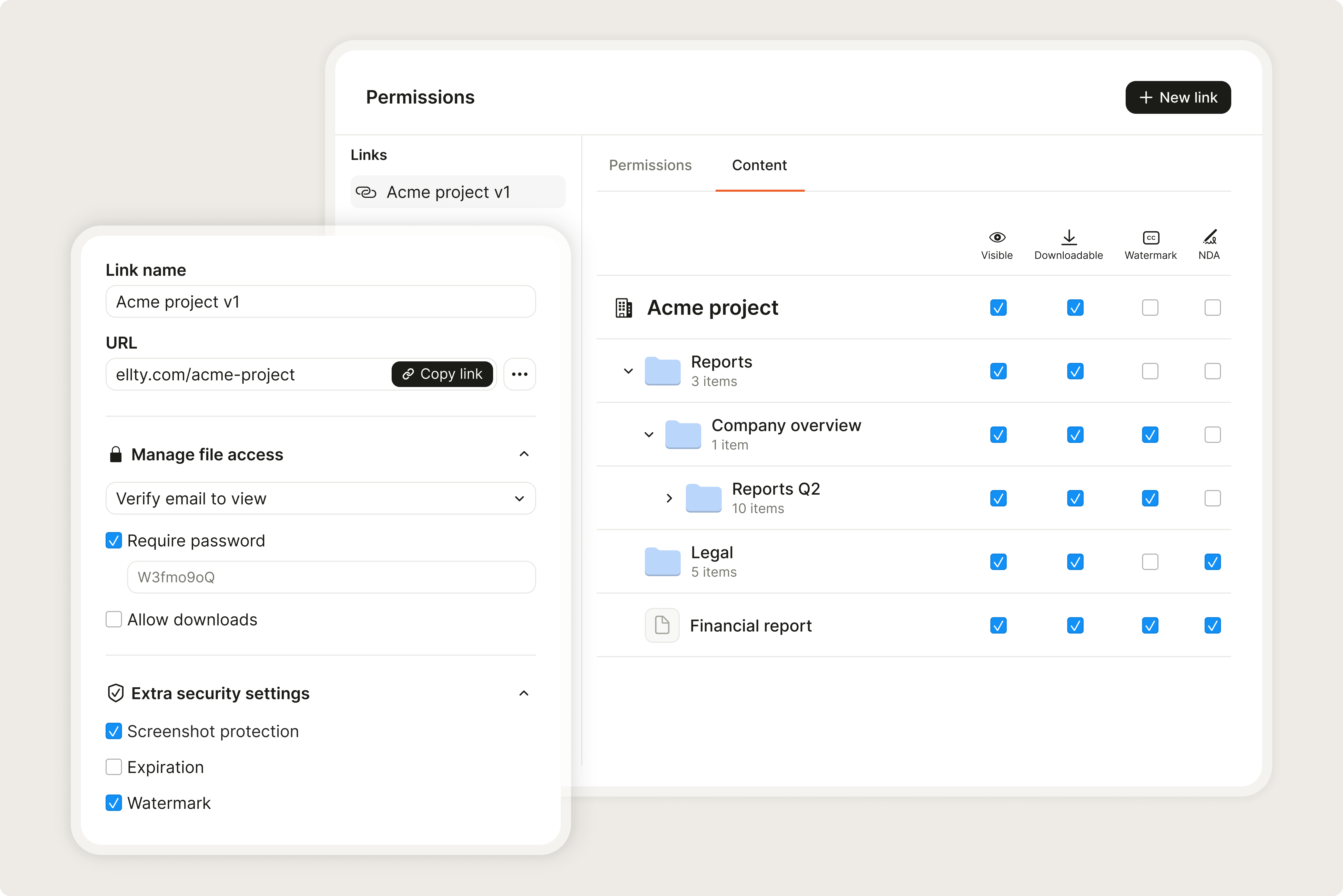
- 2.Create separate links for each fund you approachGenerate a separate trackable link per investor and require email verification before access. This prevents your cap table and financial model from circulating outside the people you intended to share with.
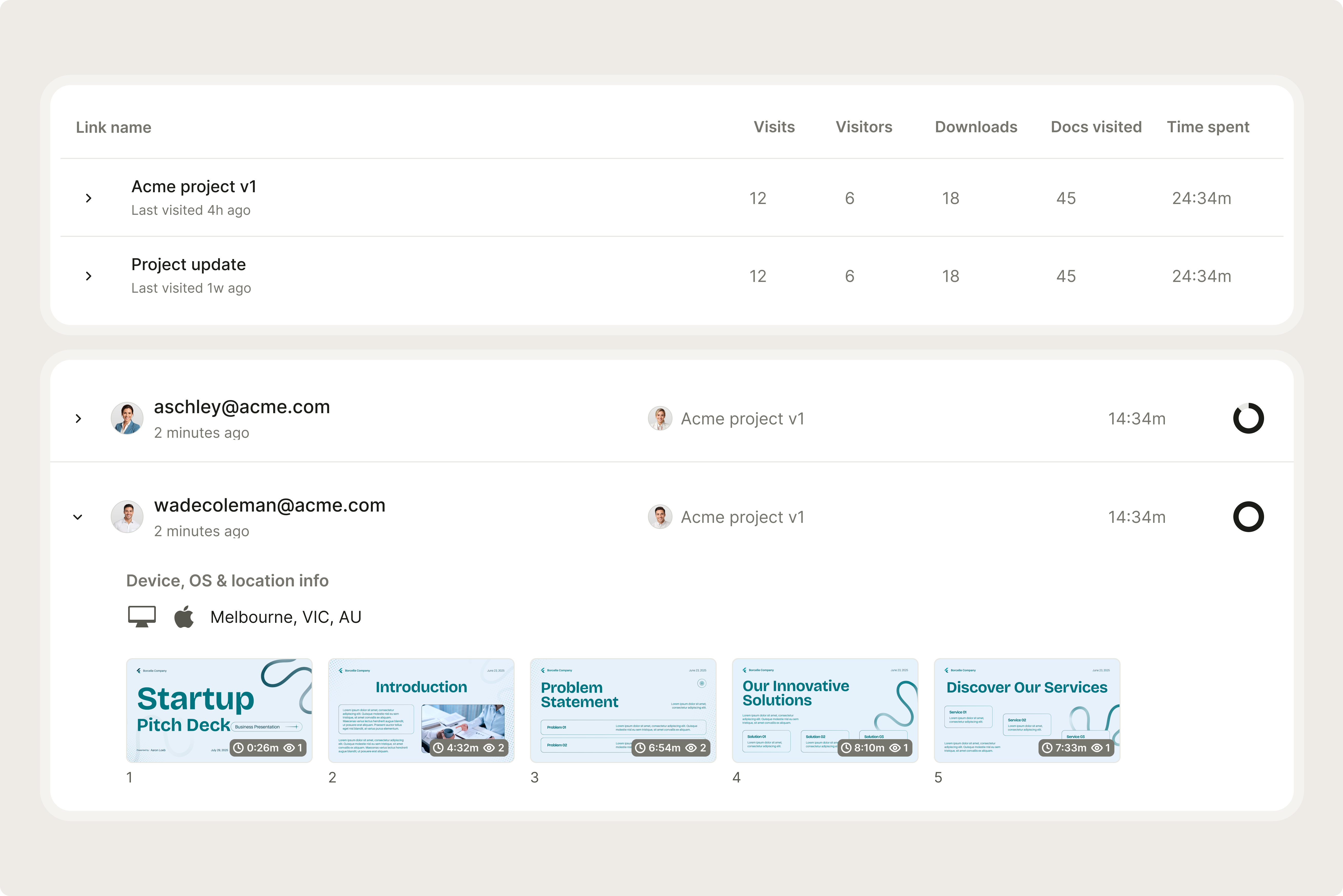
- 3.Get notified the moment investors open your documentsGet an instant notification when an investor opens your link and see which pages they review. If a seed partner spends time on your ARR slide, follow up on that specific metric the same day.
Common questions about seed investors
- Search Crunchbase for their investments in the past six months with confirmed dates. If the most recent deal is older than four months, message the fund directly and ask if they're currently accepting new seed applications.
- Most funds now want $10K-$50K in monthly recurring revenue or a signed pilot customer before writing a check. Some pre-revenue-friendly funds like Mantella and Highline Beta still back exceptional founding teams at the pre-product stage.
- Yes - run parallel processes with 15-25 target investors. Toronto seed funds don't require exclusivity during the pitch stage, and parallel outreach lets you create urgency if one fund expresses strong interest while others are still deciding.
- Before your first outreach email. Seed investors who like your pitch ask for financials and cap table within 24 hours - having an Ellty data room ready prevents you from losing momentum when it matters most.
- Not required, but warm intros from portfolio founders convert at 30 percent versus under 3 percent for cold email. Two weeks finding one portfolio founder connection is worth more than sending 100 cold messages.
- Most Toronto seed rounds dilute founders by 15-25 percent. At a $2M seed round with a $10M post-money valuation, you're giving up 20 percent - negotiate hard on valuation if you have competing term sheets from two funds.