Logistics tech investors in Toronto backed Waabi's $750M Series C in January 2026 - the largest fundraise in Canadian history. From TMS software to autonomous trucking and freight automation, these 13 investors are actively writing checks into the sector right now.
Toronto has two layers of logistics tech investment. The first is generalist Toronto VCs - Garage Capital, Ripple Ventures, Inovia - who backed freight and supply chain companies when the thesis was right. The second is global funds like Khosla Ventures and G2 Venture Partners that followed Waabi's trajectory and now have Toronto logistics on their radar.
If you're building in freight, TMS, last-mile, autonomous trucking, or supply chain software, both layers matter. The generalist funds are accessible at seed and Series A. The global funds want proof of scale before they engage.
Toronto's logistics tech scene punches above its weight. Rose Rocket raised $69M total for its TMS platform from Y Combinator, Ripple Ventures, Addition Capital, and Scale Venture Partners - all while staying headquartered on Front Street. Cartage raised $3.3M from Garage Capital and Y Combinator in October 2024 for AI freight automation. These aren't flukes.
The category is maturing fast. Waabi's $1B raise in January 2026 put Toronto on the map for physical AI applied to transportation. Founders raising in freight tech, autonomous systems, and logistics SaaS can now reference a genuine ecosystem - not just isolated deals. Read the startup fundraising guide before approaching any fund on this list.
Set up your data room before your first outreach. Use Ellty to upload your pitch deck, financial model, and customer evidence into a trackable room. When you send materials to logistics investors, you'll see exactly who opens your deck and how long they spend on your unit economics before you follow up.
| Stage | Check size | Sector focus | Contact | |
|---|---|---|---|---|
| Garage Capital | Pre-seed, Seed | $250K-$2M | B2B software, freight tech, logistics SaaS | garage.vc |
| Ripple Ventures | Pre-seed, Seed | $500K-$2M | B2B SaaS, logistics software, workflow automation | rippleventures.com |
| Scale Venture Partners | Series A, Series B | $10M-$50M | Enterprise SaaS, TMS, logistics platforms | scalevp.com |
| Addition Capital | Series A, Series B | $10M-$40M | Supply chain software, TMS, vertical SaaS | additioncapital.com |
| Khosla Ventures | Seed, Series A, Series C | $5M-$750M | Physical AI, autonomous trucks, frontier tech | khoslaventures.com |
| G2 Venture Partners | Series B, Series C | $20M-$200M | Autonomous transport, logistics, climate tech | g2vp.com |
| BDC Capital | Seed, Series A | $250K-$3M | Canadian tech, supply chain innovation, SaaS | bdc.ca |
| TELUS Global Ventures | Series A, Series B, Series C | $5M-$100M | Logistics tech, AI, enterprise platforms | telus.com/en/global-ventures |
| Radical Ventures | Seed, Series A, Series C | $1M-$50M | AI-native companies, physical AI, deep tech | radical.vc |
| Inovia Capital | Seed, Series A, Series B | $500K-$20M | SaaS, enterprise software, logistics platforms | inovia.vc |
| Golden Ventures | Seed | $500K-$3M | Sector-agnostic, B2B SaaS, marketplaces | golden.ventures |
| Wayfinder Ventures | Pre-seed, Seed | $250K-$2M | B2B software, logistics, climate, AI | wayfinder.com |
| Y Combinator | Pre-seed, Seed | $500K-$1M | Sector-agnostic, freight tech, SaaS, AI | ycombinator.com |
Know who reads your logistics pitch
Upload your deck to Ellty and send each investor a trackable link. You'll see who opens it before you follow up.
Start free 14-day trialWhat is a Toronto logistics tech investor?
A Toronto logistics tech investor backs founders building software or hardware for freight, supply chains, transportation management, and warehouse automation. They're different from general VCs because logistics deals require sector fluency - unit economics in trucking don't look like SaaS ARR multiples.
Check sizes vary dramatically by stage. Garage Capital writes $250K to $2M at pre-seed for freight software founders with traction. Khosla Ventures and G2 Venture Partners led Waabi's $750M Series C for autonomous trucking - that's the same sector, wildly different stage.
Toronto logistics investors usually want to see you understand the operator's problem, not just the technology. Rose Rocket's investors backed founders who came from trucking - Justin Sky ran a freight brokerage before building TMS software. Cartage's founders worked at Rose Rocket and scaled a logistics company at 16. Read the venture capital overview before reaching out to any fund on this list.
What they expect beyond capital returns: most Toronto logistics investors will ask for board or observer seats at seed and Series A. Khosla and G2 are more passive at scale but active when they lead. If you're raising from Garage or Ripple, expect real operational involvement in your first 12 months.
It's a miss if you don't invest in Canada. The talent is here, the vision is here, and the track record is building.
13 Toronto logistics tech investors
1. Garage Capital
The Waterloo-based seed fund that backed Cartage's $3.3M freight automation round alongside Y Combinator - operators investing in operators, with Vidyard and Substack exits giving them the credibility to attract technical logistics founders.
- Recent Deals: Co-invested in Cartage $3.3M seed (October 2024) alongside Y Combinator and Wayfinder; backed Upside Robotics $7.5M seed (February 2026); backed Jetson $50M Series A (January 2026); 10 unicorns in portfolio
- LinkedIn: Garage Capital LinkedIn
- Sector Focus: B2B software, logistics tech, freight automation, robotics, cleantech
- Stage Focus: Pre-seed, Seed
- Location: Waterloo, ON
- Website: garage.vc
2. Ripple Ventures
Toronto's most active seed fund for workflow automation - they wrote the first institutional check into Rose Rocket in 2020, the Toronto TMS company that went on to raise $69M total, and they back B2B software with logistics applications from seed stage.
- Recent Deals: Led Rose Rocket seed $6M (October 2020); co-invested in Rose Rocket Series A $25M alongside Addition Capital (October 2021); Fund III deploying with RBCx as anchor; 3 investments in 2025 and 2 in early 2026
- LinkedIn: Ripple Ventures LinkedIn
- Sector Focus: B2B SaaS, workflow automation, logistics software, data analytics
- Stage Focus: Pre-seed, Seed
- Location: Toronto, ON
- Website: rippleventures.com
3. Scale Venture Partners
The Foster City fund that led Rose Rocket's $38M Series B in June 2023 - they back logistics and transportation SaaS companies at Series A and B when the platform has enterprise traction and can demonstrate network effects across carriers, brokers, and shippers.
- Recent Deals: Led Rose Rocket $38M Series B (June 2023); $1.9B AUM with 380+ investments; portfolio includes HubSpot, DocuSign, Bill.com; deep expertise in enterprise SaaS and vertical software serving logistics operators
- LinkedIn: Scale Venture Partners LinkedIn
- Sector Focus: Enterprise SaaS, TMS, logistics platforms, vertical software
- Stage Focus: Series A, Series B
- Location: Foster City, CA
- Website: scalevp.com
4. Addition Capital
The growth-stage fund that co-led Rose Rocket's $25M Series A in October 2021 - they target high-conviction rounds in companies building category-defining software for large, fragmented industries like trucking and logistics.
- Recent Deals: Co-led Rose Rocket $25M Series A with Shine Capital (October 2021); participated in Rose Rocket Series B alongside Scale Venture Partners; portfolio built around enterprise vertical SaaS serving logistics and other physical industries
- LinkedIn: Addition Capital LinkedIn
- Sector Focus: Supply chain software, TMS, enterprise vertical SaaS
- Stage Focus: Series A, Series B
- Location: New York, NY
- Website: additioncapital.com
5. Khosla Ventures
The Silicon Valley firm that co-led Waabi's $750M Series C in January 2026 alongside G2 Venture Partners - Vinod Khosla has called autonomous trucking one of the most fundable frontier tech bets of the decade, and they've backed Waabi across multiple rounds.
- Recent Deals: Co-led Waabi $750M Series C (January 2026); participated in Waabi $200M Series B (June 2024); $1.9B AUM; portfolio includes 85+ unicorns; 8 sectors with frontier tech and autonomous systems as a core thesis
- LinkedIn: Khosla Ventures LinkedIn
- Sector Focus: Physical AI, autonomous vehicles, frontier tech, climate, enterprise SaaS
- Stage Focus: Seed through Series C
- Location: Menlo Park, CA
- Website: khoslaventures.com
Prepare your logistics data room now
Set up an Ellty data room with your deck, financial model, and customer evidence before you pitch investors.
Start free 14-day trial6. G2 Venture Partners
The Portola Valley fund that co-led Waabi's $750M Series C in January 2026 - they focus exclusively on transformative technology in energy, manufacturing, and transportation, and look for companies that can measurably reduce emissions from physical industries.
- Recent Deals: Co-led Waabi $750M Series C (January 2026); 57 investments total; 8 portfolio exits; active in autonomous transportation, clean logistics, and sustainable freight across North America
- LinkedIn: G2 Venture Partners LinkedIn
- Sector Focus: Autonomous transport, logistics, clean energy, manufacturing, agriculture
- Stage Focus: Series B, Series C
- Location: Portola Valley, CA
- Website: g2vp.com
7. BDC Capital
Canada's most active early-stage investor - they participated in Waabi's Series C in January 2026 through their Thrive Venture Fund and are a co-investor on most Canadian institutional rounds in logistics, supply chain, and AI-driven freight software.
- Recent Deals: Participated in Waabi $750M Series C through Thrive Venture Fund (January 2026); 384+ investments total; $200M committed to tech for legacy industries (August 2025); regular co-investor alongside Golden Ventures on Ontario logistics rounds
- LinkedIn: BDC Capital LinkedIn
- Sector Focus: Canadian tech, AI, supply chain innovation, SaaS, logistics software
- Stage Focus: Seed, Series A
- Location: Toronto, ON (national presence)
- Website: bdc.ca
8. TELUS Global Ventures
The corporate VC arm of TELUS - they participated in Waabi's $750M Series C in January 2026 and back companies where TELUS's network and infrastructure can accelerate commercial traction, including IoT logistics and fleet telematics.
- Recent Deals: Invested in Waabi $750M Series C (January 2026); 57 investments in 25 years; 2 new investments in 2025 and 1 in early 2026; portfolio spans enterprise applications, logistics, healthtech, and vertical SaaS
- LinkedIn: TELUS Global Ventures LinkedIn
- Sector Focus: Logistics tech, AI, enterprise platforms, IoT, fleet technology
- Stage Focus: Series A, Series B, Series C
- Location: Vancouver, BC (active across Canada including Toronto)
- Website: telus.com/en/global-ventures
9. Radical Ventures
Toronto's leading AI-specialist fund - they participated in both Waabi's $200M Series B and $750M Series C, and they back AI-native companies including physical AI platforms that are reshaping how goods move through autonomous systems.
- Recent Deals: Participated in Waabi $200M Series B (June 2024) and $750M Series C (January 2026); Fund III closed at $650M (October 2025); portfolio includes Cohere ($7B valuation) and Waabi; 6 unicorns in portfolio
- LinkedIn: Radical Ventures LinkedIn
- Sector Focus: AI-native companies, physical AI, autonomous systems, machine learning
- Stage Focus: Seed, Series A
- Location: Toronto, ON
- Website: radical.vc
10. Inovia Capital
Canada's full-stack VC with $2.5B AUM - they back logistics SaaS and enterprise software companies from pre-seed through pre-IPO, and their most recent investment in Ranger (May 2026) shows they're still writing first checks into B2B software for physical industries.
- Recent Deals: Backed Ranger (May 2026); backed Bench IQ $5.3M (August 2025); participated in Cohere $500M (August 2025); co-founded Venture Scientist Fund with Mila (January 2026); 10 unicorns in portfolio
- LinkedIn: Inovia Capital LinkedIn
- Sector Focus: AI, SaaS, enterprise software, logistics platforms, fintech
- Stage Focus: Seed, Series A, Series B
- Location: Toronto, ON / Montreal, QC / Calgary, AB
- Website: inovia.vc
11. Golden Ventures
Toronto's most consistent seed fund - sector-agnostic but with deep portfolio exposure to supply chain and marketplace companies through their co-investment pattern with Garage Capital in the broader Toronto freight tech ecosystem.
- Recent Deals: Backed swXtch.io (April 2026); co-invested in Cybrid Series A (October 2025); backed Tilt $7.1M seed (September 2025); 145 companies backed with 5 unicorns; regular co-investor alongside Garage Capital on B2B software deals
- LinkedIn: Golden Ventures LinkedIn
- Sector Focus: Sector-agnostic, B2B SaaS, AI, marketplaces, logistics software
- Stage Focus: Seed
- Location: Toronto, ON
- Website: golden.ventures
12. Wayfinder Ventures
The San Francisco seed fund with University of Toronto roots - founded by Yuri Sagalov, a former YC partner, who co-invested in Cartage's $3.3M freight automation round in October 2024 and backs early-stage logistics and supply chain software founders.
- Recent Deals: Co-invested in Cartage $3.3M seed (October 2024) alongside Y Combinator and Garage Capital; backed Oway $4M seed (August 2025); invested in Garage (March 2026); 29 investments total; $85M AUM
- LinkedIn: Wayfinder Ventures LinkedIn
- Sector Focus: B2B software, logistics, climate tech, AI, freight automation
- Stage Focus: Pre-seed, Seed
- Location: San Francisco, CA
- Website: wayfinder.com
13. Y Combinator
The world's most influential accelerator - they backed Rose Rocket (YC S16) and Cartage (YC 2024 batch), and Paul Graham angel invested personally alongside the Garage Capital round, making YC a genuine signal that Toronto freight tech is worth backing early.
- Recent Deals: Backed Cartage $3.3M seed (October 2024, Paul Graham invested personally); backed Rose Rocket (YC S16, 2016 batch); 5,000+ startups launched; Cartage is part of YC's freight automation portfolio
- LinkedIn: Y Combinator LinkedIn
- Sector Focus: Sector-agnostic with proven freight tech and logistics SaaS portfolio
- Stage Focus: Pre-seed, Seed
- Location: San Francisco, CA (global, with Toronto logistics portfolio)
- Website: ycombinator.com
What logistics investors check in diligence
Logistics investors focus on two things before anything else: whether the founder understands the operator's pain and whether the unit economics survive a real freight market cycle. "I love logistics" doesn't close a term sheet. "Our CAC is $200 with 24-month payback on annual contracts" does.
Freight tech due diligence is heavier on integration than most SaaS categories. Investors want to know which carriers, shippers, or 3PLs you're connected to and whether customers can switch off your platform without losing months of operational data. A wide integration layer is a moat. A narrow one is a liability.
Dead pilots kill rounds faster than almost anything else. If your biggest customer has been in a pilot for eight months without converting to a paid contract, every investor on this list will flag it. One signed contract with real revenue is worth ten enthusiastic pilots on your deck.
Revenue quality matters more than quantity in this category. Investors like Scale Venture Partners and Addition Capital want to see annual contracts with sticky workflow software. Use Ellty's secure data room to share customer retention data with screenshot protection - freight contracts contain commercially sensitive lane pricing.
How to find the right logistics investor
Don't start with the fund - start with the portfolio company. Every fund on this list has backed at least one logistics or supply chain company in the last 24 months. Find that founder, send a short LinkedIn message, and ask for 15 minutes to hear about their fundraising experience.
Map your category before you pitch. Freight tech isn't a monologue - investors will ask whether you're building TMS, freight marketplace, fleet telematics, warehouse automation, or autonomous vehicles. Know exactly where you sit, who the 3-5 direct competitors are, and why your approach wins on a specific dimension.
The investor network in Toronto logistics is tight. Justin Sky from Rose Rocket knows the Cartage founders. Garage Capital co-invested with Wayfinder and Y Combinator on the same deal. These relationships matter when you ask for introductions. Upload your materials to Ellty's pitch deck tracking and send a trackable link to see who opens within 24 hours.
Before reaching out to any of the 13 investors here, read the data room setup guide. Logistics investors request financial models, customer contracts, and carrier integration data within hours of expressing interest. Having these organized before your first email puts you ahead of every founder who scrambles after the call.
Why investors pass on good logistics companies
The most common reason a logistics pitch fails isn't the technology - it's the founder's inability to explain the sales motion. Investors know how hard it is to sell into trucking and 3PLs. If you can't explain your buyer persona and how long it takes to go from first demo to signed contract, you've given a reason to pass.
AI claims in logistics are now table stakes, not differentiators. Every freight tech pitch in 2026 mentions AI-powered routing, AI-assisted dispatch, or AI-driven pricing. If your AI advantage is real, explain it with specificity - model architecture, training data, accuracy versus baseline, and customer-measured outcomes. Investors will assume it's marketing wrapped around traditional SaaS if you can't.
The most fundable logistics companies in 2026 show that their software is in the operator's workflow every single day. If your usage metrics are monthly instead of daily, you're a reporting tool. Reporting tools get churned in freight market downturns. Workflow tools survive them.
How to pitch a Toronto logistics investor
Specific steps for founders raising from freight tech and supply chain investors in Toronto in 2026.
- 1.Lead with the operator problem, not the technologyOpen with a specific pain point - detention costs, empty miles, dispatch latency. Show investors exactly which part of freight you're solving and why now is the right time to build it.
- 2.Show your sales motion before the product featuresLogistics VCs want to know who signs contracts, what the typical deal size is, and how long you've been in the market. Founders who explain GTM in 60 seconds move faster to second meetings.
- 3.Secure one paying customer reference before outreachA signed contract with a real carrier, shipper, or 3PL who will take a 20-minute reference call is worth more than any deck slide. Book the reference before outreach, not after investor interest.
- 4.Send a trackable Ellty link within 24 hours of any meetingUpload your deck and financial model to Ellty and send a trackable link the same day as any investor conversation. You'll see which slides they review most before you decide how to follow up.
- 5.Have your complete data room ready before your first emailBuild your Ellty data room with customer contracts, revenue breakdown, cap table, and formation documents before outreach - logistics investors request materials within hours of expressing interest.
How Ellty helps you land a logistics tech investor
You have the investor list. Now prepare materials that prove your metrics and customer evidence before any outreach starts. Upload your freight tech materials to Ellty and share a trackable link with each investor you contact.
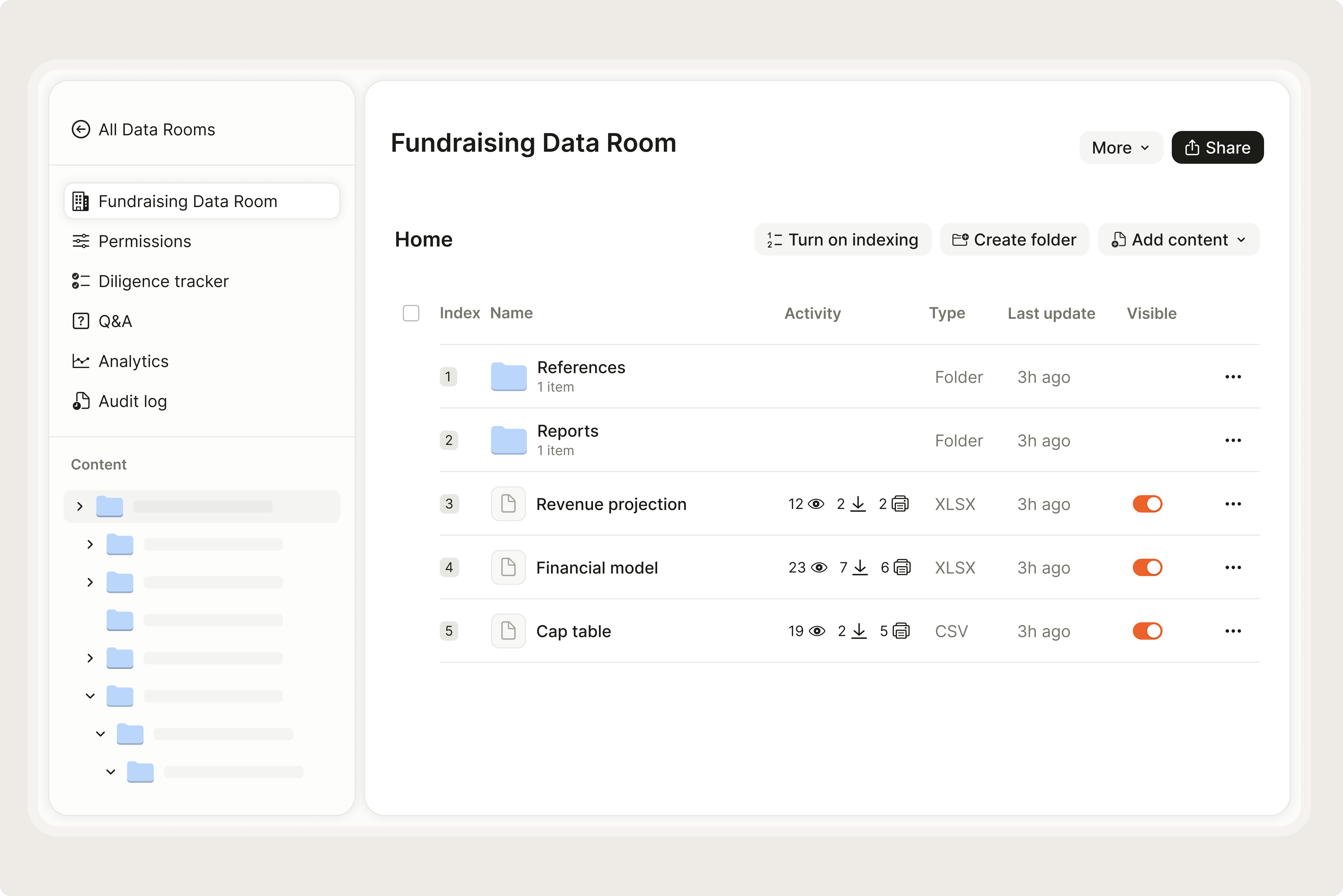
- 1.Build your freight data room before any outreachCreate an Ellty data room and upload your pitch deck, financial model, and customer contract evidence. Logistics investors ask for unit economics and carrier agreements within 24 hours - having them organized signals you execute fast.
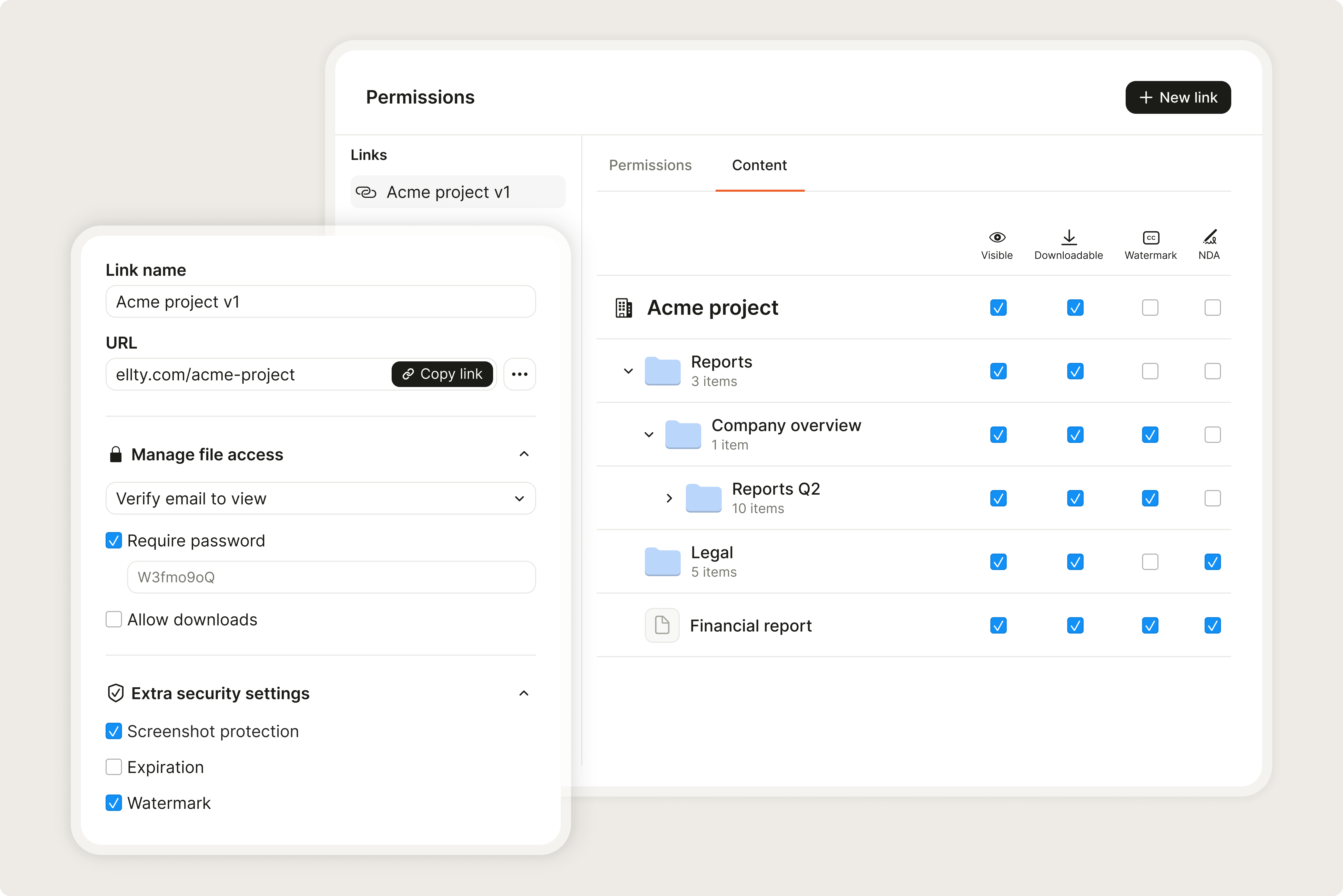
- 2.Set separate link permissions per investor you contactGenerate a separate trackable link per investor and require email verification before access. This prevents your freight contracts, lane pricing data, and cap table from circulating to unauthorized contacts.
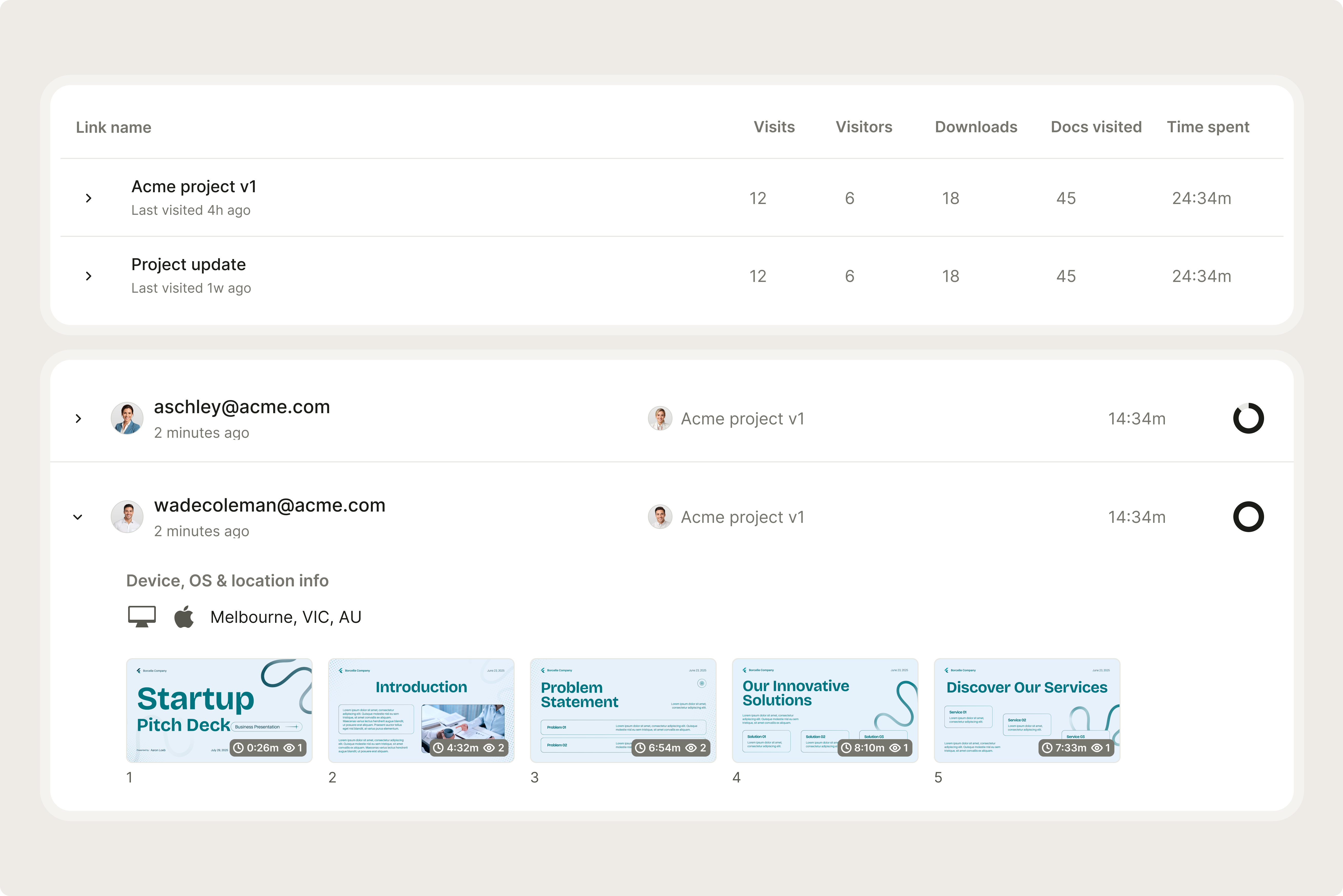
- 3.Get instant alerts when investors open your materialsGet instant notifications when an investor opens your link and see which sections they spend the most time reviewing. If a fund spends time on your unit economics slide, follow up on that metric the same day.
Common questions about logistics tech investors
- Not always - but warm intros from logistics portfolio founders convert at 30% vs under 3% for cold email. Two weeks finding one founder connection is worth more than 100 cold messages.
- Most seed investors want at least one paying customer or a signed contract with a real carrier or 3PL. Pilots that haven't converted to paid contracts are a red flag, not a proof point.
- Target both in parallel. Toronto seed funds like Garage and Ripple are accessible at earlier stages. US funds like Scale and Khosla engage after you have Series A-level traction and metrics.
- Before your first outreach email. Logistics investors who like your pitch ask for financials and customer contracts within hours - an Ellty data room ready prevents losing momentum when it matters.
- Integration depth, sales cycle length, and operator trust all affect valuation. Investors want sticky workflow software with annual contracts, not API connections customers can remove overnight.
- Check Crunchbase for investments in the past six months with confirmed dates and named companies. Ask the investor directly which fund they're deploying from and which year of that fund they're in.