A verified list of 11 active Toronto healthtech investors deploying capital in 2026. Covers dedicated life sciences VCs, digital health funds, medtech specialists, and government-backed seed programs — with recent deals, check sizes, stage focus, and LinkedIn profiles for each.
Toronto has one of the deepest healthtech ecosystems in North America.
The city is home to more than 200 healthtech and life sciences companies, backed by research institutions including the University of Toronto, SickKids, and the UHN hospital network.
Lumira Ventures just closed the first tranche of its fifth fund in April 2026 with a US$200M target — that's a clear signal that institutional capital is still flowing into Canadian health companies.
The investor mix here is wide. You have dedicated life sciences VCs writing $20M+ Series A and B checks, seed programs funding the first $500K, and healthcare investment banks that can take you public or run your financing process. Not all of them are looking for the same thing.
If you're raising for a digital health platform, medical device, or health AI startup, you need to know who's actually deploying in 2026 — and who closed a fund three years ago and went quiet.
Toronto healthtech investors: overview
| Stage | Check | Focus | Contact | |
|---|---|---|---|---|
| Lumira Ventures | Series A, B, C | $10M–$50M | Biotech, medtech, life sciences | lumiraventures.com |
| iGan Partners | Seed, Series A, B | $1M–$15M | Medical devices, digital health | iganpartners.com |
| Genesys Capital | Series A, B | $5M–$25M | Biotech, pharma, medtech | genesyscapital.com |
| MaRS IAF | Pre-seed, Seed | Up to $1.5M | Healthtech, enterprise SaaS | marsiaf.com |
| BDC Capital | Pre-seed to Growth | $500K–$20M | Healthtech, life sciences, IT | bdc.ca |
| Bloom Burton & Co. | Growth, Pre-IPO | $5M+ | All healthcare verticals | bloomburton.com |
| OMERS Ventures | Series A, B | $5M–$25M | Digital health, health AI, SaaS | omersventures.com |
| Graphite Ventures | Pre-seed, Seed | $500K–$3M | Health SaaS, healthtech B2B | graphitevc.com |
| Relay Ventures | Series A, Growth | $3M–$15M | Digital health, health IT | relayventures.com |
| Sixty Degree Capital | Series A to Pre-IPO | $5M–$50M | Healthcare, biotech, software | sixtydegree.com |
| Round13 Capital | Series A, Growth | $3M–$15M | Health AI, enterprise software | round13capital.com |
Share your healthtech deck with trackable links
Upload your pitch materials to Ellty and see which investors open your clinical data and financials.
Start free 14-day trialWhat is a Toronto healthtech investor?
Toronto healthtech investors are not a single category — and treating them as one is a common mistake.
Lumira and Genesys focus on biotech and medical devices with long development cycles. They write $10M–$50M checks and expect FDA or Health Canada regulatory pathways in your plan. A digital health SaaS pitch won't land with them.
OMERS Ventures and Round13 back digital health and AI-enabled platforms. They look for product-market fit, paying enterprise customers, and a credible path to $10M ARR. Clinical evidence helps but regulatory timelines aren't the core of their underwriting.
MaRS IAF and BDC Capital serve as early entry points — they write first checks under $1.5M for Ontario-based founders and co-invest alongside the larger VCs. If you're pre-revenue with a working prototype, these are your realistic starting points.
The common thread is that Toronto's healthtech investor community is tight. The same names appear repeatedly across most rounds. If you approach the wrong tier for your stage, you burn an introduction you can't get twice.
Fund V represents the next step in our commitment to building globally competitive healthcare companies from Canada and across North America.
11 Toronto healthtech investors in 2026
1. Lumira Ventures
Canada's largest dedicated life sciences VC — just announced the first closing of Fund V in April 2026 with a US$200M target and completed the first investment in that fund immediately.
- Recent deals: Nervonik investment (Apr 2026); $52M Series B for an undisclosed pre-commercial medtech company (Fund V first deal, Apr 2026); Congruence Therapeutics $32M (Sep 2025); Corvia Medical $55M (Jun 2025); Cancer Breakthrough Fund first close with Terry Fox Foundation (May 2026)
- LinkedIn: Lumira Ventures
- Sector focus: Biotechnology, medical devices, life sciences, digital health
- Stage focus: Series A, Series B, Series C
- Location: Toronto, ON (also Montreal, Vancouver, Boston)
- Website: lumiraventures.com
2. iGan Partners
One of Canada's most active early-stage medical device investors — led the $10M follow-on financing for Exact Imaging, the world's leading prostate cancer detection platform, in February 2026.
- Recent deals: Exact Imaging $10M (Feb 2026); DOCSI seed round (Aug 2025); Cosm Medical Seed+ lead (Jun 2025); 48 total investments across 4 funds
- LinkedIn: iGan Partners
- Sector focus: Medical devices, digital health, health technology, clinical diagnostics
- Stage focus: Seed, Series A, Series B
- Location: 60 Bloor St W, Toronto, ON
- Website: iganpartners.com
3. Genesys Capital
A dedicated life sciences VC with 25+ years in Toronto — co-hosted the Fiesta de Bio Reception at Toronto Health Innovation Week 2026 alongside Life Sciences Central and Osler.
- Recent deals: Enspire DBS Therapy Series B co-investor (Jan 2026); Feldan Therapeutics US$21M Series B co-lead (Sep 2024); Flosonics Medical $20M Series C co-investor (May 2024); 32 total portfolio companies, 2 IPOs and 9 acquisitions
- LinkedIn: Genesys Capital
- Sector focus: Biotechnology, pharmaceuticals, medical devices, diagnostics
- Stage focus: Series A, Series B
- Location: Toronto, ON
- Website: genesyscapital.com
Before reaching out to any of these investors, organize your clinical data and financials into a structured due diligence package. Lumira and Genesys expect to see IP documentation, preclinical data, and a regulatory strategy — not a folder of emailed attachments.
4. MaRS Investment Accelerator Fund (IAF)
Ontario's most active seed-stage fund — reached its 200th investment milestone in January 2026 and recently backed TimeSmartAI, an AI-driven physician contract compliance startup, alongside Graphite Ventures.
- Recent deals: TimeSmartAI (Apr 2026); MedReddie investment (Nov 2025); 200th investment milestone (Jan 2026); $100M+ deployed since 2008 across 200+ startups
- LinkedIn: MaRS Investment Accelerator Fund
- Sector focus: Healthtech, enterprise SaaS, cleantech, life sciences (Ontario-based mandate)
- Stage focus: Pre-seed, Seed
- Location: MaRS Discovery District, 101 College St, Toronto, ON
- Website: marsiaf.com
5. BDC Capital
The government-backed national VC platform — an anchor LP in most active Toronto health funds and a direct co-investor at every stage, with a specific healthtech vehicle for medical devices, digital health, and biotech.
- Recent deals: Active healthtech co-investment through 2025–2026; investments include Dialogue (telemedicine) and OpSens (medtech sensors); committed $200M to tech-for-legacy-industries program (Aug 2025); $3B+ AUM across 15 vehicles
- LinkedIn: BDC Capital
- Sector focus: Healthtech, life sciences, medical devices, digital health platforms
- Stage focus: Pre-seed through Growth
- Location: Toronto, ON (also nationwide)
- Website: bdc.ca
Organize your health due diligence documents
Set up an Ellty data room with your clinical data, cap table, and financial model before investors ask.
Start free 14-day trial6. Bloom Burton & Co.
Toronto's dedicated healthcare investment bank — hosted the 2026 Bloom Burton Healthcare Investor Conference at the Metro Toronto Convention Centre on April 21–22, bringing 66+ health companies to active investors.
- Recent deals: 2026 Healthcare Investor Conference (Apr 2026); Conavi Medical $12M public offering advisory; LSL Pharma $12M private placement; Cybin $175M registered direct offering; ongoing healthcare capital markets advisory
- LinkedIn: Bloom Burton & Co.
- Sector focus: All healthcare verticals: biotech, pharma, medical devices, diagnostics, healthcare services, health IT
- Stage focus: Growth, Pre-IPO, Public markets
- Location: Toronto, ON
- Website: bloomburton.com
Set up an Ellty virtual data room before approaching Bloom Burton. Their financing process moves quickly, and you want your investor materials, cap table, and financial model shareable as a controlled trackable link — not a Google Drive folder anyone can forward.
7. OMERS Ventures
The VC arm of Canada's $100B OMERS pension — backs digital health, health AI, and enterprise software from Series A through growth, with a dedicated healthtech investment thesis run from its Toronto office.
- Recent deals: Arize AI $70M Series C co-investor (Feb 2025); Turnstile $29M co-investor (Feb 2026); 98 portfolio companies, 10 unicorns; active healthtech deployment through 2025–2026
- LinkedIn: OMERS Ventures
- Sector focus: Digital health, health AI, enterprise SaaS, healthtech platforms
- Stage focus: Series A, Series B
- Location: Toronto, ON (also London, Palo Alto)
- Website: omersventures.com
8. Graphite Ventures
The Toronto seed fund that evolved from MaRS IAF — backed TimeSmartAI alongside MaRS IAF (Apr 2026) and myStoriaAI, a Canadian AI health platform, with a $1.6M seed round in the same month.
- Recent deals: TimeSmartAI (Apr 2026); myStoriaAI $1.6M seed (Apr 2026); Trusty seed lead alongside Relay Ventures (2025); Mycroft investment (2025); $110M Fund IV closed August 2023
- LinkedIn: Graphite Ventures
- Sector focus: Healthtech SaaS, enterprise software, B2B health IT, fintech
- Stage focus: Pre-seed, Seed
- Location: Toronto, ON
- Website: graphitevc.com
Use Ellty to share your pitch deck with each investor as a separate trackable link. If a Graphite partner opens your deck three times but skips your go-to-market slide, you know what to address in your follow-up before they decide.
9. Relay Ventures
A Toronto thematic VC with active digital health investments through 2025 — co-led the Trusty seed round with Graphite Ventures in 2025 and maintained a consistent healthtech and fintech deployment pace.
- Recent deals: Trusty seed round co-lead with Graphite Ventures (2025); active healthtech and fintech deployment through 2025–2026; 2 investments in the past 12 months per January 2026 data
- LinkedIn: Relay Ventures
- Sector focus: Digital health, health IT, fintech, B2B software
- Stage focus: Series A, Growth
- Location: Toronto, ON
- Website: relayventures.com
10. Sixty Degree Capital
A Toronto growth investor backing healthcare, biotech, and digital infrastructure from Series A through pre-IPO — named participant in Toronto Health Innovation Week 2026 alongside BDC and Bloom Burton.
- Recent deals: Active deployment across healthcare and biotech through 2025–2026; named participant in Toronto Health Innovation Week April 2026 alongside BDC, Genesys, and Bloom Burton
- LinkedIn: Sixty Degree Capital
- Sector focus: Healthcare, biotech, digital infrastructure, software
- Stage focus: Series A, Series B, Pre-IPO
- Location: Toronto, ON
- Website: sixtydegree.com
11. Round13 Capital
Toronto's growth-stage VC with a clear health AI thesis — backed a $12M round for an enterprise AI platform serving regulated healthcare organizations in February 2026.
- Recent deals: $12M enterprise AI control systems investment (Feb 2026); portfolio includes League (digital health benefits) and PointClickCare (senior care SaaS); continued health AI deployment through 2025–2026
- LinkedIn: Round13 Capital
- Sector focus: Health AI, enterprise software, regulated-industry SaaS
- Stage focus: Series A, Growth
- Location: Toronto, ON
- Website: round13capital.com
What Toronto healthtech investors check first
Life sciences VCs like Lumira and Genesys go straight to your IP and regulatory pathway before anything else.
They want to see a clear Health Canada or FDA strategy, evidence of defensible intellectual property, and named co-investors or clinical partners. A promising mechanism of action without a regulatory pathway is not fundable for these firms.
Digital health investors like OMERS and Round13 underwrite differently. They look for real enterprise customers, quantified clinical or operational outcomes, and a path to $10M ARR. Clinical evidence matters when it shows ROI — but they won't wait seven years for a regulatory approval.
Both groups check your cap table early. Messy cap tables, missing co-founder agreements, or undefined IP assignments are common deal killers in Toronto's healthtech market. Use Ellty to organize your fundraising materials — including cap table, IP documentation, and clinical data — into a clean data room before your first serious call.
Dead companies in your reference network also matter. If you name advisors or co-investors and those companies folded quietly, expect it to surface in diligence. Toronto's healthcare investor community is small and has a long memory.
How regulatory timelines affect your raise
A founding mistake healthtech founders make is treating regulatory milestones as a later problem.
For Lumira, Genesys, and iGan — which back medical devices and biotech — your Health Canada or FDA pathway is essentially your product roadmap. Investors underwrite against regulatory catalysts the same way SaaS investors underwrite against revenue milestones. If you don't know your pathway, they won't invest.
Digital health investors at OMERS and Round13 are less regulatory-intensive, but not immune. Ontario's PHIPA data privacy rules and PIPEDA directly affect how quickly you can land hospital contracts. Show that you've thought through compliance costs and timelines before your first investor meeting.
This is also where a virtual data room for venture capital becomes a practical tool. Regulatory documents — pre-submission meeting records, IRB approvals, clinical protocols — need to be organized and shareable under permission controls. Sending raw PDFs over email signals you haven't run a formal diligence process before.
Where Toronto healthtech deals get done
Most deals in Toronto's healthtech space start inside a short list of institutional venues.
The Bloom Burton Healthcare Investor Conference (April annually, Metro Toronto Convention Centre) is the most deal-dense event in the Canadian health calendar. The 2026 edition hosted 66 companies alongside the most active investors in the city. If you're raising a growth round or planning a financing process, this event is table stakes — not optional.
Toronto Health Innovation Week ran April 20–24 in 2026 and brought together BDC, Genesys, Sixty Degree, Bloom Burton, and MaRS under one set of events. These are genuine working meetings, not networking theater. Target specific sessions where your investor is listed on the agenda.
MaRS Discovery District at 101 College Street hosts ongoing programming for life sciences and digital health founders. For early-stage rounds, MaRS IAF runs through MaRS, and many of its portfolio companies get warm introductions to Graphite, Relay, and OMERS through that network.
Upload your materials to Ellty and send unique trackable links before any event. If an iGan partner opens your device data but skips your financials the night before you're scheduled to meet, you know what to lead with in the first five minutes. Track engagement from your data room and follow up when engagement is active, not on a weekly cadence.
How to pitch a Toronto healthtech investor
Specific steps for founders raising from Canada's most rigorous healthcare investment community.
- 1.Lead with your regulatory pathway, not your market sizeLumira, Genesys, and iGan evaluate every medical device and biotech pitch through a regulatory lens. Know your Health Canada or FDA submission type before your first meeting — 510(k), PMA, NDS, or biologics license. If you can't name it, you're not ready to pitch these funds. Put your mechanism of action and regulatory approach on slide two, not a $50B TAM claim.
- 2.Separate your pitch deck from your clinical documentationToronto healthtech investors expect layered materials. Your pitch deck gets the meeting. Your clinical data package, IP summary, and financial model get reviewed in diligence. Do not send everything in one email attachment. Upload your full documentation to an Ellty data room before your first call and share a trackable link so you can see exactly which sections they review.
- 3.Build the warm intro through clinical networks, not just VC networksiGan, Genesys, and Lumira source deals through hospital networks, academic medical centers, and clinical researchers — not just founders. If you have an advisor at SickKids, UHN, or the University of Toronto's medical faculty, that connection is more valuable than a generic founder intro. Lead with clinical relationships when requesting a warm introduction.
- 4.Show a signed pilot or named hospital partner before Series AOMERS, Round13, and Relay want evidence that enterprise health buyers will actually pay for your product. A signed pilot with a Toronto hospital, regional health authority, or employer health benefits program is the strongest signal at early Series A. An LOI from a hospital is weaker — most LOIs don't convert on healthcare procurement timelines.
- 5.Don't raise too early for the fund tier you're targetingPitching Lumira at seed stage, or pitching MaRS IAF at Series B, wastes your best intro. Match stage to fund mandate before outreach. Toronto's healthtech investor community is small — being seen as someone who didn't do basic mandate research signals poor judgment to every fund your contact knows.
How Ellty helps you land a Toronto healthtech investor
Now that you know the investors, here's how to prepare your materials. Toronto healthtech investors — from Lumira to MaRS IAF — expect documentation that matches the clinical rigor of the sector. A shared Google Drive with unlabelled PDFs signals an unprepared founder. Set up a permission-controlled data room before your first meeting and show from day one that you run a professional fundraising process.
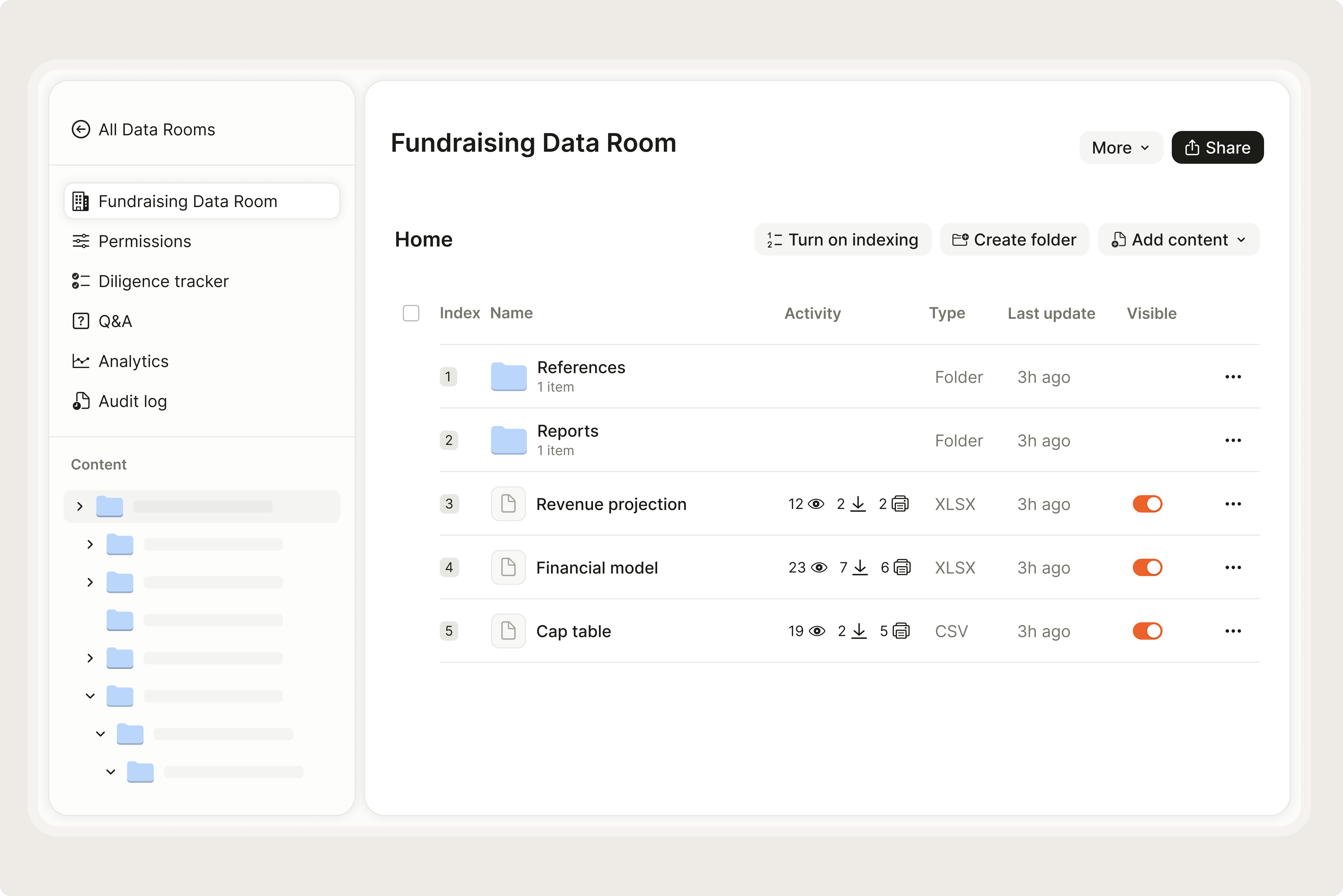
- 1.Build your healthtech data room before investor introductionsCreate an Ellty data room and upload your pitch deck, IP summary, clinical data, regulatory pathway documents, cap table, and financial model. Organize into clear folders: clinical, regulatory, financial, and legal. Toronto life sciences investors like Lumira and Genesys review hundreds of companies and immediately see when a founder has documentation in order versus scrambling.
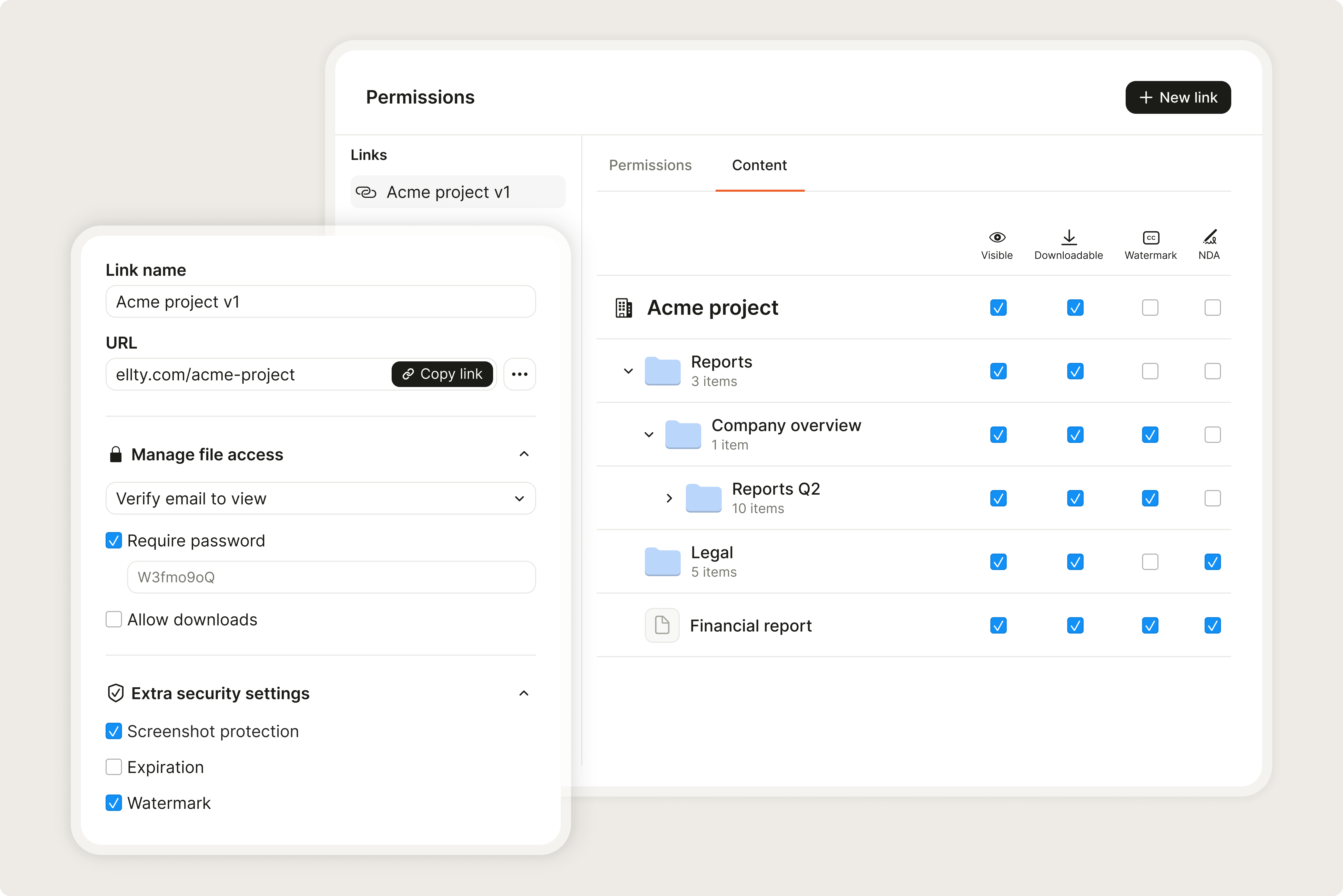
- 2.Send each fund a separate permission-controlled linkGenerate a separate trackable link for each investor — Lumira, iGan, Genesys, MaRS IAF, OMERS, Round13. Require email verification before viewing your clinical documentation. Enable screenshot protection on your cap table and IP filings. Know immediately when a partner forwards your link to a technical or legal reviewer — that's a strong signal of active interest.
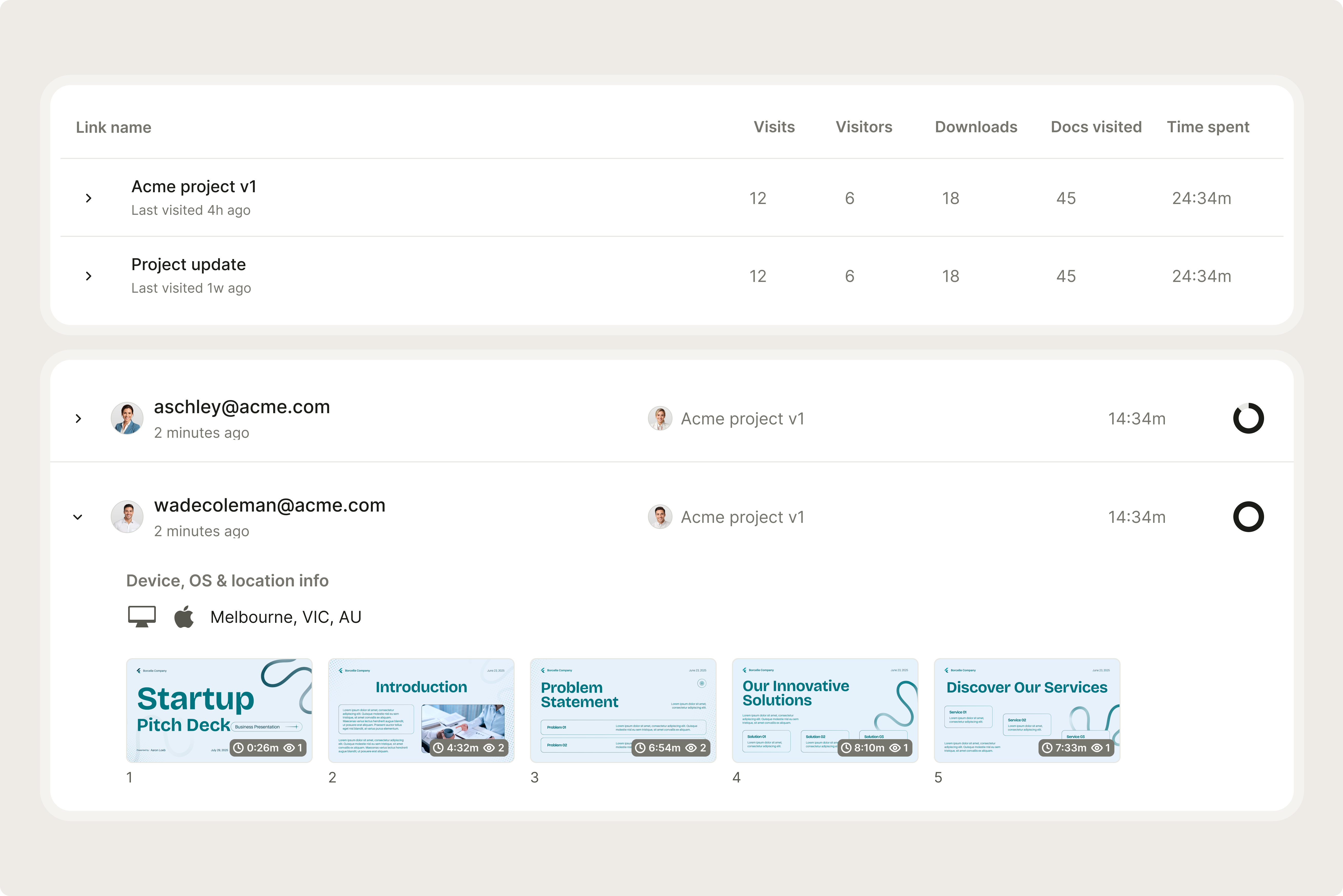
- 3.Get instant alerts when health investors open your materialsGet a real-time notification the moment a Toronto healthtech investor opens your link. See which sections they spent the most time on and which they skipped. If a Lumira partner reads your IP summary twice but ignores your go-to-market slide, lead with IP defensibility on your follow-up call.
Questions healthtech founders ask before raising in Toronto
- Not necessarily, but you need a clear regulatory pathway. Lumira, Genesys, and iGan evaluate early-stage companies before any regulatory approval. What they want to see is a defensible regulatory strategy: submission type, timeline, and clinical evidence plan. If you haven't mapped your Health Canada or FDA approach, spend time on that before requesting a first meeting.
- A life sciences VC like Lumira or Genesys invests in biotech, pharma, and medical device companies with long development cycles and regulatory pathways. They write large checks and hold for 7–12 year fund lifecycles. A digital health investor like OMERS Ventures or Round13 backs software platforms and AI tools that improve how healthcare is delivered — shorter cycles, faster revenue milestones, less regulatory exposure. Pitching to the wrong category wastes time and introductions.
- Before your first serious investor conversation. Lumira, iGan, and Genesys can go from first meeting to term sheet in weeks for the right company. Have your clinical documentation, IP summary, financial model, and cap table in an Ellty data room from day one. Scrambling to organize materials after an investor requests diligence access kills momentum when you can least afford it.
- Rarely. Toronto's health investor community is built through hospital networks, academic medical centers, and clinical co-investors. The fastest path to iGan, Lumira, or Genesys is through a reference from a clinical partner, co-investor, or portfolio founder they already know. Warm intros through MaRS Discovery District, UHN, or SickKids connections are more effective than LinkedIn messages to partners.
- Send a personalized pitch to 6–8 funds where you genuinely match stage, sector, and mandate. Toronto's health investor pool is small — Lumira, Genesys, iGan, and Bloom Burton all know each other and talk. Mass-targeting signals you couldn't prioritize your most important relationship first. Work your strongest introduction before moving to the next fund.
- Pitch deck, IP summary and patent filings, regulatory pathway documentation, clinical data or pre-clinical study results, financial model, cap table, co-founder agreements, and any signed pilot agreements with health system partners. Digital health investors additionally want product metrics, cohort data, and customer contracts with named buyers.