
Need a secure data room without the enterprise price tag?
You're raising capital or closing a deal. Investors want access to your financials, cap table, contracts, and IP documentation. You need somewhere secure to share hundreds of documents with dozens of people, track who's viewing what, and control access granularly.
Ansarada is one option. It's enterprise-grade, feature-rich, and has been around since 2005. It's also expensive, complex to set up, and might be overkill for your needs.
This guide walks through what Ansarada data room actually offers, what it costs (including hidden fees), how long setup takes, and when simpler alternatives like Ellty make more sense.
What is Ansarada data room?

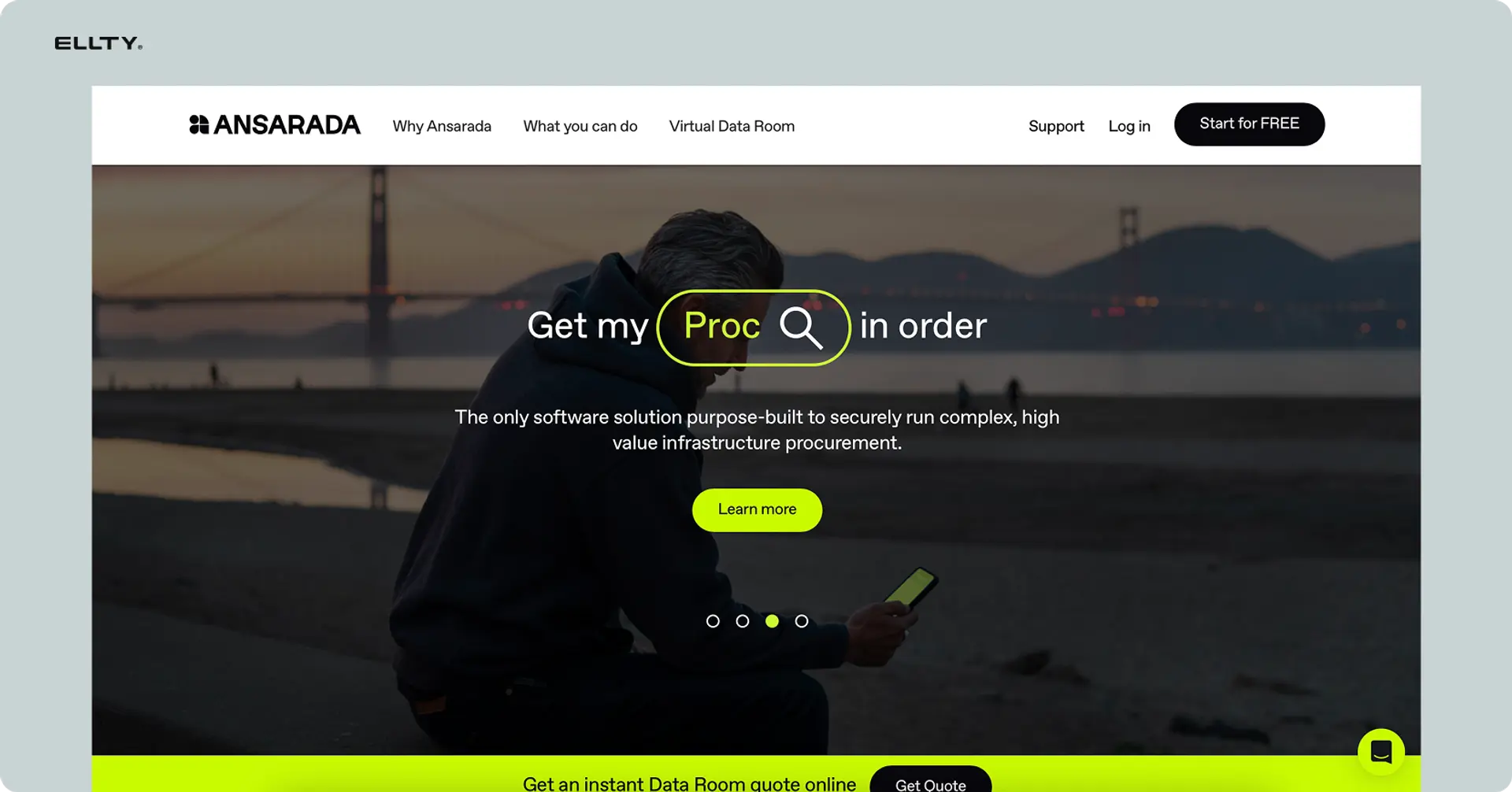
Data rooms explained
A virtual data room (VDR) is a secure online repository for storing and sharing confidential documents during transactions. Unlike Dropbox or Google Drive, data rooms are built specifically for situations where document security, detailed analytics, and granular access controls matter more than ease of use.
Key features include:
- Folder hierarchies that mirror physical due diligence rooms
- User-level permissions (view, download, print controls)
- Document-by-document analytics tracking
- NDA enforcement and audit trails
- Watermarking and security features
Companies use data rooms during fundraising, M&A transactions, audits, board meetings, and any process requiring controlled document sharing with external parties.
Ansarada's data room feature


Ansarada launched in 2005 as one of the first cloud-based virtual data room providers. They focused initially on M&A transactions and have since expanded into fundraising, board management, procurement, and compliance.
Ansarada offers a full-featured VDR platform, not just a data room add-on to existing software. Core functionality includes:
Document management:
- Drag-and-drop upload with bulk operations
- Automatic indexing and folder structures
- Version control and document histories
- Full-text search across all files
- Support for 200+ file types
Security and compliance:
- ISO 27001, SOC 2 Type II certified
- Bank-grade encryption (256-bit AES)
- Two-factor authentication
- Dynamic watermarking on documents
- Granular user permissions (view, download, print)
- Detailed audit trails for compliance
Analytics and AI:
- Material Tracker showing engagement levels
- AI-powered insights predicting deal outcomes
- User activity monitoring (time spent, pages viewed)
- Document heat maps showing interest areas
- Automated Q&A management
Collaboration features:
- Built-in Q&A workflows
- Redaction tools
- Approval workflows
- Mobile apps (iOS, Android)
Who uses Ansarada:
- Mid-market to enterprise companies in M&A processes
- Private equity firms managing deal pipelines
- Investment banks facilitating transactions
- Corporate development teams
- Legal firms managing due diligence
- Companies raising Series B+ funding rounds
Ansarada positions itself as enterprise-grade infrastructure for high-stakes transactions. Their average deal size is $50M+ and typical customers are managing complex, multi-party processes worth millions.
Ansarada data room vs regular file sharing
Ansarada is purpose-built as a data room platform, so there's no "regular Ansarada" to compare against. But understanding how Ansarada differs from standard file sharing tools helps clarify when you actually need this level of infrastructure.
Opening: Most companies already use Dropbox, Google Drive, or similar tools for document sharing. Ansarada costs 10-50x more. Here's what that premium buys you and when it matters.
Comparison table


When to use standard file sharing
You don't need Ansarada if you're:
- Sharing pitch decks with early-stage investors (seed, pre-seed)
- Collaborating internally on documents
- Sending proposals or contracts to clients
- Sharing marketing materials or public documents
- Working with fewer than 10 external parties
- Running processes where detailed analytics don't matter
Standard tools work fine when security concerns are moderate, you don't need granular permissions, and the cost of a document leak wouldn't be catastrophic.
When to use Ansarada data room
Ansarada makes sense when:
- Transaction value exceeds $10M
- You're managing 50+ documents with 15+ external users
- Regulatory compliance requires audit trails (financial services, healthcare)
- Document leaks would have material financial or legal consequences
- You need to prove chain of custody for legal purposes
- Multiple parties need different access levels to the same repository
- AI-powered deal insights would inform strategy
- You're running competitive bid processes
The key difference
Standard file sharing treats documents as files to store and share. Ansarada treats documents as evidence in a process that needs tracking, control, and eventual audit. You're paying for insurance, compliance infrastructure, and analytical capabilities that matter when millions of dollars are at stake.
If your deal wouldn't justify hiring a transaction attorney, it probably doesn't justify Ansarada's pricing either.
Setting up an Ansarada data room
Opening: Ansarada setup requires planning. This isn't "create a folder and send a link." You're building infrastructure for a transaction.
Step-by-step process
Step 1: Initial consultation and scoping (1-2 days)
- Contact Ansarada sales for demo and quote
- Discuss transaction type, timeline, user count
- Receive custom pricing proposal
- Sign contract and complete compliance checks
Step 2: Room creation and configuration (2-4 hours)
- Ansarada creates your data room instance
- You or your team sets up folder structure
- Common frameworks: by document type, by department, by topic
- M&A deals often use standard indices (financial, legal, commercial, IP, HR)
- Configure security settings (watermarks, download permissions, expiry dates)
Step 3: Document upload and organization (1-3 days)
- Bulk upload documents via web interface or desktop sync
- Ansarada auto-indexes many files but review is essential
- Add document descriptions and metadata
- Set up version control for living documents
- Create document numbering system
- Time varies based on document count (100 vs 1000+ files)
Step 4: User and permission setup (2-4 hours)
- Create user groups (investors, advisors, management, board)
- Assign permissions at group and individual levels
- Configure two-factor authentication requirements
- Set up NDAs that users must accept before access
- Define which documents each group can view/download/print
- Test permissions with dummy accounts
Step 5: Q&A workflow configuration (1-2 hours)
- Enable Q&A module if needed
- Assign question moderators and responders
- Set up email notifications for new questions
- Create templates for common responses
Step 6: Testing and launch (2-3 hours)
- Test all user access levels
- Verify documents display correctly
- Check mobile app functionality
- Review analytics dashboard
- Train internal team on management
- Send access invitations to first users
Total setup time:
- Small data room (100-200 documents, 10 users): 1-2 days
- Medium data room (500+ documents, 20+ users): 3-5 days
- Large M&A data room (1000+ documents, 50+ users): 1-2 weeks
This assumes you have documents already organized. If you're starting from scattered files across multiple systems, add several days for document gathering and preparation.
Ongoing maintenance
Daily tasks:
- Monitor new user access requests
- Review analytics for red flags or high interest areas
- Respond to Q&A inquiries within SLAs
- Upload updated documents as needed
Weekly tasks:
- Generate activity reports for stakeholders
- Add new users as process expands
- Archive or remove outdated documents
- Review permission changes
Per-transaction tasks:
- Configure new data room for each deal
- Migrate or archive completed transactions
- Extract analytics for post-deal analysis
Ansarada typically requires 5-10 hours per week of administrator time during active transactions, more during setup and closing phases.
Ansarada data room pricing
Opening: Ansarada doesn't publish pricing. Every quote is custom based on transaction type, timeline, user count, and document volume. Here's what we've learned from actual users and pricing discussions.
Plan availability
Ansarada doesn't offer fixed plans like "Basic" or "Pro." All pricing is custom, but they do have standard packages for different transaction types:
Which plans include data rooms


Detailed pricing breakdown
Standard M&A package
Base price: $500-800/month
- Includes up to 10GB storage
- Up to 25 external users
- Standard security features
- 3-month minimum commitment
- Setup fee: $500-1000 (sometimes waived)
Typical 6-month M&A transaction total: $3,500-5,500
Capital Raising package
Base price: $800-1500/month
- Unlimited investor users
- AI-powered investor engagement tracking
- 10-50GB storage depending on materials
- 6-month minimum (typical fundraise timeline)
- Setup and advisory: $1000-2000
Typical Series A raise (6 months): $6,000-11,000
Board & Governance
Base price: $1200-2500/month
- Annual contract (paid monthly or upfront)
- Includes board portal features
- Meeting management and approvals
- Up to 50 users (board, advisors, management)
- 25-100GB storage
Annual cost: $14,400-30,000
Enterprise custom
For companies running multiple concurrent transactions:
- Volume discounts (typically 20-40% off standard pricing)
- Dedicated account manager
- Custom integrations and workflows
- Advanced analytics and reporting
- Training and onboarding support
Typical enterprise deals start at $50,000+/year
Hidden costs to consider
Beyond base subscription pricing:
Setup and training:
- Initial setup fee: $500-2000 (sometimes included in first month)
- Advanced training for administrators: $500-1500
- Custom folder template creation: $500-1000
- Integration setup (if connecting to other systems): $1000-5000
User scaling:
- Additional users beyond package limits: $50-100/user/month
- Premium user features (advanced analytics): +$200-500/month
- External advisor access: Sometimes charged separately
Feature add-ons:
- Advanced AI insights: +$500-1000/month
- Custom branding and white-labeling: +$200-500/month
- API access: +$500-1500/month
- Additional integrations: $500-2000 per integration
- OCR and document processing: Varies by volume
Storage overages:
- Most packages include 10-50GB
- Additional storage: $50-100 per 10GB/month
- Large file handling fees sometimes apply
Time extensions:
- Many contracts are 3-6 months
- Month-to-month extensions: Often 20-30% premium
- If transaction extends beyond initial term, budget for continuation fees
Real cost examples
Startup raising Series A (6-month fundraise)
- Base capital raising package: $1200/month × 6 = $7,200
- Setup fee: $1,000
- 5 additional management users: $75/user/month × 5 × 6 = $2,250
- Extra storage (20GB): $100/month × 6 = $600
- Total: $11,050
Mid-market company in M&A process (4-month transaction)
- Standard M&A package: $700/month × 4 = $2,800
- Setup and custom folder structure: $1,500
- 15 additional users (buyers, advisors): $75/user/month × 15 × 4 = $4,500
- Advanced AI analytics: $800/month × 4 = $3,200
- Total: $12,000
Enterprise with 3 concurrent deals (annual)
- Enterprise license: $60,000/year
- 3 concurrent data rooms included
- 100 total users across all rooms
- Dedicated support and account management
- Custom integrations to CRM and deal management
- Total: $60,000/year (effectively $5,000/month or $1,667/room/month)
Cost comparison with competitors
For a standard 6-month M&A transaction with 25 users:


Ansarada sits in the mid-to-upper tier of enterprise VDR pricing. You're paying a premium for AI features, deal experience, and compliance certifications. For simple fundraising or smaller deals, this premium might not deliver proportional value.
Use cases for data rooms
Opening: Data rooms make sense in specific scenarios where document security, access control, and analytics justify the cost and complexity. Here are the main use cases where Ansarada works well.
1. Fundraising (Series A to Series C+)
The scenario: You're raising $5M+ from institutional investors. You need to share detailed financials, customer contracts, product roadmaps, and legal documents with 10-30 potential investors. Each investor requires different information at different stages of diligence. Some get full access after term sheets, others see high-level materials only.
Why a data room helps:
- Centralize all fundraising materials investors will request
- Grant staged access (teaser, then full diligence after LOI)
- Track which investors spend time on which documents
- Update financials or metrics once, everyone sees current version
- Maintain audit trail for regulatory compliance
- Professional presentation signals operational maturity
What you'd include:
- Pitch deck and executive summary
- 3-5 year financial projections and historical statements
- Cap table with all equity instruments
- Customer list, contracts, and pipeline breakdown
- Product roadmap and technical architecture
- Team bios, org chart, option pool details
- Articles of incorporation, bylaws, material contracts
- IP portfolio (patents, trademarks, licenses)
- Board minutes and previous investor rights
- Insurance policies and compliance certifications
Example workflow: "Create data room with tiered folder structure. Initial investor meetings include pitch deck only via trackable link. After first call, grant access to executive summary and high-level financials folder. When investor indicates serious interest, expand access to detailed financials, customer data, and legal docs. Track engagement to identify who's genuinely interested vs. tire-kicking. Use heat maps to see which sections raise questions, prepare FAQs proactively."
Ansarada features that matter:
- AI predictions showing which investors are most engaged
- Granular permissions for staged access
- Material Tracker showing document interest levels
- Q&A workflow for investor questions
- Automatic watermarking to prevent sharing
2. Mergers and acquisitions (M&A due diligence)
The scenario: You're selling your company or acquiring another business. The transaction involves months of due diligence with buyers/sellers, investment banks, lawyers, accountants, and advisors examining every aspect of the business. Hundreds of documents need sharing with dozens of parties, many with conflicting interests.
Why a data room helps:
- Control exactly what each party sees (buyer vs. competitor buyer)
- Maintain legal defensibility with complete audit trails
- Manage competitive bid processes without information leakage
- Track which buyers are actively reviewing vs. posturing
- Respond to diligence requests in organized Q&A format
- Prove compliance with information barriers
What you'd include:
- Complete financial records (3-5 years)
- Customer and supplier contracts
- Employee agreements, compensation, benefits
- Real estate leases and property ownership
- Insurance policies and claims history
- Litigation records and legal proceedings
- Tax returns and compliance documentation
- Environmental assessments and permits
- IT systems and infrastructure documentation
- Pending transactions and commitments
- Related party transactions
- Financial projections and business plans
Example workflow: "Seller creates comprehensive data room with all diligence materials indexed by category. Investment banker manages access, granting different buyers access to different rooms to prevent competitive intelligence leakage. As buyers submit questions via Q&A module, seller coordinates responses with legal and finance teams. Track which buyers are actively reviewing (vs. those requesting access for competitive intelligence). Use analytics to inform negotiation strategy. Maintain detailed audit logs for future legal compliance."
Ansarada features that matter:
- Redaction tools for sensitive information
- Clean team functionality for competitive situations
- Forensic audit trails for legal compliance
- Advanced user permissions preventing downloads
- Dynamic watermarking with user identity
- Q&A workflows with response tracking
3. IPO preparation and readiness
The scenario: You're preparing for public offering. Underwriters, auditors, lawyers, and regulatory advisors need access to comprehensive company documentation. Process takes 6-18 months with constantly updating materials. Everything must meet regulatory standards and maintain strict confidentiality before public announcement.
Why a data room helps:
- Centralize materials for multiple advisory firms
- Maintain version control as documents evolve
- Prove regulatory compliance with audit trails
- Manage confidential information before going public
- Coordinate updates across legal, finance, and operations
- Enable remote due diligence efficiently
What you'd include:
- SEC filings and registration statements
- Audited financial statements (3+ years)
- Corporate governance documents
- Executive compensation details
- Material contracts and commitments
- Risk factors and disclosures
- Related party transactions
- Litigation and regulatory issues
- Business operations documentation
- Market analysis and competitive positioning
Example workflow: "Create data room early in IPO process. Grant underwriters full access to initial diligence materials. Add accountants and lawyers with specific permissions for their domains. As S-1 drafts evolve, maintain version control with clear dating. Use Q&A to manage hundreds of diligence questions from multiple firms. Update materials continuously as audits complete and business evolves. Maintain strict access controls before public announcement."
Ansarada features that matter:
- Regulatory compliance certifications
- Detailed version control and document histories
- Audit trails meeting SEC requirements
- High-security settings for pre-announcement confidentiality
- Collaboration tools for multi-party coordination
4. Board meetings and governance
The scenario: You're managing quarterly or monthly board meetings with distributed board members, observers, and advisors. Board packages include confidential strategic plans, financial results, executive compensation, and sensitive discussions. Materials need secure distribution, reading tracking, and long-term archival.
Why a data room helps:
- Distribute board materials securely to all directors
- Track whether directors reviewed materials before meeting
- Maintain permanent archive of board decisions
- Control access for board members vs. observers vs. management
- Enable remote participation with consistent materials
- Prove governance compliance for audits and investors
What you'd include:
- Board meeting agendas and minutes
- Financial reports and variance analysis
- Strategic plans and updates
- CEO and executive reports
- Committee reports (audit, compensation, governance)
- Voting resolutions and approvals
- Executive compensation proposals
- M&A opportunities and evaluations
- Risk assessments and compliance reports
Example workflow: "Upload board package 5-7 days before meeting. Board members receive notification and access materials via secure portal. Track who's reviewed which sections to identify preparation levels. Enable Q&A for questions before meeting. During meeting, reference materials in real-time via shared screen. After meeting, upload approved minutes and resolutions. Maintain permanent archive of all board materials for compliance and future reference."
Ansarada features that matter:
- Mobile access for directors reviewing on devices
- Read receipts and engagement tracking
- Long-term archival with search
- Approval workflows for resolutions
- Meeting-specific folders and organization
5. Legal due diligence and litigation support
The scenario: You're involved in litigation, regulatory investigation, or complex legal matter requiring document production and review. Opposing counsel, expert witnesses, and regulatory agencies need controlled access to specific documents. Chain of custody and access logs are legally critical.
Why a data room helps:
- Maintain legally defensible audit trails
- Control document access by party and privilege
- Prevent unauthorized copying or distribution
- Demonstrate compliance with discovery obligations
- Coordinate multi-party document reviews
- Redact privileged or sensitive information systematically
What you'd include:
- Relevant business records and communications
- Contracts and agreements at issue
- Financial records supporting claims
- Employment and HR files
- Email and communication records
- Expert reports and analyses
- Previous legal opinions and correspondence
Example workflow: "Legal team creates data room with all potentially relevant documents. Apply privilege logs and redactions before opposing counsel access. Grant regulatory agency access to specific folders only. Use audit trails to prove when documents were produced and who accessed them. Coordinate document reviews among internal team, outside counsel, and experts. Maintain strict controls preventing unauthorized sharing."
Ansarada features that matter:
- Forensic audit trails for legal proceedings
- Redaction tools meeting legal standards
- Privileged document separation
- Watermarking with user and timestamp
- Download and print restrictions
- Detailed access logs as evidence
6. Real estate transactions
The scenario: You're selling or acquiring commercial property. Transaction requires sharing property records, environmental assessments, tenant agreements, and financial performance with buyers, lenders, and advisors. Process involves multiple parties reviewing detailed property information simultaneously.
Why a data room helps:
- Organize extensive property documentation logically
- Grant different access to buyers vs. lenders vs. brokers
- Track which parties are seriously reviewing vs. browsing
- Maintain confidentiality of tenant information
- Coordinate diligence from multiple advisors
- Prove compliance with disclosure obligations
What you'd include:
- Property deeds and title documentation
- Environmental site assessments (Phase I, Phase II)
- Tenant leases and rent rolls
- Operating statements and financial performance
- Property tax records and assessments
- Building permits and certificates of occupancy
- Maintenance records and capital improvements
- Property management agreements
- Utility records and consumption data
- Surveys and engineering reports
- Insurance policies and claims
Example workflow: "Create data room organized by property and document type. Provide initial access to offering memorandum and basic property info. As buyers indicate interest, expand access to detailed financials and tenant information. Grant lender separate access to underwriting materials. Track engagement to prioritize serious buyers. Use Q&A for buyer questions about property condition or lease terms."
Ansarada features that matter:
- Support for large file types (blueprints, surveys)
- Geographic organization for multi-property portfolios
- Tenant information confidentiality controls
- Financial document organization tools
7. Private equity fund operations
The scenario: You're managing private equity fund with limited partners (LPs) requiring quarterly reporting, annual audits, and capital call documentation. Need to distribute materials to 50-100+ LPs globally while maintaining confidentiality between investors and portfolio companies.
Why a data room helps:
- Distribute quarterly reports and capital calls efficiently
- Maintain separate areas for fund-level vs. deal-level materials
- Control LP access to appropriate fund information
- Archive all investor communications for compliance
- Coordinate annual audits with distributed documentation
- Enable LP portal for ongoing access
What you'd include:
- Quarterly financial statements and performance reports
- Capital call notices and funding status
- Portfolio company summaries and valuations
- Fund formation documents and amendments
- K-1 tax documents and schedules
- Annual audit reports and management letters
- Side letter agreements and special terms
- Investment committee materials and approvals
Example workflow: "Create fund data room with ongoing structure. Upload quarterly materials 30 days after quarter close. LPs receive notifications and access reports via their designated portal. Maintain historical archive of all previous quarters. During annual audit, grant auditors time-limited access to supporting documentation. Use analytics to see which LPs actively monitor fund vs. passive investors."
Ansarada features that matter:
- Ongoing access (not deal-specific)
- Large user base management (100+ LPs)
- Historical archival and organization
- Scheduled notifications for regular reporting
- Multi-fund management for GP firms
8. Corporate development and strategic partnerships
The scenario: You're exploring strategic partnerships, joint ventures, or licensing deals requiring mutual due diligence. Both parties need to share confidential information while protecting competitive secrets. Process involves technical, commercial, and legal review.
Why a data room helps:
- Facilitate reciprocal diligence efficiently
- Control which information each party sees
- Protect IP while demonstrating capabilities
- Track partner interest and engagement
- Maintain confidentiality during exploratory talks
- Document information sharing for future reference
What you'd include:
- Technology documentation and demonstrations
- Market analysis and competitive positioning
- Customer references and case studies
- Intellectual property portfolio
- Manufacturing or service delivery capabilities
- Proposed partnership terms and economics
- Regulatory approvals and compliance
- Integration requirements and timelines
Example workflow: "Create data room for potential partnership. Share high-level capabilities and market positioning initially. As discussions progress, provide access to technical documentation and detailed financials. Use separate folders for reciprocal information sharing. Track which technical materials generate most interest. Maintain clear records of what was shared when for future partnership negotiations."
Ansarada features that matter:
- Reciprocal access with separate permissions
- Technical document support (CAD, specs)
- Granular folder-level controls
- Partnership-specific organization
- Time-limited access for evaluation periods
Ansarada data room limitations
Opening: Ansarada is powerful but not perfect. Here's what it can't do well or where it falls short compared to alternatives.
Key limitations
1. Price makes it prohibitive for early-stage deals
Ansarada's $500-2000+/month pricing doesn't make economic sense for deals under $5-10M. If you're raising a $2M seed round, spending $6,000-12,000 on a data room is 0.3-0.6% of the capital you're raising. That money is better spent on product development or customer acquisition.
The minimum commitment periods (3-6 months) also create risk. If your fundraise completes in 6 weeks, you're still paying for 3-6 months. Month-to-month options exist but carry 20-30% premiums.
2. Setup complexity requires dedicated resources
Getting an Ansarada data room production-ready takes days to weeks, not hours. You can't decide Friday afternoon to create a data room and share it Monday morning. The learning curve is steep enough that most companies hire consultants or rely on investment bankers to manage setup.
If you don't have a dedicated corporate development person or aren't working with advisors, the administrative burden becomes significant. Expect 5-10 hours weekly during active use.
3. Overkill for simple sharing needs
Ansarada's feature set addresses complex, multi-party transactions. If you're sharing documents with 5-10 people who all need the same access level, you're paying for granular permissions you won't use, AI predictions that don't matter, and compliance certifications that aren't relevant.
The professional data room interface can also intimidate early-stage investors who expect simple folder sharing. Some seed-stage VCs have complained that elaborate data rooms feel like founders are "playing enterprise" instead of focusing on building product.
4. Limited customization without enterprise pricing
Standard packages come with predefined workflows and limited branding options. If you want custom folder templates, white-labeling, or integration with your CRM or deal management systems, you need enterprise pricing ($50K+/year minimum).
API access for programmatic data room creation or analytics extraction is enterprise-only. Smaller teams can't automate repetitive tasks or build data room provisioning into their existing workflows.
5. Mobile experience is functional but not optimized
While Ansarada offers iOS and Android apps, the mobile experience focuses on document viewing rather than full administration. You can't easily restructure folders, manage complex permissions, or handle bulk operations from mobile. This matters for board members or investors who primarily work from tablets.
Document rendering on mobile sometimes struggles with complex Excel models or large PDFs. Investors reviewing financial models may need desktop access for full functionality.
6. Learning curve for non-technical users
The permission system is powerful but confusing for first-time users. Understanding the difference between user groups, individual permissions, document-level controls, and inheritance rules requires training.
Common mistakes include:
- Accidentally granting download permissions when intending view-only
- Creating permission conflicts between group and individual settings
- Not understanding that watermarks apply only to downloads, not screen captures
- Misconfiguring Q&A workflows so questions route to wrong people
These mistakes can have serious consequences in high-stakes transactions.
7. Storage limits require careful planning
Standard packages include 10-50GB storage. This sounds like plenty until you're uploading:
- Complete email archives for diligence
- Engineering documentation with large CAD files
- Video demonstrations or recorded meetings
- High-resolution property images or architectural plans
- Complete ERP system exports
Companies often hit storage limits mid-transaction and face additional fees or need to selectively remove less critical documents.
8. No built-in document preparation tools
Ansarada stores and shares documents but doesn't help create them. You need separate tools to:
- Redact sensitive information from PDFs
- Create document summaries or indices
- Convert files to searchable formats
- Extract data from scanned documents (OCR available but at extra cost)
- Merge related documents into single files
Other platforms like DealRoom include document preparation workflows. With Ansarada, you handle this externally.
9. AI features oversold for smaller transactions
Ansarada heavily markets AI-powered deal insights and predictions. In reality, these features work best with large datasets from many similar transactions. For one-off deals or unique circumstances, the AI predictions are generic and not particularly actionable.
The "deal predictor" analyzing investor engagement is interesting but rarely changes outcomes. If an investor is engaged, you can see that from basic analytics. If they're not, AI confirmation doesn't help you close them.
10. Vendor lock-in during active transactions
Once you've built a data room and shared access with 20+ external parties, migrating to another platform mid-transaction is practically impossible. If you become unhappy with Ansarada's pricing, support, or functionality, you're stuck until the deal closes.
This creates negotiating leverage for Ansarada during contract renewals or term extensions. Some companies report significant price increases when requesting 2-3 month extensions beyond initial contracts.
11. Support quality varies significantly
Enterprise customers get dedicated account managers and white-glove support. Standard package customers rely on email support with 12-24 hour response times. During critical moments (weekend before close, urgent permission change needed), slower support becomes problematic.
Knowledge base documentation is comprehensive but written for experienced users. New users struggle to find answers to basic questions without trial and error.
12. Collaboration features lag modern tools
The Q&A module works but feels dated compared to modern collaboration platforms. No threaded conversations, limited formatting options, no easy way to loop in additional people mid-thread. Teams often end up managing complex questions in email or Slack and just documenting final answers in Ansarada.
Internal team collaboration (discussing documents, assigning tasks, tracking follow-ups) requires separate tools. Ansarada doesn't replace your project management or communication platform.
Alternatives to Ansarada data room
Opening: Ansarada works well for complex, high-value transactions, but several alternatives offer different tradeoffs on price, simplicity, and features. Here's how they compare.
Ellty - Simple data rooms without per-user fees

What it is:
Ellty is a document sharing, tracking, and virtual data room platform built for startup founders and investors. Upload documents, create trackable links, see detailed engagement analytics, and manage full due diligence - all without per-user seat charges.
Key features:
Upload unlimited documents and professional presentations. Create trackable links with granular access controls. Get real-time notifications when someone opens your document. See page-by-page analytics showing where viewers spend their time. Track session duration and return visits. Build virtual data rooms with folder organization, NDA gating, granular permissions, and dynamic watermarking for due diligence. Send and collect eSignatures without a separate tool. Your whole team can collaborate without ballooning per-seat costs.
Pricing:
Starts significantly lower than Digify for teams. You're not charged per user, so adding team members doesn't increase costs. Plans are based on features, starting free forever, with paid plans from $69/month unlocking data rooms, eSignatures, and advanced access controls.
Best for:
Startup founders raising capital who need reliable document tracking and a clean due diligence process. Teams tired of per-user pricing where costs scale with headcount. Anyone who needs document tracking, eSignatures, and a full virtual data room under one roof without paying for multiple tools.
Compared to Ansarada:


When to choose Ellty:
- Your transaction value doesn't justify $5K+ on a data room
- You need a data room operational this week, not next month
- You're sharing with 10-50 people and don't want per-user fees
- Simple fundraising or M&A where AI insights don't matter
- You prefer straightforward tools over feature-rich complexity
- You want to test data room approach before committing long-term
- Early-stage startup where every dollar matters
When to choose Ansarada instead:
- Transaction exceeds $25M and warrants premium tools
- Regulatory compliance requires ISO 27001 certification
- You're managing competitive bid with sophisticated access controls
- AI deal insights would inform strategy
- You have dedicated corporate development resources
- Legal team requires forensic audit trails
- Complex permission schemes across 50+ users
DealRoom - Project management meets data room
What it offers: DealRoom combines virtual data room functionality with deal pipeline management and workflow tools. Built for M&A practitioners running multiple concurrent deals.
Key features:
- Data room with standard security and permissions
- Deal tracker showing pipeline and stage
- Task management and diligence checklists
- Integration with common M&A workflows
- Document preparation and redaction tools
- Pricing: $500-1500/month depending on deal count
Best for:
- Corporate development teams managing deal flow
- Mid-market M&A with $5-50M valuations
- Companies running multiple concurrent transactions
- Teams wanting integrated project management
When to choose over Ansarada: DealRoom costs 30-50% less than Ansarada while including project management features Ansarada lacks. Better for teams that need workflow coordination, not just document storage. Trade-off is fewer AI features and less sophisticated analytics.
Firmex - Budget-friendly enterprise VDR
What it offers: Firmex provides enterprise-level VDR functionality at lower price points than Ansarada or Intralinks. Canadian company serving mid-market M&A and legal markets since 2006.
Key features:
- Full VDR feature set including permissions, analytics, Q&A
- SOC 2, ISO 27001 certified
- Flat monthly pricing with unlimited users
- Good document organization and search
- Pricing: $400-1000/month for standard deals
Best for:
- Mid-market M&A ($5-100M)
- Legal due diligence and litigation support
- Real estate transactions
- Budget-conscious buyers wanting enterprise features
When to choose over Ansarada: Firmex offers 40-60% cost savings with similar core functionality. Interface is less modern and AI features are limited, but for straightforward deals where advanced analytics don't matter, Firmex delivers comparable security and organization at significantly lower cost.
Datasite (formerly Merrill DataSite) - Enterprise standard
What it offers: Datasite is one of the oldest and most established VDR providers, owned by Datasite Global Corporation. Primary competitor to Ansarada in the enterprise M&A market.
Key features:
- Comprehensive VDR functionality for large deals
- Exceptional security and compliance certifications
- AI-powered analytics and redaction
- 24/7 white-glove support
- Pricing: $800-3000+/month depending on deal size
Best for:
- Large M&A transactions ($100M+)
- Investment banking and private equity
- Cross-border deals requiring multi-language support
- Situations requiring maximum security and compliance
When to choose over Ansarada: Datasite has longer track record and broader industry acceptance in traditional M&A. Ansarada has more modern interface and better AI features. If you're working with conservative investment banks or in heavily regulated industries, Datasite's reputation can be worth the premium. Pricing is similar or slightly higher than Ansarada.
Box - Basic data room functionality
What it offers: Box is primarily enterprise file storage and collaboration but offers data room features through Box Governance and Box KeySafe add-ons.
Key features:
- Familiar interface if already using Box
- Basic access controls and permissions
- Audit trails and compliance features
- Integration with Office 365, Google Workspace
- Pricing: Box Business ($15-30/user) + Governance add-ons ($5-15/user)
Best for:
- Companies already using Box for file storage
- Simple document sharing not requiring specialized VDR
- Teams preferring familiar tools over specialized platforms
- Limited budgets ($500-1000 total monthly spend)
When to choose over Ansarada: Box works when you need basic secure sharing with people you already trust and transaction complexity is low. Significantly cheaper if you're already paying for Box. Not suitable for competitive M&A processes or situations requiring sophisticated access controls and analytics.
Google Drive or Dropbox with organization
What it offers: Standard cloud storage with careful folder organization and permission management can serve as makeshift data room for very simple scenarios.
Key features:
- Folder-level permission controls
- Basic version history
- Familiar interface for all users
- Mobile apps standard
- Pricing: $10-20/user/month
Best for:
- Pre-seed or seed fundraising with 3-8 investors
- Sharing with parties you completely trust
- Non-competitive situations where analytics don't matter
- Absolute minimum budget (<$200/month)
When to choose over Ansarada: Only appropriate when transaction value is very low (<$2M), parties involved are limited (<10), and you don't need detailed analytics or advanced security. This is "better than nothing" rather than "appropriate alternative." Most professional investors expect actual data room for Series A+.
Quick comparison table


Choosing the right alternative
Match tool to transaction value:
- Under $2M: Ellty, Google Drive, or organized folders
- $2-10M: Ellty or Firmex
- $10-50M: DealRoom, Firmex, or Ansarada
- $50M+: Ansarada or Datasite
Match tool to complexity:
- Simple sharing (one folder, similar access): Ellty, Box, or basic storage
- Moderate complexity (multiple user groups, staged access): Ellty, DealRoom, or Firmex
- High complexity (competitive bids, sophisticated permissions): Ansarada or Datasite
Match tool to timeline:
- Need data room today/tomorrow: Ellty or Google Drive
- Need within a week: Ellty, Box, or Firmex
- Can wait 1-2 weeks for setup: Ansarada or Datasite
Match tool to budget:
- Under $500/month: Ellty, Google Drive, or Dropbox
- $500-2000/month: Ellty Pro/Business, Firmex, or DealRoom
- $2000+/month: Ansarada or Datasite
Match tool to expertise:
- No dedicated resources: Ellty or Box
- Internal coordinator available: Firmex or DealRoom
- Corporate development team or advisors: Ansarada or Datasite
The goal is appropriate tooling for your situation, not the most feature-rich platform regardless of needs.
Is Ansarada data room right for you?
Opening: Ansarada excels in specific scenarios but isn't the default choice for everyone. Here's how to decide if it matches your needs.
Choose Ansarada data room if:
- Your transaction value exceeds $25M and justifies premium tooling
- You're managing complex M&A with multiple bidders requiring strict information barriers
- Regulatory compliance mandates ISO 27001 and SOC 2 certifications
- You need forensic audit trails for legal or compliance purposes
- AI-powered deal insights would genuinely inform strategy or negotiations
- You're working with investment banks or advisors who prefer Ansarada
- You have dedicated resources to manage setup and ongoing administration
- Budget allows $5,000-15,000+ for data room over transaction lifecycle
- You're running multiple concurrent deals and need enterprise features
- Document security requirements exceed what simpler platforms provide
- Your industry (financial services, healthcare) has specific compliance needs
- You need sophisticated permission schemes with 50+ external users
- Timeline allows 1-2 weeks for proper setup and configuration
Look at alternatives if:
- Transaction value is under $10M and you're cost-sensitive
- You need a data room operational this week without dedicated setup time
- You're sharing with fewer than 20 people who need similar access levels
- Budget is limited and every expense requires clear ROI justification
- You don't have corporate development team or advisors managing the process
- Simple fundraising without competitive dynamics or complex permissions
- You prefer straightforward tools over feature-rich complexity
- AI predictions and advanced analytics aren't decision factors
- Your investors or counterparties don't expect enterprise VDR infrastructure
- You want flexibility to cancel monthly rather than 3-6 month commitments
- Setup complexity would delay your transaction timeline
- Previous data room experience was frustrating and you want simpler approach
- Compliance certifications beyond SOC 2 aren't required
Decision framework
Ask yourself:
About your use case:
- What's the total value of this transaction or fundraise?
- How many external parties need access?
- How many distinct permission levels do I need?
- Will information sharing happen in competitive context?
- What compliance or regulatory requirements apply?
About your team:
- Do I have someone who can dedicate 10-20 hours to setup?
- Will I have 5-10 hours weekly for ongoing administration?
- Am I working with advisors who can manage the data room?
- Does my team have experience with enterprise software?
About your budget:
- Can I justify $5,000-15,000 for data room infrastructure?
- What percentage of transaction value would this represent?
- Are there better uses for this capital at my stage?
- Do I need monthly flexibility or can I commit 3-6 months?
About timing:
- When do I need the data room ready?
- Can I wait 1-2 weeks for proper setup?
- Will the transaction close before minimum commitment expires?
- Is there risk the deal falls through, leaving me paying for unused months?
Honest recommendation
Ansarada makes sense for transactions where the stakes justify the investment. If you're managing a $50M M&A process, raising a $20M Series B, or preparing for IPO, the $10,000-20,000 you'll spend on Ansarada over 6-12 months is a rounding error relative to transaction value. The advanced features, compliance certifications, and proven track record provide insurance worth paying for.
For smaller deals, early-stage fundraising, or straightforward due diligence, Ansarada's pricing and complexity often exceed what the situation requires. A startup raising a $3M Series A doesn't benefit meaningfully from AI deal predictions or sophisticated permission inheritance rules. Spending $6,000 on a data room means $6,000 less for product development or customer acquisition.
The right question isn't "Is Ansarada the best data room platform?" It's "Does my specific situation warrant enterprise-grade infrastructure, or would a simpler alternative deliver the same outcome at a fraction of the cost?"
Frequently asked questions
Does Ansarada offer a free trial?
No, Ansarada doesn't provide free trials or freemium tiers. You can request a demo where they'll walk through features using sample data, but you can't test with your own documents without signing a contract. This differs from alternatives like Ellty (14-day free trial) or Firmex (free trial available). The lack of trial period means you're committing based on demos and sales conversations rather than hands-on experience.
Can I use Ansarada for small fundraising rounds?
Technically yes, but economically it rarely makes sense for rounds under $5M. At $500-2000/month for 3-6 months, you're spending $3,000-12,000 on infrastructure for a small raise. Many seed and Series A companies use simpler alternatives like Ellty ($69-149/month) or even organized Google Drive folders. Ansarada's features target larger, more complex transactions.
How long does it take to set up an Ansarada data room?
Plan for 3-7 days from contract signing to being ready to share with investors or buyers. This includes initial room creation (few hours), document upload and organization (1-3 days depending on volume), user and permission configuration (several hours), and testing. If you're starting from disorganized documents across multiple systems, add time for gathering and preparation. Companies with dedicated corporate development teams or working with advisors can sometimes complete setup in 2-3 days.
Does Ansarada charge per user?
Yes, most packages include a base number of users (typically 10-25) and charge $50-100 per additional user per month. Enterprise contracts sometimes include unlimited users but at significantly higher base prices. This per-user model can become expensive quickly. For example, if you're managing an M&A process with 30 external parties, you might pay $500 base + $500-1000 in user fees monthly.
Can investors or buyers download documents from Ansarada?
You control download permissions at the document or folder level. You can set documents to view-only (no downloads), allow downloads with watermarks, or enable unrestricted downloads. Most companies allow downloads for due diligence materials but restrict downloading for particularly sensitive documents. Even with download restrictions, users can screenshot or photograph screens, so document-level security isn't foolproof.
What happens to my data room when the contract ends?
Ansarada typically provides a grace period (30-90 days) after contract expiration to download your documents and data. After that, the data room becomes inaccessible unless you renew. Before contract ends, export all documents, download analytics reports, and save Q&A histories. Some companies maintain data rooms longer term by converting to annual contracts at reduced rates for archival purposes.
Does Ansarada work on mobile devices?
Yes, Ansarada offers iOS and Android apps for document viewing and basic administration. Investors and board members can review materials from tablets or phones. However, complex administrative tasks (restructuring permissions, bulk uploads, detailed configuration) work better on desktop. Mobile apps prioritize document access over data room management.
How does Ansarada compare to DocSend for pitch deck sharing?
Different use cases. DocSend ($10-50/month) is designed for tracking individual document sharing, primarily pitch decks and one-pagers. Ansarada ($500-2000+/month) is built for complex multi-document repositories during formal diligence. For initial investor outreach with pitch deck, use DocSend or Ellty. Once you're in diligence with serious investors requesting comprehensive materials, consider data room infrastructure. Many companies use both: DocSend for outbound sales, Ansarada for inbound diligence.
Can I customize the look of my Ansarada data room?
Standard packages offer limited branding (logo, colors). Full white-labeling (custom domain, complete brand customization, hiding Ansarada branding) requires enterprise pricing. Most users accept the standard Ansarada-branded interface since external parties expect professional VDR infrastructure regardless of whose branding appears.
Is my data secure in Ansarada?
Ansarada maintains strong security standards: ISO 27001 and SOC 2 Type II certified, 256-bit AES encryption, multi-factor authentication, and data centers in multiple geographic regions. They've been operating since 2005 without major security breaches. However, no system is completely secure. The bigger risk is usually user error (granting wrong permissions, sharing login credentials) rather than Ansarada's infrastructure being compromised.
Do I need technical expertise to use Ansarada?
You don't need to be technical, but there's a learning curve. Setting up folder structures, configuring permissions, and managing users requires systematic thinking and attention to detail. Most companies either have someone with prior data room experience handle it, hire consultants, or rely on investment bankers managing the process. The Q&A module, analytics dashboard, and permission system can be confusing initially. Ansarada provides training and documentation, but expect 5-10 hours to become comfortable with the platform.
Can I integrate Ansarada with my CRM or other tools?
API access and integrations are enterprise-tier features. Standard packages don't offer programmatic access or pre-built integrations with common business tools. If you need to automatically create data rooms from your deal pipeline, sync user lists with your CRM, or extract analytics into your BI tools, you'll need enterprise pricing ($50K+/year minimum). For most users, Ansarada operates as standalone platform requiring manual data entry and export.
Author

Anika Tabassum Nionta is a Content Manager at Ellty, where she writes about secure document sharing, virtual data rooms, M&A, due diligence, fundraising, and sales enablement. With over 6 years of writing experience, she helps professionals understand how to share confidential documents securely, track engagement, and manage deals more effectively. Anika holds both a BA and MA in English from Dhaka University. Outside of work, she enjoys reading, exploring new cafes in Dhaka, and connecting with entrepreneurs and dealmakers in her community.

