
Ansarada's pricing isn't published on their website. You need to contact sales for a quote, which makes it hard to budget or compare options before talking to a rep.
This guide covers what we know about Ansarada's pricing structure, typical costs for different team sizes based on user reports, what's included in their plans, and transparent alternatives with public pricing. You'll learn how to estimate your costs and decide if Ansarada fits your budget.
What is Ansarada?

Ansarada is a virtual data room (VDR) and deal management platform. They focus on M&A transactions, capital raises, IPOs, and other high-stakes financial deals that require secure document sharing and buyer due diligence.
Key features:
- Secure document storage and sharing
- Granular permission controls and user access tracking
- AI-powered due diligence automation
- Built-in redaction and watermarking
- Real-time activity tracking and analytics
- Q&A management for deal processes
- Compliance tools (GDPR, SOC 2, ISO 27001)
- Deal pipeline management
Market position:
Ansarada has been around since 2005 and is based in Australia. They position themselves as an enterprise VDR for complex financial transactions. Their platform is used by investment banks, private equity firms, law firms, and corporations managing high-value deals.
Current Ansarada pricing (2026)
Ansarada doesn't publish pricing on their website. All plans require contacting their sales team for a custom quote.
Pricing structure:
Pricing is project-based, not per-user. You pay per data room or deal, typically with a monthly or fixed-term fee. Costs vary based on deal size, number of users, storage needs, and contract length.
What influences your price:
- Deal type (M&A, capital raise, IPO, litigation)
- Number of data rooms needed
- Project duration (monthly vs. fixed term)
- Storage requirements
- Number of users and external participants
- Features required (AI tools, redaction, etc.)
- Support level needed
Reported pricing ranges
Based on user reviews and third-party reports, here's what teams typically pay:
Small deals - $1,000-$3,000/month
Who it's for: Single transactions with limited scope, small M&A deals, seed funding rounds
What's typically included:
- Single data room
- Basic document management
- Standard security features
- Limited users (typically 10-20)
- Email support
- Standard storage limits
Key limitations:
- No AI-powered features
- Limited customization
- Basic reporting only
- No dedicated support
Best for: Startups or small businesses running their first transaction
Standard deals - $3,000-$8,000/month
Who it's for: Mid-market M&A, Series A/B fundraising, standard due diligence projects
What's typically included:
- Single data room with more storage
- AI-powered due diligence tools
- Advanced permission controls
- Watermarking and redaction
- More users (50-100+)
- Activity analytics
- Phone and email support
- Custom branding
Key limitations:
- Single project focus
- Limited concurrent deals
- Standard SLA
- No dedicated account manager
Best for: Growing companies or mid-market transactions with moderate complexity
Enterprise deals - $8,000-$25,000+/month
Who it's for: Large M&A transactions, IPOs, complex multi-party deals, corporations with ongoing deal flow
What's typically included:
- Multiple data rooms
- Full AI suite with automated due diligence
- Advanced security and compliance features
- Unlimited users
- Dedicated account manager
- White-glove onboarding and training
- Custom integrations
- Priority support with SLA
- Advanced analytics and reporting
Key limitations:
- Pricing not transparent
- Long contract terms often required
- Complex setup process
Best for: Investment banks, PE firms, large corporations with regular deal activity
Pay-per-project pricing
Some users report fixed-fee options for specific deal types:
- Small M&A deal: $5,000-$15,000 flat fee
- Capital raise: $3,000-$10,000 flat fee
- IPO data room: $15,000-$50,000+ flat fee
These typically include a fixed term (3-6 months) and set number of users.
Costs not shown in base pricing
Implementation and training:
- Onboarding and setup: Often included but can be $1,000-$5,000 for complex requirements
- Training sessions: Usually included for 1-2 sessions, additional training may cost extra
- Custom configuration: Additional fees for specific workflows
Add-ons and extras:
- Extra storage beyond plan limits
- Extended project timelines (monthly fees continue)
- Additional concurrent data rooms
- Advanced AI features on lower tiers
- Third-party integrations
- Custom reporting or analytics
Support upgrades:
- Dedicated support beyond standard hours
- Account manager for non-enterprise plans
- Priority SLA guarantees
Real costs for teams
Project-based pricing means costs depend on your deal frequency and complexity. Here's what different scenarios actually cost.
Scenario 1: Startup raising Series A
Team size: 3-5 internal users, 20-30 investors viewing
Use case: Single fundraising round, 3-4 month process
Recommended plan: Standard deal pricing
Total cost: $12,000-$20,000 (3-4 months at $3,000-$5,000/month)
What this includes:
- Single data room for pitch deck and financials
- Investor tracking and analytics
- Standard security features
- Email support
Limitations to watch:
- Cost continues monthly until deal closes
- Additional months add $3,000-$5,000 each
- Limited to single fundraising process
Scenario 2: Mid-market company selling
Team size: 5-10 internal users, 50+ potential buyers
Use case: M&A sale process, 6-9 month timeline
Recommended plan: Standard to enterprise pricing
Total cost: $30,000-$60,000 (6-9 months at $5,000-$8,000/month)
What this includes:
- Full data room with AI due diligence
- Advanced buyer tracking
- Q&A management
- Phone support
Limitations to watch:
- Extended processes increase costs significantly
- May need to upgrade if buyer group grows
- No concurrent deals on standard plans
Scenario 3: PE firm with deal pipeline
Team size: 15-25 users across multiple deals
Use case: 3-5 active transactions simultaneously
Recommended plan: Enterprise pricing
Total cost: $120,000-$300,000/year ($10,000-$25,000/month)
What this includes:
- Multiple concurrent data rooms
- Full AI and automation suite
- Unlimited users and storage
- Dedicated account manager
Limitations to watch:
- Annual contracts often required
- Pricing increases with deal volume
- Setup and training time needed
Scenario 4: Law firm supporting clients
Team size: 10-20 attorneys, multiple client deals
Use case: Ongoing litigation and M&A support
Recommended plan: Enterprise pricing
Total cost: $180,000-$360,000/year ($15,000-$30,000/month)
What this includes:
- Multiple data rooms for different clients
- Advanced security and compliance
- Custom branding per client
- Priority support
Limitations to watch:
- Per-project fees may be better for sporadic work
- Need to budget for each new client matter
Cost comparison by use case


Hidden cost multipliers
Costs increase when you need:
- Extended timelines beyond initial estimate (each extra month adds full monthly fee)
- Multiple concurrent deals (often requires enterprise tier)
- Custom integrations with your existing systems
- Additional training for new team members mid-project
- Premium support or dedicated resources
- White-label branding for client-facing rooms
What teams actually need
Most teams overpay by choosing VDR platforms built for large M&A when they just need secure document sharing. Here's what actually matters for different use cases.
Early-stage fundraising (pre-Series A)
Must-have features:
- Secure document sharing with trackable links
- View analytics (who viewed what and when)
- Basic permission controls
- Professional presentation
Nice-to-have features:
- NDA management
- Q&A tools
- Custom branding
Skip these features:
- AI-powered due diligence
- Advanced redaction tools
- Multi-room capabilities
- Enterprise compliance certifications
Recommended approach: Simple pitch deck sharing tools ($0-$50/month) instead of full VDR ($3,000+/month)
Series A/B fundraising
Must-have features:
- Secure data room for financials and legal docs
- Granular permission controls by investor
- Activity tracking and notifications
- Professional appearance
Nice-to-have features:
- AI-powered document organization
- Built-in Q&A management
- Watermarking
Skip these features:
- Complex workflow automation
- Multiple concurrent rooms
- Dedicated account manager
Recommended approach: Mid-tier data room or purpose-built fundraising tools ($50-$500/month) before jumping to enterprise VDR
M&A transactions under $10M
Must-have features:
- Robust security and audit trails
- Granular access controls
- Document indexing and search
- Activity analytics
Nice-to-have features:
- AI due diligence assistance
- Redaction tools
- Phone support
Skip these features:
- Multiple data rooms
- White-label branding
- Dedicated support team
Recommended approach: Project-based VDR pricing ($5,000-$15,000 flat fee) rather than monthly enterprise contracts
M&A transactions over $10M
Must-have features:
- Enterprise-grade security
- Complete audit trails
- AI-powered due diligence
- Advanced permission controls
- Dedicated support
- Compliance certifications
Nice-to-have features:
- Custom integrations
- White-label options
- Training and onboarding
Skip these features:
Nothing. At this deal size, comprehensive VDR features are justified.
Recommended approach: Ansarada or similar enterprise VDR makes sense for deals of this complexity
Decision framework
Ask yourself:
How long will my project take? Ansarada charges monthly. A 6-month process costs 2-3x more than a 2-month process. If timelines are uncertain, monthly costs add up fast.
How many deals will I run? Single transaction vs. ongoing deal flow changes the value equation. One-off deals may be better served by flat-fee options.
What's actually at stake? $50M M&A deal justifies $50,000 VDR cost. $500K seed round doesn't justify $15,000 data room expense.
Who needs access? 5 people viewing pitch decks don't need the same platform as 100 buyers in due diligence with 50,000 documents.
Do I need AI features? AI due diligence helps with complex transactions. It's overkill for simple fundraising with standard documents.
What users say about Ansarada pricing
We reviewed hundreds of user comments on G2, Capterra, and Trustpilot. Here's what actual customers say about Ansarada's pricing.
What users like
Enterprise features for complex deals:
"For our $200M acquisition, the cost was justified. The AI due diligence saved our team weeks of work." — M&A Director, G2
Dedicated support included:
"Unlike other VDRs where you're on your own, Ansarada assigned us a customer success manager who helped set everything up properly." — Investment Banking Associate, Capterra
Common pricing complaints
No public pricing creates friction:
"Having to schedule a sales call just to get a ballpark figure is frustrating. We needed to budget before talking to vendors." — CFO, G2
High costs for simple needs:
"We paid $18,000 for a 4-month Series A raise. In retrospect, we could have used a simple pitch deck sharing tool for $100." — Startup Founder, Capterra
Monthly fees add up:
"Our deal took 3 months longer than expected. That added $15,000 to our budget we hadn't planned for." — Corporate Development Manager, G2
Overkill for early-stage companies:
"As a seed-stage startup, Ansarada was way more than we needed. We ended up using maybe 20% of the features but paid for enterprise-level tools." — Founder, Trustpilot
Contract lock-in:
"We were locked into a 12-month contract for multiple rooms even though we only needed 6 months. Couldn't negotiate out of it." — PE Associate, Capterra
Is Ansarada worth the cost?
Users consistently say Ansarada delivers value for large, complex transactions where security, compliance, and AI features matter. Investment banks, PE firms, and corporations running multi-million dollar deals find the cost justified.
For smaller deals, early-stage fundraising, or simple document sharing, users frequently report feeling they overpaid for features they didn't use. The platform works well but the pricing doesn't match the actual complexity of smaller transactions.
The lack of transparent pricing frustrates buyers who need to budget before engaging sales. This creates friction in the buying process, especially for first-time users or smaller organizations.
Ansarada vs alternatives: quick comparison
Here's how Ansarada pricing compares to similar tools. All prices are estimates based on comparable plans since Ansarada requires custom quotes.

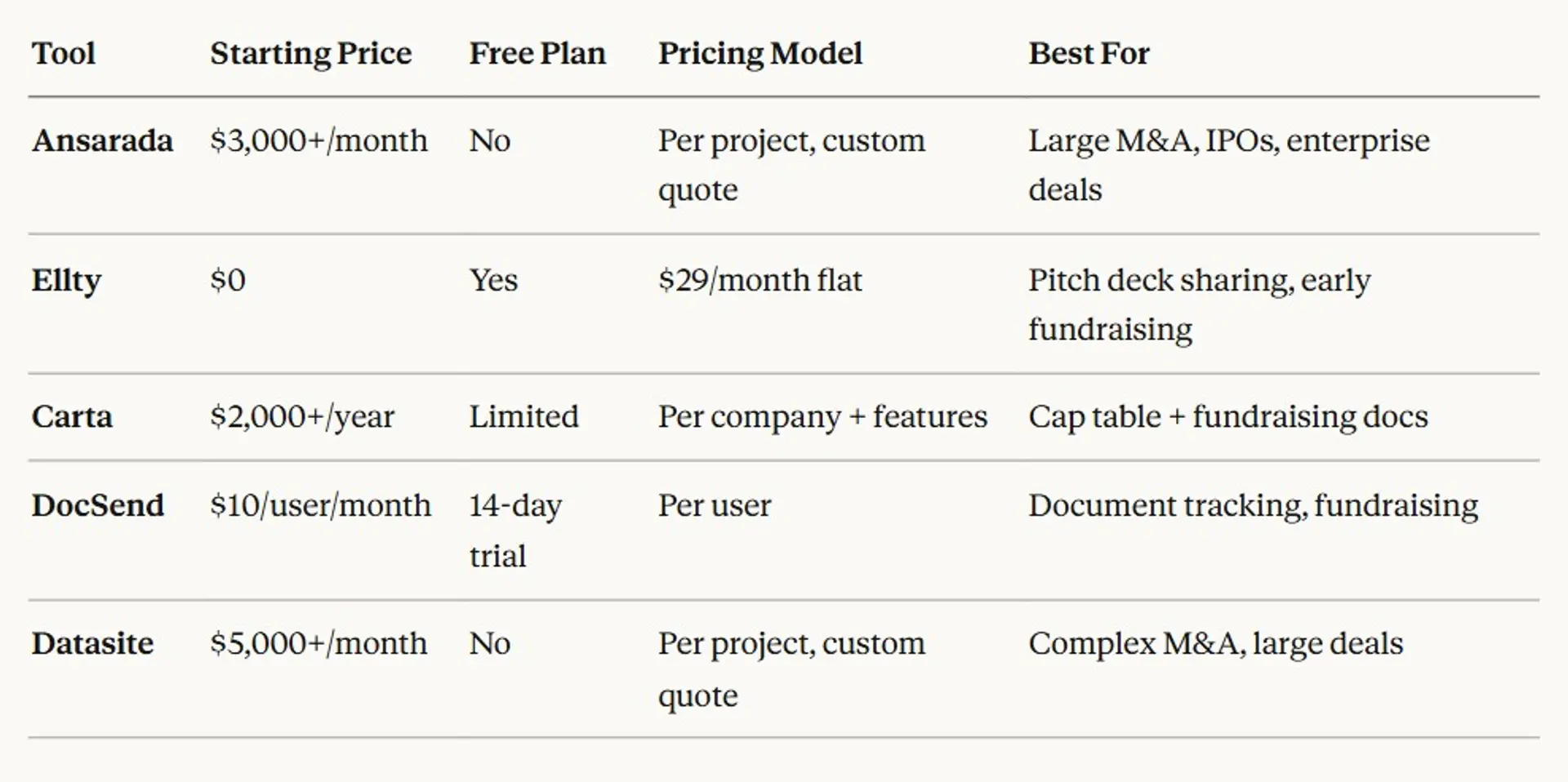
Ellty - $0-$69/month
- Free plan: Document tracking, real-time analytics, 10 GB storage, free forever
- Standard: $69/month — unlimited documents, advanced analytics, eSignatures, data rooms
- Data Room: $149/month — granular permissions, NDA gating, dynamic watermarking, restricted visitor access, 3 users included
- Data Room Plus: $349/month — group visitor permissions, data room audit logs, 4,000 assets per data room, 3 users included
DocSend - $10/user/month
- Starts at $10/user/month for Standard plan
- Focused on document sharing and tracking, not full VDR
- Good for pitch decks and simple fundraising
- NDAs and email verification included
- Less expensive than VDRs but limited security features
- Best for early-stage fundraising and sales collateral
Carta - $2,000+/year
- Known for cap table management, also offers data room
- Pricing bundled with cap table features
- Good if you already use Carta for equity management
- Limited compared to dedicated VDRs
- Best for startups raising Series A/B who need both cap table and data room
Datasite - $5,000+/month
- Enterprise VDR similar to Ansarada
- Custom pricing per project
- Strong in M&A and IPO transactions
- Comparable features and pricing to Ansarada
- Best for large deals where both are viable options
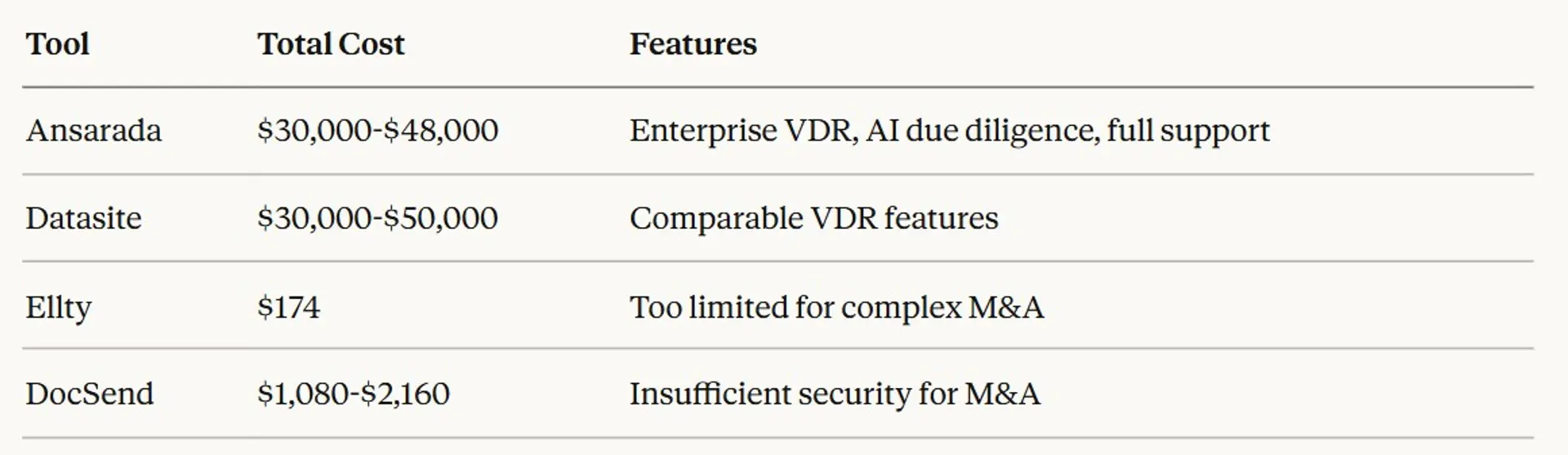
Cost comparison for common scenarios
For a Series A fundraising round (3 months):


For a $20M M&A deal (6 months):

When Ansarada makes sense
Ansarada is appropriate when:
- Running M&A transactions over $10M where security and compliance are critical
- Managing IPOs or other public market transactions
- You're a PE firm or investment bank with regular deal flow
- You need AI-powered due diligence for complex document sets
- Enterprise security certifications are required by buyers or regulators
- You have budget allocated for professional-grade VDR tools
When alternatives make sense
Consider alternatives when:
- Raising seed or Series A funding (Ellty, DocSend)
- Running simple transactions under $5M
- You need transparent, predictable monthly costs
- Your primary need is pitch deck sharing with analytics
- Budget is constrained and enterprise features aren't required
- Timeline is short and you want to minimize total cost
Special offers and discounts
Ansarada doesn't publish standard promotions, but here are ways to potentially reduce costs:
How to save money
Negotiate contract length:
Committing to annual contracts or multiple projects upfront may reduce per-project costs. Ask about volume discounts if you have predictable deal flow.
Choose fixed-fee pricing:
For defined projects with clear timelines, ask about flat-fee options instead of month-to-month billing. This caps your cost even if the project runs long.
Limit scope appropriately:
Don't pay for features you won't use. If you don't need AI due diligence or multiple concurrent rooms, negotiate those out of your package.
Time your start date:
Since you pay monthly, starting your data room exactly when you need it (not weeks early) saves money. Be ready to upload and launch quickly.
Startup and accelerator programs
Ansarada occasionally partners with accelerators. If you're part of YC, Techstars, or similar programs, ask if they have negotiated rates.
Educational pricing
Universities and research institutions may qualify for academic pricing. Contact sales if you're running a transaction on behalf of an educational organization.
Negotiation tips for enterprise
- Get quotes from Datasite and other competitors as leverage
- Ask what the "standard deal" costs, then negotiate from there
- Request pilot pricing for your first project if committing to more
- Negotiate payment terms (quarterly vs. monthly upfront)
- Ask about early termination options if deal falls through
How to calculate your true cost
Base price is just the start. Here's how to calculate what you'll actually pay for Ansarada.
Step 1: Base subscription
Estimate your project duration: Be realistic. Add 1-2 months buffer since deals always take longer than expected.
Example: Series A fundraising typically takes 4-5 months, not 2-3 months.
Get base monthly rate from sales: Ask specifically what the monthly fee is, not just total project cost.
Calculate base cost: Monthly rate × realistic timeline
Example: $4,000/month × 5 months = $20,000
Step 2: Add-ons and extras
Extra storage: If you have more than 50GB of documents, ask about storage overage fees.
Extended timeline: Add your buffer months to account for delays.
Additional rooms: If you might need concurrent rooms, get that pricing upfront.
Premium features: AI tools, advanced redaction, or custom integrations may cost extra.
Example add-on costs: $2,000-$5,000 for typical extras
Step 3: Implementation
Setup and onboarding: Usually included but confirm. Custom setup may be $1,000-$3,000.
Training: First session typically included. Additional training for new team members may cost extra.
Migration: If moving from another platform, budget time and potential consulting fees.
Example implementation cost: $1,000-$3,000
Step 4: Ongoing costs
Support beyond contract: If deal extends, monthly fees continue at full rate.
Document updates: Unlimited usually, but verify no per-upload fees exist.
User additions: Confirm whether adding users mid-project incurs fees.
Analytics and reporting: Custom reports beyond standard dashboards may cost extra.
Example ongoing costs: Plan for 20-30% cost overrun from timeline extensions
Total first-year cost calculation example
Base subscription: $4,000/month × 5 months = $20,000
Add-ons: Extra storage and features = $3,000
Implementation: Setup and training = $2,000
Contingency: 2 extra months for delays = $8,000
Total project cost: $33,000
True monthly cost (amortized): $33,000 ÷ 5 months = $6,600/month
Hidden costs to remember
- Monthly fees continue until you close the data room, even if deal stalls
- You'll pay for entire months even if deal closes mid-month
- Reactivation fees if you need to reopen room after closing
- Export fees for taking your data out after project ends
- Learning curve time investment for your team
Compare this to alternatives
- Base cost: $149/month × 5 = $745 (Data Room plan)
- Add-ons: $0 (unlimited visitors and data rooms included)
- Implementation: $0 (self-service, no onboarding fees)
- Total: $745 vs. $33,000 Ansarada
- Savings: $32,255 (97.7%)
DocSend for same project:
- Base cost: $10/user × 5 users × 5 months = $250
- Add-ons: $0
- Implementation: $0
- Total: $250 vs. $33,000 Ansarada
- Savings: $32,750 (99.2%)
This doesn't mean Ansarada isn't worth it for complex deals. But for straightforward fundraising, the math is stark.
Switch to Ellty (free Ansarada alternative)

Ansarada requires custom quotes and sales conversations before you know what you'll pay. Ellty offers transparent pricing and includes the core features most teams actually need for pitch deck sharing and fundraising.
Here's the rewritten section:
Ellty Free — $0 forever
- Real-time document tracking and engagement analytics
- Secure shareable links with view tracking
- Real-time notifications (who viewed, when)
- Page-by-page engagement analytics
- Aggregate & individual visit dashboard
- 10 GB storage per user
- Live chat support
Best for: Early-stage founders who need reliable document tracking and analytics without any cost or time limit.
Ellty Standard — $69/month
Everything in Free, plus:
- Advanced analytics dashboard and visitor export
- eSignatures — create, send, and collect signatures natively
- Full data room functionality for due diligence
- Unlimited visitors and document sharing
- Access controls (password protection, email verification, link expiration)
- Custom branding and branded custom subdomain
- Import from Google Drive, Dropbox, OneDrive, and Box
- Priority email support
- 50 GB storage per user
Best for: Seed through Series B founders managing investor outreach, eSignatures, and due diligence under one roof.
Ellty Data Room — $149/month
Everything in Standard, plus:
- Granular folder and file-level permissions
- NDA gating and secure viewer email authentication
- Dynamic watermarking to prevent leaks
- Restricted visitor access
- Personalized sharing links per visiting group
- 2,000 assets per data room
- 3 users included ($60/user/month for additional users)
Best for: Growth-stage startups and investors managing structured due diligence with multiple stakeholders.
Side-by-side comparison: Ansarada vs Ellty


What you save with Ellty
For a 5-month Series A fundraising round:
- Ansarada: $15,000-$25,000
- Ellty Pro: $145
- Savings: $14,855-$24,855 (98-99%)
For a seed-stage pitch deck sharing:
- Ansarada: $3,000-$5,000 minimum
- Ellty Free: $0
- Savings: $3,000-$5,000 (100%)
For a 12-month fundraising pipeline (multiple decks, ongoing sharing):
- Ansarada: Would require new project each time or expensive annual contract
- Ellty Pro: $348/year flat
- Typical savings: $30,000+ annually
When Ellty makes sense
Ellty is the right choice when:
- You're raising seed through Series B funding
- Your primary need is pitch deck sharing with investor tracking
- You want transparent pricing without sales calls
- Budget is limited and you need professional features
- You're sharing documents that don't require enterprise-grade security
- You want instant setup without implementation process
- You need unlimited users and storage without per-user fees
When to stick with Ansarada
Ansarada is appropriate when:
- Running M&A transactions over $10M
- Enterprise compliance certifications are required
- You need AI-powered due diligence for thousands of documents
- Managing IPOs or complex multi-party transactions
- Your buyers or auditors require specific VDR security standards
- You're a PE firm with regular deal flow needing multiple concurrent rooms
Migration is simple
Moving from planning Ansarada to using Ellty takes minutes:
- Sign up for Ellty (no credit card required for Free plan)
- Upload your pitch deck or documents
- Create trackable links
- Share with investors and watch analytics in real-time
No sales calls, no implementation, no training required. If you need data room features later, upgrade to Pro instantly from your dashboard.
Quick answers
Does Ansarada have a free plan?
No. Ansarada doesn't offer a free plan or free tier. All plans require contacting sales for custom pricing quotes. There's no self-service option to start using the platform without a paid contract.
Does Ansarada offer a free trial?
Ansarada offers demos through their sales team, but not true free trials where you can test the platform independently. You need to schedule a call with sales to see the product, and trials are typically only provided to qualified enterprise buyers during the sales process.
Does Ansarada have monthly billing or only annual?
Ansarada offers both monthly and fixed-term billing depending on your project type. Most customers pay monthly fees for the duration of their transaction. Enterprise customers with ongoing deal flow may negotiate annual contracts. Pricing structure is determined during the sales conversation based on your specific needs.
What payment methods does Ansarada accept?
Ansarada typically invoices customers and accepts payment via bank transfer, credit card, or wire transfer. Payment terms are negotiated during the sales process and vary by customer size and contract value. Enterprise customers often negotiate net-30 or net-60 payment terms.
Does Ansarada charge for implementation or onboarding?
Implementation and basic onboarding are usually included in enterprise plans. For standard plans, basic setup is included but extensive custom configuration, data migration, or additional training sessions may incur extra fees. Complex implementations can add $1,000-$5,000 to your total cost.
Can I cancel anytime?
This depends on your contract terms. Month-to-month project pricing typically allows cancellation with 30 days notice, but you'll pay for the full final month. Annual enterprise contracts usually require fulfillment of the contract term. Cancellation policies are negotiated during sales and should be clarified before signing.
Does Ansarada have an API?
Yes, Ansarada offers API access for enterprise customers. This allows integration with existing systems, automated workflows, and custom reporting. API access is typically only available on higher-tier enterprise plans and may require additional fees or minimum contract values.
Does Ansarada have a mobile app?
Yes, Ansarada has mobile apps for iOS and Android. Users can access data rooms, review documents, and receive notifications from mobile devices. The mobile experience is generally well-reviewed for basic viewing and approval workflows, though complex document management works better on desktop.
Are there limits on storage or documents?
Storage limits vary by plan and are negotiated based on your project needs. Small deals might include 50-100GB, while enterprise plans can include terabytes. Document count limits typically don't exist, but very large document sets (50,000+ files) may affect pricing. Overage fees apply if you exceed your allocated storage.
Do I need to pay per user or can I share one account?
Ansarada pricing is project-based, not strictly per-user for most plans. You typically pay for the data room itself with a set number of users included (often 10-100+ depending on plan tier). Additional users beyond your plan limit may incur extra fees. Account sharing is tracked and violates terms of service.
What happens if I exceed my plan limits?
If you exceed storage limits, you'll need to upgrade your plan or pay overage fees. If you need additional users beyond your plan, you'll pay extra per user or need to upgrade tiers. If your project timeline extends beyond your contracted period, monthly fees continue at the same rate until you close the data room. Always clarify overage costs before signing.
Does Ansarada offer refunds?
Refund policies vary by contract type. Month-to-month project pricing typically doesn't offer refunds for partial months. Annual contracts usually don't offer refunds if you cancel early. Some customers report negotiating partial refunds if technical issues prevented platform use, but this isn't standard policy. Get refund terms in writing before paying.
Author

Anika Tabassum Nionta is a Content Manager at Ellty, where she writes about secure document sharing, virtual data rooms, M&A, due diligence, fundraising, and sales enablement. With over 6 years of writing experience, she helps professionals understand how to share confidential documents securely, track engagement, and manage deals more effectively. Anika holds both a BA and MA in English from Dhaka University. Outside of work, she enjoys reading, exploring new cafes in Dhaka, and connecting with entrepreneurs and dealmakers in her community.

