
Need a secure data room without the premium price?
You're raising capital or going through due diligence. Investors want organized access to your financials, contracts, and metrics. You need a secure data room.
But most virtual data room solutions start at €10,000+ per year with multi-seat minimums. That's a significant expense when you're trying to extend runway.
There are alternatives. Some offer the same core functionality without enterprise pricing or forced seat minimums. This guide compares Dealroom's data room feature against practical options that might fit your budget better.
What is Dealroom data room?


Data rooms explained
A virtual data room (VDR) is secure online storage for sharing sensitive documents during fundraising, M&A, or due diligence. Unlike Dropbox or Google Drive, data rooms provide granular permissions, detailed analytics on who viewed what, and audit trails.
Key features include folder-level access control, document watermarking, NDA enforcement, view-only restrictions, and engagement tracking. Companies use them when document security and visibility matter more than basic file sharing.
Dealroom's data room feature
Dealroom is primarily a venture capital intelligence platform. It provides market data, company databases, and investor tracking for the VC ecosystem. The data room feature was added as part of their Premium and Premium Plus offerings.
What Dealroom offers:
- Secure document storage integrated with their deal flow platform
- Permission-based access for different investor tiers
- Analytics on document engagement and access patterns
- Integration with their broader VC database and company profiles
The data room sits within Dealroom's larger intelligence platform. It's designed for investors managing deal flow and companies raising capital who already use Dealroom's ecosystem.
Who uses it:
- VC firms managing portfolio due diligence
- Startups raising Series A-B from Dealroom-native investors
- Corporate development teams tracking acquisition targets
- Limited partners conducting fund diligence
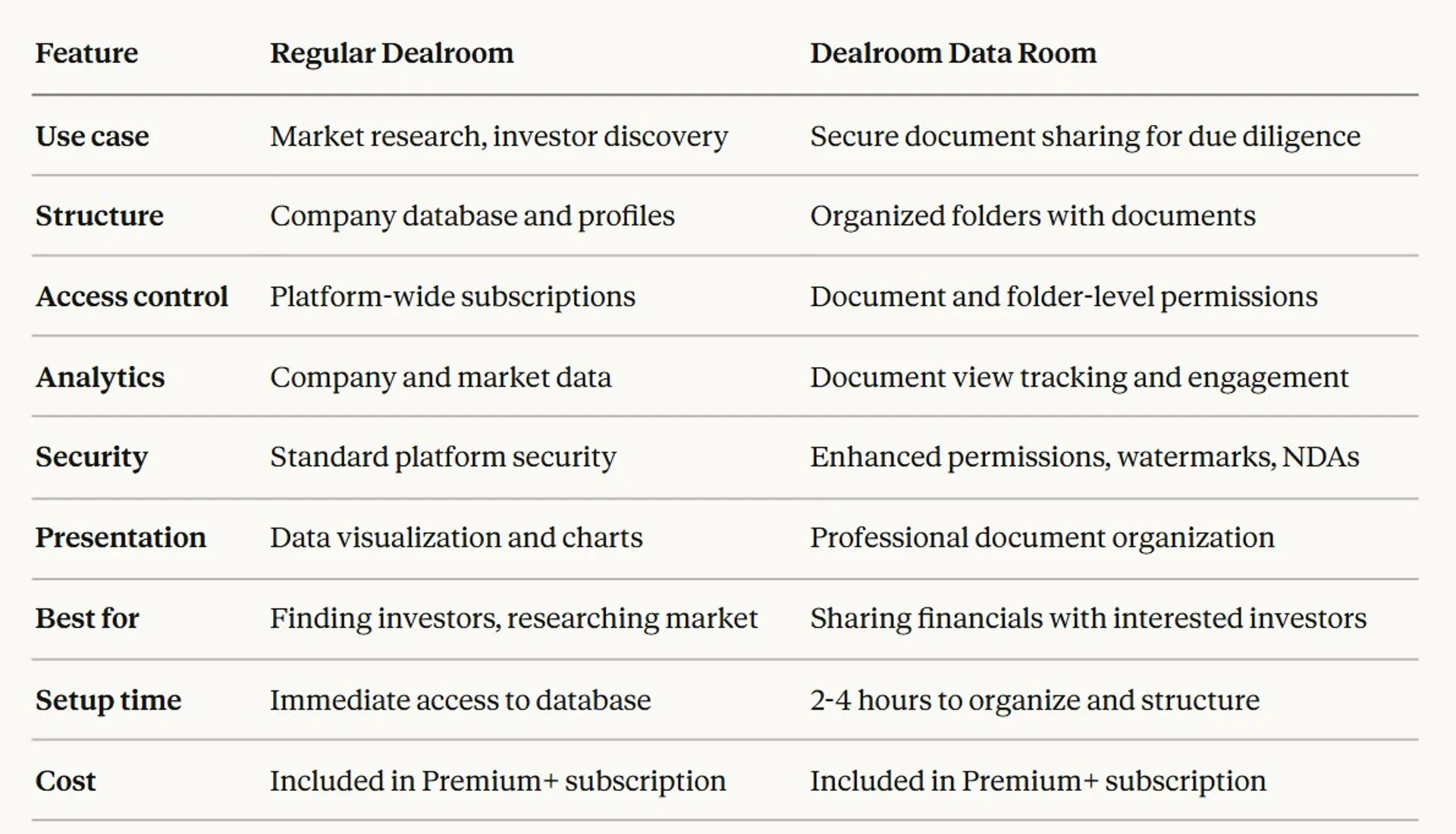
Dealroom data room vs regular Dealroom
Dealroom offers company profiles and data intelligence as their core product. The data room feature is an add-on for document sharing within that ecosystem. Here's how they differ.
Comparison table:

When to use regular Dealroom:
- Researching potential investors for your round
- Analyzing competitor funding and valuation data
- Building target lists for outreach
- Tracking VC firm portfolios and investment patterns
- Understanding market sizing and trends
When to use Dealroom data room:
- Investors have expressed serious interest and requested materials
- You need to share sensitive financials with multiple parties
- You want to track which documents investors review most
- You're managing due diligence for multiple concurrent conversations
- Professional presentation matters for credibility
The key difference:
Regular Dealroom helps you find and research investors. The data room helps you share documents with investors who are already interested. One is about discovery, the other is about due diligence.
Setting up a Dealroom data room
Opening:
Setting up a Dealroom data room requires organizing documents within their platform structure. Here's what the process actually involves.
Step-by-step process:
Step 1: Subscribe to Premium or Premium Plus
- Data room access requires minimum Premium plan (€12,500/year)
- Minimum 3 seats required
- Contact sales for enterprise access
Step 2: Access data room feature
- Navigate to data room section within your Dealroom account
- Create new data room project
- Name and configure basic settings
Step 3: Organize folder structure
- Create logical folder hierarchy (typically 6-10 main folders)
- Common structure: Financials, Legal, Product, Team, Customers, Metrics
- Add subfolders for specific document types
Step 4: Upload documents
- Upload files to appropriate folders
- Dealroom supports PDF, Excel, Word, PowerPoint
- Name files clearly and consistently
- Recommended total: 30-80 documents for typical Series A
Step 5: Configure permissions
- Set folder-level access controls
- Create user groups (Lead Investors, General Access, Limited Access)
- Define view-only vs download permissions
- Enable watermarking if needed
Step 6: Set up analytics
- Configure tracking for document views
- Set up notifications for access events
- Define reporting preferences
Step 7: Add users and send invitations
- Import investor contact information
- Assign permission levels
- Send customized invitation emails
- Include NDA requirements if needed
Step 8: Test access
- Log in as different user types to verify permissions
- Check document visibility and download restrictions
- Confirm analytics tracking works
Total setup time:
- Initial folder setup and document upload: 3-4 hours
- Permission configuration: 1-2 hours
- Testing and refinement: 1 hour
- Total first-time setup: 5-7 hours
Ongoing maintenance:
- Document updates: 15-30 minutes per update
- Adding new investors: 5-10 minutes per person
- Reviewing analytics: 15 minutes weekly
- Quarterly cleanup and reorganization: 2-3 hours
Dealroom data room pricing
Opening:
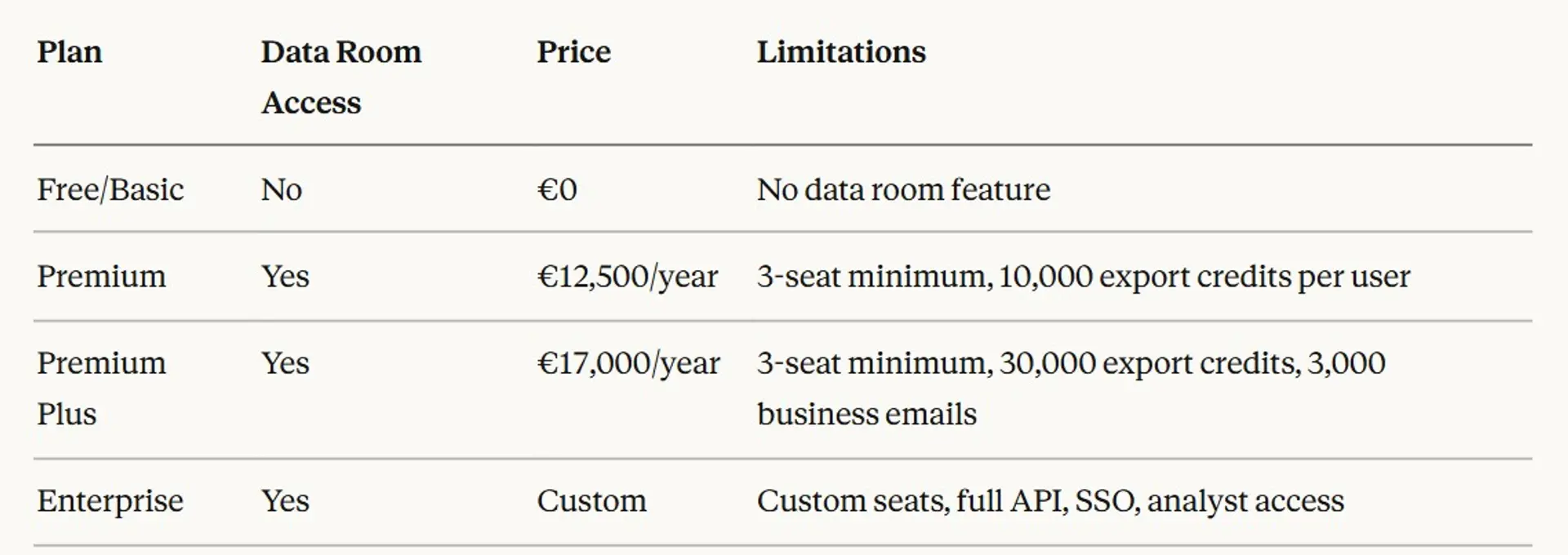
Dealroom doesn't offer standalone data room pricing. Access requires subscribing to their full platform, which starts at €12,500 per year with a three-seat minimum.
Plan availability
Which plans include data rooms:

Detailed pricing breakdown
Premium - €12,500/year
- Minimum 3 seats required = €37,500/year minimum
- €4,167 per seat per year (€347/month per seat)
- 10,000 export credits per user
- Email support only
- Access to Dealroom's full database and data room feature
- No CRM integration
Premium Plus - €17,000/year (Most Popular)
- Minimum 3 seats required = €51,000/year minimum
- €5,667 per seat per year (€472/month per seat)
- 30,000 export credits per user
- 3,000 business email credits
- CRM integration via Zapier or API
- Priority support
- Best value if you need the broader Dealroom platform
Enterprise - Custom pricing
- Pricing not publicly available
- Full API access for custom integrations
- MCP Server integration
- Custom seat count (can be higher or lower than 3)
- 2 hours analyst access per quarter
- SSO sign-in for larger teams
- Dedicated account management
Hidden costs to consider
Beyond base subscription:
Setup and training:
- No additional setup fees mentioned
- Training included with Premium Plus and Enterprise
- Self-service setup for Premium tier
User scaling:
- Adding seats beyond minimum 3 costs €12,500-17,000 per additional seat annually
- No month-to-month payment option
- Annual commitment required
Feature add-ons:
- Export credit overages may incur additional costs
- Business email credits limited to Premium Plus and above
- API access only with Enterprise (custom pricing)
Storage overages:
- Storage limits not publicly disclosed
- Likely included in Enterprise negotiations
Real cost examples
Startup raising Series A (5 users)
- Premium Plus: €17,000 × 5 seats = €85,000/year
- Includes data room + full Dealroom platform access
- Overkill if you only need document sharing
- Makes sense if you're actively using Dealroom for investor research
Company in M&A process (15 users)
- Enterprise custom pricing, likely €150,000-250,000/year
- Includes advanced security, SSO, API access
- Justifiable for multi-million dollar transactions
- Excessive for early-stage fundraising
Cost comparison with competitors


Dealroom's pricing reflects its positioning as a comprehensive VC intelligence platform, not a standalone data room. You're paying for market data, company databases, and investor tracking alongside document sharing.
Use cases for data rooms
Opening:
Data rooms make sense when document security, access control, and engagement tracking justify the setup effort and cost. Here are scenarios where they add real value.
1. Fundraising (Series A to Series C)
The scenario: You're raising €2-10M and speaking with 15-30 institutional investors simultaneously. Each investor requests different materials at different stages. Some need full financial access immediately, others start with high-level metrics.
Why a data room helps:
- Centralize all fundraising materials instead of sending individual emails
- Grant tiered access as conversations progress from initial interest to term sheet
- Track which investors spend time on financials vs product roadmap
- Update projections once and everyone sees current version
- Professional presentation signals operational maturity
What you'd include:
- Pitch deck and executive summary
- Three-year financial statements and monthly P&L
- Financial projections and unit economics model
- Cap table showing current ownership and option pool
- Product roadmap and technical architecture overview
- Customer contracts, pipeline, and cohort retention data
- Team bios, organizational chart, and key hire plans
- Legal documents (incorporation, IP assignments, material contracts)
- Previous investor updates and board materials
Example workflow: Create data room with three permission levels. Grant Level 1 (pitch deck, executive summary, high-level metrics) to all interested investors. Promote to Level 2 (full financials, customer data) after initial meetings. Grant Level 3 (legal docs, detailed contracts) only to investors in final diligence. Track engagement to identify who's actively reviewing vs passively interested.
Dealroom features that matter:
- Integration with Dealroom's investor database for quick user setup
- Folder-level permissions for staged access
- Analytics showing which investors review which documents
- Ability to watermark sensitive financials
2. M&A due diligence (seller side)
The scenario: You're selling your company for €10-50M. Multiple potential acquirers want access to detailed financials, customer contracts, employee agreements, and IP documentation. Each buyer has different timelines and focus areas.
Why a data room helps:
- Provide consistent document access to all buyers
- Track which areas each buyer focuses on during diligence
- Maintain audit trail of who accessed what and when
- Update documents without re-sending to multiple parties
- Protect sensitive information with watermarks and view-only access
What you'd include:
- Complete financial history (5+ years)
- All customer contracts and revenue breakdown
- Employee agreements, compensation, and equity grants
- IP assignments, patents, trademarks
- Material vendor and partnership agreements
- Insurance policies and claims history
- Tax returns and filings
- Product architecture and technical documentation
- Known liabilities and legal issues
Example workflow: Set up data room with full documentation before accepting LOIs. Grant initial access to qualified buyers after NDA signing. Create separate folders for different diligence workstreams (financial, legal, technical, HR). Monitor which buyers request additional documents or clarification. Use engagement data to gauge serious vs tire-kicker interest.
Dealroom features that matter:
- Granular permission controls for sensitive documents
- Audit trail for compliance and legal protection
- Ability to revoke access if deal falls through
- Download restrictions on confidential materials
3. Investor reporting and LP updates
The scenario: You're a VC fund manager reporting to 30+ limited partners quarterly. LPs want access to portfolio company updates, fund performance data, and capital call schedules. Different LP classes have different information rights.
Why a data room helps:
- Centralize quarterly reports and fund documents
- Provide always-current fund performance dashboard
- Grant tiered access based on LP share class
- Reduce email volume for routine document requests
- Professional presentation enhances LP experience
What you'd include:
- Quarterly fund performance reports
- Portfolio company updates and valuations
- Capital call notices and distribution schedules
- Fund formation documents and amendments
- Audited financial statements
- Tax documents (K-1s, schedules)
- Investment memos for new portfolio companies
- Exit summaries and proceeds distributions
Example workflow: Create data room with separate sections for each fund vintage. Upload quarterly reports on consistent schedule. Grant all LPs access to performance reports and distributions. Restrict detailed investment memos to LPs above certain commitment threshold. Use analytics to identify LPs who actively monitor vs passive investors.
Dealroom features that matter:
- Integration with Dealroom's portfolio tracking
- Scheduled notifications for new quarterly reports
- Permission tiers for different LP classes
- Professional presentation for institutional LPs
4. Board materials and governance
The scenario: You have a board of directors requiring secure access to board decks, financial reports, and strategic planning documents. Board members access materials on different schedules and from various devices. You need version control and access history.
Why a data room helps:
- Centralized board material archive
- Version control for deck iterations
- Mobile access for board members traveling
- Track which directors reviewed materials pre-meeting
- Maintain governance compliance with access logs
What you'd include:
- Board meeting decks and supporting materials
- Monthly financial reports and variance analysis
- Strategic plans and initiative updates
- CEO updates and operational metrics
- Risk registers and mitigation plans
- Compensation committee materials
- Audit committee reports
- Minutes from previous meetings
Example workflow: Upload board materials 72 hours before meetings. Send notification to all directors with access link. Track who reviews materials before vs after meeting. Archive all board materials for governance compliance. Revoke access for outgoing directors and grant to new board members.
Dealroom features that matter:
- Access logging for compliance
- Mobile-friendly document viewing
- Version history for deck iterations
- Secure sharing with external board members
5. Strategic partnership negotiations
The scenario: You're negotiating a significant partnership or joint venture. Both parties need to share sensitive product roadmaps, customer data, and financial projections. Multiple stakeholders on each side need different levels of access.
Why a data room helps:
- Mutual NDA compliance with access controls
- Track which stakeholders engage with materials
- Separate technical, financial, and legal workstreams
- Update shared materials as negotiations progress
- Professional presentation signals seriousness
What you'd include:
- Partnership proposal and business case
- Relevant financial projections and ROI models
- Product roadmaps and integration requirements
- Customer overlap analysis
- Technical architecture for integration
- Legal entity structures and governance proposals
- Key personnel bios for joint team
- Risk analysis and mitigation plans
Example workflow: Create mutual data room with both parties uploading materials. Grant technical teams access to integration documentation. Limit financial projections to executive stakeholders. Track engagement to identify blockers or concerns. Update terms and models as negotiations progress.
Dealroom features that matter:
- Two-way sharing capability
- Separate permission groups for different workstreams
- Analytics on partner engagement patterns
- Document versioning as terms evolve
6. Regulatory compliance and audit preparation
The scenario: You're preparing for regulatory audit or compliance review. Auditors need access to specific document categories. You need to demonstrate organized record-keeping and provide audit trail of access.
Why a data room helps:
- Organized document categorization for auditor requests
- Access logs demonstrating compliance procedures
- Controlled sharing with external audit teams
- Version control for policy and procedure documents
- Professional presentation to regulators
What you'd include:
- Compliance policies and procedures
- Employee training records and certifications
- Financial controls documentation
- Customer data handling procedures
- Security audits and penetration test results
- Incident response logs and remediation
- Vendor risk assessments
- Internal audit findings and responses
Example workflow: Organize documents by compliance category before audit notice. Grant auditor access to requested categories only. Track which documents auditors review most. Respond to document requests by expanding folder access. Maintain complete access log for compliance demonstration.
Dealroom features that matter:
- Granular folder permissions for specific audit requests
- Complete audit trail of document access
- Secure external sharing with audit firms
- Professional organization demonstrating compliance
7. Syndicated investment rounds
The scenario: You're raising a round with a lead investor and 5-10 syndicate members. Each investor has different diligence requirements and timelines. Some focus on financials, others on product-market fit or team.
Why a data room helps:
- Single source of truth for all syndicate members
- Prevent version confusion with multiple email threads
- Track which investors complete diligence
- Lead investor can monitor syndicate progress
- Staged access as syndicate confirms participation
What you'd include:
- Complete pitch deck and appendix slides
- Financial model and assumptions documentation
- Customer interviews and reference contacts
- Product demo access and technical overview
- Competitive analysis and market sizing
- Team backgrounds and reference contacts
- Term sheet and deal structure
- Timeline for closing and wire instructions
Example workflow: Lead investor gets full access immediately. Grant syndicate members access after lead confirms term sheet. Track which syndicate members review materials vs rely on lead diligence. Identify members who need specific questions answered. Close access after funding closes.
Dealroom features that matter:
- Easy user management for syndicate additions
- Analytics showing syndicate engagement levels
- Lead investor can see syndicate member activity
- Timed access grants aligned with funding milestones
8. Employee equity and 409A documentation
The scenario: You provide employees access to equity documentation, option grants, and 409A valuations. Employees need to understand their equity but shouldn't access company-wide cap table details.
Why a data room helps:
- Secure distribution of individualized equity grants
- Centralized access to 409A valuations and methodology
- Employee self-service reduces HR workload
- Audit trail of equity document distribution
- Easy updates when new grants issued
What you'd include:
- Individual option grant letters
- Stock option plan documentation
- 409A valuation reports (sanitized)
- Exercise procedures and instructions
- Tax implications guides
- Vesting schedules
- Company valuation FAQs
- Contact info for equity questions
Example workflow: Create individual folders for each employee with personalized grants. Upload company-wide equity education materials to shared folder. Grant employees access only to their specific folder plus shared resources. Update 409A valuation documentation after each new valuation. Send notifications when new documents added.
Dealroom features that matter:
- Individual permission controls per employee
- Secure distribution of sensitive personal information
- Version control for updated grant documents
- Employee self-service access reduces admin work
Dealroom data room limitations
Opening:
Dealroom data rooms work well within their ecosystem but have constraints worth understanding before committing to €37,500+ annually.
Key limitations
1. Not a standalone product You can't buy just the data room. You're purchasing Dealroom's full VC intelligence platform. If you only need document sharing for fundraising, you're paying for market data, investor databases, and analytics you may not use.
2. Minimum three-seat requirement Even solo founders raising capital must purchase three seats at €12,500-17,000 each. That's €37,500-51,000 minimum annual commitment. No option to start with one seat and scale up.
3. Annual commitment only Dealroom requires annual contracts. No monthly payment option. If you close your round in three months, you've paid for nine months of unused access.
4. Limited to Dealroom ecosystem The data room works best when both you and your investors use Dealroom. Investors unfamiliar with the platform face learning curve. Not ideal if your target investors prefer other systems.
5. Feature access depends on tier CRM integration requires Premium Plus (€51,000 minimum). API access requires Enterprise (custom pricing). You can't add specific features à la carte.
6. Export credit system can be confusing Premium includes 10,000 export credits per user. Not immediately clear what consumes credits or how to manage usage. Easy to hit limits during active fundraising.
7. No free trial for data room testing You can't test the data room functionality before committing to annual subscription. Demo available through sales but not hands-on testing with your documents.
8. Overkill for simple fundraising If you're raising a €500K pre-seed round from angels, Dealroom's enterprise features and pricing don't match the use case. Built for institutional rounds.
9. Storage limits unclear Public pricing doesn't specify storage capacity. Likely need to negotiate with Enterprise for large document volumes.
10. Learning curve for setup While powerful, the platform has complexity. First-time setup takes 5-7 hours. Not "upload and share in 20 minutes" simple.
11. Mobile experience secondary Dealroom is desktop-first platform. Mobile access exists but not optimized for investors reviewing documents on phones during travel.
12. Limited document editing Data rooms are view-only for shared documents. Can't collaborate on edits within platform. Need to edit externally and re-upload.
When these limitations matter:
- You're pre-seed or seed stage with limited budget
- You need data room for 2-3 months, not full year
- Your investors don't use Dealroom platform
- You want to test before committing €37,500+
- You're solo founder needing just one seat
- You need simple document sharing, not full VC intelligence platform
When these limitations don't matter:
- You're Series A+ with institutional investors
- You actively use Dealroom for investor research already
- Budget supports €50,000+ annual tools
- Your investors are Dealroom-native VCs
- You need the broader platform features beyond data room
- You're raising multiple rounds over several years
Alternatives to Dealroom data room
Opening:
Several alternatives provide data room functionality without requiring €37,500+ annual commitments or three-seat minimums. Here's how they compare.
Ellty - Virtual data rooms for startups


What it offers:
Ellty provides purpose-built data rooms for startup fundraising and due diligence. Upload documents, create organized folders, share secure links with investors, and track engagement. No complex setup, no forced seat minimums, no annual contracts.
Key features:
- Unlimited data rooms on all paid plans
- Document-level analytics showing view time and engagement
- Customizable folder structure for due diligence materials
- Secure link sharing with optional NDA requirements
- Real-time notifications when investors access materials
- Mobile-optimized viewing for investors
- Custom branding on Business plan
- No per-user fees or seat minimums
Pricing:
- Free plan: Document tracking, real-time analytics, secure sharing — free forever
- Standard ($69/month): Unlimited documents, advanced analytics, eSignatures, data rooms, custom branding
- Data Room ($149/month): Granular permissions, NDA gating, dynamic watermarking, restricted visitor access, 3 users included
- Data Room Plus ($349/month): Group visitor permissions, audit logs, 4,000 assets per data room
No forced annual contracts. No minimum seats. Cancel anytime.
Best for:
- Startups raising capital
- Founders who need data room quickly without multi-week setup
- Teams with 1-5 people managing fundraising
- Companies wanting to test data room functionality before major commitment
- Budget-conscious startups extending runway
Compared to Dealroom:


When to choose Ellty:
- You need data room functionality today, not after three-month procurement
- €37,500 annual spend doesn't fit current budget
- You're raising €500K-5M, not €10M+ institutional round
- Your investors don't use Dealroom ecosystem
- You want to test data room approach before major commitment
- Simple, focused tool preferable to complex platform
- You're a solo founder or small team (1-3 people)
DocSend - Document tracking and analytics
What it offers:
DocSend focuses on document sharing with detailed page-by-page analytics. Track exactly which pages investors view, how long they spend, and whether they download. Commonly used for pitch decks and fundraising materials.
Key features:
- Page-level analytics for presentations
- Time-spent tracking per document
- Email verification before access
- NDA requirements and e-signatures
- Link expiration controls
- Watermarking on Enterprise plans
Pricing:
- Personal: $15/month (limited features)
- Standard: $50/month per user
- Advanced: $165/month per user
- Enterprise: Custom pricing
Best for:
- Tracking pitch deck engagement in detail
- Understanding which slides investors care about
- Founders who want granular analytics
- Companies sending hundreds of documents to different recipients
When to choose over Dealroom:
- You need detailed page-by-page analytics
- Budget supports $50-165/month per user vs €12,500/year
- Focus is pitch decks and presentations more than full due diligence
- You don't need Dealroom's broader VC intelligence platform
Carta - Cap table management with data room
What it offers:
Carta is primarily cap table management software that includes data room functionality. If you're already using Carta for equity management, their data room integrates with your cap table and ownership data.
Key features:
- Data room integrated with cap table
- Automated investor updates from cap table data
- 409A valuations included
- Stakeholder portal for investors and employees
- Fundraising pipeline management
Pricing:
- Starts around $2,000-5,000/year depending on company stage
- Additional fees for 409A valuations
- Scales with company complexity and round size
Best for:
- Companies already using Carta for cap table
- Startups wanting integrated equity and fundraising tools
- Teams needing 409A valuations alongside data room
When to choose over Dealroom:
- You need cap table management anyway
- You want integrated equity and fundraising workflow
- Budget supports $2,000-5,000/year vs €37,500/year
- You don't need Dealroom's VC intelligence features
Caplinked - Dedicated VDR platform
What it offers:
Caplinked is purpose-built virtual data room software for M&A, fundraising, and due diligence. More enterprise-focused than Ellty but more accessible than Dealroom's pricing.
Key features:
- Enterprise-grade security and encryption
- Granular permission controls
- Audit trails and compliance reporting
- Bulk document upload
- Q&A management for due diligence
- Customizable watermarks
Pricing:
- Starter: $99/month per user
- Professional: Custom pricing (typically $3,000-5,000 annually)
- Enterprise: Custom pricing
Best for:
- Later-stage M&A transactions
- Companies requiring enhanced security certifications
- Due diligence with complex permission requirements
- Teams managing multiple concurrent deals
When to choose over Dealroom:
- You need dedicated VDR without broader platform
- M&A focus vs fundraising focus
- Budget supports $3,000-5,000/year vs €37,500/year
- You don't use or need Dealroom's VC database
Dropbox or Google Drive with structured folders
What it offers:
Standard cloud storage with manually organized folder structure. Not purpose-built for data rooms but functional for basic document sharing needs.
Key features:
- Familiar interface most people already use
- Simple folder sharing with permissions
- Basic access controls
- Version history
- Commenting and collaboration
Pricing:
- Google Workspace: $6-18/month per user
- Dropbox Business: $15-25/month per user
Best for:
- Very early stage companies (pre-seed, friends and family)
- Extremely limited budgets
- Investors who just need basic document access
- Temporary solution before investing in purpose-built tool
When to choose over Dealroom:
- You're raising under €250K from angels
- Investors aren't requesting formal data room
- Zero budget for specialized tools
- You need something functional immediately
Limitations vs purpose-built data rooms:
- No analytics on document engagement
- No watermarking or advanced security
- Manual permission management
- No investor-specific features
- Looks less professional to institutional investors
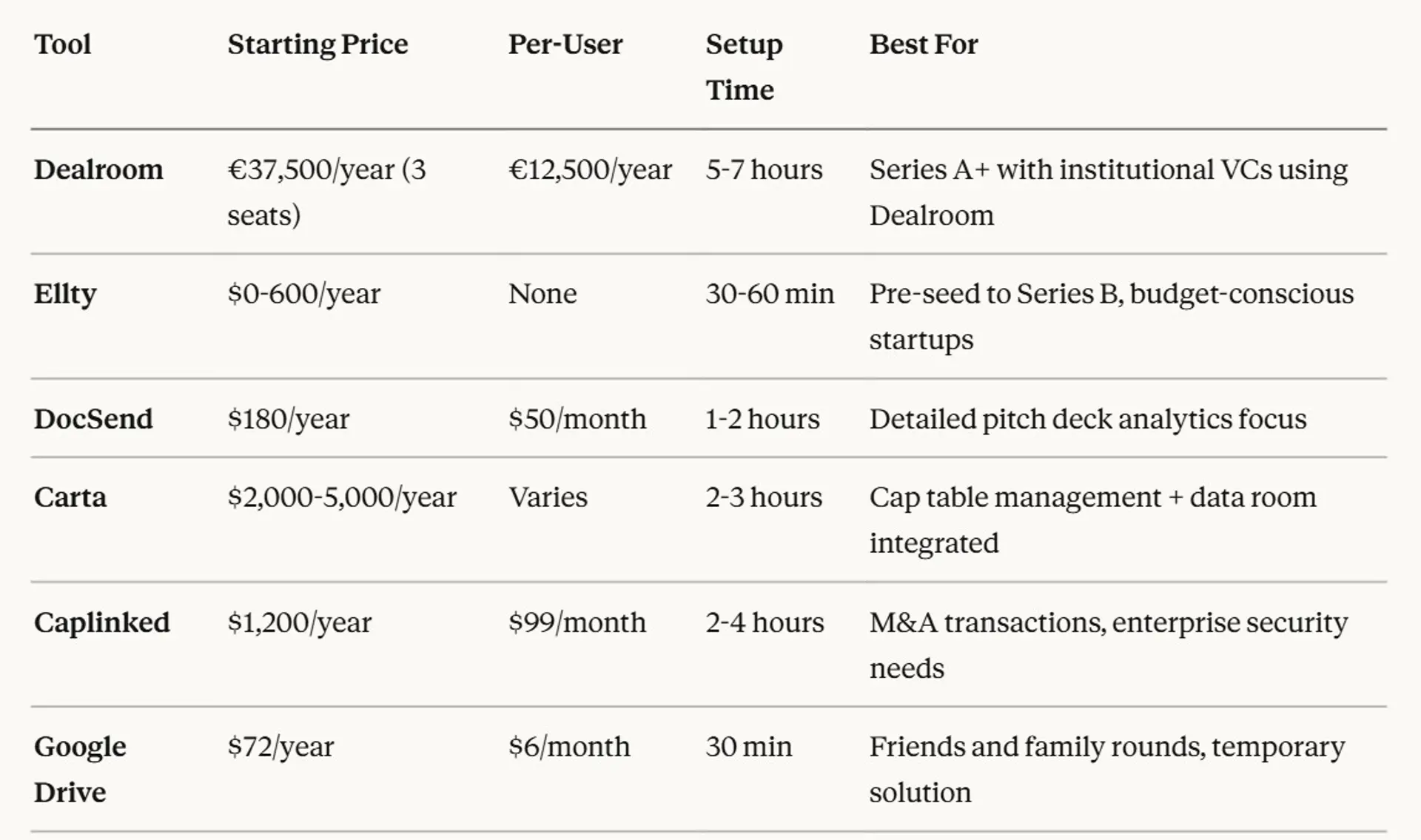
Quick comparison table

Choosing the right alternative
Choose Ellty if: You're raising, need data room quickly, want to avoid annual contracts and seat minimums, prefer simple over complex, and budget is under $5,000/year for fundraising tools.
Choose DocSend if: Page-by-page analytics matter more than folder organization, you send many different documents to different recipients, you want to understand pitch deck engagement deeply, and budget supports $50-165/month per user.
Choose Carta if: You need cap table management anyway, integrated equity and fundraising workflow appeals, you want 409A valuations included, and budget supports $2,000-5,000/year for combined tools.
Choose Caplinked if: You're managing M&A transaction not fundraising, enhanced security certifications required, complex permission structures needed, and budget supports $3,000-5,000/year for dedicated VDR.
Stick with Dealroom if: You're Series A+ raising from institutional VCs, your investors actively use Dealroom platform, you need the VC intelligence features beyond just data room, budget easily supports €37,500+ annually, and integrated platform approach outweighs cost.
Use Google Drive if: You're raising under €250K from angels, investors aren't requesting formal data room, you have zero budget for specialized tools, and you need functional access immediately.
Is Dealroom data room right for you?
Opening:
Dealroom data rooms make sense for specific situations. Here's how to determine if the €37,500+ annual commitment fits your needs.
Choose Dealroom data room if:
- You're raising Series A or later from institutional VCs
- Your target investors already use Dealroom's platform actively
- You need the full VC intelligence platform, not just data room
- Budget comfortably supports €37,500-51,000 minimum annual spend
- You have 3+ team members who'll use the platform
- You're raising multiple rounds over 2-3 years
- Integration with VC ecosystem database adds value
- Professional presentation to Dealroom-native investors matters
- You want combined market research and due diligence tools
- Your investors specifically request Dealroom access
- You're managing ongoing investor relations, not just one round
- Company stage and funding justify enterprise tool investment
Look at alternatives if:
- You're pre-seed or seed stage with limited budget
- You need data room for single 2-3 month fundraising process
- €37,500+ annual cost doesn't fit current runway
- You're solo founder or 1-2 person team (forced 3-seat minimum wasteful)
- Your investors don't use Dealroom platform
- You need simple document sharing, not full VC intelligence
- You want to test data room approach before major commitment
- Monthly flexibility preferable to annual lock-in
- You're raising from angels or early-stage funds
- Setup complexity and learning curve concern you
- You need data room operational in days, not weeks
- You don't need export credits, business emails, or market data features
Decision framework
Ask yourself:
About your use case:
- Are you raising Series A+ from institutional investors? (Yes = Dealroom consideration)
- Do your target investors actively use Dealroom? (Yes = Dealroom advantage)
- Will you use Dealroom's market data and investor database features? (No = probably overbuying)
- Are you raising one round or multiple rounds over 2+ years? (Multiple = better ROI)
About your team:
- Do you have 3+ people who'll actively use the platform? (No = wasting seats)
- Can someone dedicate 5-7 hours to proper initial setup? (No = consider simpler tools)
- Is your team comfortable with complex enterprise software? (No = learning curve issue)
About your budget:
- Can you commit €37,500-51,000 annually without straining runway? (No = look elsewhere)
- Would €37,500 be better spent on other growth activities? (Possibly = reconsider)
- Does your current or projected funding round justify this investment? (Seed round raising €500K = probably not)
About timing:
- Do you need data room functional this week? (Yes = Dealroom too slow to set up)
- Can you commit to annual contract even if you close round in 3 months? (No = wasteful)
- Are you willing to go through sales process and demos? (No = consider self-serve tools)
Honest recommendation
Dealroom data rooms excel when you're Series A+ stage, raising from institutional VCs who use Dealroom, and need the broader platform features beyond document sharing. The €37,500+ price makes sense if you're actively using the VC intelligence, market data, and investor database features.
For earlier-stage companies raising pre-seed to seed rounds, or founders who only need secure document sharing for 2-3 months of fundraising, the cost and complexity don't match the use case. You'll get 90% of the benefit at 5% of the cost with tools like Ellty, DocSend, or even well-organized Google Drive folders.
The three-seat minimum is the biggest constraint for small teams. If you're a solo founder or two-person team, you're forced to pay for unused seats. That's €25,000-34,000 annually for seats sitting empty.
Dealroom works best as part of your permanent infrastructure for investor relations and market intelligence, not as a temporary solution for a single fundraising process. If you're building long-term investor relationships and actively research the VC ecosystem, the integrated platform justifies the investment. If you just need to share pitch decks and financials for three months, look at focused alternatives.
Frequently asked questions
Does Dealroom offer standalone data room pricing?
No. Dealroom data rooms are included with Premium (€12,500/year per seat) and Premium Plus (€17,000/year per seat) subscriptions. You must purchase the full platform to access data room functionality. Minimum three seats required, so actual minimum annual cost is €37,500-51,000.
Can I try Dealroom data room before committing?
Dealroom offers demos through their sales team but not hands-on free trials. You can see the data room functionality in a demo but can't test with your actual documents before purchasing. This differs from tools like Ellty that offer free tiers for testing.
What's the difference between Premium and Premium Plus for data rooms?
Both include data room access. Premium Plus (€17,000/year per seat) adds CRM integration via Zapier or API, 3,000 business email credits, 30,000 export credits per user (vs 10,000), and priority support. For data room functionality specifically, the differences are minimal. Premium Plus makes sense if you need CRM integration or higher export limits.
How long does Dealroom data room setup take?
Initial setup takes 5-7 hours for someone familiar with data rooms. This includes organizing folder structure, uploading 30-80 documents, configuring permissions, setting up analytics, and testing access. Ongoing maintenance requires 15-30 minutes per document update and 15 minutes weekly for analytics review.
Can investors access Dealroom data room from mobile devices?
Yes, but Dealroom is desktop-first platform. Mobile access exists and works but isn't optimized for investors reviewing detailed financial documents on phones. Investors traveling or reviewing materials between meetings may find mobile experience less smooth than purpose-built mobile-optimized tools.
What security features does Dealroom data room include?
Dealroom provides folder and document-level permissions, access logging, user authentication, and view-only restrictions. Watermarking available on certain plans. Download controls prevent unauthorized sharing. Audit trails track who accessed which documents when. Security certifications not publicly detailed on standard pricing tiers.
How many documents can I upload to Dealroom data room?
Storage limits aren't specified on public Premium or Premium Plus pricing. Likely included in annual subscription up to reasonable limits. Large document volumes or special storage needs probably require Enterprise tier negotiation. Typical Series A data room (30-80 documents, mostly PDFs) should fit within standard limits.
Can I customize branding on Dealroom data room?
Branding customization availability depends on plan tier. Likely limited on Premium, more options on Premium Plus, full customization on Enterprise. Not as central feature compared to Dealroom's focus on data and analytics. Check with sales if white-labeling or extensive brand customization required.
What happens to my data room if I cancel Dealroom subscription?
You should download all documents before canceling. Dealroom likely provides some grace period for data export but won't maintain data room access after subscription ends. Unlike tools with free tiers (where documents persist), Dealroom data room access terminates with subscription. Plan document migration before canceling.
Does Dealroom integrate with cap table management tools?
Not directly. Dealroom focuses on VC intelligence and deal flow. For cap table integration, tools like Carta offer combined cap table and data room functionality. You'd need to manually coordinate between Dealroom data room and separate cap table tool like Carta or Pulley.
Can I share Dealroom data room with investors who don't use Dealroom?
Yes. You can invite external users who don't have Dealroom subscriptions. They create guest accounts to access your specific data room. However, the experience works best when investors are already Dealroom users familiar with the platform. Unfamiliar investors face learning curve.
How does Dealroom data room compare to Carta or DocSend?
Dealroom positions as comprehensive VC platform with data room as one feature. Carta focuses on cap table management with integrated data room. DocSend specializes in document tracking and analytics. Dealroom costs €37,500+ minimum vs Carta $2,000-5,000 vs DocSend $600-2,000 annually. Choose based on whether you need broader platform (Dealroom), cap table integration (Carta), or focused document analytics (DocSend).
Need affordable data room for your fundraising?
Ellty offers data rooms starting at $69/month with no seat minimums or annual contracts. Upload documents, track investor engagement, and share securely without the €37,500+ commitment.
Author

Anika Tabassum Nionta is a Content Manager at Ellty, where she writes about secure document sharing, virtual data rooms, M&A, due diligence, fundraising, and sales enablement. With over 6 years of writing experience, she helps professionals understand how to share confidential documents securely, track engagement, and manage deals more effectively. Anika holds both a BA and MA in English from Dhaka University. Outside of work, she enjoys reading, exploring new cafes in Dhaka, and connecting with entrepreneurs and dealmakers in her community.

