
Need document tracking that actually works?
You send pitch decks, proposals, or sales materials. Then nothing. You don't know if anyone opened them. You don't know which pages they read. You're just guessing when to follow up.
Document tracking tools fix this. They show you exactly who viewed your documents, which pages they spent time on, and when they opened them. No more sending files into a void.
Orangedox is one option in this space. It's a Dropbox-based document tracking platform that helps you share files and see analytics. But it's not the only choice, and it won't fit everyone.
This guide explains what Orangedox actually is, how it works, what it costs, and when you should consider alternatives.
What is Orangedox?


Orangedox is a document tracking and analytics platform built on top of Dropbox. It lets you share files from your Dropbox account with trackable links, then shows you who viewed them and how they engaged.
Think of it as a layer you add to Dropbox. You still store files in Dropbox, but Orangedox handles sharing and tracking. When someone opens your document through an Orangedox link, you get real-time notifications and detailed analytics.
Core functionality
What Orangedox does:
Orangedox turns static Dropbox files into trackable documents. You select a file from Dropbox, create a secure link through Orangedox, and share that link instead of a regular Dropbox link. The recipient opens the document in their browser through Orangedox's viewer.
Document sharing:
Files open in a branded web viewer. You can customize this viewer with your logo and colors. Recipients don't need to download anything or create an account. They just click the link and view the document.
Tracking and analytics:
You see when someone opens your link, how long they spend on each page, and which sections they revisit. Orangedox sends real-time email notifications when someone views your document. The analytics dashboard shows engagement metrics across all your shared documents.
Access control:
You can require email verification before someone views a document. You can set expiration dates on links. You can disable downloads or add watermarks. You can revoke access to a link at any time.
Use cases:
Sales teams use it to track proposal engagement. Recruiters share job descriptions and see which candidates actually read them. Founders send pitch decks and know which investors spent time reviewing. Consultants share reports and track client engagement.
What makes Orangedox different
Different from email attachments:
Email attachments disappear into inboxes. You can't update them after sending. You can't see if anyone opened them. Orangedox links stay current, track opens, and let you update the underlying file.
Different from Google Drive or Dropbox:
Standard file sharing shows you if someone downloaded a file, but not if they actually looked at it. Orangedox shows page-by-page engagement. You know which parts of a 30-page deck someone actually read.
Different from enterprise document management:
Enterprise DMS systems like SharePoint focus on internal collaboration and version control. Orangedox focuses on external sharing and tracking engagement. It's lighter, faster to set up, and designed for sharing outside your organization.
Market position
Orangedox targets individuals and small teams who already use Dropbox and need basic document tracking. It's not trying to be a full data room or replace enterprise systems. It solves one specific problem: seeing who engaged with files you shared from Dropbox.
How Orangedox works
Using Orangedox is straightforward if you already have Dropbox. The whole system runs through your existing Dropbox account.
Step-by-step process
1. Connect your Dropbox account
You authorize Orangedox to access your Dropbox files. This is a one-time setup. Orangedox uses Dropbox's API to read files from folders you specify. Your files stay in Dropbox.
2. Select a document to share
You browse your Dropbox folders inside Orangedox and pick the file you want to share. Orangedox supports PDFs, presentations, spreadsheets, images, and videos. Most people share PDFs.
3. Configure sharing settings
You choose whether to require email verification, set an expiration date, allow or block downloads, and customize the viewer appearance. You can add your logo and brand colors.
4. Generate a trackable link
Orangedox creates a unique URL for this document. This link opens the file in Orangedox's web viewer. You copy this link and share it however you want - email, LinkedIn, text message, wherever.
5. Monitor engagement
When someone clicks your link, Orangedox tracks the session. You see when they opened it, how long they viewed it, which pages they looked at, and whether they downloaded it. You get email notifications in real time.
6. Review analytics
The dashboard shows all your shared documents and their analytics. You can see engagement trends, compare performance across documents, and identify your most engaged recipients.
Additional features
Data rooms (on all plans):
Orangedox offers virtual data rooms on all plans. These are secure spaces where you organize multiple documents for due diligence or investor reviews. Recipients get one link to access everything, and you control permissions per folder.
Integrations:
Orangedox integrates with HubSpot, Salesforce, and Zapier. You can push tracking events to your CRM automatically. The integrations are basic but functional for logging views and downloads.
Team collaboration:
On team plans, multiple users can share the same Orangedox account. You can see what your teammates shared and track engagement across your whole team. There's basic permission management.
Typical workflows
Sales team workflow: Sales rep saves proposal in Dropbox. Creates Orangedox link with email verification. Sends link to prospect. Gets notification when prospect opens it. Sees prospect spent 8 minutes on pricing page. Follows up the next day referencing specific sections.
Investor outreach workflow: Founder uploads pitch deck to Dropbox. Creates separate Orangedox links for each investor. Shares links via email. Tracks which investors actually reviewed the deck. Sees which slides each investor spent time on. Prioritizes follow-up based on engagement.
What are the limitations of Orangedox?
Orangedox works well for basic document tracking from Dropbox, but it has real constraints you should know about.
No tool is perfect. Orangedox makes specific tradeoffs that matter depending on what you need.
Requires Dropbox or Google Drive
The issue: Orangedox only works with files stored in Dropbox, and Google Drive. You must have an active Dropbox or Google account.
Why it matters: If your team uses Microsoft 365, you'll need to maintain a separate Google Workspace or Dropbox account just for Orangedox. This creates workflow friction and duplicate file storage.
Who this affects: Teams standardized on non-Dropbox ecosystems, companies with strict file storage policies, anyone who doesn't want to manage multiple cloud storage accounts.
Limited file format support
The issue: Orangedox works best with PDFs. Other formats like Word docs, Excel files, and PowerPoint presentations get converted to PDF for viewing. The viewer doesn't support interactive elements or complex formatting.
Why it matters: If you share spreadsheets with formulas or presentations with animations, recipients see a static PDF version. They lose interactivity. Complex documents may not render correctly.
Who this affects: Anyone sharing interactive content, teams that rely on native Office formats, users who need recipients to see exact formatting.
Basic analytics compared to specialized tools
The issue: Orangedox shows you basic metrics - who viewed, when, which pages, how long. It doesn't track scroll depth, heatmaps, rewatches, or advanced engagement signals. The analytics interface is functional but not sophisticated.
Why it matters: You get enough data to know if someone engaged, but not deep behavioral insights. If you need detailed funnel analysis or A/B testing, Orangedox won't provide it.
Who this affects: Sales teams wanting detailed engagement scoring, marketers running content experiments, anyone who needs granular analytics for optimization.
Dropbox integration dependency
The issue: If Dropbox's API has issues, Orangedox breaks. If you lose Dropbox access, you lose Orangedox access. You're dependent on two services working together instead of one self-contained platform.
Why it matters: You have two potential failure points. Troubleshooting issues requires figuring out whether the problem is Dropbox, Orangedox, or the connection between them.
Who this affects: Teams needing high reliability, users in regions where Dropbox access is restricted, anyone preferring self-contained tools.
No offline access
The issue: Recipients must view documents through Orangedox's online viewer. There's no offline viewing option unless you enable downloads, which defeats tracking purposes.
Why it matters: If someone's internet connection is poor or they're traveling, they can't reliably view your documents. This creates friction in the sharing process.
Who this affects: Anyone sharing with recipients in low-connectivity areas, international deals across regions with varying internet quality.
When limitations become dealbreakers
These limitations become serious problems when you're using non-Dropbox storage, sharing complex interactive documents, need advanced analytics, have a growing team (cost scaling), require guaranteed uptime, or frequently share with people in low-connectivity situations.
For basic PDF tracking from Dropbox with a small team, these limitations usually don't matter much.
Who uses Orangedox?
Orangedox serves specific user types who share documents externally and want to track engagement without enterprise complexity.
Most Orangedox users already have Dropbox and need simple tracking on top of it.
Sales professionals and teams
Who they are: Individual sales reps, sales teams at small to mid-size companies, account executives sending proposals and contracts.
How they use Orangedox: They save sales proposals in Dropbox, create trackable Orangedox links, send to prospects, and monitor engagement. They see when prospects open proposals and which pricing sections get attention. They time follow-ups based on viewing activity.
Why it works for them: They get notifications when hot prospects engage. They can reference specific pages in follow-up conversations. They track proposal performance across deals. The Dropbox integration fits their existing workflow.
Example scenario: An account executive sends a 20-page proposal. She gets notified when the prospect opens it at 2pm. Analytics show he spent 5 minutes on the pricing page and 3 minutes on case studies. She follows up the next morning referencing those specific sections, showing she knows what he cares about.
Startup founders fundraising
Who they are: Early-stage founders pitching investors, entrepreneurs sending decks to VCs and angels, founders managing due diligence.
How they use Orangedox: They store pitch decks in Dropbox, create unique links for each investor, track which investors actually review materials, and see which slides capture attention. During due diligence, they use data rooms to organize all investor materials.
Why it works for them: They know which investors are seriously interested versus who's just collecting decks. They can see if an investor spent 30 seconds or 30 minutes on their pitch. They get real-time alerts when investors review materials before meetings.
Example scenario: A founder sends her deck to 50 investors. Analytics reveal that 12 actually opened it, and 4 spent over 10 minutes reviewing. She focuses follow-up on those 4 engaged investors instead of chasing people who never looked.
Recruiters and HR professionals
Who they are: Recruiters at staffing agencies, in-house talent acquisition teams, HR managers sharing offer letters and onboarding materials.
How they use Orangedox: They share job descriptions, employee handbooks, offer letters, and onboarding documents. They track which candidates opened job details and which new hires reviewed onboarding materials.
Why it works for them: They see which candidates are seriously interested by tracking who actually reads job descriptions. They can confirm new hires received and reviewed important documents. They streamline document distribution.
Example scenario: A recruiter shares a detailed job description with 15 candidates. Five never open it. Ten open it, but only three spend more than 2 minutes reading. The recruiter focuses interview scheduling on the three engaged candidates.
Consultants and agencies
Who they are: Independent consultants, small agencies, professional services firms delivering client reports and proposals.
How they use Orangedox: They share strategy documents, research reports, audit findings, and project proposals with clients. They track whether clients reviewed materials before meetings.
Why it works for them: They know if clients actually read reports before calls. They can adjust meetings based on what clients focused on. They look professional with branded document viewers. They maintain control over sensitive client materials.
Example scenario: A consultant sends a 40-page strategy report before a client call. Analytics show the client only viewed the executive summary. The consultant adjusts the meeting agenda to walk through key findings the client missed, making better use of meeting time.
Company sizes
Orangedox fits individuals and small teams (1-10 people) best. It works for some mid-size teams (10-50 people), but cost scaling becomes an issue. Large enterprises rarely use Orangedox and they typically need enterprise features Orangedox doesn't offer.
Industries
Common industries include SaaS sales, financial services, real estate, recruiting, consulting, legal services, and startups. Any industry that shares sensitive documents externally and needs to track engagement can use Orangedox.
When Orangedox is NOT the right fit
Orangedox doesn't work well if you don't use Dropbox, or Google Drive. It's not ideal for teams needing advanced analytics or complex permission structures. It's expensive for larger teams. It won't suit you if you need offline access or if you share primarily interactive documents that lose functionality in PDF conversion.
If you need a full virtual data room with granular permissions, enterprise security certifications, or white-label capabilities, Orangedox probably won't meet your requirements.
Orangedox pricing & plans
Orangedox uses flat subscription pricing. There's no free tier, but plans are straightforward. You pay a fixed monthly or annual rate, and the number of admin seats is set per plan. Viewers and recipients don't need licenses, so you're not paying per person who receives or views a document.
Quick Pricing Overview
Orangedox has three plans: Starter, Business, and Teams.
- Starter — $75/month (monthly) or $55/month (billed yearly) — includes 1 admin seat
- Business — $95/month (monthly) or $65/month (billed yearly) — includes 2 admin seats
- Teams — $195/month (monthly) or $135/month (billed yearly) — includes 5 admin seats
Annual billing discounts are clearly listed on their pricing page, no need to contact sales.
Detailed Plan Breakdown
Starter Plan — $55/month (annual) / $75/month (monthly) 1 admin seat included
What you get: Unlimited document shares, full analytics, email notifications, email verification, download control, expiration dates, watermarks, custom branding, Google Drive and Dropbox integration, virtual data rooms, priority support.
Good for: Solo consultants, individual sales reps, recruiters, or founders who need solid document tracking on their own.
Limitations: Only 1 admin seat. Analytics history limited to 6 months. Not suited for teams that need multiple people managing documents.
Business Plan — $65/month (annual) / $95/month (monthly) 2 admin seats included
What you get: Everything in Starter, plus 2 admin seats, shared analytics dashboard, team document library, and admin controls.
Good for: Small partnerships, co-founders, or tiny sales teams where 2 people manage documents.
Limitations: Only 2 admin seats. Analytics retained for up to 2 years. If you need more admins, you'll need to move up to Teams.
Teams Plan — $135/month (annual) / $195/month (monthly) 5 admin seats included
What you get: Everything in Business, plus 5 admin seats, virtual data rooms, advanced permissions, CRM integrations (Salesforce, HubSpot), Zapier access, white labeling, custom domain, and SSO capabilities.
Good for: Growing sales teams, professional services firms, startups fundraising with data rooms, and agencies managing multiple clients.
Limitations: Analytics retained for up to 5 years. For needs beyond 5 admin seats, you'd likely need to contact sales for a custom arrangement.
Key thing to remember: Viewers and recipients, the people you share documents with, don't need a paid seat on any plan. You only pay for admin seats (the people who manage and send documents).
Pricing comparison table


Annual vs. Monthly Billing
The savings from annual billing are clearly shown on Orangedox's pricing page:
- Starter: $75/mo → $55/mo (save $20/mo)
- Business: $95/mo → $65/mo (save $30/mo)
- Teams: $195/mo → $135/mo (save $60/mo)
No need to contact sales. You can see and choose your plan directly on their site.
What About Hidden Costs?
Since viewers don't need licenses, the cost stays flat regardless of how many people receive or open your documents. The main extra cost to be aware of is cloud storage, Orangedox connects to Google Drive and Dropbox, but doesn't include storage. If you need more storage space, that's a separate subscription.
CRM integrations like Salesforce and HubSpot are available on the Teams plan, and you'll also need a compatible CRM plan that supports API connections on your end.
Cost Comparison to Alternatives
Orangedox's flat pricing is much more competitive once you factor in that viewers are free. You're essentially paying for the admin seats only.
At $55/month (annual), the Starter plan is reasonable for solo users who need professional document tracking with data rooms included right away, that's a feature many tools charge extra for or lock behind higher tiers.
For context:
- 1 admin: Orangedox $55/mo (annual) vs. Ellty $69/mo/3 users
- 2 admins: Orangedox $65/mo (annual) vs. Ellty $69/mo/3 users
- 5 admins: Orangedox $135/mo (annual) vs. Ellty $149/mo/3 users
Unlike per-user tools where costs grow with every person you add, Orangedox's flat plan pricing stays predictable. And with virtual data rooms included on all plans, not just top tiers, it offers solid value for teams that need that feature without paying extra for it.
Orangedox pros and cons
Here's a balanced assessment of Orangedox's strengths and weaknesses based on actual usage and testing.
No tool is perfect. Here's what works and what doesn't.
Pros (Advantages)
1. Seamless Dropbox integration
If you already use Dropbox, setup takes minutes. Your files stay where they are. You don't migrate or duplicate storage. The integration feels native.
2. Real-time notifications
You get instant email alerts when someone views your document. This timing advantage helps you follow up while you're fresh in their mind.
3. Page-level analytics
You see exactly which pages readers spent time on. This granularity helps you understand what resonated and what they skipped.
4. Easy link sharing
Creating trackable links is fast. Copy, paste, send. Recipients don't need accounts or downloads. Friction is minimal.
5. Email verification option
Requiring email before viewing adds security and gives you contact information. Useful for gated content.
6. Download control and watermarks
You can prevent downloads or add watermarks to protect sensitive materials. Good for confidential documents.
7. Clean, simple interface
The dashboard is straightforward. You don't need training. New users figure it out quickly.
8. Data rooms on all plan
The data room feature works well for fundraising or due diligence. One link, multiple organized documents, granular permissions.
9. Link expiration and revocation
You can set expiration dates or revoke access anytime. Useful when deals fall through or information becomes outdated.
10. Custom branding available
You can add your logo and colors to the document viewer on higher plans. Helps maintain brand consistency.
Cons (Disadvantages)
1. Extremely expensive pricing
Starting at $55/per admin/month makes Orangedox one of the most expensive document tracking tools available. This pricing is prohibitive for most small businesses and startups.
2. No free plan or tier
Unlike most competitors, there's no free option. You must pay $55+ to use the service at all, even for light usage. The only way to test is the 14-day trial.
3. Requires Dropbox, or Google Drive dependency
You must use Dropbox, or Google Drive. If you're on OneDrive, you can't use Orangedox without adding another storage platform.
4. Awkward pricing tiers The jump from $55 for 1 admin to $65 for exactly 2 admins to $135 for 5 admins is confusing. The 2-user limit on Business plan is oddly restrictive.
5. Limited file format support
Non-PDF files get converted to PDF. Interactive elements disappear. Complex formatting may break. You lose document fidelity.
6. Basic analytics depth
You get view counts and time spent, but not behavioral analytics like scroll depth, rewatch patterns, or engagement scoring.
7. No native mobile app
Everything happens in web browsers. There's no iOS or Android app for managing documents on the go.
8. Two-service dependency risk
If either Dropbox or Orangedox has issues, your workflow breaks. You're relying on two systems instead of one.
9. No offline viewing
Recipients need internet to view documents. If connectivity is poor, the experience suffers. Downloads defeat tracking.
10. Poor value proposition for small teams
At $135+/month for teams, you're paying premium prices without getting premium features that justify the cost compared to alternatives.
Orangedox alternatives to consider
Orangedox isn't your only option for document tracking. Here are legitimate alternatives, including platforms with different pricing models and feature sets.
Each tool makes different tradeoffs. Choose based on your specific needs.
Ellty - Virtual data rooms

What it is:
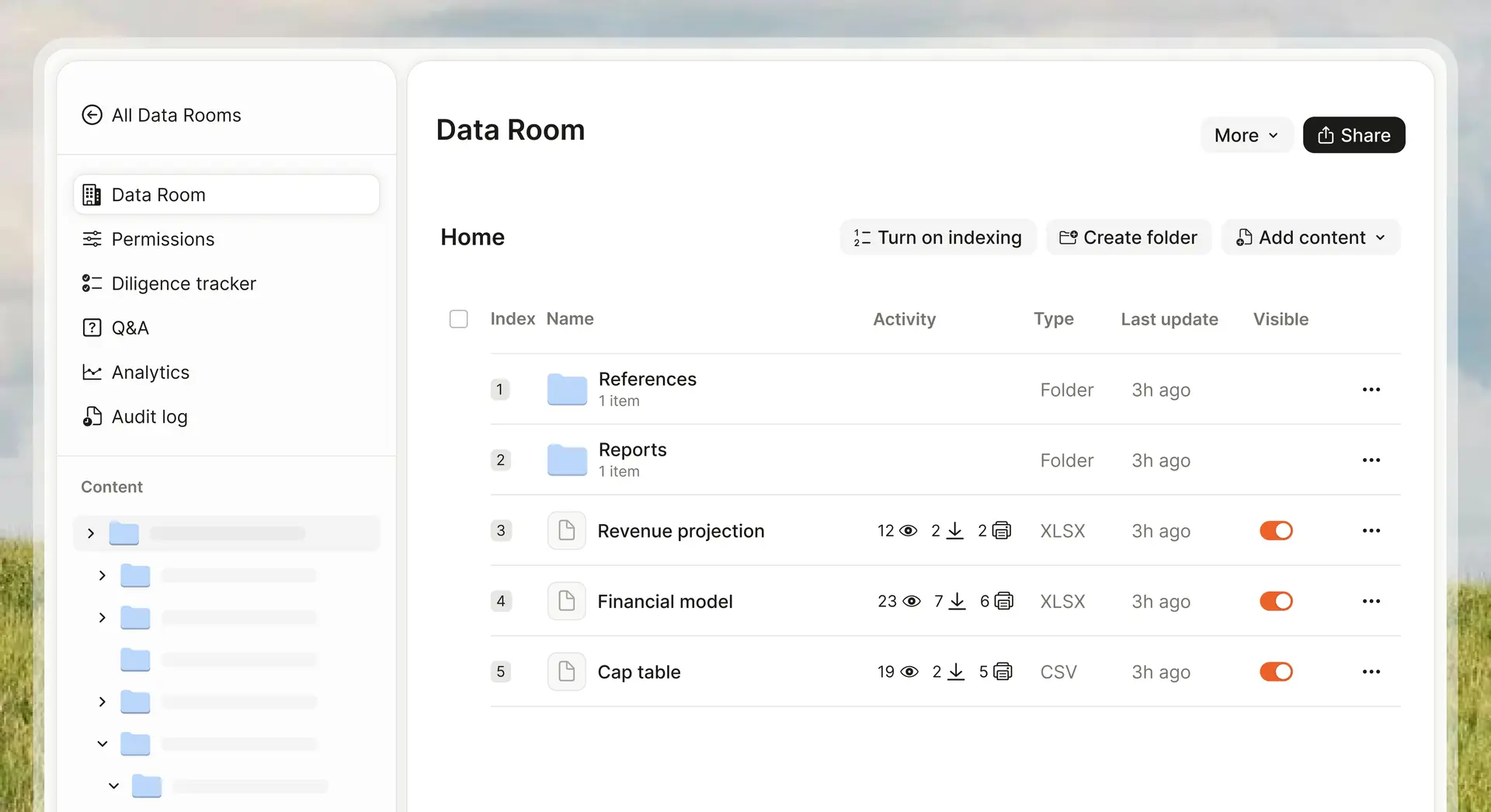
Ellty is a secure document sharing, deck analytics, and data room platform. It focuses on pitch deck tracking, virtual data rooms, and investor engagement without charging per team member.
Key features:
Upload pitch decks and documents directly to Ellty platform (no external storage dependency). Create trackable links with custom branding. Get real-time notifications when someone views your materials. See detailed page-by-page analytics showing which slides captured attention. Set up secure data rooms for due diligence with granular folder permissions. Access analytics showing total views, unique viewers, average time spent, and page-level engagement. Invite unlimited team members without additional per-user costs.
Pricing:
Free forever for core tracking and analytics; Standard at $69/month with unlimited documents, eSignatures, and data rooms; Data Room plan at $149/month for granular permissions, NDA gating, and dynamic watermarking.
We tested the Standard plan, which gave us unlimited documents, detailed analytics, eSignatures, full data room functionality, and custom branding.
Best for:
Businesses sharing data rooms and pitch decks with investors, sales teams tracking proposal engagement, growing teams needing flat-rate pricing, anyone who wants standalone tracking without Dropbox, or G-Drive dependency, teams prioritizing cost predictability as they scale.
When to choose Ellty:
Choose Ellty when you're building a team and want predictable costs. Choose it when you prefer a standalone platform. Choose it when you're primarily sharing data rooms, pitch decks and proposals. Choose it when flat-rate pricing makes budgeting easier.
When to choose Orangedox:
Choose Orangedox when you're already committed to Dropbox and want tight integration. Choose it when you're an individual user or very small team where per-user pricing doesn't hurt. Choose it when you need specific Dropbox features that Ellty doesn't replicate.

DocSend - Enterprise-focused document tracking
What it is: DocSend is a document tracking and analytics platform owned by Dropbox. It offers robust security features and detailed analytics, targeting larger sales organizations and enterprises.
Key differentiator: Strong enterprise security with SOC 2 compliance, detailed viewer permissions, and extensive integration ecosystem. More expensive but more feature-rich than Orangedox.
Pricing: Starts at $10/user/month for basic plans, up to $45+/user/month for advanced features. Enterprise pricing requires sales contact.
Best for: Mid-market and enterprise sales teams, companies needing strict compliance, organizations already using Dropbox Business.
vs. Orangedox: DocSend offers more advanced analytics and security but costs more per user. Similar per-user pricing model means costs scale with team size. Better integration options but steeper learning curve.
PandaDoc - All-in-one document workflow
What it is: PandaDoc combines document creation, tracking, eSignatures, and payments in one platform. It's broader than just tracking - it handles the entire document lifecycle.
Key differentiator: Integrated eSignature and payment collection. You can create, send, track, sign, and get paid through one tool. Built-in templates and editor.
Pricing: Starts at $35/user/month for Essentials, up to $65/user/month for Business. Enterprise plans available.
Best for: Sales teams needing contracts and proposals with signatures, businesses wanting all-in-one document workflow, teams who value templates and document creation tools.
vs. Orangedox: PandaDoc does more but costs significantly more. If you only need tracking, it's overkill. If you need signatures and payments, it's more complete. No Dropbox dependency.
Pitch.com - Presentation-focused collaboration
What it is: Pitch is a presentation creation and sharing platform focused on team collaboration and design. It's more about making decks than tracking them, but includes basic analytics.
Key differentiator: Beautiful presentation templates and real-time collaboration. Think Figma for presentations. Analytics are secondary to creation and design.
Pricing: Free for basic use, Pro at $8/user/month, Business at $20/user/month.
Best for: Teams creating many presentations collaboratively, design-conscious users, companies prioritizing presentation aesthetics over detailed analytics.
vs. Orangedox: Pitch focuses on creation, Orangedox focuses on tracking. If you need to make great-looking decks and share them, Pitch works. If you already have decks and just need tracking, Orangedox is simpler.
Notion - Flexible document workspace with basic sharing
What it is: Notion is a workspace platform for notes, docs, wikis, and databases. You can share pages publicly or privately and see basic view counts.
Key differentiator: Extremely flexible content creation and organization. Light analytics (view counts only), but excellent for building comprehensive resource libraries.
Pricing: Free for individuals, Plus at $10/user/month, Business at $15/user/month.
Best for: Teams wanting a central knowledge hub, users needing flexible document types, organizations building internal wikis with some external sharing.
vs. Orangedox: Notion's analytics are minimal - just view counts. Orangedox gives much deeper tracking. Notion excels at organization and content creation. Choose Notion for workspace, Orangedox for tracking.
Is Orangedox safe?
Orangedox uses industry-standard security practices. Files are encrypted in transit (SSL/TLS) and at rest. They maintain SOC 2 Type II certification. Access controls let you require email verification, set expiration dates, and revoke links. Since files stay in Dropbox, you benefit from Dropbox's security infrastructure too.
The main security consideration is the double dependency - both Dropbox and Orangedox need to maintain security. If either platform has a breach, your documents could be affected. For highly sensitive materials, review both Dropbox and Orangedox's security documentation before using.
Is Orangedox right for you?
Orangedox makes sense if you already use Dropbox, or Google Drive, need straightforward document tracking, have a small team where per-user costs stay reasonable, and want real-time engagement notifications. It works well for sales reps, recruiters, consultants, and founders sharing standard documents like PDFs and presentations.
Skip Orangedox if you have a growing team where per-admin pricing becomes expensive, need advanced analytics beyond basic engagement metrics, or primarily share interactive documents that lose functionality when converted to PDF. Also skip it if you want a standalone platform without external storage dependencies.
Getting started with document tracking
Document tracking changes how you share important materials. Instead of sending files blind, you get visibility into engagement. This data helps you follow up smarter, prioritize leads better, and understand what content resonates.
Start by identifying which documents matter most. Don't track everything. Focus on high-stakes shares - pitch decks to investors, proposals to prospects, reports to clients. These are where knowing engagement makes a real difference. Track selectively so you actually review and act on the analytics.
Best practices: always create unique links for different recipients so you can identify who engaged. Set expectations with recipients that you're sharing a trackable link. Use page-level analytics to understand what sections capture attention, then reference those specific parts in follow-ups. Review analytics within 24 hours of sending while the interaction is fresh. Build a habit of checking engagement before follow-up calls or meetings.
Frequently asked questions
Can recipients see that I'm tracking them?
Recipients can tell they're viewing through Orangedox's branded viewer. The interface shows your logo and branding if configured. Most people understand document tracking is standard for business materials. If you want to be transparent, mention you're sharing a trackable link.
How accurate is the time-spent metric?
Time spent measures how long the browser tab stays active on the document. If someone opens your document and switches to another tab, the timer pauses. It's reasonably accurate for actual viewing time but doesn't account for reading speed or attention quality.
Can I use Orangedox for free long-term?
The free plan works indefinitely but limits you to 10 document shares per month. For most business uses, you'll hit this limit quickly. The free plan is better for testing than long-term use.
What happens if I cancel my subscription?
Existing shared links continue working temporarily but you lose access to analytics and can't create new links. Recipients who already have links can still view documents. Download your analytics before canceling if you want to keep the data.
Does Orangedox store copies of my files?
No. Files stay in your Dropbox account. Orangedox reads them from Dropbox when someone views a link. This means if you delete a file from Dropbox, the Orangedox link breaks.
How many team members can I add?
Unlimited on paid plans, but you pay per user. On Pro plan at $15/user/month, adding 5 team members costs $75/month total. There's no team cap, just scaling costs.
What integrations does Orangedox support?
Orangedox integrates with Zapier (Pro plan), Salesforce (Business plan), and HubSpot (Business plan). The integrations push view events to your CRM. Integration options are more limited than platforms like DocSend or PandaDoc.
Can recipients download documents?
You control download permissions per link. You can allow downloads, block downloads completely, or require a watermark on downloads. Blocking downloads means recipients can only view in the browser.
Is there a mobile app?
No native mobile app. Everything works through web browsers on mobile devices. The viewer is mobile-responsive but there's no dedicated iOS or Android app for document management.
How long do analytics stay available?
Analytics stay in your account as long as your subscription is active. If you downgrade or cancel, you may lose access to historical data. Export important analytics before making plan changes.
Author

Anika Tabassum Nionta is a Content Manager at Ellty, where she writes about secure document sharing, virtual data rooms, M&A, due diligence, fundraising, and sales enablement. With over 6 years of writing experience, she helps professionals understand how to share confidential documents securely, track engagement, and manage deals more effectively. Anika holds both a BA and MA in English from Dhaka University. Outside of work, she enjoys reading, exploring new cafes in Dhaka, and connecting with entrepreneurs and dealmakers in her community.

