
Visible's pricing isn't immediately clear on their website. They don't list prices publicly, which makes it hard to budget or compare options.
This guide covers current Visible plans and pricing, real costs for different team sizes, how their pricing compares to alternatives, and how to calculate what you'll actually pay. Everything is based on current information as of early 2026.
What is Visible?

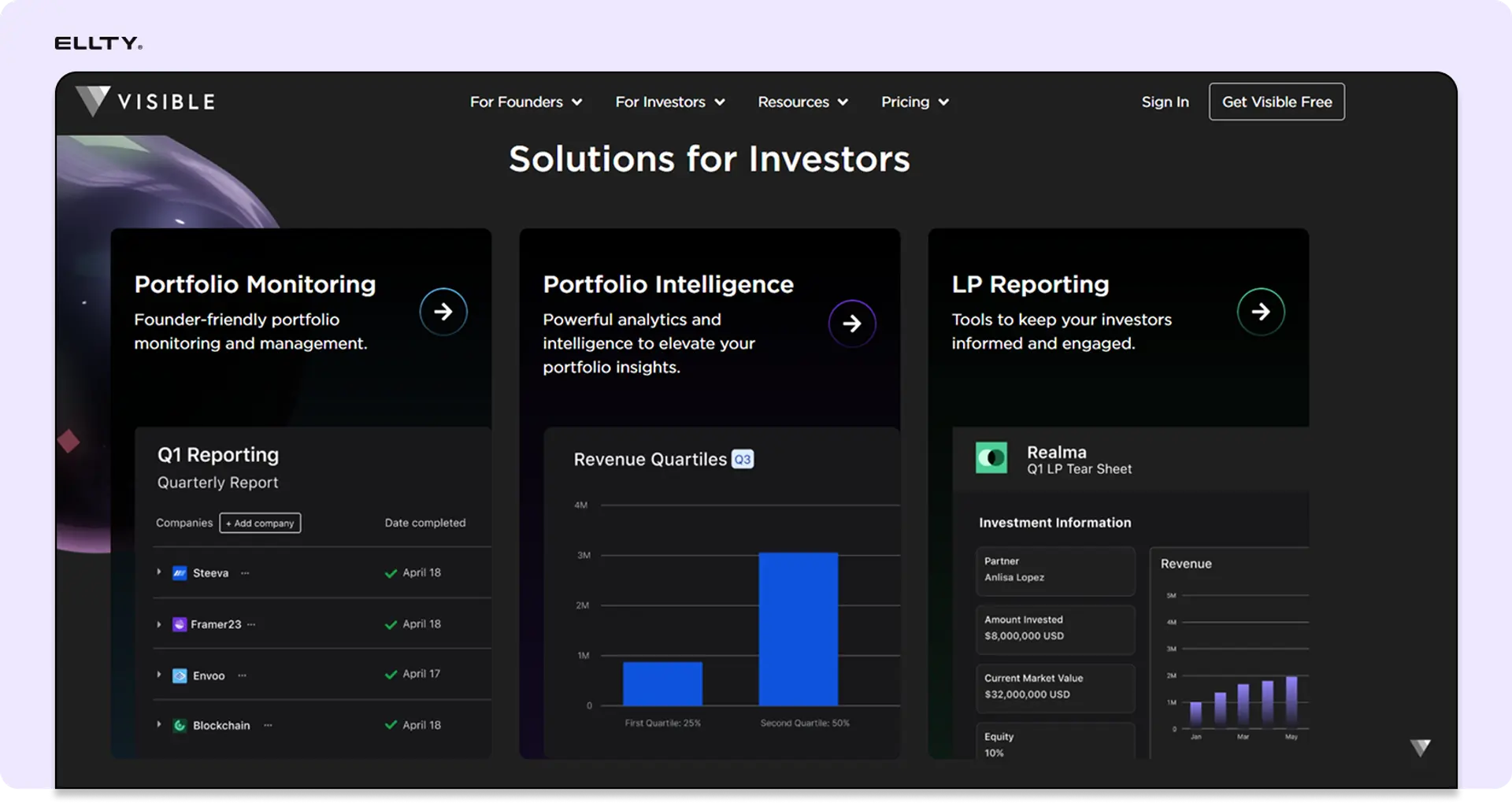
Visible is a investor relations and fundraising platform for startups. It helps founders share updates with investors, track fundraising progress, and manage investor relationships.
Core use cases:
- Sending investor updates
- Tracking fundraising pipelines
- Managing cap tables
- Sharing pitch decks with investors
Key features:
- Investor update templates
- Fundraising CRM
- Portfolio company reporting
- Integration with data rooms
- Email tracking and analytics
- Investor database access
Market position: Visible launched in 2015 and has been used by thousands of startups. They're known for investor update templates and their fundraising CRM features. The company focuses primarily on early-stage startups raising seed to Series B rounds.
Current Visible pricing (2026)


Visible doesn't publish pricing on their website. You need to book a demo or contact sales to get a quote.
All pricing is custom based on your specific needs, team size, and which features you want. There's no self-serve option and no monthly billing. You'll need to commit to an annual contract.
Billing structure: Pricing is typically annual only. Visible requires you to speak with their sales team before getting access. No month-to-month option is available.
Starter plan - Estimated $500-800/month
Who it's for: Early-stage startups just beginning to fundraise or send regular investor updates.
What's included:
- Investor updates
- Basic fundraising pipeline tracking
- Investor database access
- Email templates
- Basic analytics
- Up to 100 investor contacts
Key limitations:
- Limited investor contacts
- No advanced integrations
- Basic reporting only
- No API access
- Limited customer support
Best for: Pre-seed or seed-stage companies with small investor lists who primarily need update templates and basic tracking.
Growth plan - Estimated $1,000-1,500/month
Who it's for: Startups actively fundraising or managing larger investor bases.
What's included:
- Everything in Starter
- Unlimited investor contacts
- Advanced fundraising pipeline
- Custom branding
- Integration with data rooms
- Priority support
- Advanced analytics
- Multiple team members
Key limitations:
- Still limited API access
- No white-label options
- Standard integrations only
Best for: Series A or B companies with active fundraising processes and multiple stakeholders managing investor relationships.
Enterprise plan - Custom pricing
Who it's for: Larger startups, VCs, or companies with complex investor reporting needs.
What's included:
- Everything in Growth
- Custom integrations
- API access
- White-label options
- Dedicated account manager
- Custom onboarding
- Advanced security features
- SSO
Key limitations:
- Pricing not transparent
- Requires long sales cycle
- Minimum commitment typically 12+ months
Best for: Well-funded companies, venture capital firms, or organizations needing extensive customization and dedicated support.
Plan comparison table


Enterprise pricing:
Custom pricing based on:
- Number of portfolio companies (for VCs)
- Team size and seats needed
- Integration requirements
- White-label and branding needs
- Data security and compliance requirements
- Level of dedicated support
Contact sales for quote. Typically starts around $2,000-3,000/month for smaller enterprise needs, but can go much higher for VCs or large organizations.
Costs not shown in base pricing
Setup and onboarding: Visible includes basic onboarding, but complex migrations or custom setups may require additional consulting fees. Not typically charged separately for standard plans.
Data migration: If you're moving from another investor relations platform, you'll need to manually migrate data. Visible doesn't charge for this, but it takes time.
Integration costs: Most standard integrations are included. Custom integrations on Enterprise plans may require development work charged separately or as part of a higher base price.
Training: Basic training is included. Additional team training sessions may be available but aren't typically charged separately.
Contract terms: Annual contracts only. No month-to-month option. You'll need to commit to 12 months minimum, often longer for Enterprise plans.
Real costs for teams
Per-company or per-user pricing from Visible isn't publicly disclosed, making it hard to budget. Here's what Visible actually costs for common startup scenarios based on available information.
Scenario 1: Pre-seed startup
Team size: 1-2 founders
Use case: Sending monthly updates to 20-30 angel investors, tracking early conversations
Recommended plan: Starter
Annual cost: $6,000-9,600 ($500-800/month × 12)
Monthly cost (if available): Not available - annual only
What this includes:
- Investor update templates
- Basic email tracking
- Up to 100 investor contacts
- Fundraising pipeline basics
Limitations to watch:
- Can't add unlimited investors
- Limited analytics
- Only 1-2 team member access
Scenario 2: Seed-stage company actively fundraising
Team size: 2-4 team members (founders + investor relations hire)
Use case: Managing active fundraise, weekly investor updates, tracking 100+ investor conversations
Recommended plan: Growth
Annual cost: $12,000-18,000 ($1,000-1,500/month × 12)
What this includes:
- Unlimited investor contacts
- Advanced pipeline tracking
- Multiple team members
- Custom branding
- Priority support
Limitations to watch:
- Still no API access
- Limited customization
- Standard integrations only
Scenario 3: Series A/B company with portfolio reporting
Team size: 5+ people managing investor relations
Use case: Regular LP updates, portfolio company tracking, investor database management
Recommended plan: Growth or Enterprise
Annual cost: $18,000-36,000+ ($1,500-3,000+/month × 12)
What this includes:
- Everything in Growth
- Possibly API access (Enterprise)
- Dedicated support
- Custom integrations
Limitations to watch:
- Enterprise pricing not transparent
- Long contract commitments
- Setup time can be weeks
Scenario 4: VC firm managing portfolio
Team size: 10+ people across investment team
Use case: Managing updates from 20-50 portfolio companies, LP reporting, deal flow tracking
Recommended plan: Enterprise
Annual cost: $36,000-60,000+ (estimated $3,000-5,000+/month × 12)
What this includes:
- White-label capabilities
- Full API access
- Dedicated account manager
- Custom onboarding
- Unlimited users
Limitations to watch:
- Requires long sales cycle
- Custom pricing means negotiation needed
- Implementation can take months
Cost comparison table


Hidden cost multipliers:
Costs increase when you need:
- More investor contacts beyond plan limits (Starter only)
- Additional team member seats
- Custom integrations or API work
- Migration help from previous tools
- Extended onboarding or training
What teams actually need
Most startups overpay because they buy features for future scale, not current needs. Here's what actually matters for different use cases.
Early fundraising (pre-seed/seed)
Must-have features:
- Clean investor update templates
- Basic email tracking to see who opens updates
- Simple contact management for your investor list
- Ability to share a pitch deck link
Nice-to-have features:
- Advanced analytics
- Custom branding
- Integration with data rooms
Skip these features:
- API access (you won't use it yet)
- White-label capabilities
- Dedicated account manager
- Unlimited team seats
Recommended plan: You probably don't need Visible yet. Use free tools like Ellty for pitch deck sharing, and email for updates.
Active fundraising (Series A/B)
Must-have features:
- Pipeline tracking for investor conversations
- Update scheduling and templates
- Analytics on investor engagement
- Team collaboration (multiple users)
- Data room integration
Nice-to-have features:
- Custom branding
- Advanced reporting
- Priority support
Skip these features:
- White-label options
- Custom API integrations (unless you have specific tech stack needs)
Recommended plan: Growth ($1,000-1,500/month). Only if you're actively managing 50+ investor relationships and need team collaboration.
Portfolio management (VC or late-stage startup)
Must-have features:
- Unlimited contacts
- Multi-company management
- Custom reporting
- API access for integrations
- Team permissions and roles
Nice-to-have features:
- White-label branding
- Dedicated support
- Custom onboarding
Skip these features:
- Nothing - you likely need Enterprise features
Recommended plan: Enterprise (custom pricing). You're managing complex relationships and need the infrastructure.
Decision framework
Ask yourself:
How many investors are you actually communicating with regularly?
- Under 50: You might not need Visible at all
- 50-200: Growth plan makes sense if you're actively fundraising
- 200+: Growth or Enterprise depending on team size
How often do you send updates?
- Monthly or less: Email works fine, save your money
- Weekly during fundraise: Tracking becomes valuable
- Multiple times per week: You need proper tooling
How many team members need access?
- Just you: Don't pay for multi-user features
- 2-3 people: Standard plans work
- 5+ people: You need better collaboration tools
Are you actively fundraising right now?
- No: Don't pay for Visible. Use it when you need it.
- Yes: The tracking and pipeline features pay for themselves
- Always (you're a VC): Enterprise makes sense
What users say about Visible pricing
We reviewed user comments on G2, Product Hunt, and startup forums. Here's what actual customers say about Visible's pricing.
What users like
Professional appearance for investor communications:
"The templates make our updates look polished. Investors take us more seriously now." — Seed-stage founder, G2
Time savings on investor relations:
"We were spending hours formatting updates in Google Docs. Visible cut that down to 20 minutes." — Series A CEO, G2
Common pricing complaints
No transparent pricing:
"I just wanted to know if we could afford it. Had to sit through a 45-minute sales call to find out it was way over our budget." — Pre-seed founder, Reddit
Expensive for early-stage startups:
"We're bootstrapped and $800/month just for investor updates felt insane. We went back to email." — Founder, Product Hunt
Annual commitment required:
"They wouldn't let us pay monthly. We weren't sure if we'd use it for a full year but had to commit anyway." — Seed-stage startup, G2
Features locked behind higher tiers:
"Basic plan was too limited. We needed custom branding which pushed us to Growth plan - basically doubled the price." — Series A founder, G2
Overkill for small investor lists:
"We only have 15 investors. Paying $6,000+ per year to send them monthly emails is hard to justify." — Angel-backed founder, Twitter
Is Visible worth the cost?
Users actively fundraising or managing large investor bases find value in the time savings and professional presentation. The tracking features help them understand which investors are engaged.
However, early-stage founders with small investor lists consistently say it's too expensive for what they need. Many end up canceling after their first year once fundraising slows down.
VCs and later-stage companies with dedicated investor relations teams see it as essential infrastructure. For them, the cost is reasonable relative to the scale of capital they're managing.
The consensus: worth it if you're actively fundraising and managing 100+ investor relationships. Probably overkill if you're pre-seed or only send quarterly updates.
Visible vs alternatives: quick comparison
Here's how Visible pricing compares to similar tools. All prices for comparable plans.


Ellty - Free to $69/month


Ellty is a document sharing, tracking, and virtual data room platform. Upload your documents, create trackable links, and see who viewed them, which pages they spent time on, and when plus manage full investor due diligence in organized data rooms as your fundraising progresses.
Pricing advantages:
- Free tier includes core tracking and analytics features, no expiration
- Standard plan is $69/month (not per user)
- Data Room plan at $149/month includes full due diligence functionality
- No annual commitment required
- Self-serve, no sales calls
Feature comparison:
- Document tracking and analytics ✓
- Real-time view notifications ✓
- Page-by-page engagement tracking ✓
- Virtual data rooms with NDA gating and granular permissions ✓
- eSignatures ✓
- Investor updates ✗
- Fundraising CRM ✗
- Email templates ✗
Who it's best for: Startups that need reliable document tracking and a clean data room for investor due diligence, without the complexity or cost of a full investor relations platform.
Free tier: Document tracking, real-time engagement analytics, and secure shareable links - free forever. Paid plans add eSignatures, data rooms, advanced access controls, custom branding, and more.
DocSend - $10/user/month
Owned by Dropbox. General document sharing with analytics, not specifically built for fundraising.
Pricing: Starts at $10/user/month (Standard plan). Advanced plan is $65/user/month.
vs Visible: Much cheaper for basic document tracking. Lacks investor-specific features like update templates and fundraising pipeline. Better if you need general secure document sharing beyond just investor relations.
Who it's best for: Teams that share lots of documents (pitch decks, contracts, proposals) and want tracking across all of them, not just investor materials.
Carta - Free to $2,000+/month
Cap table management with investor update features added on.
Pricing: Free for basic cap table. Investor updates and advanced features require paid plans starting around $200/month and going up to $2,000+/month for full suite.
vs Visible: Carta is primarily a cap table tool. If you already use Carta for equity management, their investor update features might be enough. But if you don't need cap table management, you're paying for features you won't use.
Who it's best for: Companies that need cap table management and investor updates in one place.
Finta - $99-299/month
Automated investor update tool focused on pulling data from your financial tools.
Pricing: $99/month (Starter), $199/month (Growth), $299/month (Scale). Monthly or annual billing available.
vs Visible: Cheaper than Visible, focuses on automation. Integrates with QuickBooks, Stripe, etc. to auto-populate financial metrics in updates. Less focused on fundraising pipeline tracking.
Who it's best for: Companies that want to automate monthly investor updates with real financial data rather than manually creating reports.
Cost comparison for common scenarios
For a Series A startup (5-person team, annual pricing):


When Visible makes sense
You should consider Visible if you:
- Manage 100+ active investor relationships
- Send weekly or bi-weekly updates during fundraising
- Have a dedicated team managing investor relations (3+ people)
- Need integrated fundraising pipeline with update tracking
- Are a VC managing portfolio company communications
- Have budget for dedicated investor relations infrastructure
When alternatives make sense
Consider alternatives if you:
- Primarily need pitch deck tracking (use Ellty)
- Want document sharing beyond investor relations (use DocSend)
- Already use Carta for cap table (use their update features)
- Want automated updates from financial data (use Finta)
- Are pre-seed or seed with under 50 investors (use free tools)
- Need to watch budget closely and only need core features
Special offers and discounts
Visible doesn't publicly advertise discounts, but there are ways to reduce costs.
Current promotions
Visible occasionally offers promotional pricing for startups in accelerators or specific programs. Check with your accelerator program manager if they have a partnership.
How to save money
Annual payment discount: Already required - no monthly option exists. You're forced into annual, so there's no discount for choosing it.
Startup/accelerator programs: Y Combinator, Techstars, and some other accelerators have partnerships with Visible. You might get 3-6 months free or 20-30% off first year. Ask your program coordinator.
Educational pricing: Not typically offered. Visible focuses on revenue-generating startups and VCs, not educational institutions.
Non-profit discounts: Not advertised. Visible's product isn't really designed for non-profit use cases.
Free trial strategy
Visible doesn't offer a traditional free trial. You need to request a demo, go through sales process, then they might offer a pilot period as part of contract negotiation.
Negotiation approach:
- Ask for a 30-day pilot before committing to annual contract
- Request to start with lower tier and upgrade mid-contract if needed
- See if they'll include additional features at Growth price point
Negotiation tips (for Enterprise)
Everything is negotiable at Enterprise level:
- Ask for 10-20% discount for annual prepayment
- Request added features at no cost (like API access)
- Negotiate for quarterly payment terms instead of full year upfront
- Ask them to waive setup fees
- Request extended pilot period (60-90 days) before full commitment
- Get them to lock in pricing for multi-year contract
Best leverage: You're comparing multiple tools and want to make a decision this quarter. Sales teams have quarterly quotas - use that timing to your advantage.
How to calculate your true cost
Base price is just the start. Here's how to calculate what you'll actually pay for Visible.
Step 1: Base subscription
Choose your plan:
- Starter: $6,000-9,600/year ($500-800/month × 12)
- Growth: $12,000-18,000/year ($1,000-1,500/month × 12)
- Enterprise: $36,000+/year (custom pricing)
For this example, let's use Growth plan: $15,000/year
Step 2: Add-ons and extras
Additional users beyond plan limit: Growth typically includes 3-5 users. Additional users might cost $100-200/month each.
- Example: 2 extra users = $2,400-4,800/year
Data migration assistance: If you need help migrating from another platform, this might be included or could cost $1,000-5,000 as professional services.
- Example: $0 (included in Growth)
Custom integrations: Standard integrations are included. Custom API work is Enterprise only or charged separately.
- Example: $0 (not needed yet)
Total add-ons: $2,400-4,800/year
Step 3: Implementation
Setup time cost: Even though Visible includes basic onboarding, you'll spend internal time setting up templates, importing contacts, training team.
- Estimate: 20-40 hours of internal team time
- At $100/hour blended rate: $2,000-4,000
Migration from existing tools: Moving from email, Notion, or another tool takes time.
- Estimate: 10-20 hours
- Cost: $1,000-2,000 in team time
Total implementation: $3,000-6,000 (one-time)
Step 4: Ongoing costs
Content creation time: Someone still needs to write the actual updates. Visible provides templates but you create content.
- Estimate: 2-4 hours per update, 12-24 updates per year
- Cost: 48-96 hours = $4,800-9,600/year in team time
Administration and maintenance: Updating contact lists, managing permissions, reviewing analytics.
- Estimate: 2-4 hours/month
- Cost: 24-48 hours/year = $2,400-4,800/year
Total ongoing: $7,200-14,400/year
Total first-year cost:
- Base subscription: $15,000
- Add-ons: $3,600 (average)
- Implementation: $4,500 (one-time)
- Ongoing team time: $10,800
- Total Year 1: $33,900
Total year two and beyond:
- Base subscription: $15,000
- Add-ons: $3,600
- Ongoing team time: $10,800
- Total Year 2+: $29,400/year
True monthly cost (amortized over 2 years):
($33,900 + $29,400) ÷ 24 months = $2,637/month true cost
This is 76% more than the advertised $1,250/month base price.
Hidden costs to remember:
- Team time to create actual content (biggest cost)
- Learning curve and training time
- Annual commitment means you pay even if you don't use it
- Adding users mid-contract typically requires plan upgrade
- Custom needs often push you to higher tier
Compare this to alternatives:
Ellty for document sharing and data rooms:
- Base: $69/month ($828/year)
- Setup: 2 hours ($200)
- Ongoing: 1 hour/month ($1,200/year)
- True monthly cost over 2 years: $180/month
The question is whether Visible's investor update and pipeline features are worth the price difference for your specific use case — or whether reliable document tracking, eSignatures, and a full virtual data room at a fraction of the cost covers everything you actually need.
Switch to Ellty (simple pitch deck sharing alternative)

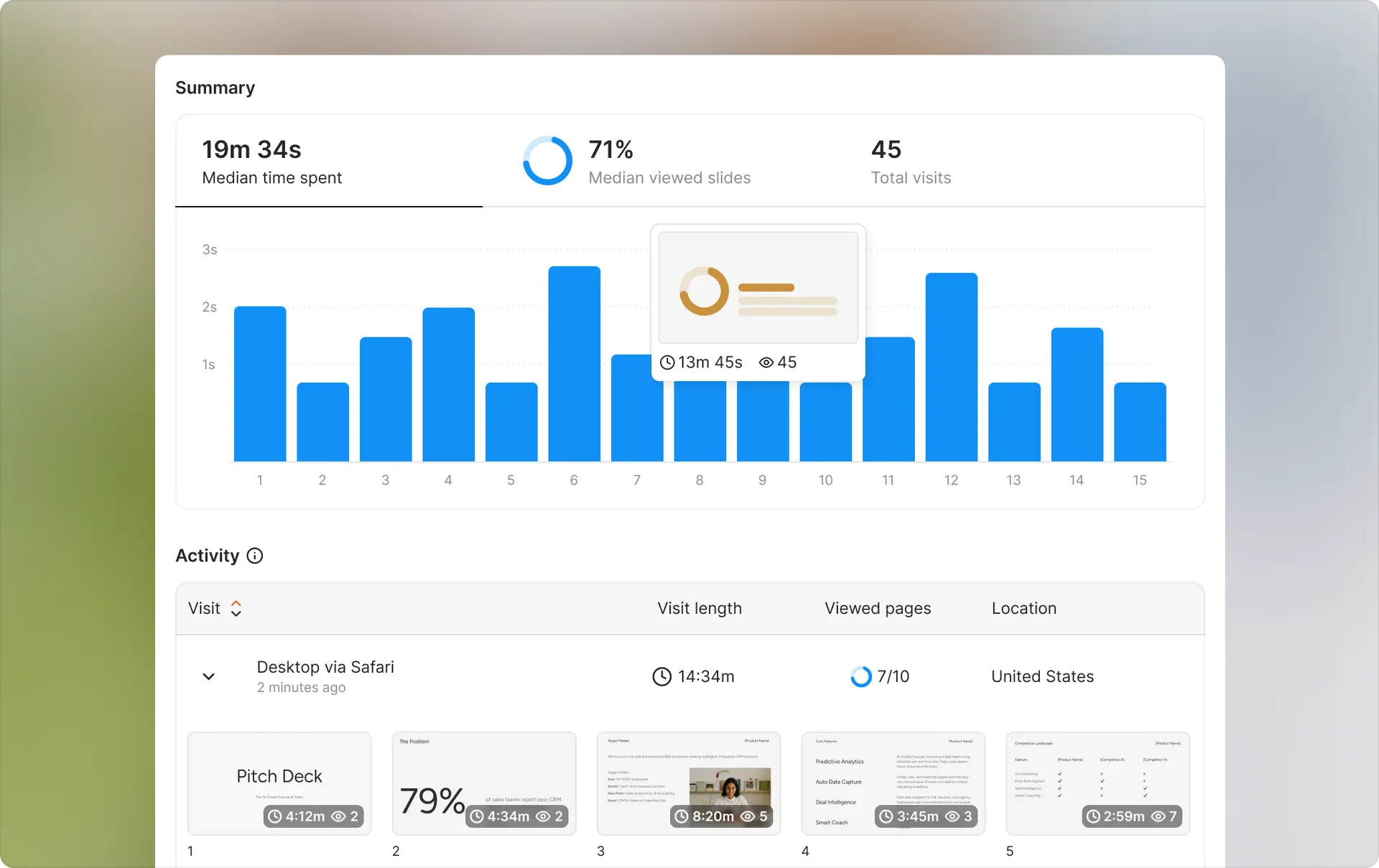
Visible's pricing makes sense for VCs and companies with complex investor relations needs. But most early-stage founders just need to share their pitch deck and see who's interested.
That's what Ellty does, without the complexity or annual contracts.
Ellty Free
Price: $0
- Upload unlimited pitch decks
- Create trackable share links
- See who viewed your deck
- Page-by-page analytics
- View time tracking
- Real-time notifications when someone opens your deck
Best for: Pre-seed and seed-stage founders sharing decks with investors, tracking interest, and following up based on actual engagement.
Ellty Standard - $69/month
Ellty offers a complete document sharing and tracking solution with a generous free tier and powerful paid plans that include data rooms — making it a strong alternative for founders who need more than just basic tracking.
- Free plan includes document tracking, real-time engagement notifications, and an aggregate visit dashboard
- Standard plan adds advanced analytics, eSignatures, access controls, and full data room functionality
- Data Room plan unlocks granular permissions, NDA gating, dynamic watermarking, and restricted visitor access
- 50 GB storage per user on paid plans
Best for: founders who want to start free and scale into a full data room solution as fundraising progresses
Side-by-side comparison: Visible vs Ellty


What you save with Ellty
For a seed-stage startup:
- Visible Growth: $12,000-18,000/year
- Ellty Pro: $468/year
- Savings: $11,652-17,652/year (97%)
For a Series A company:
- Visible Growth: $15,000/year (estimated mid-range)
- Ellty Pro: $468/year
- Savings: $14,652/year (98%)
When Ellty makes sense
You should use Ellty instead of Visible if you:
- Primarily need pitch deck sharing and tracking
- Want to know which investors are actually reading your deck
- Don't need investor update email templates
- Prefer simple, self-serve tools over sales-driven ones
- Want to avoid annual contracts
- Are watching budget closely (pre-seed, bootstrapped)
- Just need the core tracking features without CRM complexity
When to stick with Visible
Visible makes more sense if you:
- Send weekly or bi-weekly investor updates (not just deck shares)
- Need a full fundraising pipeline CRM
- Manage communications with 200+ investors regularly
- Have a dedicated investor relations team
- Want email template library and scheduling
- Need integration with cap table tools
- Are a VC firm managing portfolio updates
Migration is simple
From Visible to Ellty:
- Export your pitch deck from wherever you store it
- Upload to Ellty (takes 2 minutes)
- Create a trackable link
- Share with investors
No complex data migration, no setup calls, no training needed. You can be up and running in under 5 minutes.
Try Ellty Free - No credit card required. Upload your deck and start tracking views in 2 minutes.
Quick answers
Does Visible have a free plan?
No. Visible requires a paid subscription starting around $500-800/month. There's no free tier or permanently free option. You need to contact sales and commit to an annual contract.
Does Visible offer a free trial?
Not a traditional free trial. You need to request a demo, go through their sales process, and they may offer a pilot period as part of contract negotiations. Expect to talk to sales before getting any access.
Does Visible have monthly billing or only annual?
Only annual billing. You must commit to a 12-month contract minimum. There's no month-to-month option, even at higher price points.
What payment methods does Visible accept?
Credit card or ACH bank transfer for annual payments. They typically invoice annually or allow quarterly payments for larger contracts. Specific payment terms are negotiated during sales process.
Does Visible charge for implementation or onboarding?
Basic onboarding is included in all plans. Complex migrations or extensive training may incur additional professional services fees, typically $1,000-5,000+ depending on needs. Standard setup is covered.
Can I cancel anytime?
No. You're locked into your annual contract. If you cancel early, you typically don't get a refund for unused months. Some contracts may allow cancellation with 30-60 days notice at renewal time.
Does Visible have an API?
Limited API access on Growth plan. Full API access requires Enterprise plan. If you need programmatic access to data or want to build custom integrations, expect to pay Enterprise pricing.
Does Visible have a mobile app?
Yes. Visible has mobile apps for iOS and Android. You can send updates, view analytics, and manage investor communications from mobile. The mobile experience is decent for checking notifications but updates are easier to create on desktop.
Are there limits on storage or documents?
This varies by plan. Starter plans may have storage limits. Growth and Enterprise typically include generous storage. Exact limits aren't published - ask during sales process if you have large media files or many documents.
Do I need to pay per user or can I share one account?
Visible charges based on plan level, not strictly per user, but plans have user limits. Starter includes 1-2 users. Growth includes 3-5 users typically. Additional users beyond plan limits require upgrade or additional fees. Account sharing is against terms of service.
What happens if I exceed my plan limits?
You'll need to upgrade to a higher tier. Visible will notify you when you're approaching limits on contacts or users. There's no overage billing - they'll simply require you to move to the next plan level.
Does Visible offer refunds?
Refund policies aren't publicly stated. Since you're locked into annual contracts, refunds are unlikely unless negotiated as part of your specific agreement. Some contracts may have satisfaction guarantees in first 30-60 days - ask during sales process.
Author

Anika Tabassum Nionta is a Content Manager at Ellty, where she writes about secure document sharing, virtual data rooms, M&A, due diligence, fundraising, and sales enablement. With over 6 years of writing experience, she helps professionals understand how to share confidential documents securely, track engagement, and manage deals more effectively. Anika holds both a BA and MA in English from Dhaka University. Outside of work, she enjoys reading, exploring new cafes in Dhaka, and connecting with entrepreneurs and dealmakers in her community.

