Miami closed $6.2B across 400+ deals in 2025. Fintech took 30% of that capital. The city went from crypto hype in 2021 to actual payments and banking infrastructure by 2025. Latin American fintech startups use Miami as their U.S. base. You'll compete with both local founders and international companies raising here. Most fintech investors in Miami want revenue before writing checks.
Quick list
Kaszek Ventures (Miami): Led Pomelo's $35M Series B, now processing $2B annually in remittances from Miami
Valor Capital Group (Miami): Backed Tribal's $60M Series B for SMB lending across Latin America from their Brickell office
QED Investors (Miami): Invested in Stori's $125M round, Mexico's fastest-growing credit card from Miami operations
SoftBank Latin America Fund (Miami): Funded Credijusto $100M Series C for Mexican SMB loans, managed from Miami Beach office
Greycroft (Miami): Early investor in Nuvocargo at $20M Series A, now moving $500M freight annually
Acrew Capital (Miami): Backed Deel's Miami expansion at $425M Series D, payroll for 100K+ companies
NXTP Ventures (Miami): Funded Ualá's Miami office expansion, now 5M users across Latin America
Clocktower Ventures (Miami): Invested in Brex's Miami fintech hub, corporate cards for 10K+ startups
Rappi Ventures (Miami): Backed multiple Miami-based payment processors, portfolio worth $2.3B
Endeavor Catalyst (Miami): Supported Bitso's $250M round, Latin America's largest crypto exchange with Miami presence
Kayyak Ventures (Miami): Funded several Miami fintech B2B companies, $30M+ deployed in 2025
MAYA Capital (Miami): Invested in Kushki's $100M Series B for Latin American payment infrastructure
Draper Cygnus (Miami): Backed Miami crypto and blockchain startups, 15+ portfolio companies
Susa Ventures (Miami): Early investor in Ramp's Miami office, $8B valuation corporate spend platform
H20 Capital Innovation (Miami): Funded Latin American fintechs operating from Miami, $150M+ under management
Why Miami for fintech fundraising
Miami raised $1.8B in fintech deals alone in 2025. That's 30% of all Miami venture capital. The ecosystem specializes in three areas: Latin American payments, crypto infrastructure, and B2B banking tools. Average fintech seed round in Miami is $3.2M. Series A averages $12M. Those numbers are lower than SF but higher than Austin.
Miami investors understand Latin American markets better than coastal VCs. If you're building payment rails to Brazil or remittances to Colombia, Miami funds know the regulatory landscape. They have relationships with Latin American banks and processors. That knowledge matters more than check size for international fintech.
The downside is limited late-stage capital. Miami has plenty of seed and Series A fintech investors. Series B and beyond usually requires bringing in New York or San Francisco funds. Only a handful of Miami-based funds write $20M+ checks. Plan your cap table accordingly.
Picking the right Miami fintech investor
Local presence matters differently in fintech than other sectors. Miami investors with Latin American networks can intro you to regional banks, processors, and regulatory consultants. That's worth more than a passive check from a coastal fund. Look for investors who've actually deployed capital into cross-border payments or crypto infrastructure from Miami.
Portfolio companies tell you what they actually fund versus what they claim. Check if they've backed payments, lending, crypto, or B2B banking tools. Miami has investors who say they do fintech but only have one token investment. Verify recent deals from 2024-2025. If their last fintech investment was 2021 crypto, they're not active anymore.
Check sizes in Miami fintech range from $500K angels to $15M Series A leads. Seed rounds typically see $2-4M from lead investors. Series A leads write $8-12M checks. Know which funds lead versus follow. Half the "fintech investors" in Miami only follow rounds led by QED or Kaszek. Share your deck with Ellty links to see which investors actually engage with your financial projections versus just skimming.
Local network means access to Latin American founders, banks, and exits. The best Miami fintech investors can connect you to Rappi executives, Nubank alumni, or MercadoLibre payment leads. That network accelerates partnerships and hiring. Ask portfolio founders if their investor actually made intros or just attended board meetings.
Communication moves fast once Miami fintech investors commit. They'll want weekly updates during diligence. Upload your deck to Ellty and track which sections each fund reviews. Miami VCs spend more time on unit economics and team slides than market size. Expect 3-4 in-person meetings before term sheets, all in Brickell or Miami Beach offices.
Follow-on capacity is limited in Miami for fintech Series B and beyond. QED, Valor, and SoftBank can fund through growth stages. Most other Miami fintech investors tap out at Series A. You'll need relationships with New York or SF funds by Series B. Ask upfront about their follow-on reserves and co-investment partners for later rounds.
How to find and approach Miami fintech investors
Research local deals through Crunchbase and Latin American tech publications. Filter for fintech investments in Miami from 2024-2026. Check which funds led versus followed. Read the press releases to understand deal structure. Most Miami fintech rounds include at least one fund with Latin American expertise.
Leverage local ecosystem through eMerge Americas and Endeavor Miami. Both organizations connect fintech founders with active investors. The LAB Miami runs a fintech-focused program. Attend their demo days. Venture Cafe Miami on Thursdays attracts fintech investors scouting deals. These aren't networking events, they're where actual checks get written.
Build relationships first at fintech-specific events. Miami Fintech Week in January draws every active investor. Blockchain conferences in Miami Beach attract crypto-focused funds. Don't cold email Miami investors. Get intros from portfolio founders or mutual connections. The ecosystem is relationship-driven, especially for fintech where trust matters.
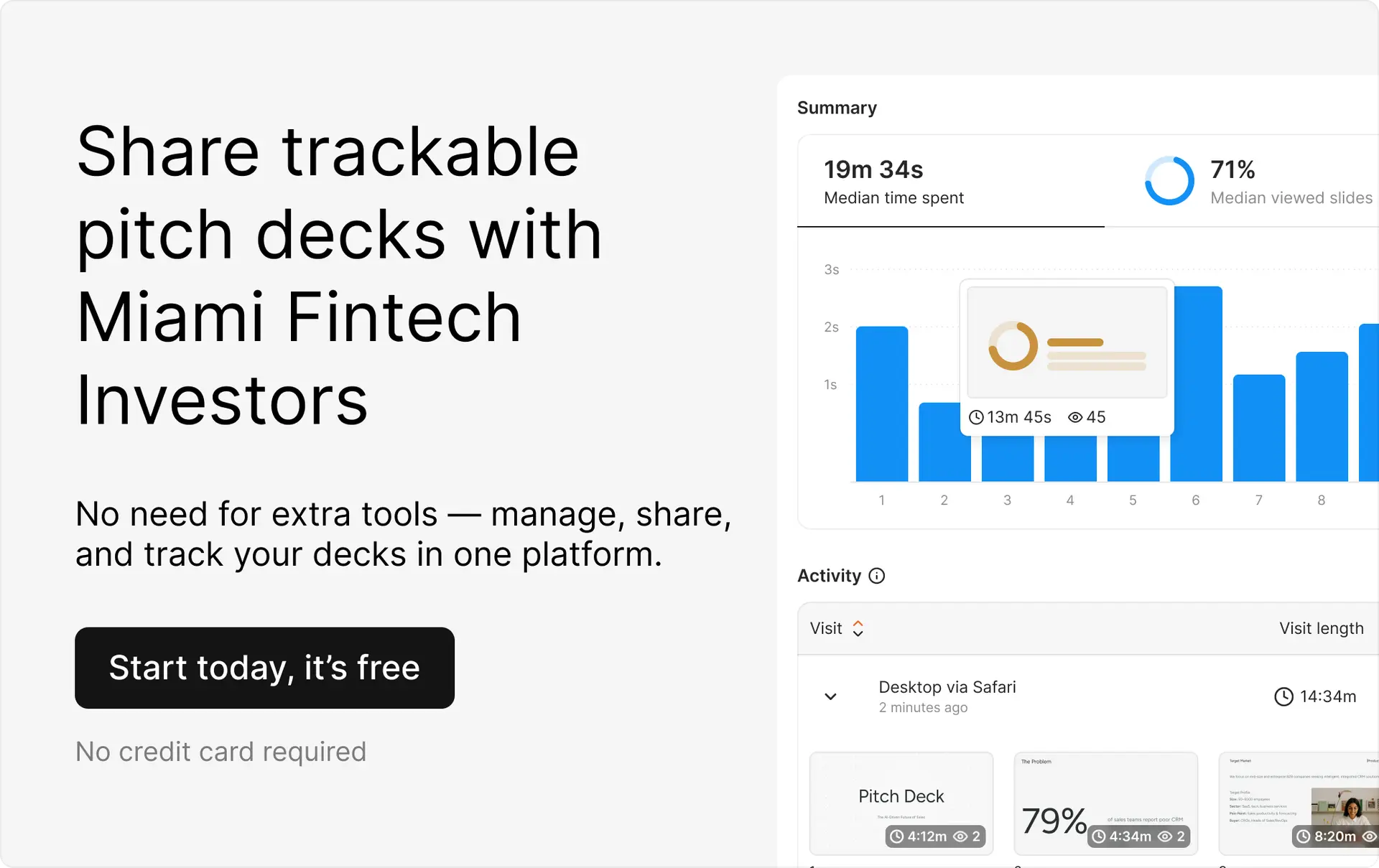
Share your pitch deck with trackable Ellty links once you have a warm intro. Miami fintech investors review decks within 72 hours if they're interested. You'll see exactly which investors open your compliance section or skip straight to financials. Most focus heavily on your payment processor relationships and regulatory status.
Attend local events like eMerge Americas, South Summit Miami, and Miami Tech Week. These three events account for 60% of Miami fintech intros. Skip smaller meetups unless you're pre-seed. Investors expect you at the major conferences. Book meetings two weeks ahead. Everyone's calendar fills up fast.
Connect with portfolio founders from Pomelo, Tribal, Stori, and other Miami-based fintechs. Ask them which investors actually help versus which just take board seats. They'll tell you response times, follow-on behavior, and intro quality. This intel matters more than the fund's marketing materials.
Organize due diligence with an Ellty data room before first meetings. Miami fintech investors want to see bank partnerships, compliance documentation, and unit economics immediately. Have your SOC 2, privacy policies, and financial model ready. They'll request these in meeting one, not meeting three.
Understand local pace - Miami fintech deals close faster than other sectors but slower than SF. Expect 6-8 weeks from first meeting to term sheet if you have revenue. Pre-revenue fintech in Miami takes 12+ weeks. Investors want to verify your banking relationships and regulatory status. That diligence takes time. Many early founders explore DocSend alternatives so they can track investor engagement without committing to heavy software costs during the first stages of fundraising.
Miami-specific fintech considerations
Miami fintech investors prioritize three things: revenue, Latin American market knowledge, and regulatory clarity. If you're pre-revenue, you'll struggle here. The crypto winter in 2022 made Miami VCs cautious about fintech without clear monetization. Show $50K+ MRR for seed rounds, $500K+ MRR for Series A.
Latin American focus gives you an edge. Miami investors understand cross-border payments, remittances, and regional banking better than SF or NYC funds. If your fintech serves Latin American markets, Miami is the best place to raise. You'll compete with international founders using Miami as their U.S. base. Timelines move slower than SF but faster than traditional East Coast firms. Most deals close in 45-60 days once investors commit.


15 top fintech investors in Miami
1. Kaszek Ventures
They've backed 8 fintech unicorns across Latin America and lead most major Miami-based fintech rounds.
- Recent Deals: Pomelo $35M Series B (2025), Tribal $60M Series B (2024), Ualá $150M Series C (2024)
- LinkedIn: Nicolas Szekasy
- Sector Focus: payments, neobanks, B2B fintech, lending, crypto infrastructure
- Stage Focus: Seed, Series A, Series B, Series C
- Office Location: 1111 Brickell Avenue, Miami
- Website: kaszek.com
2. QED Investors
They write the largest fintech checks in Miami and have deep relationships with payment processors and banks.
- Recent Deals: Stori $125M Series C (2025), Creditas $260M Series F (2024), Nubank $400M Series G (2023)
- LinkedIn: Nigel Morris
- Sector Focus: digital banking, payments, lending, insurtech, wealth management
- Stage Focus: Seed, Series A, Series B, Series C, Growth
- Office Location: 2600 South Bayshore Drive, Miami
- Website: qedinvestors.com
3. Valor Capital Group
They focus exclusively on cross-border fintech between U.S. and Latin America from their Brickell office.
- Recent Deals: Tribal $60M Series B (2025), Stone $2.15B IPO (2024), Creditas $255M Series F (2024)
- LinkedIn: Alan Vaksman
- Sector Focus: payments, lending, B2B banking, financial infrastructure
- Stage Focus: Series A, Series B, Series C, Growth
- Office Location: 801 Brickell Avenue, Miami
- Website: valorcapitalgroup.com
4. SoftBank Latin America Fund
They operate their $5B Latin America fund from Miami Beach and write the biggest fintech checks in the region.
- Recent Deals: Credijusto $100M Series C (2025), Konfio $110M Series D (2024), Kavak $485M Series D (2024)
- LinkedIn: Paulo Passoni
- Sector Focus: lending, payments, marketplaces, B2B fintech
- Stage Focus: Series B, Series C, Series D, Growth
- Office Location: 4100 Salzedo Street, Miami Beach
- Website: latinamerica.softbank
5. Greycroft
Their Miami office focuses on fintech infrastructure and B2B payments after backing several regional winners.
- Recent Deals: Nuvocargo $20M Series A (2024), Brex $425M Series D (2024), Ramp $750M Series D (2023)
- LinkedIn: Dana Settle
- Sector Focus: B2B payments, financial infrastructure, lending, insurtech
- Stage Focus: Seed, Series A, Series B
- Office Location: 1001 Brickell Bay Drive, Miami
- Website: greycroft.com
6. NXTP Ventures
They've invested in 15+ Latin American fintechs operating from Miami with strong regional networks.
- Recent Deals: Ualá $150M Series C (2024), Auth0 $120M Series F (2024), Albo $45M Series B (2023)
- LinkedIn: Marta Cruz
- Sector Focus: neobanks, payments, financial inclusion, B2B fintech
- Stage Focus: Seed, Series A, Series B
- Office Location: 1428 Brickell Avenue, Miami
- Website: nxtp.vc
7. Endeavor Catalyst
They co-invest alongside their Endeavor entrepreneurs and have backed multiple Miami fintech exits.
- Recent Deals: Bitso $250M Series C (2025), Konfio $110M Series D (2024), Clip $250M Series D (2023)
- LinkedIn: Allen Taylor
- Sector Focus: payments, crypto, lending, neobanks
- Stage Focus: Series A, Series B, Series C, Growth
- Office Location: 240 Crandon Boulevard, Miami
- Website: endeavor.org/catalyst

8. Acrew Capital
They expanded to Miami in 2024 specifically for fintech and backed several payment infrastructure companies.
- Recent Deals: Deel $425M Series D (2024), Ramp $750M Series D (2023), Pilot $100M Series C (2024)
- LinkedIn: Lauren Kolodny
- Sector Focus: B2B fintech, payroll, financial infrastructure, payments
- Stage Focus: Seed, Series A, Series B
- Office Location: 848 Brickell Avenue, Miami
- Website: acrew.vc
9. Clocktower Ventures
They focus on early-stage fintech in Miami and have strong relationships with payment processors.
- Recent Deals: Brex Miami expansion $425M Series D (2024), Column $75M Series B (2024)
- LinkedIn: Brian Alvarez
- Sector Focus: payments, banking infrastructure, B2B fintech
- Stage Focus: Seed, Series A
- Office Location: 121 Alhambra Plaza, Coral Gables
- Website: clocktowerventures.com
10. Rappi Ventures
They invest exclusively in fintech and infrastructure that supports their ecosystem and portfolio companies.
- Recent Deals: Multiple payment processor investments in Miami (2024-2025), undisclosed amounts
- LinkedIn: Matias Laks
- Sector Focus: payments, logistics fintech, financial infrastructure
- Stage Focus: Seed, Series A, Series B
- Office Location: 1450 Brickell Avenue, Miami
- Website: rappi.ventures
11. Kayyak Ventures
They're one of the most active seed-stage fintech investors in Miami with 12+ portfolio companies.
- Recent Deals: Multiple B2B fintech seed rounds in Miami (2025), $1-3M checks
- LinkedIn: David Aronoff
- Sector Focus: B2B payments, lending, financial infrastructure
- Stage Focus: Seed, Series A
- Office Location: 600 Brickell Avenue, Miami
- Website: kayyak.vc
12. MAYA Capital
They specialize in payment infrastructure and cross-border fintech from their Miami office.
- Recent Deals: Kushki $100M Series B (2024), PayRetailers $65M Series A (2024)
- LinkedIn: Ines Gomez
- Sector Focus: payments, cross-border infrastructure, B2B fintech
- Stage Focus: Series A, Series B
- Office Location: 1111 Brickell Avenue, Miami
- Website: maya.capital
13. Draper Cygnus
They focus on crypto and blockchain fintech from Miami and backed 15+ portfolio companies.
- Recent Deals: Multiple crypto infrastructure investments in Miami (2024-2025)
- LinkedIn: Michael Terpin
- Sector Focus: crypto, blockchain, DeFi, digital assets
- Stage Focus: Seed, Series A
- Office Location: 2101 Biscayne Boulevard, Miami
- Website: drapercygnus.com
14. Susa Ventures
They opened their Miami office in 2023 and focus on enterprise fintech with revenue traction.
- Recent Deals: Ramp $750M Series D (2023), Modern Treasury $85M Series C (2024)
- LinkedIn: Leo Polovets
- Sector Focus: corporate spend, payments, financial automation
- Stage Focus: Seed, Series A, Series B
- Office Location: 1200 Brickell Avenue, Miami
- Website: susaventures.com
15. H20 Capital Innovation
They invest in Latin American fintechs using Miami as their U.S. operations base.
- Recent Deals: Multiple Latin American fintech investments operating from Miami (2024-2025)
- LinkedIn: Alexandre Costa
- Sector Focus: payments, lending, neobanks, financial inclusion
- Stage Focus: Seed, Series A, Series B
- Office Location: 701 Brickell Avenue, Miami
- Website: h20capital.com.br
Start tracking your Miami fintech investor outreach


These 15 investors closed Miami fintech deals in 2025-2026. Before you start reaching out to Miami funds, set up proper tracking.
Upload your deck to Ellty and create a unique link for each Miami investor. You'll see exactly which slides they view and how long they spend on your regulatory compliance and unit economics sections. Miami-based fintech investors often skip market size slides but focus heavily on your payment processor relationships and Latin American expansion plans.
When Miami investors ask for compliance docs, financial models, or SOC 2 reports, share an Ellty data room instead of email attachments. Your cap table, banking partnerships, and regulatory status in one secure place with view analytics.
Common questions
Do I need Latin American market focus to raise from Miami fintech investors?
Not required but it helps significantly. 70% of Miami fintech capital goes to companies serving Latin American markets. Pure domestic U.S. fintech can raise here but you'll compete with international founders who know the region better.
How does Miami fintech funding compare to San Francisco?
Miami seed rounds average $3.2M versus SF's $4.5M. Series A averages $12M versus SF's $18M. Miami investors want revenue earlier. You won't get funded pre-revenue unless you have exceptional team pedigree or Latin American traction.
What's the average time from first meeting to term sheet in Miami?
6-8 weeks if you have revenue and clean compliance. 12+ weeks for pre-revenue fintech. Miami investors do thorough regulatory and banking partnership diligence. Crypto startups take longer due to regulatory uncertainty.
Should I raise locally or go straight to SF/NYC for fintech?
Raise in Miami if you're building for Latin American markets or need regional banking relationships. Go to SF/NYC if you're pure domestic U.S. fintech or need $20M+ Series B checks. Most successful Miami fintech companies raise seed and Series A locally, then add coastal investors at Series B.
Do Miami fintech investors expect in-person meetings?
Yes, especially for seed and Series A. Expect 3-4 in-person meetings in Brickell or Miami Beach offices before term sheets. Remote-only fundraising rarely works in Miami fintech. The ecosystem values face-to-face relationships and most investors want to meet your full team.
What fintech sectors get funded most in Miami?
Payments takes 40% of Miami fintech capital, followed by lending (25%), neobanks (20%), and crypto infrastructure (15%). B2B fintech infrastructure raised more in 2025 than consumer fintech. Cross-border payments and remittances get funded faster than domestic-only solutions.
How important is regulatory compliance for Miami fintech fundraising?
Critical. Miami investors won't write checks without clear regulatory status. Have your money transmitter licenses, banking partnerships, and compliance framework documented before first meetings. Crypto startups need extra clarity on SEC and CFTC positioning. Budget 20-30% longer diligence timelines than other sectors.