
You searched for Datasite pricing. Datasite doesn't publish it. That's frustrating - and it's intentional. Their per-page model means your cost depends on your project, not a plan page. Total bills range from $40,000 to well over $100,000 per project.
This guide covers how Datasite pricing actually works, what different project sizes realistically cost, what's not included in the base quote, and how it compares to alternatives including Ellty. No fluff - just numbers and context to help you make an informed call.
What is Datasite?

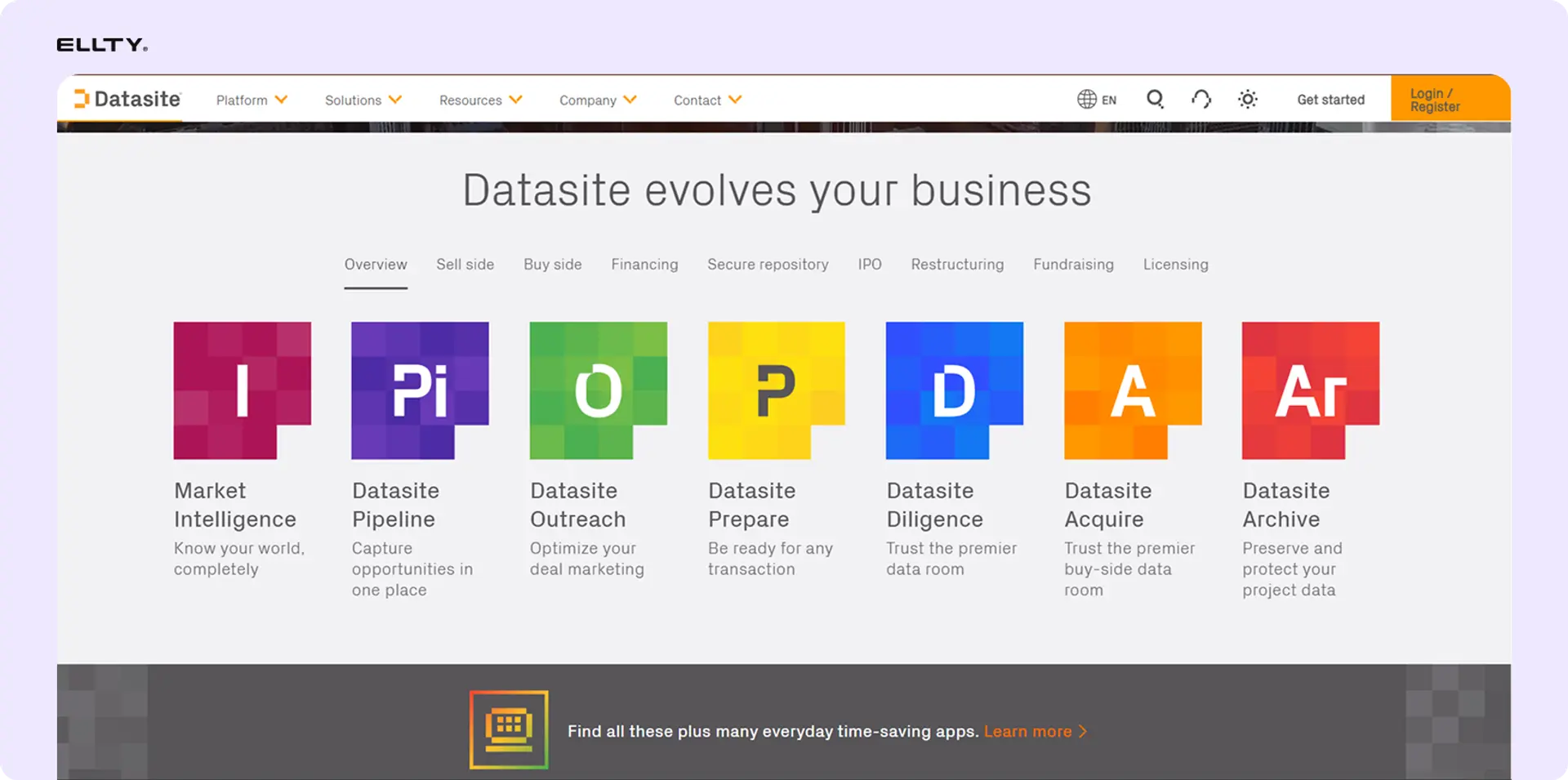
Datasite (formerly Merrill DataSite, part of Merrill Corporation) is a virtual data room (VDR) built for high-stakes financial transactions. Its core use case is M&A due diligence - specifically, managing the secure exchange of sensitive documents between buyers, sellers, advisors, and legal counsel during a deal.
It's used primarily by investment banks, private equity firms, corporate development teams, law firms, and large enterprises running M&A deals, divestitures, IPOs, restructurings, and capital raises.
Key features
- Secure document repository with drag-and-drop bulk upload
- AI-powered redaction to automatically remove sensitive content
- Granular user permissions and access controls
- Real-time activity tracking and audit trails
- Q&A module for buyer/seller communication
- AI translation and PDF-to-Excel conversion
- Single sign-on (SSO) and multi-factor authentication (MFA)
- Hosted on Microsoft Azure with Cloudflare protection
Market position
Datasite is one of the most established names in VDRs - the Merrill Corporation has been around for decades, and Datasite rebranded from Merrill DataSite in 2020. It's considered a premium option, frequently compared to Intralinks and DFIN (formerly Donnelley). It's well-regarded in investment banking circles and regularly ranks near the top of G2 and Capterra for enterprise VDRs.
Datasite pricing (2026)
Datasite doesn't list prices on their website. You won't find a plan comparison table or a monthly rate. Pricing is custom-quoted based on your project, and you need to contact sales to get a number.
What we know from user reports, industry research, and review platforms:
How the pricing model works
Datasite uses a per-page pricing model. Every page you upload costs money. The typical rate is around $0.40-$0.60 per page, depending on file type and deal volume.


There are no fixed plans. No tiers. No "Starter" or "Growth" options. Every engagement is a custom quote. The final cost depends on:
- Number of pages uploaded
- File types included (PDFs, Excels, media files)
- Deal duration - longer deals cost more
- Number of users needing access
- Storage volume required
- Service and support level selected
Estimated project costs
Based on aggregated user reports and industry data:


Note: These are estimates based on the ~$0.60/page rate and industry reports. Actual quotes vary by account manager, region, deal volume, and negotiated terms. Always request a formal quote for your specific project.
Feature overview


Costs not shown in base pricing
Users consistently report surprise charges that don't appear in initial quotes:
- Excel file handling - because 10KB of spreadsheet data counts as 1 page, your 100-tab Excel can become hundreds of billed pages
- Special media surcharges - JPEG, video, and other non-standard files are charged per MB, not per page, at rates up to $15/MB
- Deal extension fees - if your deal runs past the original timeline, expect non-prorated penalties. A one-month delay can approach double the original monthly rate
- Re-upload costs - uploading a revised 1,000 MB file can cost as much as the original upload
- Additional user fees - adding team members mid-project typically triggers new user access charges
- Training and implementation - not always included in base quotes; some users report $500-$2,500+ for onboarding support
- Premium support tiers - higher support levels cost extra beyond standard service
Does Datasite have a free plan?
No. Datasite doesn't offer a free plan or a standard free trial. The only no-cost option is requesting a demo, which is a product walkthrough with a sales rep - not a self-serve trial where you can upload documents and test the platform yourself.
What you can't do without paying
- Upload documents or create a data room
- Invite users or test permissions
- Run any due diligence workflow
- Access any platform features independently
Who this matters for
If you're a startup founder or small team looking to test a VDR before committing to a $40,000+ engagement, Datasite isn't designed for that use case. The platform targets enterprise deal teams who already know they need it and can justify the cost with a deal in progress.
If you need to run due diligence for a fundraising round or smaller transaction and want to understand the tool before signing, you'll want to either negotiate a paid pilot or evaluate alternatives with actual free tiers or trials.
Real costs for teams
Per-page pricing is hard to budget. Unlike SaaS tools where 5 users x $X = monthly bill, Datasite costs scale with document volume. Here's what different scenarios realistically cost.
Scenario 1: seed-stage startup fundraising
Team size: 3-5 users (founders + legal)
Use case: Series A data room - financials, cap table, contracts, IP docs
Estimated pages: 5,000 - 15,000
Duration: 2-4 months
Estimated cost: $15,000 - $40,000 total
Limitations to watch: Excel cap tables inflate costs. Adding investor users mid-round triggers extra fees. If the round closes late, extension fees apply.
Scenario 2: mid-market M&A sell-side
Team size: 10-25 users (investment bankers, legal, corp dev, buyers)
Use case: Full due diligence for $50M-$200M transaction
Estimated pages: 50,000 - 150,000
Duration: 6-12 months
Estimated cost: $40,000 - $100,000 total
Limitations to watch: Multiple bidder groups need separate access profiles. Q&A volume can be high. Media files (presentation decks with images) add costs.
Scenario 3: large enterprise M&A or IPO
Team size: 50-200+ users
Use case: Complex transaction - multiple work streams, international teams
Estimated pages: 200,000 - 500,000+
Duration: 12-24 months
Estimated cost: $100,000 - $500,000+
Limitations to watch: Multiple file format types, ongoing uploads, and long timelines create compounding costs. This is where per-page pricing really accelerates.
Cost comparison by scenario


Hidden cost multipliers
Costs increase when you need:
- Excel-heavy documentation - can multiply page counts 10x vs PDF equivalent
- Mixed media assets - images, videos, and presentations with embedded graphics
- Deal extensions - any timeline slip triggers additional fees
- Re-uploads of revised documents - counted as new pages
- Premium support - training, implementation, and dedicated support tiers
Which Datasite plan do you actually need?
Datasite doesn't have plans to choose from - it's one platform, custom-quoted every time. The real question is whether Datasite is the right tool for your situation at all. Here's how to think through it.
Use case 1: startup due diligence for seed or Series A
- Must-have: secure document sharing, basic access controls, activity tracking
- Nice-to-have: Q&A module, investor analytics
- Skip: AI redaction, enterprise SSO, advanced compliance features
Reality: Datasite is overkill. You don't need M&A-grade infrastructure for a fundraising round. The minimum cost of $15,000+ makes the math hard to justify when alternatives handle this at $0-$50/month.
Use case 2: mid-market M&A transaction
- Must-have: granular permissions per buyer group, robust Q&A, full audit trail, reliable uptime
- Nice-to-have: AI redaction, bulk upload, document search
- Skip: most AI features if your team is comfortable doing it manually
Reality: This is Datasite's core use case. The platform is genuinely strong here. The cost is real, but you can usually pass it through as a deal expense. Budget $50,000 - $100,000 and negotiate hard upfront.
Use case 3: large enterprise or complex transaction
- Must-have: everything - enterprise security, SSO, 24/7 support, compliance logging, multi-region data storage
- Nice-to-have: AI translation, advanced analytics
Reality: Datasite is one of the strongest options at this level. Intralinks is the main comparable. Both are expensive. The cost is real but expected for transactions at this scale.
Decision framework
Ask yourself:
- Is this a formal M&A, IPO, or restructuring transaction? If yes, Datasite makes sense. If it's a fundraising round or smaller deal, probably not.
- Do you have a dedicated deal team to manage the VDR? Datasite has a learning curve. Without someone who knows it, you'll pay for support.
- Can you pass the cost through as a deal expense? For investment banks and PE firms, yes. For startups paying out of pocket, the math is harder.
- Do you need enterprise security and compliance logging? If not, simpler tools handle document sharing for a fraction of the cost.
What users say about Datasite pricing
We reviewed user feedback across G2, Capterra, TrustRadius, and Software Advice. Here's what actual customers report.
What users like
Strong platform for M&A practitioners
"The feature set checks every box for practitioners: smart access controls, strong reporting, streamlined Q&A, and seamless bulk upload tools."
- Associate, Financial Services - Capterra
Easy to use once set up
"I use Datasite for roughly 10 deals a year and it is the best option that I've experienced."
- Investment Banking Associate - Capterra
Intuitive interface for complex workflows
"The platform is intuitive and efficient, making it easy to manage sensitive documents during due diligence."
- Due Diligence Project Manager - SourceForge
Common pricing complaints
Per-page model is confusing and hard to predict
"Terrible pricing structure, at a cost per page, and extra costs for Excels. Very predatory and way too expensive compared to other VDR providers."
- Programme Manager, Mechanical Engineering - Capterra
Billing is unclear until the invoice arrives
Multiple users note that the billing structure isn't explained well upfront, and that unexpected charges for file types and extensions appear on final invoices. Transparency is a consistent friction point.
Cost scales unpredictably
Users running multiple deals per year report significant variation in project costs even with similar document volumes, depending on which account manager handled quoting and what file mix was included.
Not appropriate for cost-sensitive clients
"It is less appropriate for price-sensitive clients, but the best option in a vacuum for any sell-side process."
- Investment Banking user - TrustRadius
Is Datasite worth the cost?
For large-scale, high-stakes M&A deals, most practitioners say yes - the platform is reliable, well-supported, and widely recognized in the industry. Counterparties and investors are comfortable with it.
For smaller deals, fundraising rounds, or teams without a designated VDR administrator, the cost-to-value ratio is harder to defend. Users doing smaller transactions consistently note that alternatives handle their needs at a fraction of the price.
The consensus: Datasite is worth it if deal size and complexity justify the spend. For most startups and smaller teams, there are better-fit options.
Datasite vs alternatives: quick comparison
Here's how Datasite pricing compares to similar tools. All prices are for comparable use cases.


Ellty - from $0/month


Ellty takes a fundamentally different approach to document sharing and due diligence. It's built for startups and founders managing investor outreach, eSignatures, and fundraising due diligence - not for 100,000-page enterprise M&A transactions.
- Flat, predictable pricing: Free ($0), Standard ($69/month), Data Room ($149/month), Data Room Plus ($349/month)
- Features: secure document sharing with trackable links, real-time engagement analytics, page-by-page viewer tracking, eSignatures, virtual data rooms with NDA gating, granular permissions, and dynamic watermarking
- Free plan available - no credit card required, no trial expiration
- Best for: startup fundraising, investor outreach, early-stage due diligence
Intralinks
Datasite's closest direct competitor. Similar per-page pricing model, similar enterprise focus, and similar cost range. Often comes down to relationship and preference within investment banks. No public pricing.
Firmroom
Flat-rate pricing starting around $595/month. For a 6-month deal, that's roughly $3,570 vs. Datasite's typical $60,000 for similar scope. Strong option for mid-market deals where Datasite-level features aren't required.
Cost comparison for a 6-month mid-market deal


When Datasite makes sense
- You're running a formal M&A, IPO, or restructuring with institutional counterparties
- Your deal team is experienced with enterprise VDRs and can manage the platform
- Deal size justifies the cost - $50M+ transactions where VDR cost is a rounding error
- Counterparties specifically request or expect Datasite
When alternatives make sense
- You're a startup sharing materials with investors or running early-stage due diligence
- Your deal is smaller and the cost-to-value ratio doesn't work
- You need predictable monthly pricing, not usage-based billing
- You don't need enterprise M&A features like Q&A, AI redaction, or multi-workstream management
Special offers & discounts
Datasite doesn't publish promotional pricing. Here's what you can realistically do to reduce costs.
Annual / multi-project commitments
If you run multiple deals per year, negotiate a volume agreement. Firms doing 5+ transactions annually report better per-page rates than single-deal clients. Your account manager has pricing flexibility.
Upfront negotiation
Get the full scope of your project defined before signing. Know your approximate page count, file types, expected duration, and user count. Every unknown at signing becomes a potential surprise charge. Push for hard caps on extension fees and media surcharges in the contract.
Startup and accelerator programs
Datasite doesn't publicly advertise startup pricing. If you're backed by a notable VC or accelerator, ask your account rep directly - some programs have pre-negotiated rates through their portfolio support infrastructure. It's worth asking.
Negotiation tips
- Get at least two competing quotes - from Datasite and at least one other VDR - before signing
- Ask for a cap on per-page overages or negotiate a fixed project cost instead of open-ended page pricing
- Negotiate extension fees before the deal starts, not after a delay occurs
- If you're a first-time customer, ask about a pilot pricing arrangement
- Request itemized invoices so you can track actual vs. estimated page counts
How to calculate your true cost
Base per-page rate is just the start. Here's how to estimate what you'll actually pay.
Step 1: estimate your page count
Count your documents. For PDFs, assume ~5-10 pages per document on average. For Excel files, remember that 10KB = 1 page under Datasite's model - a 500KB spreadsheet is 50 pages. For presentations (PowerPoint/PDF), count slides as pages.
Formula: Total pages = (PDF docs x avg pages) + (Excel files x size-based page estimate) + (presentations x slide count)
Step 2: calculate base cost
Use $0.50/page as a conservative mid-range estimate:
Base cost = total pages x $0.50
Example: 50,000 pages x $0.50 = $25,000
Step 3: add media surcharges
If you have images or video files, add $10-$15 per MB for those assets.
Example: 200MB of image/media files x $12/MB = $2,400
Step 4: add duration costs
Datasite's model charges for the life of the project. If your deal runs 6 months, build that into your estimate. If there's any chance of extension, budget for 1-2 extra months at the same monthly rate or higher.
Step 5: add user and support costs
For each additional user group or support tier above standard, expect additional charges. Get specifics in your quote.


Compare this to: Ellty Standard at $69/month, or Ellty Data Room at $149/month for startup and fundraising use cases. For mid-market M&A with FirmRoom: ~$595/month.
Ellty: a simpler data room for startups and founders

Datasite is purpose-built for large, complex financial transactions. It's a serious tool for serious deals - and the pricing reflects that. If your use case is closer to sharing pitch materials, running early-stage investor due diligence, or managing a startup fundraising round, Datasite's cost structure doesn't fit the use case.
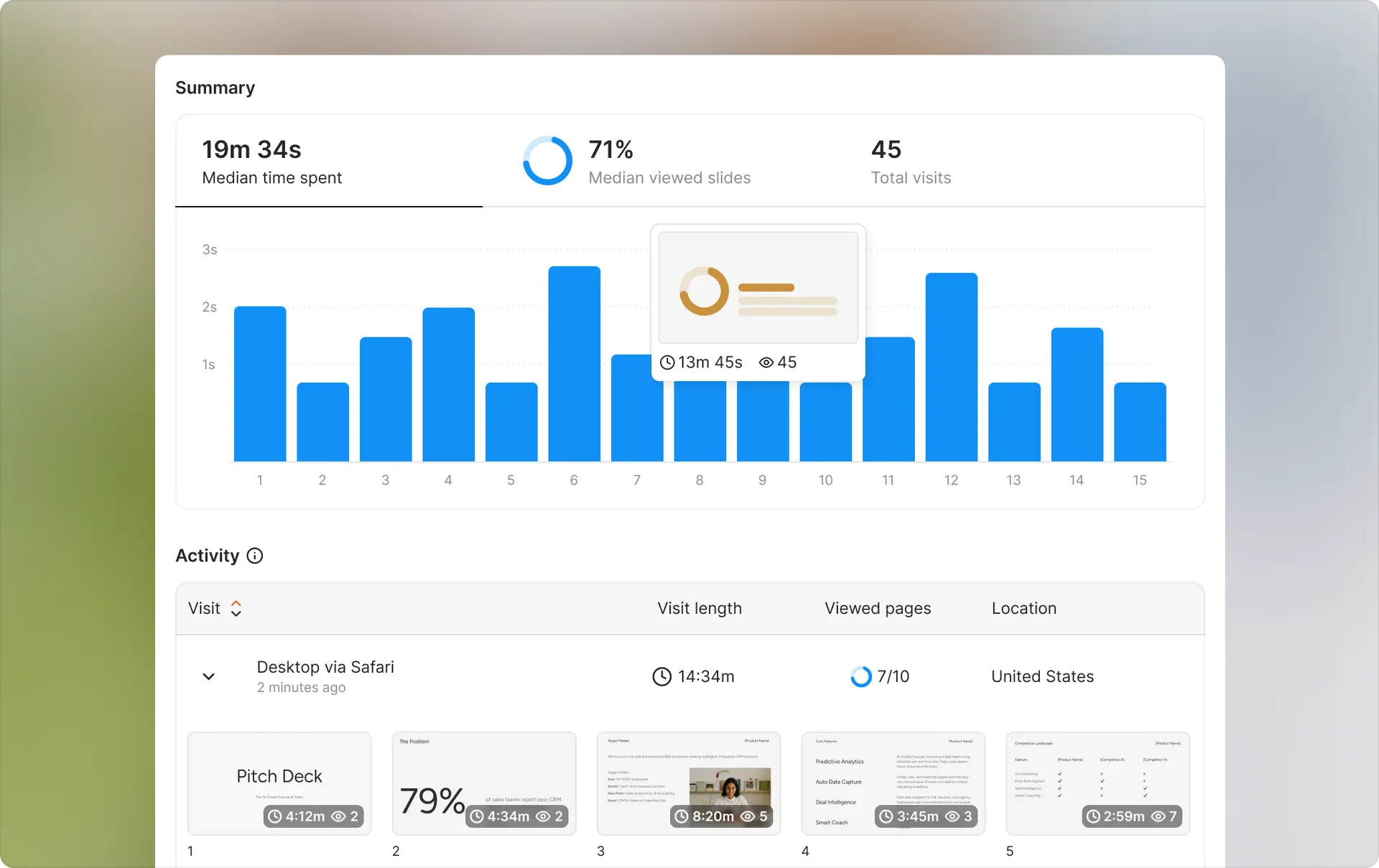
Ellty is a pitch deck sharing and analytics platform with virtual data room functionality. It offers a different approach: flat monthly pricing, trackable links, real-time viewer analytics, and secure data rooms - without the enterprise price tag.
Ellty pricing


What Ellty includes
- Upload pitch decks and deal documents
- Create trackable shareable links
- See who viewed your documents, which pages, and for how long
- Real-time notifications when someone opens your materials
- Secure data rooms for due diligence
- No per-page charges, no usage billing, no surprise invoices
Datasite vs Ellty: side-by-side


What you save with Ellty
For a startup running a Series A fundraising process over 6 months:
- Datasite: ~$15,000–$40,000 (full project cost)
- Ellty Data Room: $894 (6 months × $149/month)
- Difference: $14,106–$39,106
That's not Ellty being "cheaper" — it's a different product for a different use case. Datasite's cost is justified for a $100M M&A deal. It's hard to justify for a $5M Series A.
When Ellty makes sense
- You're a startup founder managing investor outreach and early-stage due diligence
- You need to know who's opening your materials, which pages they focused on, and how engaged they are
- You need eSignatures without paying for a separate tool
- You're running due diligence with a small to mid-size investor group and need NDA gating, granular permissions, and dynamic watermarking without enterprise overhead
- You want predictable monthly pricing with no surprise invoices
- Your document volume doesn't require enterprise M&A infrastructure
When to stick with Datasite
- You're running a formal M&A, IPO, or restructuring transaction
- Your counterparties expect enterprise-grade VDR security and audit trails
- Deal size and complexity justify the per-page cost
- You need features like AI redaction, multi-workstream Q&A, or enterprise compliance logging
Migration is simple
If you're currently using Datasite for document sharing that doesn't require M&A-grade infrastructure, moving to Ellty takes minutes. Upload your documents, create a trackable link, and start seeing viewer analytics immediately. No migration complexity. No onboarding call required.
Quick answers: Datasite pricing FAQs
Does Datasite have a free plan?
No. Datasite doesn't offer any free tier. The only no-cost option is requesting a product demo.
Does Datasite offer a free trial?
Not in the traditional sense. You can request a demo with a sales rep, but there's no self-serve trial where you can upload documents and test the platform independently.
What does Datasite actually charge?
Approximately $0.40-$0.60 per page uploaded, with surcharges for Excel files, media files, deal extensions, and additional users. There are no standard plans or published rates.
How much does a typical Datasite project cost?
Small deals: $15,000 - $40,000. Mid-market M&A: $40,000 - $100,000. Large transactions: $100,000 to $500,000+. These estimates are based on industry reports and user feedback - actual quotes vary.
Does Datasite charge per user?
Datasite's primary pricing is per page, but adding users mid-project typically triggers additional user access fees. The per-page model is the dominant cost driver.
Can I get a fixed-price quote from Datasite?
You can negotiate for a fixed project cost rather than open-ended per-page billing. Firms with ongoing volume do this. For single projects, it's harder but worth asking for - especially if you can define the scope precisely upfront.
Does Datasite have monthly billing?
Datasite bills by project, not monthly subscription. The billing structure depends on your contract terms - some deals are billed monthly, others upfront or at deal completion.
What payment methods does Datasite accept?
Bank transfer and corporate payment methods are standard for enterprise contracts. Contact Datasite directly for payment specifics as part of your contract negotiation.
Does Datasite charge for implementation or onboarding?
Some users report $500-$2,500+ for training and implementation support that wasn't included in their initial quote. Clarify this before signing.
Can I cancel anytime?
Datasite projects are contract-based. Cancellation terms depend on your specific agreement. Don't assume monthly flexibility - confirm cancellation terms before signing.
Does Datasite have an API?
API access is available. Contact sales for specifics - it's not a standard self-serve integration.
Does Datasite have a mobile app?
Yes. Datasite has iOS and Android apps.
Are there storage or document limits?
No hard storage cap - but more pages and more storage directly increase your cost. There's no 'unlimited' plan.
Does Datasite offer refunds?
No standard refund policy is published. Dispute resolution and refund terms are governed by individual contracts. Negotiate dispute terms before signing, especially for long engagements.
What happens if I exceed my estimated page count?
You get charged for the additional pages at the per-page rate. There are no automatic plan upgrades or caps unless you negotiate them. This is where budgets often overrun.
About Ellty
Ellty is a pitch deck sharing and analytics platform with virtual data room functionality for startups. Upload docs, create trackable links, and see real-time analytics on who views your materials. Plans start at $0. ellty.com
Pricing data sourced from: Datasite user reviews on G2, Capterra, TrustRadius, and Software Advice; industry reports from data-rooms.org, Vendr, FirmRoom, and Papermark; and publicly available deal cost estimates. Datasite does not publish pricing. All estimates should be verified with a direct Datasite quote.
Author

Anika Tabassum Nionta is a Content Manager at Ellty, where she writes about secure document sharing, virtual data rooms, M&A, due diligence, fundraising, and sales enablement. With over 6 years of writing experience, she helps professionals understand how to share confidential documents securely, track engagement, and manage deals more effectively. Anika holds both a BA and MA in English from Dhaka University. Outside of work, she enjoys reading, exploring new cafes in Dhaka, and connecting with entrepreneurs and dealmakers in her community.

