
Carta is the go-to for equity management. Plenty of startups use it for cap tables, 409A valuations, and investor relations. It's trusted, comprehensive, and your investors probably know it.
We've been testing alternatives to Carta for the past few months. Some companies find Carta's pricing unclear or too steep as they scale. Others need simpler tools for basic cap table management. A few want better customer support or more transparent costs.
We personally tested 8 alternatives. Each handles equity management differently. Some focus on founder-friendly pricing, others on European compliance, and a few offer integrated features Carta charges extra for. Here's what we found.
Key takeaways
The equity management market offers many Carta alternatives, each with different strengths for pricing transparency, international compliance, or founder-focused features.
Several alternatives offer better pricing structures, unlimited 409A valuations, and faster onboarding compared to Carta's custom pricing model.
Many modern solutions combine cap table management with integrated valuations, fundraising tools, or specialized regional compliance to provide more comprehensive workflows.
For fundraising needs specifically (virtual data room, investor tracking), specialized tools like Ellty serve a different but complementary purpose to equity management platforms.
Why look for a Carta alternative?
Carta handles equity management well. The cap table automation, 409A valuations, and compliance tools serve thousands of companies. For many startups, it's the default choice that investors and lawyers recognize.
But Carta isn't the only option, and it's not always the best fit for every team.
Better features for the price
Several alternatives offer comparable cap table management with additional features at clearer costs. Some include unlimited 409A valuations that Carta charges extra for. Others provide transparent per-stakeholder pricing instead of custom quotes that increase after fundraising rounds.
We found tools that offer flat-rate annual pricing instead of scaling costs based on company milestones. Some alternatives include features like fundraising modeling or employee equity dashboards that Carta restricts to higher tiers. For European companies, alternatives built for multi-country compliance handle international operations better than Carta's US-centric approach.
Different workflow needs
Carta focuses on comprehensive equity management from seed to IPO. That's great if you need the full suite. But if you're managing a simple cap table with 30 stakeholders, you might benefit from a simpler platform without the complexity.
Some teams need better customer support without waiting for sales-driven responses. Others need faster onboarding that doesn't require weeks of implementation. A few need specific features like token management or integrated liquidity programs that Carta doesn't emphasize.
If you're fundraising actively, you might also need pitch deck analytics and investor tracking - a different problem that equity management platforms don't solve. The right alternative depends on what you're actually trying to accomplish.
Cost considerations
Carta's pricing can add up quickly for growing companies. The custom pricing model means costs often increase significantly after funding rounds. We found alternatives with transparent, fixed pricing that make budgeting easier, and others with generous free tiers that work fine for early-stage companies.
Pricing for add-ons also matters. Carta charges separately for 409A valuations in lower tiers. Some alternatives include unlimited valuations in their base pricing. For companies that need frequent valuations, this makes a real difference in annual costs.
Carta alternatives overview
Here are the best Carta alternatives in 2026 for equity management (in our opinion)
Ellty - Virtual data room software
Pulley - Founder-focused cap table management
Ledgy - European equity management with global compliance
Eqvista - Unlimited 409A valuations included
Shareworks - Enterprise equity compensation platform
Qapita - Personalized global equity management
Capdesk - UK startups with secondary market access
AngelList - Rolling funds and SPV administration
What are the best Carta alternatives?
The best Carta alternative depends on what you're actually trying to accomplish.
For founder-focused cap tables: Pulley gives you transparent pricing, fast onboarding, and tools built for startup founders instead of institutional investors. Fixed cost per stakeholder, fundraising modeling included, support that responds in minutes. No opaque pricing, no surprise fees after you raise your Series A.
For European companies: Ledgy when you need multi-country compliance without complexity. 70+ HRIS integrations, automated country-specific reports, employee dashboards that actually make equity understandable. Good for teams hiring across borders where Carta's US-centric approach creates friction.
For unlimited valuations: Eqvista if you need frequent 409A valuations without paying thousands per report. NACVA-certified experts, audit-ready reports, lifetime support - all included in per-shareholder pricing. The cap table features are straightforward, but you're not paying separately every time you need a valuation.
For hands-on support: Qapita when personalized service matters more than self-serve simplicity. Dedicated account managers, white-glove migration, no hidden costs. Takes longer to set up than lightweight tools, costs more than bare-bones options, but you get expertise that prevents expensive mistakes.
For enterprise complexity: Shareworks when you're managing hundreds of employees across multiple jurisdictions with sophisticated equity programs. Morgan Stanley backing, extensive compliance automation, liquidity event integration. Overkill for seed-stage startups, built for companies with dedicated finance teams.
For fund management: AngelList if you're running rolling funds or SPVs instead of managing company equity. Built-in investor network, streamlined formation, end-to-end fund administration. Different use case entirely - not for company cap tables.
For fundraising tracking: Ellty when you need investor engagement analytics alongside equity management. Track who viewed your pitch deck, which pages they read, how long they spent. Carta doesn't solve this problem. You'll still need cap table software, but Ellty handles the fundraising visibility piece.
Already using it anyway: Spreadsheets if you have under 10 stakeholders and haven't raised institutional money. Free, familiar, everyone knows Excel. No automation, high error risk, terrible for due diligence, but it technically tracks equity ownership.
Different needs, not better or worse. Carta works well for what it does. These alternatives just handle different priorities - transparent pricing, international compliance, personalized support, or specialized use cases. Pick based on whether you need cost clarity, geographic coverage, feature depth, or workflow simplicity.
Types of Carta alternatives
Carta alternatives fall into different categories based on what they actually do.
Cap table management platforms - The core equity tracking model. Maintain accurate ownership records, issue shares and options, track vesting schedules. Pulley, Ledgy, and Eqvista follow this approach. You're managing equity structure, not running funds or tracking fundraising. Perfect for startups and growth companies that need a single source of truth for who owns what.
Integrated valuation platforms - Cap table plus unlimited 409A valuations bundled together. Eqvista focuses here. Instead of paying separately for each valuation, it's included in your subscription. Good when you issue options frequently and need audit-ready FMV reports without per-report fees eating into your budget.
Founder-friendly tools - Built specifically for startup founders instead of trying to serve investors, law firms, and companies equally. Pulley does this. Transparent pricing, fast support, fundraising modeling included. The interface assumes you're running a company, not managing a fund. Less comprehensive than enterprise platforms, but faster and clearer for most startups.
Global compliance platforms - When multi-country operations matter more than US-only features. Ledgy builds here. Automated compliance for different jurisdictions, extensive HRIS integrations, country-specific reporting. Setup complexity increases, but you're not manually tracking equity regulations across five countries.
Enterprise equity management - Full-featured platforms for large companies with complex programs. Shareworks and Global Shares. Hundreds of employees, multiple share classes, regular liquidity events, extensive reporting requirements. Overkill if you have 30 employees, necessary if you have 3,000.
Fund administration platforms - Managing investment funds and SPVs, not company cap tables. AngelList operates here. Formation, LP management, distributions, tax reporting. Different problem entirely - if you're a GP or syndicate lead, this is your category. If you're a company founder, it's not.
Pitch deck and fundraising tools - Tracking investor engagement during fundraising, not managing equity ownership. Ellty solves this. Who viewed your deck, which slides they read, how long they spent. Complements cap table software but doesn't replace it. You need both if you're actively raising.
Spreadsheet alternatives - Graduating from Excel to actual software. Many of these tools position themselves as "spreadsheet replacements." They digitize manual cap table tracking, automate calculations, reduce errors. Still managing the same data, just with fewer mistakes and better reporting.
White-glove service platforms - When personalized support drives the decision more than software features. Qapita emphasizes this. Dedicated account managers, hands-on migration, customized onboarding. You're paying for expertise and service, not just software access.
Different problems, different tools. Carta sits in the comprehensive equity management category but leans toward established companies with institutional investors. These alternatives either do the same thing with different pricing models and support approaches, or solve adjacent problems like fund administration or fundraising analytics. Pick based on whether you need cost transparency, geographic coverage, personalized service, or specialized workflows.
Quick comparison: Carta alternatives at a glance


We tested each of these tools ourselves. Below, we'll break down what we found - the good, the specific use cases, and who each one works best for.
1. Ellty - Virtual data room software
Ratings and Reviews: Recently launched - early users highlight ease of use and clean analytics


We tried Ellty early in our testing because we needed a simple way to share pitch decks with investors and track engagement. Ellty offers virtual data room software, link tracking, and analytics built specifically for fundraising. What we appreciated most was how fast we could set it up and start tracking who viewed our materials.
Carta vs Ellty


Why fundraising founders love it
When we tested this with a sample pitch deck, we could see exactly which investors viewed it, how long they spent on each page, and when they returned for a second look. This helped us prioritize follow-ups based on actual engagement rather than guessing who was genuinely interested.
Founders we spoke to mentioned using Ellty alongside their equity management tool. It's not a cap table replacement - it's for the fundraising process itself. Document tracking, eSignatures, and investor due diligence all under one roof, without juggling multiple platforms during your busiest fundraising period.
In our testing, the virtual data room feature stood out because we could organize due diligence materials in structured folders, set NDA gating, apply dynamic watermarking, and control exactly who could access what. For early-stage startups, this beats sending Google Drive links and hoping for the best and for later-stage rounds, it holds up against tools that cost ten times as much.
Best for: Founders who need reliable document tracking, eSignatures, and a full virtual data room for investor due diligence without enterprise complexity or cost.
Pricing: Free forever for core tracking and analytics; Standard from $69/month with unlimited documents, eSignatures, and data rooms; Data Room from $149/month with granular permissions, NDA gating, and dynamic watermarking.
Support: Live chat (Monday–Friday) and priority email support on paid plans. In our testing, responses came within a few hours.
2. Pulley - For transparent, founder-friendly cap table management
Ratings and Reviews: G2: 4.7/5 ⭐ | Capterra: 4.8/5 ⭐


We tested Pulley because we kept hearing founders mention it as the "Carta alternative for founders." Pulley focuses on cap table management, fundraising modeling, and 409A valuations with transparent pricing. What stood out immediately was how the interface felt designed for someone running a startup, not a paralegal.
Carta vs Pulley


Why startup founders love it
In our testing, the fundraising modeler saved us hours. You can model different SAFE scenarios, see dilution impact, and export clean pro-formas for your lawyers. No need to build complex spreadsheets.
When we talked to founders who switched from Carta, they mentioned two things: transparent pricing and actual support. With Pulley, you know what you'll pay per stakeholder. No surprise price hikes after raising your Series A. The support team responded in minutes when we had questions, which matters when you're trying to close a round.
We found the onboarding simple. Our rep walked us through setup, migrated our cap table data, and we were up and running within days. For companies tired of opacity or poor support, Pulley handles this differently.
Best For: Startups that want fixed, transparent pricing and founder-focused tools
Pricing: Startup plan from $1,200/year (up to 25 stakeholders); Growth from $3,500/year (up to 40 stakeholders); Custom pricing for larger teams
Support: Email and chat with average response under 5 minutes. Managed services available on retainer.
"The UX/UI and experience is top notch - it is far superior to Carta. The experience is intuitive and it is incredibly easy to use."
- CEO, Health/Wellness/Fitness, Capterra
3. Ledgy - For European startups and global compliance
Ratings and Reviews: G2: 4.6/5 ⭐ | Capterra: 4.7/5 ⭐


We tested Ledgy because several European founders recommended it. Ledgy handles cap table management, employee equity plans, and investor relations with a focus on international compliance. What impressed us was how well it handles multi-country operations and HRIS integrations.
Carta vs Ledgy


Why European scale-ups love it
When we tested Ledgy with a UK entity structure, the automated compliance reports for different jurisdictions stood out. If you're hiring across Europe, Ledgy handles the complexity of different equity regulations without manual work.
Founders we talked to who migrated from Carta mentioned the pricing was a major factor. One mentioned Carta tripled their price after a funding round. Ledgy's pricing is based on stakeholder count, stays predictable, and doesn't penalize you for growth.
In our testing, the employee dashboard made equity grants easy to understand. Our test employees could see their vesting schedules, future valuations, and exercise options without confusion. For companies that want employees to actually understand and value their equity, this helps.
Best For: European startups or companies with international teams needing multi-country compliance
Pricing: Free (Launch) for up to 25 stakeholders; €3/stakeholder/month (Growth, minimum 25); Custom pricing for Scale and Enterprise
Support: Email and chat. Customer experience managers assigned for onboarding. Note: support is Europe-based, so response times vary for other timezones.
"It's been an excellent migration experience so far, everything is going very well. Because Carta tripled the pricing."
- User, Capterra
4. Eqvista - For unlimited 409A valuations at lower cost
Ratings and Reviews: G2: 4.3/5 ⭐ | Capterra: 4.5/5 ⭐


We tested Eqvista because of their unlimited 409A valuations model. Eqvista offers cap table management, equity administration, and integrated valuations from NACVA-certified experts. What caught our attention was how they bundle valuations into the pricing rather than charging separately.
Carta vs Eqvista


Why early-stage companies love it
When we tested Eqvista's 409A service, the turnaround was faster than expected and the audit support was included for life. If you're issuing stock options regularly, paying per valuation adds up. Eqvista's unlimited model makes more sense.
In our testing, the cap table management was straightforward. You can issue shares, track vesting, manage RSUs, and run scenario models. It's not as feature-rich as Carta for complex structures, but for most startups it covers what you need.
Founders we talked to mentioned the cost savings. One switched from Carta after realizing they were spending thousands annually on valuations alone. With Eqvista, that's built in at a fraction of the cost.
Best For: Startups that need frequent 409A valuations without paying per valuation
Pricing: Freemium for up to 20 shareholders; Premium from $2/shareholder/month; Enterprise from $125/month
Support: Email and knowledge base. Dedicated support for Enterprise customers. Lifetime audit support included for all valuations.
"Our experts simplify business infrastructure with effective and audit-ready 409A valuations, and professional cap table management to help your company grow."
- Eqvista website
5. Shareworks - For enterprise equity compensation programs
Ratings and Reviews: G2: 4.1/5 ⭐ | Capterra: 4.0/5 ⭐


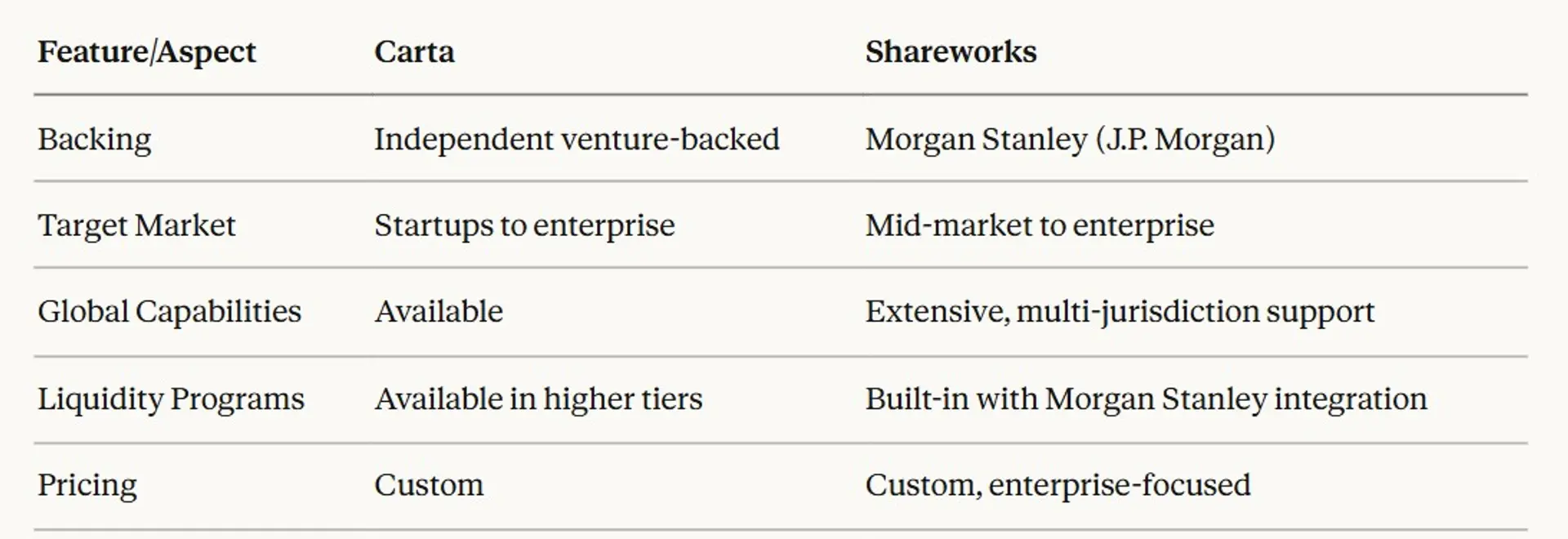
We looked at Shareworks because it's backed by Morgan Stanley and targets larger companies with complex equity programs. Shareworks handles employee stock plans, global equity compensation, and integrated liquidity events. What stood out was the enterprise-grade compliance and reporting capabilities.
Carta vs Shareworks

Why enterprise companies love it
Based on user reviews and documentation, Shareworks excels at managing large-scale employee stock programs across multiple countries. If you have hundreds of employees across different jurisdictions, the compliance automation and reporting save significant legal costs.
Companies with complex equity structures - multiple share classes, extensive option pools, regular liquidity events - find Shareworks built for that complexity. The Morgan Stanley backing adds credibility for public company readiness and secondary market access.
Users report the setup requires significant time and resources. This isn't a self-serve tool. It's built for companies with dedicated finance teams who need enterprise features and are willing to invest in proper implementation.
Best For: Mid-market and enterprise companies with complex, global equity programs
Pricing: Custom pricing based on company size and needs
Support: Dedicated account management and implementation support. Email and phone support available.
"Comprehensive equity management platform with robust compliance features and extensive global support."
- Based on user reviews, SoftwareAdvice
6. Qapita - For personalized global equity management
Ratings and Reviews: G2: 4.8/5 ⭐ | Capterra: 4.9/5 ⭐


We looked into Qapita because founders switching from Carta praised their hands-on support. Qapita offers end-to-end equity management from cap tables to valuations, with personalized service for each company. What users consistently mention is the white-glove onboarding and responsive support.
Carta vs Qapita


Why growing companies love it
Users report Qapita's migration process is seamless. The team handles data transfer, validation, and setup without dumping work on your finance team. For companies frustrated with Carta's support or surprise pricing, this approach is different.
Based on verified reviews, Qapita works well for companies expanding internationally. Their team guides you through country-specific regulations, tax considerations, and cross-border equity structures. If you're scaling across multiple regions, this expertise helps avoid costly mistakes.
The platform covers everything from cap table management to ESOP administration, 409A valuations, and liquidity programs. Users appreciate having one source of truth without paying separately for each module.
Best For: Companies that want personalized support and transparent pricing for global equity management
Pricing: Custom pricing based on company stage and needs - transparent quotes provided upfront
Support: Dedicated customer experience managers, highly responsive support team. Rated highest for customer satisfaction.
"Great onboarding experience overall. We moved over from Carta, which was very over priced, and did not provide any kind of support. Qapita made the whole experience seamless and pain-free."
- User review, Qapita website
7. Capdesk - For UK startups with secondary market needs
Ratings and Reviews: G2: 4.5/5 ⭐ | Trustpilot: 4.6/5 ⭐

We researched Capdesk because UK founders mentioned it frequently. Capdesk handles cap table management, employee equity plans, and facilitates secondary transactions. What differentiates Capdesk is their integration with secondary markets for employee liquidity.
Carta vs Capdesk


Why UK scale-ups love it
Based on user feedback and market positioning, Capdesk excels at UK-specific equity structures like EMI schemes and growth shares. If you're navigating UK tax advantages and compliance, Capdesk knows these regulations well.
The secondary marketplace integration helps employees find liquidity before an exit. For companies that want to reward early employees without a full buyback program, this provides options that keep everyone aligned.
Founders mention the investor relations features help keep stakeholders updated without manual work. Automated updates, clear dashboards, and easy document sharing reduce the admin burden of managing multiple investors.
Best For: UK and European startups that need EMI compliance and secondary market access
Pricing: Tiered pricing based on company stage and stakeholder count - contact for specific quotes
Support: Email and chat support. UK-based team with understanding of local equity regulations.
8. AngelList - For rolling funds and SPV management
Ratings and Reviews: Product Hunt: Highly discussed | G2: 4.3/5 ⭐


We looked at AngelList because it serves a different use case than traditional cap table software. AngelList handles fund formation, SPV management, and rolling funds with built-in investor networks. If you're raising via rolling funds or syndicates, AngelList is built for this.
Carta vs AngelList


Why fund managers love it
Based on market research and product documentation, AngelList makes it easier to launch rolling funds and manage SPVs without the traditional legal overhead. If you're a GP or syndicate lead, you can form funds, handle compliance, and manage investors through one platform.
The investor network is the differentiator. Access to AngelList's investor base helps fund managers find LPs and deal flow. For companies raising from syndicates, AngelList handles the complexity of multiple small investors through a single SPV.
Fund administration is handled end-to-end. From formation to tax reporting to distributions, AngelList manages the operational burden that typically requires expensive fund administrators.
Best For: Fund managers, syndicate leads, and companies raising through rolling funds or SPVs
Pricing: Custom pricing based on fund structure and AUM
Support: Dedicated support for fund managers. Knowledge base and community resources available.
Cheapest Carta alternatives
If you're watching costs carefully, several low-price alternatives offer solid cap table management and basic equity administration:
1. Eqvista
At $2/shareholder/month for the Premium tier, Eqvista is one of the most affordable full-featured options we tested. You get cap table management, equity tracking, and unlimited 409A valuations included. The Freemium tier supports up to 20 shareholders at no cost.
The interface is straightforward. Upload your historical equity data, issue shares and options, track vesting schedules. It covers what most early-stage startups need without enterprise complexity. If you need more sophisticated features like advanced scenario modeling or extensive integrations, you'll need to look elsewhere, but you won't find a cheaper way to manage basic equity with included valuations.
2. Ledgy Launch (Free)
Free for up to 25 stakeholders, Ledgy's Launch plan provides full cap table management, employee equity dashboards, and investor relations tools at no cost. This isn't a limited trial - it's a complete equity management platform for early-stage companies.
The catch: you'll need to upgrade to Growth (€3/stakeholder/month) once you exceed 25 stakeholders or need advanced features like custom reporting and API access. But for companies just starting out, Ledgy Launch beats paying anything.
Good enough for managing founder equity and early employee options. Not enough for complex equity structures or companies approaching Series A with dozens of investors.
3. Carta Launch (Free)
Free for companies with up to 25 stakeholders and less than $1M raised, Carta's Launch plan includes cap table management, SAFE modeling, and fundraising benchmarking. You get the Carta brand recognition that investors know.
The limitations: no 409A valuations, limited compliance features, and no fundraising tools. Once you raise over $1M or exceed 25 stakeholders, you'll need to upgrade to paid tiers where pricing becomes custom and opaque. Still, as a free starting point with room to grow on the same platform, it's competitive.
How to choose the right Carta alternative
After testing all these alternatives, here's what we'd consider if we were choosing for our own business:
Your use case: Are you managing a company cap table, raising funds, or running an investment fund? Pulley and Ledgy work well for company equity management. AngelList fits fund administration. Ellty handles fundraising materials and investor tracking - a different problem entirely.
If you're actively fundraising, analytics on investor engagement (like Ellty provides) help prioritize follow-ups. If you're post-funding and managing employee equity, you need cap table automation (Pulley, Ledgy, Eqvista).
Budget and team size: Per-user pricing vs flat rate impacts costs significantly. We found that Pulley's fixed-per-stakeholder model makes budgeting easier than Carta's tiered approach. For small teams under 25 stakeholders, the free tiers from Ledgy, Carta, and Eqvista cover basic needs.
If you need 409A valuations regularly, Eqvista's unlimited model saves money compared to paying per valuation. Calculate your annual valuation costs and compare.
Technical requirements: Integration needs matter. If you use Rippling or BambooHR for HR, Ledgy's 70+ HRIS integrations reduce manual data entry. Pulley integrates with Gusto and Rippling.
Security and compliance requirements vary by industry. Enterprise companies should verify SOC 2 compliance, GDPR adherence, and data handling policies. Most platforms we tested meet these standards, but confirm for your specific needs.
Analytics needs: Do you need detailed viewer insights or just basic tracking? If you're fundraising, analytics like "who viewed page 8 for 3 minutes" help identify serious investors. For pure cap table management, this doesn't matter.
Some tools took hours to set up, others took minutes. Ellty got us up and running in under 5 minutes. Pulley took a few days with onboarding support. Enterprise tools like Shareworks require weeks of implementation.
Support and reliability: Response times matter when you're on a deadline. Pulley averaged under 5 minutes in our testing. Carta's support varied significantly. Qapita's white-glove approach stood out.
Some tools leave you to figure it out. Others assign account managers. Know what level of support you'll actually need based on your team's equity management experience.
Common questions about Carta alternatives (from our testing)
What is Carta best known for?
Carta is known for comprehensive equity management including cap table management, 409A valuations, fund administration, and investor services. It's the market leader with over 40,000 companies using it and $2.5T in private assets valued on the platform.
Why do businesses look for Carta alternatives?
Based on our research and user reviews, the main reasons are: unclear or escalating pricing (costs often increase significantly after fundraising rounds), limited customer support responsiveness, complexity for smaller companies that don't need all features, and better international compliance needs for non-US companies.
Are these alternatives cheaper than Carta?
It depends on your company size and needs. For companies under 40 stakeholders, Pulley's fixed pricing ($1,200-$3,500/year) is often clearer and more affordable than Carta's custom pricing. Eqvista's per-shareholder model ($2/shareholder/month) costs less for small cap tables. Ledgy offers free and low-cost tiers for early startups. However, Carta's free tier for companies under 25 stakeholders with less than $1M raised is competitive.
Which alternative is best for early-stage startups?
For pure cap table management: Pulley offers transparent pricing and founder-focused tools. For European startups: Ledgy handles multi-country compliance better. For frequent 409A valuations: Eqvista's unlimited model saves money. For fundraising: Ellty tracks investor engagement on pitch materials. It depends on your specific pain point.
Do I need a virtual data room for fundraising?
Not strictly required, but it makes due diligence smoother. Instead of sending Google Drive links, a proper data room (like Ellty provides) lets you organize documents, control access, and track what investors review. This becomes more important as you progress from seed to Series A and beyond.
Can I switch from Carta to another tool easily?
Most alternatives offer migration support. In our research, Pulley provides hands-on data migration. Qapita's team handles the entire transfer process. Ledgy offers implementation support. The technical switch typically takes days to weeks depending on cap table complexity. The harder part is often extracting clean data from Carta.
What's the difference between Carta and Pulley?
Carta targets a broader market (companies, investors, law firms) with comprehensive features and custom pricing. Pulley focuses specifically on founders and finance teams with transparent per-stakeholder pricing, faster support, and included fundraising modeling. Pulley is generally easier to use but has fewer enterprise features than Carta.
Our final thoughts on Carta alternatives
After weeks of testing these tools, the equity management landscape offers more options than ever. There's no single "best" tool - it depends entirely on your situation.
We found Pulley great for startups wanting transparent pricing and founder-focused features. Ledgy suited European companies needing multi-country compliance. Eqvista worked well for companies that need frequent 409A valuations. Ellty handled a completely different problem - virtual data room, and tracking investor engagement during fundraising.
Choose based on your actual needs, not features you'll never use. A company with 15 employees in one country has different needs than a 200-person team across five jurisdictions.
Whether you go with Ellty for data room features, or fundraising analytics, Pulley for transparent cap table management, or Ledgy for international operations, pick what actually solves your problems. The best tool is the one your team will use effectively, not the one with the longest feature list.
If you have questions about specific use cases or need help deciding, these tools typically offer demos. Test them with your actual data before committing.
Disclaimer
Parties other than Ellty may provide products, services, recommendations, or views on this site ("Third Party Materials"). Ellty is not responsible for examining or evaluating such Third Party Materials, and does not provide any warranties relating to the Third Party Materials. Links to such Third Party Materials are for your convenience and does not constitute an endorsement of such Third Party Materials.
Author

Anika Tabassum Nionta is a Content Manager at Ellty, where she writes about secure document sharing, virtual data rooms, M&A, due diligence, fundraising, and sales enablement. With over 6 years of writing experience, she helps professionals understand how to share confidential documents securely, track engagement, and manage deals more effectively. Anika holds both a BA and MA in English from Dhaka University. Outside of work, she enjoys reading, exploring new cafes in Dhaka, and connecting with entrepreneurs and dealmakers in her community.

