Synthetic biology hit $17.3B in VC funding in 2025, triple the amount from 2022. Most of that went to precision fermentation and biomaterials, not drug discovery. The sector finally has commercial products on shelves, which changed investor appetite completely. Ginkgo's struggles scared off tourists, but serious investors doubled down.
Quick list
DCVC Bio: Led Zymergen's restructuring and backed three fermentation companies in 2025 alone
Lux Capital: Early investor in Ginkgo before backing Synonym's $30M Series A for cell-free manufacturing
Khosla Ventures: Backed Motif FoodWorks through acquisition and Perfect Day's $350M Series D
Breakthrough Energy Ventures: Gates-backed fund that led LanzaTech's carbon capture fermentation at $2.2B valuation
Cantos Ventures: Deep tech fund that backed Solugen's $357M Series D for carbon-negative chemicals
IndieBio: Accelerated over 300 synbio startups including Geltor before their $91M Series B
Fifty Years: Climate-focused fund that backed Living Carbon's $15M Series A for enhanced trees
Planet A Ventures: European fund that co-invested in multiple US biomaterial deals in 2025
Lowercarbon Capital: Backed Cemvita Factory's $20M Series B for oil-eating microbes
iSelect Fund: Specialized synbio fund that led Arzeda's $32M Series C for enzyme design
Alchemist Accelerator: Enterprise-focused accelerator that backed synbio companies selling to CPG brands
Refactor Capital: Early-stage fund that invested in three cell-free systems startups in 2024-2025
Third Sphere: Led Nobell Foods' $75M Series B for dairy proteins from soybeans
PBL Ventures: Dutch fund backing European synbio with US expansion plans
Congruent Ventures: Infrastructure-focused fund that backed Mango Materials' methane-to-plastic tech
Better Ventures: Consumer-focused fund backing synbio brands like Geltor and MycoWorks
Collaborative Fund: Consumer and climate fund that backed Allbirds' biomaterial supplier Spiber
Horizons Ventures: Hong Kong-based fund that backed Perfect Day and Memphis Meats early
Finding investors who understand biology timelines
Find investors who've backed biotech companies through FDA delays and fermentation scale-up failures. Most software VCs don't understand why going from 5L to 500L bioreactors takes 18 months. Ask their portfolio companies about actual support during tech transfer to contract manufacturers. Check if they can intro you to CDMO executives - that matters more than celebrity LP lists. For early document exchanges, review our GDPR guidance to ensure compliance.
Experience with technical risk helps since strain development rarely works on the first attempt.
Network with contract manufacturers and CPG brands separates useful investors from tourists. Early-stage funds often don't understand the capital intensity of building pilot plants.
Alignment on timeline matters since synbio exits take 8-12 years typically, not 5.
Track record with companies that reached commercial production tells you if they panic during scale-up issues. Use Ellty to share your deck with trackable links. You'll see who actually opens your techno-economic analysis and fermentation data.
Value-add promises about "introductions to Big Ag" are worthless without specific contact names.
Communication should be honest about timeline since most synbio companies take 3-4 years to reach pilot scale.
Getting meetings with synbio investors
Identify potential investors by checking who backed companies with similar production methods. A fund that only does software won't understand COGS compression timelines.
Craft a compelling pitch that leads with titer, rate, and yield numbers if you're past lab scale. Most synbio decks waste slides on TAM when investors want to see fermentation performance data.
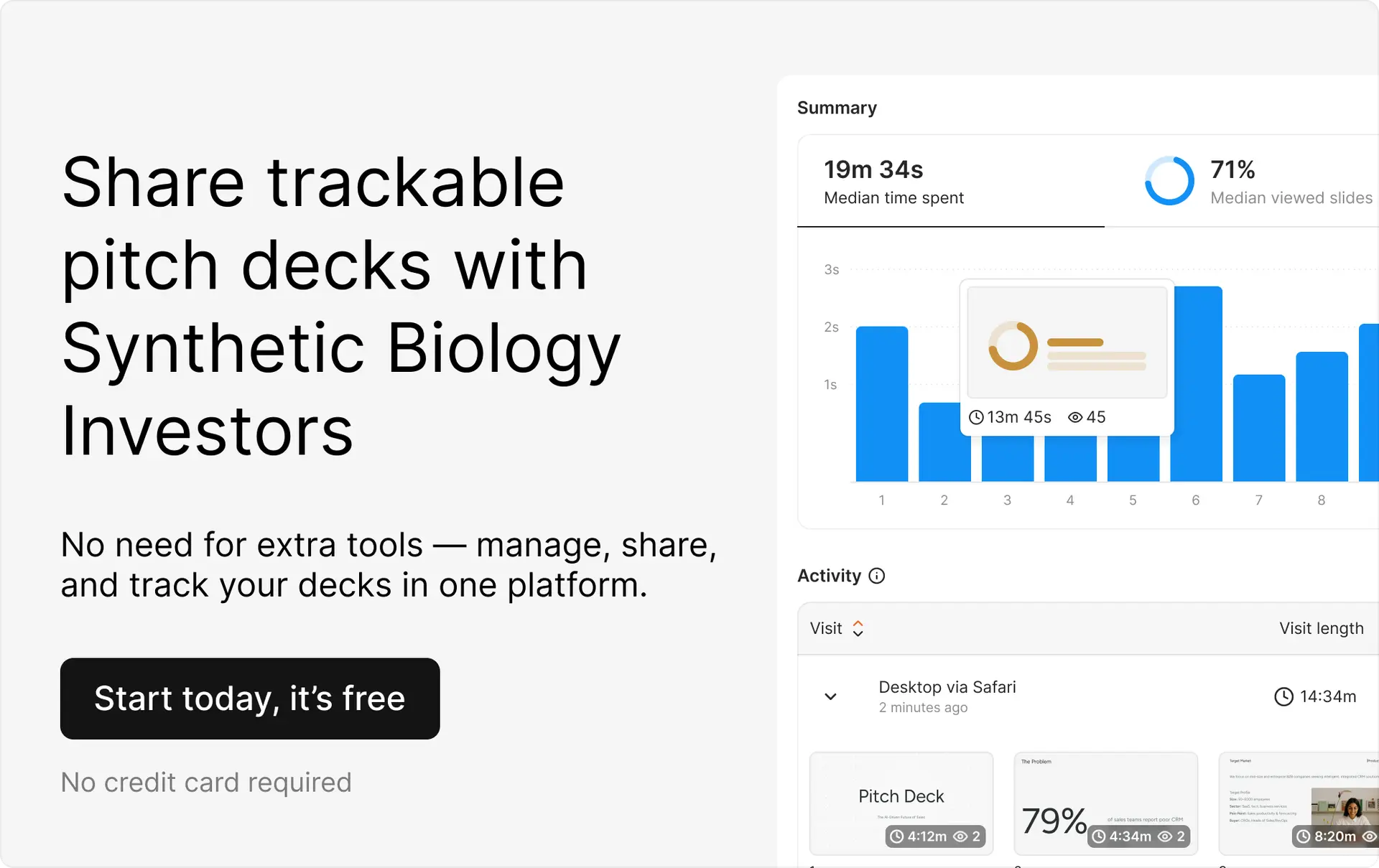
Share your pitch deck through Ellty with trackable links. Monitor which pages investors spend time on - if they skip your techno-economic model, that's useful information.
Utilize your network by asking scientists at their portfolio companies which investors actually understand strain engineering. They've sat through enough technical diligence to know who asks smart questions.
Attend networking events like SynBioBeta or the BIO International Convention where deals actually happen. Skip generic startup mixers.
Engage on online platforms by connecting with partners on LinkedIn after you've met them at a conference or through a warm intro. Cold DMs rarely work for deep tech. Track which investors re-engage with your updates using Ellty.
Organize due diligence materials before first meetings since synbio requires more technical validation than software. Set up an Ellty data room with your fermentation data, strain stability testing, and offtake agreements before they ask. It speeds up the process. Use pricing page to select a plan suited for frequent diligence cycles.
Set up introductory meetings leading with your production metrics and partnership pipeline. Don't waste 20 minutes on market size slides about plastic pollution they've seen 100 times.
Why this matters now
2025 saw Perfect Day products in Starbucks and Spiber materials in North Face jackets. Commercial proof points matter more than lab data to investors. The Inflation Reduction Act's biomanufacturing credits made US production economics work, driving $4.2B in new synbio deals. Ginkgo's valuation drop from $15B to under $1B scared away crossover funds, which helped serious biotech investors find better deals. For larger investment memos, our PDF guidance helps ensure smooth delivery.
FDA approved three synbio ingredients in 2025 alone, down from years of regulatory uncertainty. Investors who sat on the sidelines through 2021-2023 are writing checks again now that products are actually shipping.


18 best synthetic biology investors
1. DCVC Bio
They only invest in deep tech bio and understand fermentation economics better than most.
- Recent Deals: Synonym ($30M Series A, 2025), Solugen (multiple rounds including $357M Series D, 2024), Arzeda ($32M Series C, 2025)
- LinkedIn: DCVC Bio
- Sector Focus: Precision fermentation, biomanufacturing, industrial biotech, carbon-negative chemicals
- Stage Focus: Series A, Series B, Series C
- Location: San Francisco, USA
- Website: dcvc.com/bio
2. Lux Capital
Early-stage deep tech fund that backed Ginkgo at $30M valuation before it went public.
- Recent Deals: Synonym ($30M Series A, 2025), Synonym ($12M seed, 2023), Zymergen restructuring investment
- LinkedIn: Lux Capital
- Sector Focus: Cell-free manufacturing, enzyme engineering, metabolic engineering, synthetic genomics
- Stage Focus: Seed, Series A, Series B
- Location: New York, USA
- Website: luxcapital.com
3. Khosla Ventures
Backs moonshot bio companies and has patience for long development timelines.
- Recent Deals: Perfect Day ($350M Series D, 2024), NotCo ($235M Series D, 2022), Culture Biosciences ($25M Series B, 2024)
- LinkedIn: Khosla Ventures
- Sector Focus: Alt protein, precision fermentation, dairy alternatives, bioreactor technology
- Stage Focus: Series A, Series B, Series C, Growth
- Location: Menlo Park, USA
- Website: khoslaventures.com
4. Breakthrough Energy Ventures
Gates-backed fund with $2B+ under management focused on carbon reduction tech.
- Recent Deals: LanzaTech ($200M pre-IPO, 2024), Pivot Bio ($100M Series D, 2023), CarbonCure ($80M Series C, 2024)
- LinkedIn: Breakthrough Energy Ventures
- Sector Focus: Carbon capture fermentation, nitrogen fixation, industrial emissions reduction
- Stage Focus: Series B, Series C, Growth
- Location: Seattle, USA
- Website: breakthroughenergy.org
5. Cantos Ventures
Deep tech fund that only backs companies with PhDs solving hard problems.
- Recent Deals: Solugen ($357M Series D, 2024), Arzeda ($32M Series C, 2025), Allonia ($20M Series A, 2024)
- LinkedIn: Cantos Ventures
- Sector Focus: Industrial chemicals, carbon-negative manufacturing, enzyme design, synthetic pathways
- Stage Focus: Series A, Series B, Series C
- Location: Austin, USA
- Website: cantos.vc
6. IndieBio
Accelerator that funds 50+ synbio companies per year with lab space and equipment.
- Recent Deals: Geltor ($91M Series B, 2021), MycoWorks ($125M Series C, 2021), Prellis Biologics ($14M Series A, 2024)
- LinkedIn: IndieBio
- Sector Focus: Biomaterials, alt protein, bioprinting, cellular agriculture, mycelium
- Stage Focus: Pre-seed, Seed
- Location: San Francisco, USA
- Website: indiebio.co
7. Fifty Years
Climate fund that backs nature-based and synthetic biology solutions.
- Recent Deals: Living Carbon ($15M Series A, 2024), Pivot Bio (follow-on investment, 2023), soil microbiome startups
- LinkedIn: Fifty Years
- Sector Focus: Enhanced photosynthesis, soil microbiomes, carbon sequestration, agricultural biotech
- Stage Focus: Seed, Series A, Series B
- Location: San Francisco, USA
- Website: fifty.vc

8. Planet A Ventures
European climate fund that co-invests in US synbio deals with European offtake potential.
- Recent Deals: Cambrium ($20M Series A, 2024), Hoxton Farms ($22M Series A, 2024), Formo (multiple rounds)
- LinkedIn: Planet A Ventures
- Sector Focus: Biomaterials, alt protein, circular economy, European market entry
- Stage Focus: Seed, Series A, Series B
- Location: Berlin, Germany
- Website: planet-a.com
9. Lowercarbon Capital
Climate fund that backs controversial tech other VCs avoid including GMOs.
- Recent Deals: Cemvita Factory ($20M Series B, 2024), Upside Foods (follow-on), Living Carbon (co-investor)
- LinkedIn: Lowercarbon Capital
- Sector Focus: Carbon-negative biology, oil-eating microbes, methane conversion, unusual applications
- Stage Focus: Seed, Series A, Series B
- Location: San Francisco, USA
- Website: lowercarboncapital.com
10. iSelect Fund
Only fund exclusively focused on synthetic biology across all applications.
- Recent Deals: Arzeda ($32M Series C, 2025), Zymergen restructuring, multiple enzyme design companies
- LinkedIn: iSelect Fund
- Sector Focus: Enzyme engineering, metabolic engineering, platform technologies, computational biology
- Stage Focus: Series A, Series B, Series C
- Location: San Francisco, USA
- Website: iselectfund.com
11. Alchemist Accelerator
Enterprise-focused accelerator that backs synbio companies with B2B business models.
- Recent Deals: Geltor (early investor), Mythic Materials ($3M seed, 2024), multiple ingredient suppliers
- LinkedIn: Alchemist Accelerator
- Sector Focus: B2B ingredients, materials, industrial biotech, CPG partnerships
- Stage Focus: Pre-seed, Seed
- Location: San Francisco, USA
- Website: alchemistaccelerator.com
12. Refactor Capital
Early-stage fund that backs technical founders before they have fermentation data.
- Recent Deals: Multiple cell-free systems startups (2024-2025), DNA synthesis companies, enzyme platforms
- LinkedIn: Refactor Capital
- Sector Focus: Cell-free manufacturing, DNA synthesis, computational design, platform technologies
- Stage Focus: Pre-seed, Seed
- Location: San Francisco, USA
- Website: refactor.com
13. Third Sphere
Consumer and climate fund that understands CPG brand partnerships.
- Recent Deals: Nobell Foods ($75M Series B, 2024), Eclipse Foods ($40M Series B, 2022)
- LinkedIn: Third Sphere
- Sector Focus: Alt dairy, plant-based proteins, consumer ingredients, CPG partnerships
- Stage Focus: Series A, Series B, Growth
- Location: San Francisco, USA
- Website: thirdsphere.com
14. PBL Ventures
Dutch fund backing European synbio companies with US market expansion plans.
- Recent Deals: Upstream Foods ($14M Series A, 2024), Formo (follow-on), Mosa Meat (growth round)
- LinkedIn: PBL Ventures
- Sector Focus: Alt protein, cultivated meat, European regulatory pathways, transatlantic expansion
- Stage Focus: Seed, Series A, Series B
- Location: Amsterdam, Netherlands
- Website: pbl.ventures
15. Congruent Ventures
Infrastructure and climate fund that backs synbio solving waste problems.
- Recent Deals: Mango Materials ($10M Series A, 2023), methane-to-chemicals startups
- LinkedIn: Congruent Ventures
- Sector Focus: Waste-to-value, methane conversion, circular economy, industrial symbiosis
- Stage Focus: Seed, Series A, Series B
- Location: Boston, USA
- Website: congruentvc.com
16. Better Ventures
Consumer-focused fund backing synbio brands that sell direct to consumer.
- Recent Deals: Geltor (follow-on), MycoWorks (follow-on), Perfect Day (early rounds)
- LinkedIn: Better Ventures
- Sector Focus: Consumer brands, DTC synbio, biomaterials in consumer products, alt protein
- Stage Focus: Seed, Series A, Series B
- Location: San Francisco, USA
- Website: better.vc
17. Collaborative Fund
Consumer and climate fund with portfolio companies using Spiber materials.
- Recent Deals: Allbirds (uses Spiber materials), The Very Good Food Company, consumer synbio brands
- LinkedIn: Collaborative Fund
- Sector Focus: Consumer applications, fashion tech, biomaterials in apparel, brand partnerships
- Stage Focus: Seed, Series A, Series B
- Location: New York, USA
- Website: collaborativefund.com
18. Horizons Ventures
Hong Kong-based fund that backed Perfect Day and Memphis Meats before alt protein was mainstream.
- Recent Deals: Perfect Day (early rounds), Impossible Foods (multiple rounds), Upside Foods (early investor)
- LinkedIn: Horizons Ventures
- Sector Focus: Alt protein, precision fermentation, cultivated meat, Asia market entry
- Stage Focus: Series A, Series B, Series C, Growth
- Location: Hong Kong
- Website: horizonsventures.com
Track which investors actually read your fermentation data


These 18 investors closed synbio deals from 2024 to 2026. Before you start reaching out, set up proper tracking.
Upload your deck to Ellty and create a unique link for each investor. You'll see exactly which slides they view and how long they spend on your techno-economic analysis. Most synbio founders are surprised to learn investors skip the science slides but spend 10+ minutes on production costs and partnership pipeline.
When investors ask for technical validation data, share an Ellty data room instead of messy email threads. Your fermentation performance data, strain stability testing, and offtake agreements in one secure place with view analytics.
Common questions
How do I know if an investor actually understands synthetic biology?
Ask which CDMOs they've introduced portfolio companies to. Generic answers about "our network" mean they don't have manufacturing relationships. Check if their portfolio companies reached commercial production or died in pilot scale.
Should I pitch generalist VCs or synbio-focused investors?
Synbio-focused funds understand why fermentation takes 3-4 years to scale. Generalist VCs often expect software-like margins that don't exist in biomanufacturing. If you're building a consumer brand using synbio ingredients, consumer VCs work fine.
What's the difference between seed and Series A synbio investors?
Seed investors will fund you with lab-scale data and pathway design. Series A investors need 5L fermentation data and preliminary techno-economic models showing path to commercial COGS. Don't pitch Series A before you have bioreactor data.
How much fermentation data do I need before raising Series A?
Repeatable performance at 5L scale minimum. Investors want to see titer, rate, and yield numbers with strain stability over 10+ generations. One successful batch isn't enough to prove your strain works.
When should I set up a data room for synbio due diligence?
Before your first institutional investor meeting. Synbio requires more technical validation than software. Have your fermentation data, analytical chemistry results, and IP filings ready. Technical diligence takes 2-3 months.
Do investors care about which pages of my deck they view?
Yes, especially for deep tech. Use Ellty to track which sections investors review multiple times. If they keep going back to your techno-economic model, that's a buying signal. If they skip your fermentation data, they don't believe the biology works.