San Francisco robotics companies raised $4.8B across 120+ deals in 2025. Most capital went to warehouse automation and humanoid robotics. The Bay Area has more robotics engineers per capita than anywhere else, but hardware is still harder to fund than SaaS. You'll need working prototypes and pilot customers before Series A - no one funds robotics on slides anymore.
Quick list
Lux Capital (San Francisco): Led Figure AI's $675M Series B for humanoid robots in Bay Area manufacturing
DCVC (San Francisco): Backed Anduril's $1.5B round for defense robotics and autonomous systems
Eclipse Ventures (Palo Alto): Led Veo Robotics $29M Series B for manufacturing safety systems
Playground Global (Palo Alto): Funded Zipline's drone delivery expansion across California warehouses
Root Ventures (San Francisco): Backed Bright Machines at Series C for intelligent factory automation
FoundersX Ventures (San Francisco): Led robotics infrastructure plays serving Bay Area manufacturers
Calibrate Ventures (Menlo Park): Funded warehouse automation startups in South Bay logistics hubs
Khosla Ventures (Menlo Park): Backed agricultural robotics companies deploying in California fields
SOSV (San Francisco): Led HAX accelerator cohorts with 40+ hardware startups annually
Toyota AI Ventures (Los Altos): Funded autonomous vehicle and mobility robotics companies in Bay Area
Bolt (San Francisco): Backed consumer robotics products from prototype to manufacturing
Comet Labs (San Francisco): Led AI robotics startups combining machine learning with hardware
AV8 Ventures (Menlo Park): Funded aviation and aerospace robotics companies near SF
True Ventures (San Francisco): Backed early-stage robotics platforms with strong founder networks
Data Collective (San Francisco): Led industrial AI and robotics deals with technical due diligence
Lemnos Labs (San Francisco): Funded hardware-first robotics companies through dedicated accelerator program
Why San Francisco for robotics fundraising
San Francisco and the Bay Area have 60+ active robotics investors within a 20-mile radius. Average seed round is $4-6M and Series A is $15-25M, both significantly higher than robotics deals in Boston or Austin. You need that extra capital because hardware burns cash faster than software.
The Bay Area advantage is access to manufacturing partners in Fremont, San Jose, and Oakland. Most SF robotics investors have relationships with contract manufacturers and can intro you to facilities that understand low-volume production runs. Tesla, Google, and Apple all built robotics teams here, so the talent pool for mechanical engineers and roboticists is deep.
Hardware still scares most VCs. You'll pitch 50+ investors to close a seed round versus 20 for SaaS. SF robotics investors understand unit economics, supply chain risk, and manufacturing timelines better than coastal generalists. But they also expect faster progress - no one wants to fund 3 years of R&D before revenue anymore.
Picking the right San Francisco robotics investor
Local presence matters more in robotics than pure software because investors want to see your lab and touch your hardware. Most SF robotics deals happen after facility tours where investors watch live demos. Remote fundraising works for Series B+ once you have deployed units, but seed rounds need hands-on evaluation.
Portfolio companies reveal specialization that matters in hardware. Check if they've backed warehouse automation versus manufacturing versus agriculture. Those require completely different expertise in contracts, pilots, and unit economics. Look for investors with 3-4 robotics exits, not just current investments. Hardware takes 7-10 years to exit, so track record matters more than in software.
Check sizes in SF robotics range from $2M pre-seed to $30M Series B. Dedicated hardware funds like Lux and Eclipse write $8-15M Series A checks. Generalist funds typically do $3-5M seeds then need specialist co-investors for follow-ons. Industrial robotics raises 40-50% more than consumer robotics at every stage because enterprise contracts are more predictable.
Local network in SF robotics means intros to Tesla engineers considering startups, Waymo technical leads, and Boston Dynamics alumni in the Bay Area. The best SF robotics investors can connect you to contract manufacturers in San Jose and Fremont who'll take small production runs. Use our trackable links when sharing your deck so you know which investors actually review your pilot deployment data before meetings.
Follow-on capacity is critical because robotics companies need 3-4 funding rounds before they're capital efficient. Ask explicitly if your target investor leads Series B and C. Most SF robotics funds reserve 60-70% for follow-ons since hardware roadmaps always take longer than projected. If they can't lead your next two rounds, you'll waste 6 months finding new investors while burning $500K+ monthly.
How to find and approach San Francisco robotics investors
Research local deals by tracking TechCrunch robotics coverage and checking PitchBook for Bay Area hardware investments in 2025. Cross-reference investor names with RoboBusiness conference attendee lists. Most SF robotics investors attend RoboBusiness and IROS when it's in the Bay Area. Don't pitch funds that haven't done robotics deals since 2022 - they've moved on.
Leverage local ecosystem through HAX Demo Days even if you're not in their accelerator. SOSV's network connects you to manufacturing partners and technical advisors other accelerators can't access. Berkeley's SkyDeck and Stanford's StartX both have robotics tracks with investor connections. Most SF robotics intros happen through university labs, not cold outreach.
Build relationships first because SF robotics investors evaluate 30+ hardware companies monthly but only fund 1-2 annually. They need to see your progress over 4-6 months before they'll seriously consider investing. Invite them to quarterly demos at your lab. Send monthly updates showing pilot deployments and manufacturing milestones. Hardware investors want to see iteration speed, not just the final product.
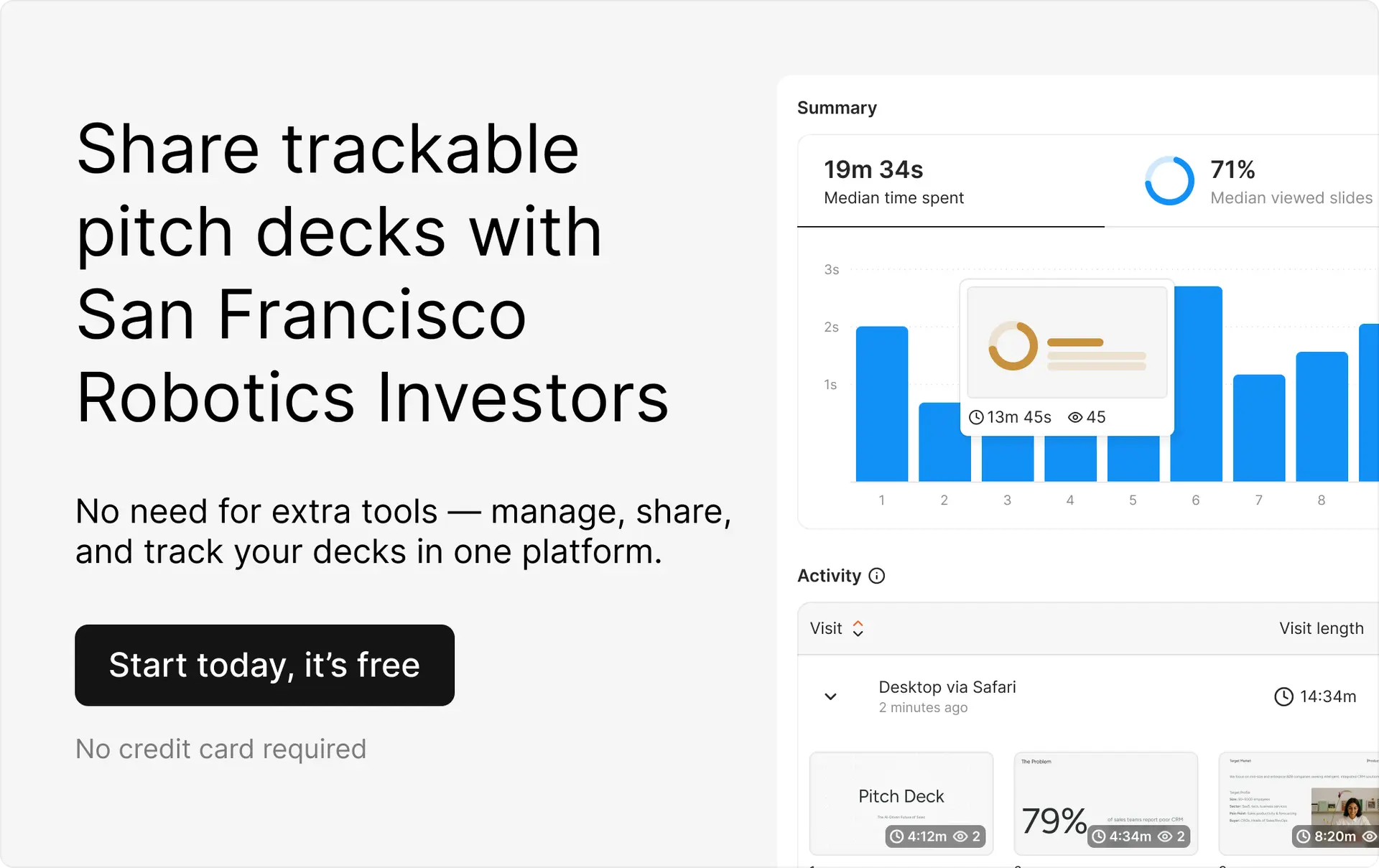
Share your pitch deck through Ellty with unique tracking links for each SF investor. You'll see exactly who opens your deck and how long they spend on your manufacturing roadmap versus market size. Most robotics investors skip straight to your bill of materials, unit economics at scale, and deployment timeline slides. Share real video of your robot working, not renderings.
Attend local events including RoboBusiness in San Jose and the IEEE IROS conference when it rotates to the Bay Area. Those two events generate 40%+ of SF robotics investor meetings. Berkeley's CITRIS Foundry hosts regular robotics showcases where investors scout. Skip generic startup events - robotics investors don't attend those.
Connect with portfolio founders from your target investors' robotics portfolios on LinkedIn. Most hardware founders openly share their fundraising timelines and investor experience because the community is small. They'll tell you which funds actually understand manufacturing delays and which ones panic when you push Series A by 4 months for pilot testing.
Organize due diligence materials in an Ellty data room before investor meetings. SF robotics investors need to see your CAD files, bill of materials, supplier contracts, and safety certifications immediately. Technical due diligence for hardware takes 6-8 weeks versus 2-3 for software. Having organized documentation signals you understand compliance requirements that kill most robotics deals.
Understand local pace because SF robotics deals close in 6-9 months for Series A, twice as long as SaaS rounds. Investors need to visit your facility, meet your manufacturing partners, and reference-check your pilot customers. Budget 12-15 investor meetings before term sheets. Most SF robotics funds want their technical partners to evaluate your hardware independently, which adds 3-4 weeks to timelines. Pitch decks often serve as a reference long after the meeting ends.
San Francisco robotics considerations
SF robotics investors split into two groups - former mechanical engineers who understand hardware constraints and former software VCs who want SaaS-like margins. The first group funds realistically and accepts longer timelines. The second group pushes for impossible unit economics and pivots to software-only solutions mid-investment. Figure out which camp your target investor is in before pitching.
Industrial robotics raises 3x faster than consumer robotics in SF because B2B pilots provide clear ROI data. Consumer robotics hasn't recovered from the 2017-2019 hype cycle when home robots all failed. You'll need exceptional founders and working units in 1,000+ homes before SF investors take consumer robotics seriously again. Most funds now require $1M+ revenue before Series A for any robotics company.
Warehouse automation gets funded most easily in SF because Amazon, Target, and Walmart all test robotics in Bay Area facilities. Manufacturing automation is second since Bay Area still has active factories in San Jose and Fremont. Agricultural robotics works if you're deploying in California's Central Valley. Humanoid robotics raised significant capital in 2025 but 90% went to Figure AI and two other companies. Don't expect humanoid funding unless you have exceptional technical pedigree.


16 top robotics investors in San Francisco
1. Lux Capital
Lux led the largest robotics rounds in SF history and their partners deeply understand physics and hardware constraints.
- Recent Deals: Figure AI $675M Series B (2025), Anduril growth rounds (2024-2025), Epirus defense tech Series C (2024)
- LinkedIn: Josh Wolfe
- Sector Focus: Humanoid robotics, defense automation, manufacturing systems, autonomous platforms
- Stage Focus: Series A, Series B, Series C, Growth
- Office Location: Financial District, San Francisco
- Website: luxcapital.com
2. DCVC
DCVC backs deep tech robotics with technical due diligence most VCs can't perform themselves.
- Recent Deals: Anduril $1.5B round (2025), Zipline drone delivery expansion (2024), industrial AI robotics (2025)
- LinkedIn: Zachary Bogue
- Sector Focus: Defense robotics, autonomous systems, industrial automation, AI-powered hardware
- Stage Focus: Series A, Series B, Growth
- Office Location: Embarcadero, San Francisco
- Website: dcvc.com
3. Eclipse Ventures
Eclipse specializes in industrial automation and has more manufacturing expertise than any SF fund.
- Recent Deals: Veo Robotics $29M Series B (2024), Factory AI platforms (2025), manufacturing automation tools
- LinkedIn: Lior Susan
- Sector Focus: Manufacturing automation, industrial robotics, factory systems, supply chain automation
- Stage Focus: Series A, Series B, Series C
- Office Location: Palo Alto
- Website: eclipse.vc
4. Playground Global
Playground provides hands-on hardware support and has an in-house engineering team that helps portfolio companies.
- Recent Deals: Zipline drone expansion (2024-2025), consumer robotics platforms, autonomous delivery systems
- Sector Focus: Autonomous delivery, consumer robotics, drone systems, logistics automation
- Stage Focus: Seed, Series A, Series B
- Office Location: Palo Alto
- Website: playground.global
5. Root Ventures
Root backs technical founders building robotics infrastructure and avoids consumer hardware hype.
- Recent Deals: Bright Machines Series C (2024), factory automation tools (2025), robotics component suppliers
- Sector Focus: Factory automation, robotics components, industrial systems, manufacturing infrastructure
- Stage Focus: Seed, Series A
- Office Location: SOMA, San Francisco
- Website: root.vc
6. FoundersX Ventures
FoundersX focuses on B2B robotics infrastructure serving manufacturers and logistics companies.
- Recent Deals: Warehouse robotics platforms (2025), logistics automation tools (2024), industrial software for robots
- Sector Focus: Warehouse automation, logistics robotics, industrial software, robotics fleet management
- Stage Focus: Seed, Series A
- Office Location: Mission Bay, San Francisco
- Website: foundersx.com
7. Calibrate Ventures
Calibrate invests in South Bay robotics companies and understands Silicon Valley manufacturing ecosystems.
- Recent Deals: Warehouse robotics startups (2024-2025), logistics automation, supply chain systems
- Sector Focus: Warehouse automation, logistics systems, supply chain robotics, fulfillment automation
- Stage Focus: Seed, Series A, Series B
- Office Location: Menlo Park
- Website: calibratevc.com

8. Khosla Ventures
Khosla backs moonshot robotics projects and agricultural automation deploying across California.
- Recent Deals: Agricultural robotics companies (2025), autonomous farming systems (2024), food production automation
- Sector Focus: Agricultural robotics, autonomous vehicles, climate tech automation, food production systems
- Stage Focus: Series A, Series B, Growth
- Office Location: Menlo Park
- Website: khoslaventures.com
9. SOSV
SOSV runs HAX accelerator with 40+ hardware startups annually and provides hands-on manufacturing support.
- Recent Deals: HAX cohort companies (2024-2025), consumer robotics platforms, industrial automation tools
- Sector Focus: Consumer robotics, industrial automation, IoT robotics, hardware prototyping
- Stage Focus: Pre-seed, Seed
- Office Location: Embarcadero, San Francisco
- Website: sosv.com
10. Toyota AI Ventures
Toyota AI Ventures backs autonomous mobility and robotics with access to Toyota's global manufacturing network.
- Recent Deals: Autonomous vehicle platforms (2025), mobility robotics (2024), last-mile delivery systems
- Sector Focus: Autonomous vehicles, mobility robotics, transportation automation, delivery systems
- Stage Focus: Series A, Series B, Growth
- Office Location: Los Altos
- Website: toyota.ai
11. Bolt
Bolt provides manufacturing resources and helps robotics founders navigate contract manufacturing in Asia.
- Recent Deals: Consumer robotics products (2024-2025), home automation devices, personal robots
- Sector Focus: Consumer robotics, home automation, personal assistant robots, IoT devices
- Stage Focus: Seed, Series A
- Office Location: Russian Hill, San Francisco
- Website: bolt.io
12. Comet Labs
Comet backs AI-first robotics companies combining machine learning with hardware systems.
- Recent Deals: AI robotics platforms (2025), computer vision systems for robots (2024), ML-powered automation
- Sector Focus: AI robotics, computer vision, machine learning hardware, autonomous systems
- Stage Focus: Seed, Series A
- Office Location: Presidio, San Francisco
- Website: comet.vc
13. AV8 Ventures
AV8 specializes in aviation and aerospace robotics with technical partners from the aerospace industry.
- Recent Deals: Aviation automation systems (2024-2025), drone platforms, aerospace manufacturing tools
- Sector Focus: Aviation automation, aerospace robotics, drone systems, aircraft manufacturing automation
- Stage Focus: Seed, Series A, Series B
- Office Location: Menlo Park
- Website: av8.vc
14. True Ventures
True backs technical founding teams early and has strong robotics portfolio despite being generalist fund.
- Recent Deals: Industrial robotics platforms (2024), warehouse automation (2025), logistics systems
- Sector Focus: Industrial automation, warehouse robotics, logistics systems, enterprise robotics
- Stage Focus: Seed, Series A
- Office Location: Jackson Square, San Francisco
- Website: trueventures.com
15. Data Collective
Data Collective performs deep technical due diligence and backs robotics companies solving hard physics problems.
- Recent Deals: Industrial AI robotics (2024-2025), autonomous systems, manufacturing automation platforms
- Sector Focus: Industrial AI, autonomous platforms, manufacturing systems, robotics infrastructure
- Stage Focus: Series A, Series B
- Office Location: Financial District, San Francisco
- Website: dcvc.com
16. Lemnos Labs
Lemnos runs a hardware-focused accelerator and provides technical resources most seed funds can't offer.
- Recent Deals: Hardware accelerator cohorts (2024-2025), robotics prototypes, early-stage automation tools
- Sector Focus: Hardware prototyping, early robotics, industrial tools, automation components
- Stage Focus: Pre-seed, Seed
- Office Location: Dogpatch, San Francisco
- Website: lemnos.vc
Start tracking your San Francisco robotics investor outreach


These 16 investors closed SF robotics deals in 2025-2026. Before you start reaching out to Bay Area hardware funds, set up proper tracking.
Upload your deck to Ellty and create a unique link for each San Francisco robotics investor. You'll see exactly which slides they view and how long they spend on your manufacturing roadmap versus market opportunity. SF robotics investors typically skip your team slide and jump straight to bill of materials, unit economics at scale, and deployment timelines.
When San Francisco investors ask for technical documentation during diligence, share an Ellty data room instead of Google Drive folders. Your CAD files, manufacturing contracts, safety certifications, and pilot deployment data in one secure place with view analytics. Most SF robotics deals require 8-12 weeks of technical due diligence, so organized documentation speeds up term sheet negotiations.
Common questions
Do I need to be in San Francisco to raise from SF robotics investors?
Yes, for seed and Series A rounds. Robotics investors want to visit your lab, see live demos, and meet your engineering team in person. You can raise remotely once you have deployed units and pilot customers generating revenue. Plan to spend 3-4 weeks in the Bay Area taking back-to-back investor meetings and facility tours.
How does San Francisco compare to Boston for robotics fundraising?
SF has more total robotics capital but Boston has deeper manufacturing expertise from legacy industrial companies. SF investors push for faster growth and software-like margins. Boston accepts hardware realities better. Defense robotics raises easier in SF. Traditional industrial automation raises easier in Boston. Both markets are equally competitive.
What's the average Series A size for SF robotics companies?
$15-25M for industrial robotics and $10-18M for consumer robotics platforms. Warehouse automation and humanoid robotics raise at the high end. Agricultural robotics struggles to break $12M unless you have 50+ deployed units. That's 60% higher than robotics Series A rounds in Austin or Denver.
Should I raise locally or pitch SF investors from another city?
Raise in SF if you're building industrial automation, humanoid robotics, or autonomous systems. The capital concentration and manufacturing network is worth relocating for. Stay local if you have strong manufacturing partnerships in another region - Detroit for automotive robotics, Boston for medical robotics, or Pittsburgh for logistics automation.
What types of robotics get funded most in San Francisco?
Warehouse automation and industrial robotics dominate SF funding in 2025-2026. Humanoid robotics raised significant capital but 90% went to three companies. Autonomous delivery systems get funded consistently. Consumer home robots struggle unless you have exceptional founder pedigree. Agricultural robotics works if deploying in California's Central Valley with clear ROI data.