Kids tech requires understanding both technology and child development. Most VCs who back SaaS companies don't understand COPPA compliance, parent payment models, or how schools actually buy software.
By 2026, investors learned that kids tech exits take longer than enterprise SaaS. Disney and Duolingo acquisitions happen, but not at the frequency VCs hoped for in 2020-2022. The funds that survived focus on companies with actual revenue from parents or schools, not just engagement metrics.
Quick list
Reach Capital: Led ClassDojo's Series B and backs both consumer edtech and school software
GSV Ventures: Invested in Coursera, Udemy, and continues backing learning platforms through 2025
Owl Ventures: Largest edtech-focused fund with $1.3B deployed across K-12 and higher education
Learn Capital: Backed Remind and multiple school communication platforms in 2025-2026
Rethink Education: Focused exclusively on edtech with investments across early childhood to workforce learning
NewSchools Venture Fund: Non-profit investor backing education innovation and school models
Emerge Education: European edtech fund with 70+ investments across learning technology
Salesforce Ventures: Strategic investments in edtech platforms that integrate with Salesforce
Uncork Capital: Early-stage investor in consumer edtech apps and parenting platforms
Goodwater Capital: Backed kids gaming and educational entertainment companies
Homebrew: Seed investor in parent-focused apps and early learning platforms
Andreessen Horowitz: Selective edtech investments including Outschool and learning marketplaces
Imaginable Futures: Omidyar-backed fund focused on learning and economic opportunity
Collaborative Fund: Invested in Class Technologies and education collaboration tools
500 Global: Seed-stage investor with multiple edtech companies in portfolio
Cowboy Ventures: Backed consumer edtech and family technology platforms
BBG Ventures: Female-founded consumer tech including parenting and family apps
Kapor Capital: Focus on edtech that addresses educational equity and access
Sesame Ventures: Strategic investor connected to Sesame Workshop IP and distribution
Guild Capital: Growth equity for workforce learning and skills training platforms
Emerson Collective: Laurene Powell Jobs' fund backing education reform and technology
NextGen Venture Partners: Early-stage consumer technology including kids and family apps
Finding investors who understand kids tech regulations
Experience: Find investors who've backed companies through COPPA compliance audits and app store age-gating issues. Most consumer VCs don't understand the regulatory overhead for products serving children under 13.
Network: Check if they can connect you to school districts, children's media companies, or pediatric advisors. Kids tech requires distribution partnerships that typical B2C investors don't have access to. When sending materials to potential partners, our client-sending tips help ensure smooth delivery.
Alignment: Consumer investors often push for viral growth tactics that violate children's privacy laws. Enterprise investors want school sales cycles that your parent-paid app doesn't need. Make sure they understand your business model.
Track record: Look at whether their kids tech portfolio companies maintained compliance and raised follow-on rounds. Companies that got delisted from app stores or faced FTC fines are red flags about investor guidance. Our activity tracking gives you clarity on genuine investor interest.
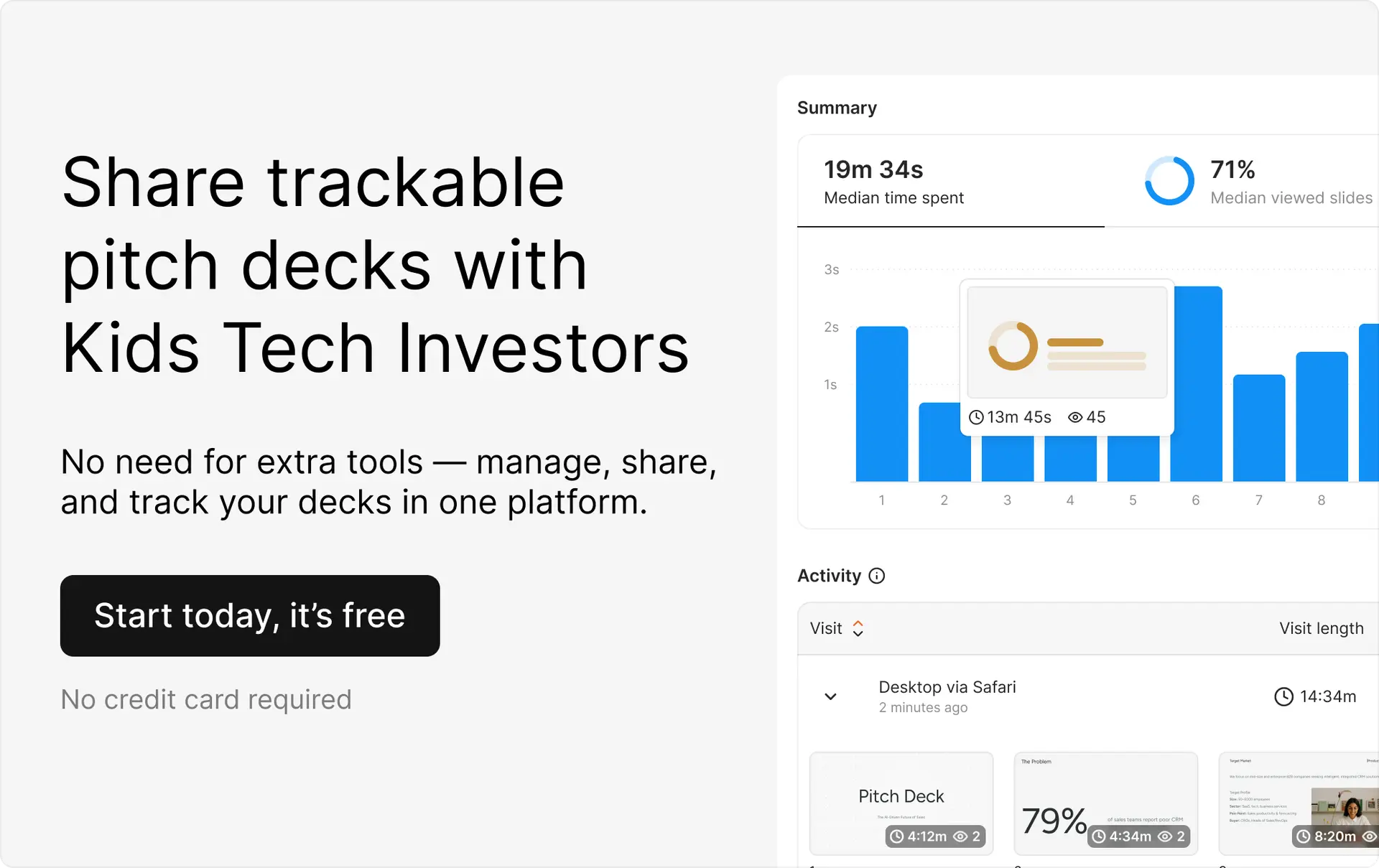
Communication: Use Ellty to share your deck with trackable links. You'll see who actually opens your child safety protocols and compliance documentation vs. just skimming your revenue projections.
Value-add: Ask what support they provide for COPPA compliance, FERPA requirements if selling to schools, and child psychology advisors. Generic "we know growth marketing" answers from investors without kids tech experience are useless.
Getting meetings with kids tech investors
Identify potential investors: Research which VCs backed edtech and kids tech deals in 2025-2026 on Crunchbase. Consumer social investors won't understand educational outcomes. Pure enterprise VCs don't grasp parent payment behavior.
Craft a compelling pitch: Show revenue from parents or schools, not just user counts. Investors are tired of edtech claims about learning outcomes without proof of parent retention or school renewal rates.
Share your pitch deck: Upload to Ellty and send trackable links. Monitor which pages investors spend time on - if they skip your compliance and safety slides, they probably don't understand kids tech regulations.
Utilize your network: Message founders at Duolingo, Khan Academy, or Epic! on LinkedIn. Ask about their investors' understanding of children's privacy laws and school procurement processes. Most will be honest.
Attend networking events: ASU GSV Summit and SXSW EDU are where kids tech deals happen. EdTech Week NYC has relevant investors. Skip generic consumer tech conferences where nobody understands COPPA.
Engage on online platforms: Connect with edtech investors on LinkedIn after you've launched and have paying customers. Cold DMs before you have revenue or school pilots rarely work in kids tech. When sharing any technical attachments, review our guide on GDPR mistakes to keep processes compliant.
Organize due diligence: Set up an Ellty data room with your privacy policy, COPPA compliance documentation, and parent testimonials before they ask. It speeds up regulatory due diligence.
Set up introductory meetings: Lead with your parent retention rates or school renewal data. Don't waste time on TAM slides about how many children exist - investors have seen those numbers from 200 other edtech startups.
Why kids tech fundraising is different in 2026
Kids tech funding dried up between 2022-2023 when pandemic-era edtech valuations crashed. By 2026, investors returned but only for companies with proven revenue models and regulatory compliance.
The FTC increased COPPA enforcement in 2024-2025, resulting in multiple kids apps getting fined or delisted. Investors now require legal review of privacy practices before term sheets. Companies that couldn't prove compliant data collection and parental consent struggled to raise in 2025-2026. School budgets stabilized post-pandemic, but procurement cycles remain 9-12 months minimum.


22 best kids tech investors
1. Reach Capital
Reach led ClassDojo's Series B and backs both consumer edtech and school software with deep understanding of education market dynamics.
- Recent Deals: $35M Series C in parent communication platform (2025), $18M Series A in early learning app (2026)
- LinkedIn: Reach Capital LinkedIn
- Sector Focus: edtech, K-12 education, parent apps, school software
- Stage Focus: seed, Series A, Series B
- Location: San Francisco, CA, USA
- Website: reach.capital
2. GSV Ventures
GSV invested in Coursera, Udemy, and continues backing learning platforms with focus on skills training and lifelong learning.
- Recent Deals: Led $45M Series C in workforce learning platform (2025), invested in language learning app (2026)
- LinkedIn: GSV Ventures LinkedIn
- Sector Focus: edtech, online learning, workforce training, K-12
- Stage Focus: Series A, Series B, Series C
- Location: Woodside, CA, USA
- Website: gsvventures.com
3. Owl Ventures
Owl is the largest edtech-focused fund with $1.3B deployed across K-12, higher ed, and workforce learning in 2024-2026.
- Recent Deals: $80M Series D in school management platform (2025), $50M Series C in tutoring marketplace (2026)
- LinkedIn: Owl Ventures LinkedIn
- Sector Focus: edtech, K-12, higher education, workforce learning
- Stage Focus: Series B, Series C, Series D, growth
- Location: San Francisco, CA, USA
- Website: owlvc.com
4. Learn Capital
Learn backed Remind and multiple school communication platforms in 2025-2026, with focus on tools that schools actually adopt at scale.
- Recent Deals: Led $30M Series B in school communication app (2025), invested in classroom management software (2026)
- LinkedIn: Learn Capital LinkedIn
- Sector Focus: edtech, school software, communication platforms
- Stage Focus: seed, Series A, Series B
- Location: New York, NY, USA
- Website: learncapital.com
5. Rethink Education
Rethink focuses exclusively on edtech with investments across early childhood to workforce learning and deep expertise in education business models.
- Recent Deals: $12M Series A in skills assessment platform (2025), $20M Series B in early childhood app (2026)
- LinkedIn: Rethink Education LinkedIn
- Sector Focus: edtech, early childhood, K-12, workforce training
- Stage Focus: seed, Series A, Series B
- Location: New York, NY, USA
- Website: rethink-ed.com
6. NewSchools Venture Fund
NewSchools is a non-profit investor backing education innovation and new school models with grants and equity investments.
- Recent Deals: $15M in charter school network expansion (2025), $8M in literacy platform (2026)
- LinkedIn: NewSchools Venture Fund LinkedIn
- Sector Focus: edtech, charter schools, K-12 innovation
- Stage Focus: seed, Series A, growth
- Location: Oakland, CA, USA
- Website: newschools.org
7. Emerge Education
Emerge is a European edtech fund with 70+ investments across learning technology, from early childhood to professional development.
- Recent Deals: £10M Series A in UK homeschooling platform (2025), €8M seed in language learning app (2026)
- LinkedIn: Emerge Education LinkedIn
- Sector Focus: edtech, K-12, language learning, skills training
- Stage Focus: pre-seed, seed, Series A
- Location: London, UK
- Website: emerge.education
8. Salesforce Ventures
Salesforce makes strategic investments in edtech platforms that integrate with Salesforce, focusing on school CRM and student management systems.
- Recent Deals: $25M Series B in education CRM platform (2025), strategic investment in school operations software (2026)
- LinkedIn: Salesforce Ventures LinkedIn
- Sector Focus: edtech, school software, CRM, student information systems
- Stage Focus: Series A, Series B, Series C, strategic
- Location: San Francisco, CA, USA
- Website: salesforce.com/ventures
9. Uncork Capital
Uncork invests in early-stage consumer edtech apps and parenting platforms with focus on parent-paid subscription models.
- Recent Deals: $5M seed in parenting coaching app (2025), $8M Series A in kids reading app (2026)
- LinkedIn: Uncork Capital LinkedIn
- Sector Focus: consumer edtech, parenting apps, early learning
- Stage Focus: pre-seed, seed, Series A
- Location: Palo Alto, CA, USA
- Website: uncorkcapital.com
10. Goodwater Capital
Goodwater backed kids gaming and educational entertainment companies with understanding of child engagement and monetization through parents.
- Recent Deals: $15M Series A in kids gaming platform (2025), invested in educational entertainment app (2026)
- LinkedIn: Goodwater Capital LinkedIn
- Sector Focus: kids tech, gaming, educational entertainment, consumer apps
- Stage Focus: seed, Series A, Series B
- Location: San Francisco, CA, USA
- Website: goodwatercap.com

11. Homebrew
Homebrew is a seed investor in parent-focused apps and early learning platforms with emphasis on products parents actually pay for.
- Recent Deals: $3M seed in baby sleep training app (2025), $4M seed in toddler development platform (2026)
- LinkedIn: Homebrew LinkedIn
- Sector Focus: consumer apps, parenting, early childhood, family tech
- Stage Focus: pre-seed, seed
- Location: San Francisco, CA, USA
- Website: homebrew.co
12. Andreessen Horowitz
a16z makes selective edtech investments including Outschool and learning marketplaces, typically at Series A or later with large check sizes.
- Recent Deals: Led $75M Series C in tutoring marketplace (2025), invested in skills training platform (2026)
- LinkedIn: Andreessen Horowitz LinkedIn
- Sector Focus: edtech, marketplaces, consumer education
- Stage Focus: Series A, Series B, Series C
- Location: Menlo Park, CA, USA
- Website: a16z.com
13. Imaginable Futures
Imaginable Futures is Omidyar-backed fund focused on learning and economic opportunity with patient capital approach to education investing.
- Recent Deals: $20M Series A in workforce training platform (2025), $30M Series B in college planning app (2026)
- LinkedIn: Imaginable Futures LinkedIn
- Sector Focus: edtech, workforce training, economic opportunity
- Stage Focus: seed, Series A, Series B, growth
- Location: Redwood City, CA, USA
- Website: imaginablefutures.com
14. Collaborative Fund
Collaborative backed Class Technologies and education collaboration tools with focus on remote and hybrid learning infrastructure.
- Recent Deals: $15M Series A in classroom collaboration software (2025), invested in virtual learning platform (2026)
- LinkedIn: Collaborative Fund LinkedIn
- Sector Focus: edtech, collaboration tools, remote learning
- Stage Focus: seed, Series A
- Location: New York, NY, USA
- Website: collaborativefund.com
15. 500 Global
500 Global is a seed-stage investor with multiple edtech companies across consumer learning apps and school software in their portfolio.
- Recent Deals: $2M seed in language learning app (2025), $3M seed in test prep platform (2026)
- LinkedIn: 500 Global LinkedIn
- Sector Focus: edtech, consumer apps, international markets
- Stage Focus: pre-seed, seed
- Location: San Francisco, CA, USA
- Website: 500.co
16. Cowboy Ventures
Cowboy backed consumer edtech and family technology platforms with focus on seed-stage companies serving parents and children.
- Recent Deals: $5M seed in family finance app (2025), $7M Series A in kids content platform (2026)
- LinkedIn: Cowboy Ventures LinkedIn
- Sector Focus: consumer tech, family apps, kids tech, edtech
- Stage Focus: seed, Series A
- Location: Palo Alto, CA, USA
- Website: cowboy.vc
17. BBG Ventures
BBG invests in female-founded consumer tech including parenting and family apps with understanding of parent purchasing decisions.
- Recent Deals: $4M seed in pregnancy tracking app (2025), $6M Series A in mom community platform (2026)
- LinkedIn: BBG Ventures LinkedIn
- Sector Focus: consumer tech, parenting, family apps, women's health
- Stage Focus: pre-seed, seed, Series A
- Location: New York, NY, USA
- Website: bbgventures.com
18. Kapor Capital
Kapor focuses on edtech that addresses educational equity and access with investments in companies serving underrepresented student populations.
- Recent Deals: $10M Series A in college access platform (2025), $12M Series B in tutoring program for low-income students (2026)
- LinkedIn: Kapor Capital LinkedIn
- Sector Focus: edtech, educational equity, access, college prep
- Stage Focus: seed, Series A, Series B
- Location: Oakland, CA, USA
- Website: kaporcapital.com
19. Sesame Ventures
Sesame makes strategic investments connected to Sesame Workshop IP and distribution, with focus on early childhood learning content.
- Recent Deals: $8M Series A in preschool learning app (2025), strategic investment in kids media platform (2026)
- LinkedIn: Sesame Workshop LinkedIn
- Sector Focus: kids tech, early childhood, educational media
- Stage Focus: seed, Series A, strategic
- Location: New York, NY, USA
- Website: sesameworkshop.org
20. Guild Capital
Guild provides growth equity for workforce learning and skills training platforms with focus on employer-sponsored education benefits.
- Recent Deals: $60M Series D in corporate training platform (2025), $40M Series C in skills marketplace (2026)
- LinkedIn: Guild Education LinkedIn
- Sector Focus: workforce learning, skills training, corporate education
- Stage Focus: Series C, Series D, growth
- Location: Denver, CO, USA
- Website: guild.com
21. Emerson Collective
Emerson is Laurene Powell Jobs' fund backing education reform and technology with patient capital and focus on systemic impact.
- Recent Deals: $25M investment in education reform initiative (2025), $40M in college access platform (2026)
- LinkedIn: Emerson Collective LinkedIn
- Sector Focus: edtech, education reform, college access
- Stage Focus: Series A, Series B, growth, impact
- Location: Palo Alto, CA, USA
- Website: emersoncollective.com
22. NextGen Venture Partners
NextGen invests in early-stage consumer technology including kids and family apps with focus on mobile-first products.
- Recent Deals: $6M seed in kids fitness app (2025), $9M Series A in family organization platform (2026)
- LinkedIn: NextGen Venture Partners LinkedIn
- Sector Focus: consumer tech, kids apps, family platforms
- Stage Focus: seed, Series A
- Location: New York, NY, USA
- Website: nextgenvp.com
Track which investors care about compliance documentation


These 22 investors closed kids tech deals from 2025 to 2026. Before you reach out, understand that kids tech investors want to see compliance documentation early.
Upload your deck to Ellty and create a unique link for each investor. You'll see exactly which slides they view and how long they spend on your COPPA compliance and child safety sections. Most kids tech founders are surprised when edtech investors spend more time on privacy policies than growth projections.
When investors ask for compliance documentation, share an Ellty data room instead of scattered Google Drive folders. Your privacy policy, parental consent flows, data retention policies, and school agreements in one secure place with view analytics.
Common questions
How do I know if an investor understands COPPA requirements?
Ask about their portfolio companies' approaches to parental consent and data collection. If they can't explain the difference between COPPA-compliant and non-compliant user flows, they'll push you toward growth tactics that violate children's privacy laws.
Should I pitch edtech investors or consumer investors?
Depends on your business model. Parent-paid apps can pitch consumer investors who understand subscription retention. School-sold software needs edtech investors who understand 9-12 month procurement cycles and pilot-to-paid conversion rates.
What's the difference between seed and Series A kids tech investors?
Seed investors will fund development and initial parent acquisition. Series A investors want to see $1M+ ARR from parents or signed school contracts. Don't pitch Series A investors without revenue proof - they've seen too many high-engagement apps with zero monetization.
How many kids tech investors should I contact?
Start with 10-15 who backed similar business models in 2025-2026. Kids tech is specialized enough that generic consumer or enterprise VCs won't understand your unit economics or regulatory requirements. Focus on investors with portfolio companies serving similar age groups.
When should I set up a compliance data room?
Before first investor meetings if you're targeting kids under 13. Series A investors will immediately ask for privacy policies, consent flows, and FTC compliance documentation. Having an Ellty data room ready with compliance docs saves weeks of back-and-forth during due diligence.
Do investors care about educational outcomes research?
Some do, most don't prioritize it until later rounds. Early-stage investors focus on parent retention or school renewal rates. If you have efficacy studies from universities or school districts, include them, but revenue and engagement metrics matter more for initial funding.