Brain-computer interface investors are harder to find than typical software VCs. Most traditional investors don't understand the regulatory pathway or clinical trial timelines. You need investors who've backed medical devices or deep tech before. Here are 15 investors who actually closed BCI deals from 2025 to 2026.
Quick list
Lux Capital: Led Synchron's $75M Series C in 2023 and doubled down with additional funding in 2025.
Khosla Ventures: Backed Paradromics' $33M round in 2024 and continues supporting invasive BCI development.
Founders Fund: Early investor in Neuralink and recently backed Precision Neuroscience's $93M Series C in 2024.
ARCH Venture Partners: Led Science Corporation's $160M round in 2023, focusing on visual cortex implants.
Brainstorm Cell Therapeutics: Invested in multiple neural interface startups including non-invasive BCI companies in 2025.
Matrix Partners: Backed Kernel's consumer neurotechnology development with follow-on funding in 2025.
Earlybird Venture Capital: European investor in Inbrain Neuroelectronics' $50M Series B in 2024.
NeuroTech Ventures: Specialized fund that backed Blackrock Neurotech's growth rounds through 2025.
SOSV: Through their HAX accelerator, funded early-stage non-invasive BCI startups in 2025-2026.
Coatue Management: Growth-stage investor in consumer neurotechnology companies with 2025 deals.
Threshold Ventures (formerly DFJ): Backed multiple brain-computer interface startups including recent 2025 investments.
Viking Global Investors: Growth equity investor in late-stage BCI companies approaching commercialization.
8VC: Deep tech investor with portfolio companies in neural recording and stimulation technology.
Catalio Capital Management: Healthcare-focused fund backing clinical-stage BCI companies in 2025.
Agent Capital: Growth-stage investor in medical device companies including BCI startups with FDA pathways.
Finding investors who understand clinical timelines
Find investors who've backed medical devices through FDA approval. Software VCs won't understand your 5–7 year timeline to revenue, especially compared to teams in the nonprofit space that operate on long horizons.
Experience matters - they need portfolio companies that survived clinical trials, not just software pivots. Use strong password protection when sharing sensitive trial data.
Network counts when you need intros to neurosurgeons and rehabilitation centers for pilot studies. Check if they can connect you to FDA consultants and reimbursement specialists. Review common GDPR mistakes to avoid compliance issues when exchanging patient-related documents.
Alignment breaks when growth investors expect software-like margins on hardware with clinical trials. Seed investors often don't grasp the capital intensity of human trials or know how to handle PDF forwarding risks when reviewing confidential decks.
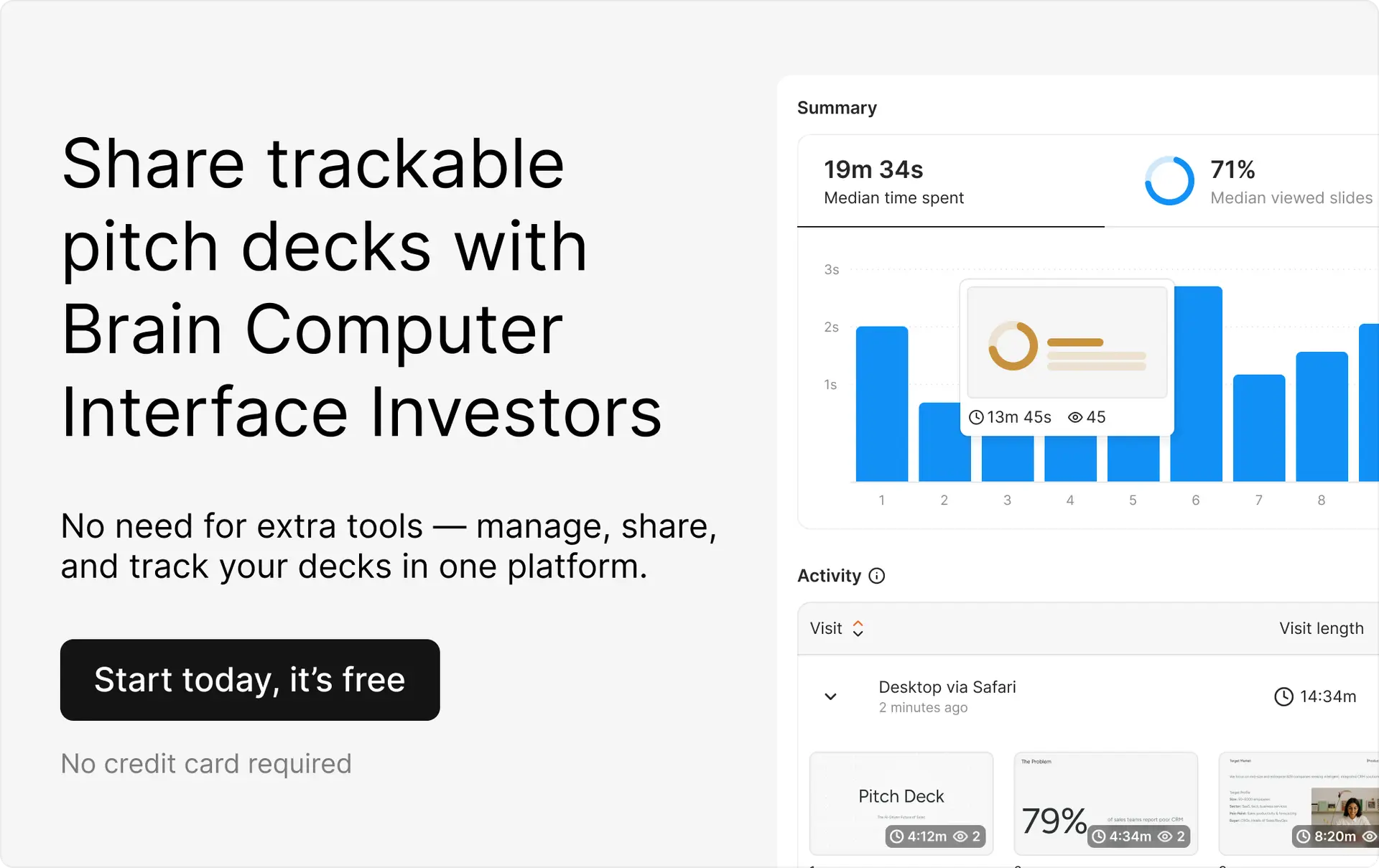
Track record shows whether their portfolio companies actually made it through regulatory approval. Dead medical device companies in their portfolio are a warning sign. Use Ellty to share your deck with trackable links. You'll see who actually opens your clinical trial data and regulatory strategy slides.
Value-add means specific intros to neurology departments and CMS contacts, not generic "we have a great network" promises.
Getting their attention with real data
Research recent deals on Pitchbook and look specifically at medical device investors who've done neurotechnology deals. Seed funds won't lead your Series B clinical trial round.
Show safety data in your pitch. Investors want to see benchtop testing results and animal study outcomes, not just engineering specs. Upload to Ellty and send trackable links. Monitor which pages investors spend time on - if they skip your biocompatibility data, they probably don't understand medical devices.
Contact portfolio founders from their BCI or medical device investments and ask about response times during FDA submissions. Most will tell you if the investor actually helped.
Attend BRAIN Initiative meetings and Society for Neuroscience conferences where these deals happen. Skip generic startup events.
Connect on LinkedIn after getting a warm intro from a neuroscientist or portfolio founder they know. Cold emails rarely work in medical device investing.
Set up an Ellty data room with your preclinical data, regulatory strategy, and reimbursement analysis before they ask. Clinical-stage investors expect this organized. Far more reliable than sending large PDFs over email.
Lead with your safety profile and regulatory pathway in first meetings. Don't spend 30 minutes on market size when they want to know about adverse events and FDA meetings.
Why this matters in 2026
FDA approved two new invasive BCIs in 2025 and the clinical pathway is clearer now. Non-invasive BCIs are getting better signal quality. Investors who were skeptical three years ago are actively looking at deals. Several BCI companies are approaching commercial launch, which makes the space less speculative. You'll see more growth-stage capital available if you have clinical data.


15 active brain-computer interface investors
1. Lux Capital
They led Synchron's breakthrough endovascular BCI trials and understand both the clinical and commercial sides of neural interfaces.
- Recent Deals: Synchron $75M Series C (2023), additional follow-on funding (2025), multiple neurotechnology investments
- LinkedIn: Josh Wolfe
- Sector Focus: brain-computer interfaces, neurotechnology, medical devices, deep tech
- Stage Focus: Series A, Series B, Series C
- Location: New York, USA
- Website: luxcapital.com
2. Khosla Ventures
Vinod Khosla backs hard tech that sounds impossible, and Paradromics' high-bandwidth invasive BCI fits that thesis.
- Recent Deals: Paradromics $33M round (2024), multiple deep tech investments in 2025
- LinkedIn: Vinod Khosla
- Sector Focus: brain-computer interfaces, deep tech, healthcare, AI
- Stage Focus: Seed, Series A, Series B
- Location: Menlo Park, USA
- Website: khoslaventures.com
3. Founders Fund
Peter Thiel's fund bet early on Neuralink and they actually understand the long timeline required for invasive neural interfaces.
- Recent Deals: Precision Neuroscience $93M Series C (2024), Neuralink (ongoing investor)
- LinkedIn: Brian Singerman
- Sector Focus: brain-computer interfaces, biotech, deep tech, frontier technology
- Stage Focus: Seed, Series A, Series B, Series C
- Location: San Francisco, USA
- Website: foundersfund.com
4. ARCH Venture Partners
They led Science Corporation's massive round and have a track record of backing breakthrough medical devices through clinical development.
- Recent Deals: Science Corporation $160M round (2023), multiple medtech investments in 2024-2025
- LinkedIn: Robert Nelsen
- Sector Focus: brain-computer interfaces, medical devices, biotechnology, neuroscience
- Stage Focus: Series A, Series B, Series C, Growth
- Location: Chicago, USA
- Website: archventure.com
5. Brainstorm Cell Therapeutics
They understand neural interface technology from a cellular level and back both invasive and non-invasive approaches.
- Recent Deals: Multiple BCI and neural interface investments (2025), focus on therapeutic applications
- LinkedIn: Brainstorm Cell
- Sector Focus: brain-computer interfaces, cell therapy, neurotechnology, regenerative medicine
- Stage Focus: Seed, Series A, Series B
- Location: New York, USA
- Website: brainstorm-cell.com
6. Matrix Partners
They backed Kernel's consumer neurotechnology play and understand the non-invasive BCI market potential.
- Recent Deals: Kernel follow-on funding (2025), consumer neurotechnology investments
- LinkedIn: Dana Settle
- Sector Focus: brain-computer interfaces, consumer technology, healthcare, AI
- Stage Focus: Series A, Series B, Series C
- Location: San Francisco, USA
- Website: matrixpartners.com
7. Earlybird Venture Capital
European investor with deep medtech experience who led Inbrain's graphene-based neural interface development.
- Recent Deals: Inbrain Neuroelectronics $50M Series B (2024), European neurotechnology investments (2025)
- LinkedIn: Hendrik Brandis
- Sector Focus: brain-computer interfaces, medical devices, deep tech, biotechnology
- Stage Focus: Series A, Series B, Series C
- Location: Berlin, Germany
- Website: earlybird.com

8. NeuroTech Ventures
Specialized fund that only does neurotechnology deals and backed Blackrock Neurotech through multiple rounds.
- Recent Deals: Blackrock Neurotech growth rounds (2024-2025), multiple neurotechnology startups
- LinkedIn: NeuroTech Ventures
- Sector Focus: brain-computer interfaces, neurotechnology, medical devices, digital health
- Stage Focus: Seed, Series A, Series B
- Location: San Francisco, USA
- Website: neurotechventures.com
9. SOSV
Their HAX accelerator in Newark funds early-stage hardware including non-invasive BCI startups with serious engineering talent.
- Recent Deals: Multiple HAX cohort BCI companies (2025-2026), hardware-focused neurotechnology investments
- LinkedIn: Sean O'Sullivan
- Sector Focus: brain-computer interfaces, hardware, medical devices, consumer electronics
- Stage Focus: Pre-seed, Seed
- Location: Newark, USA
- Website: sosv.com
10. Coatue Management
Growth investor that came into consumer neurotechnology when companies showed actual user traction in wellness and gaming applications.
- Recent Deals: Consumer neurotechnology companies (2025), growth-stage BCI investments
- LinkedIn: Thomas Laffont
- Sector Focus: brain-computer interfaces, consumer technology, healthcare, gaming
- Stage Focus: Series C, Series D, Growth
- Location: New York, USA
- Website: coatue.com
11. Threshold Ventures
Formerly DFJ, they've backed multiple brain-computer interface startups and understand the technical challenges of neural signal processing.
- Recent Deals: Multiple BCI investments (2024-2025), neurotechnology portfolio companies
- LinkedIn: Emily Melton
- Sector Focus: brain-computer interfaces, deep tech, healthcare, AI
- Stage Focus: Seed, Series A, Series B
- Location: Menlo Park, USA
- Website: threshold.com
12. Viking Global Investors
Growth equity fund investing in late-stage BCI companies that are close to commercialization with clear FDA pathways.
- Recent Deals: Late-stage medical device companies including BCI (2025), growth equity investments
- LinkedIn: Viking Global
- Sector Focus: brain-computer interfaces, medical devices, healthcare, technology
- Stage Focus: Series C, Series D, Growth, Pre-IPO
- Location: Greenwich, USA
- Website: vikingglobal.com
13. 8VC
Joe Lonsdale's fund backs deep tech including neural recording and stimulation technology with strong technical teams.
- Recent Deals: Neural interface technology companies (2024-2025), deep tech investments
- LinkedIn: Joe Lonsdale
- Sector Focus: brain-computer interfaces, deep tech, medical devices, defense technology
- Stage Focus: Seed, Series A, Series B
- Location: Austin, USA
- Website: 8vc.com
14. Catalio Capital Management
Healthcare-focused fund that backs clinical-stage BCI companies with clear therapeutic applications and FDA engagement.
- Recent Deals: Clinical-stage BCI companies (2025), medical device investments with regulatory pathways
- LinkedIn: Catalio Capital
- Sector Focus: brain-computer interfaces, medical devices, biotechnology, healthcare
- Stage Focus: Series B, Series C, Growth
- Location: Boston, USA
- Website: cataliocapital.com
15. Agent Capital
Growth-stage investor in medical device companies including BCI startups that have FDA breakthrough device designation.
- Recent Deals: Medical device growth rounds including BCI companies (2024-2025)
- LinkedIn: Agent Capital
- Sector Focus: brain-computer interfaces, medical devices, healthcare technology, digital health
- Stage Focus: Series B, Series C, Growth
- Location: San Francisco, USA
- Website: agentcapital.com
Track which investors actually read your preclinical data


These 15 investors closed brain-computer interface deals from 2025 to 2026. Before you start reaching out, set up proper tracking.
Upload your deck to Ellty and create a unique link for each investor. You'll see exactly which slides they view and how long they spend on your safety data. Most founders are surprised that investors skip market size slides but spend 10+ minutes reviewing biocompatibility testing and adverse event protocols.
When investors ask for more materials, share an Ellty data room instead of messy email threads with your preclinical study results, regulatory strategy documents, and reimbursement analysis. Your FDA pre-submission meeting notes and clinical trial protocol in one secure place with view analytics so you know what they're actually reviewing.
Common questions
How do I know if an investor understands medical device timelines?
Check their portfolio for companies that went through FDA approval or clinical trials. If they only have software investments, they won't understand your 5-7 year timeline and capital needs.
Should I pitch invasive or non-invasive focus first?
Lead with whichever you're building, but know your regulatory pathway. Invasive BCIs need stronger safety data upfront. Non-invasive needs proof of signal quality that's clinically meaningful.
Do traditional healthcare investors understand BCI technology?
Some do if they've backed neural interface or brain implant companies before. Look at their portfolio - generic medical device experience doesn't translate directly to understanding neural signal processing challenges.
When should I set up a data room for BCI fundraising?
Before you start serious conversations. Clinical-stage investors expect organized preclinical data, regulatory documentation, and reimbursement strategy from day one. Don't scramble to compile this when they ask.
How many brain-computer interface investors should I contact?
Start with 5-10 who've actually done BCI or neural interface deals. The investor pool is small and specialized. Cold outreach to generalist VCs wastes time.
What data do BCI investors spend the most time reviewing?
Safety profiles, adverse event analysis, and regulatory strategy. Use Ellty analytics to see if they're actually reading your biocompatibility data or just skimming intro slides. That tells you if they understand medical devices.